Inspiration
Insurance directories are full of therapists you can't reach. In a 2023 Senate Finance Committee study, staff called 120 mental health listings across 12 Medicare Advantage plans and booked an appointment 18% of the time. A third of the listings were wrong, disconnected, or never called back.
People often work through these lists at their lowest point, calling numbers that go nowhere. We wanted to sort the list by who is likely to answer before anyone dials.
What it does
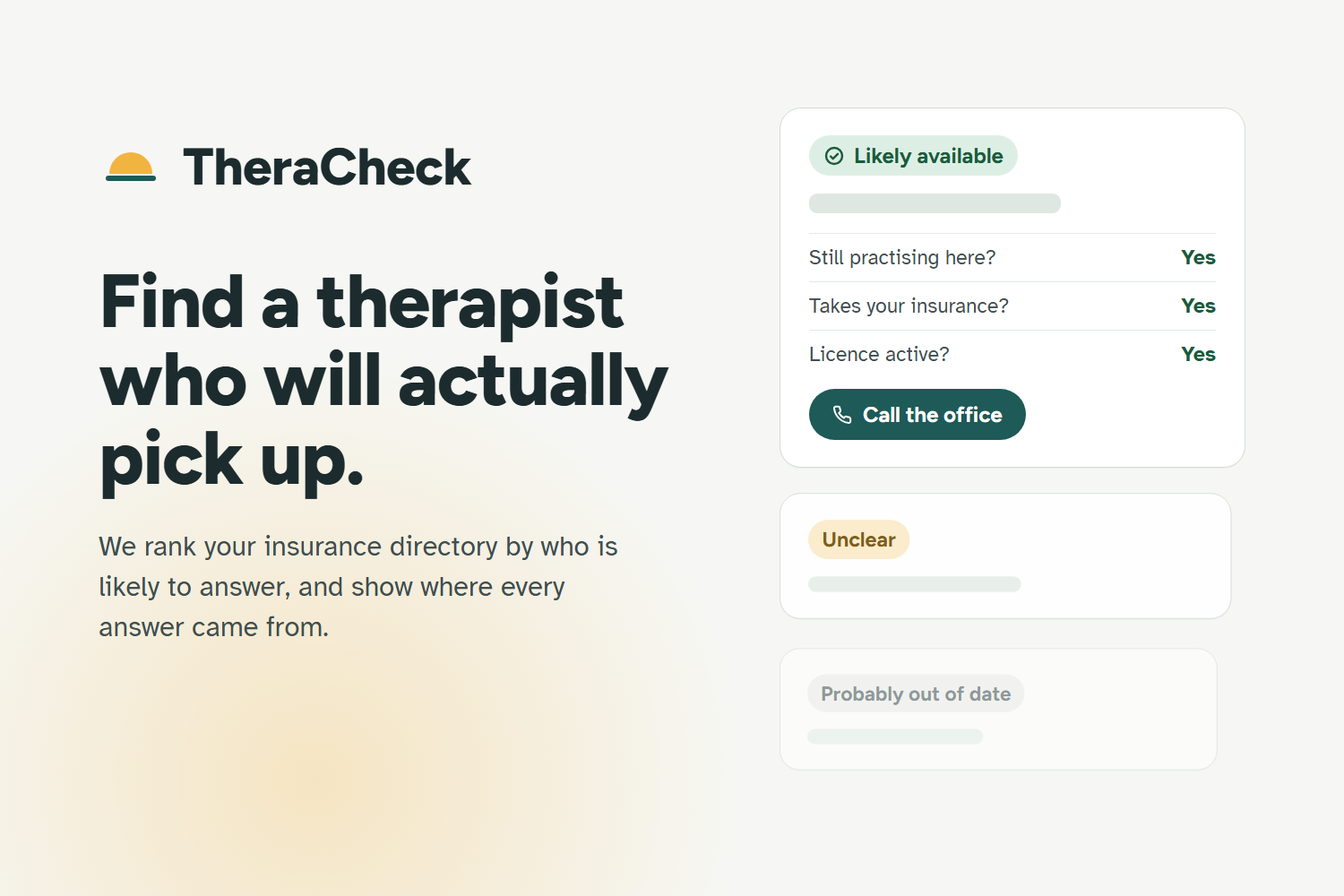
Pick your insurance and your city or ZIP code. TheraCheck ranks the therapists in your plan's directory by how likely they are to still practise there, take your plan, and take new patients.
- A label and a reason for every listing: "Likely available", "Unclear", "Likely dead end" or "Pay yourself", with one plain sentence and links to the pages we read.
- Four facts: still practising, takes this insurance, taking new patients, licence active. Each is yes, no or "we couldn't tell".
- Three ways to reach them:
- Book online when there's a booking link.
- Call yourself, with two questions to ask and one tap to report what happened. Your report updates the listing for the next person.
- Ask the assistant, an AI voice agent that calls the office landline, asks the two questions, and can connect you before it drops off.
- Cost help with no guesses: the therapist's own posted price, and the questions to ask your insurer.
- A voice helper in English and Spanish: it reads the top listings aloud. If someone mentions a crisis, it stops and gives 988, or 911 first in an emergency.
How we built it
- Bright Data Web Unlocker collects the Cigna directory and each listing's public pages: Psychology Today, the therapist's own site, and booking sites.
- California licence data comes from the Department of Consumer Affairs public files, matched by licence number.
- Gemini reads each listing's pages and returns structured facts. Plain code turns those facts into the score, so the model never sets a rank.
- Neon Postgres stores listings, evidence, verdicts and call results.
- ElevenLabs Agents with a Twilio number run both voice agents. The office agent says it's an AI and that the call is transcribed, saves its answers through a signed webhook, and honours "don't call us again".
- Next.js 16 on Vercel. Everything except voice works without JavaScript. We checked it at 320px wide and at 200% text size.
- CI runs lint, typecheck, unit tests, integration tests against Docker Postgres, Playwright end-to-end tests, CodeQL and secret scanning on every pull request. We ran a security audit before submitting and fixed what it found.
Challenges we ran into
- AI phone calls are legally sensitive. The FCC counts AI voices as artificial voices, and California requires consent to record. So the agent discloses itself, stores no audio, only calls landlines, and leaves before the patient and office talk.
- Public evidence is thin. Many listings are telehealth groups sharing one toll-free number. We couldn't tie those to one person's page without guessing, so we don't.
- Voice agents are fiddly. Getting the agent to say goodbye once and hang up took several prompt rewrites.
Accomplishments that we're proud of
- Every label shows where it came from.
- Callers improve the data for the next person.
- The voice helper handles a crisis safely, speaks Spanish, and never claims a therapist is in network.
What we learned
- "We couldn't tell" is more useful than a confident guess.
- Legal limits made the product better: the landline-only rule for AI calls led to "Call yourself", which works for every listing.
What's next
- More insurers and plans.
- More sources per listing, so fewer end up "Unclear".
- Real office calls with consent, after a legal review.
- A button that re-checks one listing in about a minute.
- The whole site in Spanish.
Limitations
- One insurer and plan, six cities: Cigna Open Access Plus in San Diego, Los Angeles, San Francisco, San Jose, Sacramento and Fresno.
- Most listings rank "Unclear", because we found no public pages for many of them. We show that rather than hide it.
- Assistant calls in this demo only ring our team's phones. The call in the video is staged.
- Labels come from public web pages. Only the office can confirm.
Built With
- bright-data
- docker
- elevenlabs
- gemini
- github-actions
- gitub
- neon
- next.js
- node.js
- playwright
- postgresql
- react
- twilio
- typescript
- vercel
- vitest


