
Bonus Blog Post: Defusing the Agentic Time Bomb
When we started building Sanctum for the Authorized to Act hackathon, we didn't just want to build another AI wrapper. We wanted to solve what we consider the most terrifying problem in enterprise software right now: The Agentic Time Bomb.
Every day, companies are connecting powerful, autonomous LLM agents to their internal databases, CRM systems, and communication platforms (like Slack or Gmail). The problem? To make these agents work, developers are hardcoding long-lived, high-privilege API keys directly into the agent's environment.
We realized that if an agent hallucinates—or worse, falls victim to a prompt injection attack—it has "God-Mode" access to destroy data or authorize massive financial transactions. The industry’s current solution to this is terrible: either don't use AI, or force the agent to stop, spin down, and redirect a human to a browser for a clunky OAuth consent flow every time it needs to take an action.
This destroys the context window. It ruins the UX. We call this the "Agentic Latency Trap."
Enter Auth0 Token Vault
Our journey with Sanctum was an exploration of how to escape this trap. When we read the documentation for Auth0 Token Vault, we realized we had found the missing puzzle piece.
Token Vault fundamentally changes the architecture of AI. Instead of the agent holding the keys to the kingdom, the agent is entirely Identity Blind. It holds nothing.
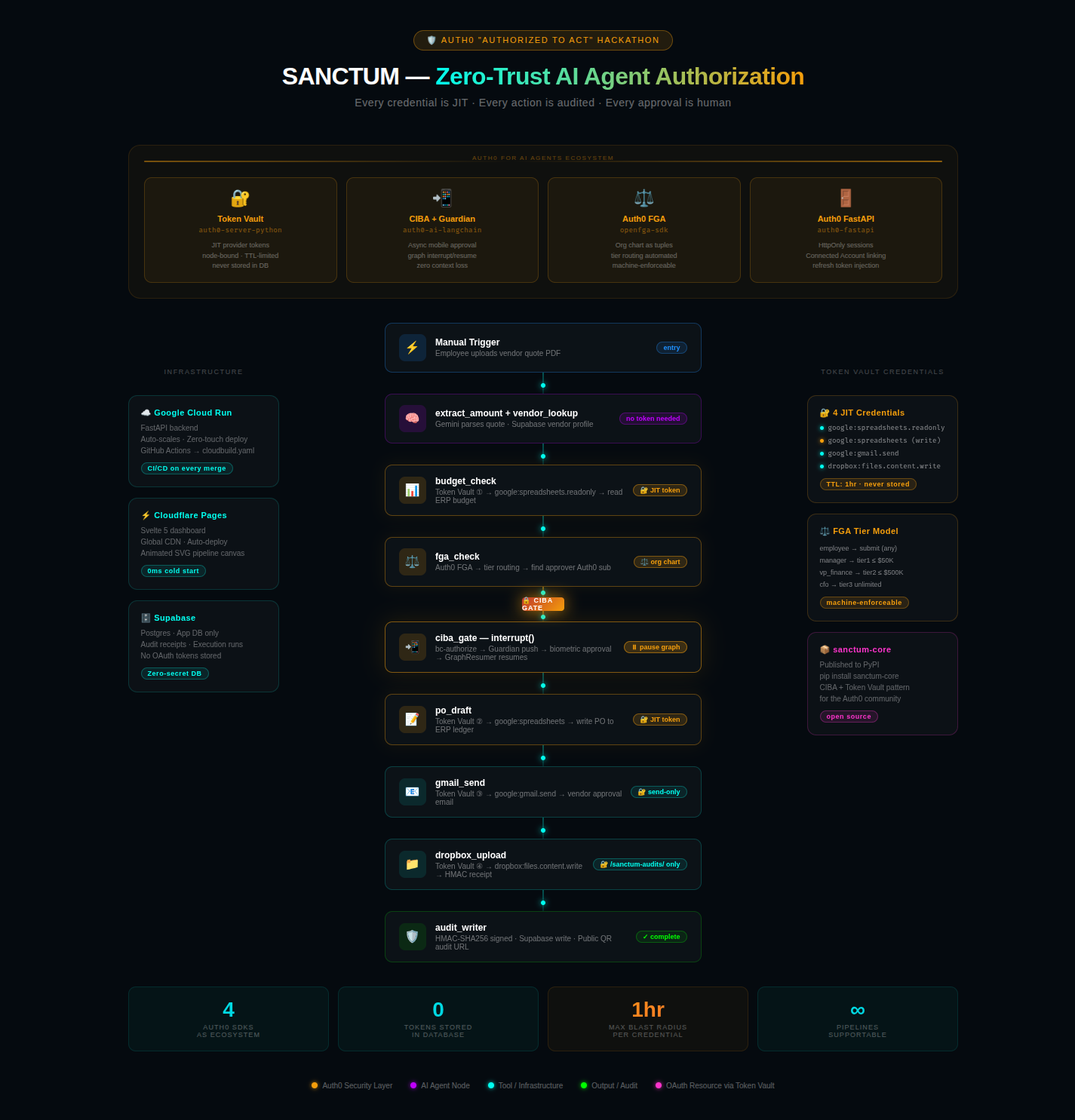
When we built the Sanctum execution engine (using LangGraph and FastAPI), we designed it so that our agents must explicitly petition the Auth0 Broker for a Just-In-Time (JIT) credential. If our PO_Draft agent wants to write a $520,000 Purchase Order to our Mock ERP (Google Sheets), it asks Token Vault for the spreadsheets scope.
The CIBA Breakthrough
But Token Vault alone wasn't enough for high-stakes actions. How do we ensure a human actually wants the agent to spend half a million dollars?
This was our biggest technical hurdle. We needed to pause the LangGraph execution asynchronously without losing the LLM's memory. We integrated Auth0 CIBA (Client-Initiated Backchannel Authentication). By mapping our corporate hierarchy into OpenFGA, Sanctum dynamically routes a biometric push notification to the correct executive's phone (via Auth0 Guardian).
The LangGraph thread enters an interrupt() state. It sleeps. The moment the VP of Finance presses "Approve" on their phone, the backend wakes up. Token Vault instantly dispenses a microscopic credential with a strict 10-minute TTL, and the agent finishes the job.
Why the Enterprise Needs This
Building the visual Svelte 5 dashboard for Sanctum—watching the glowing "plasma" physically halt at the CIBA gate and then surge forward upon biometric approval—was a profound moment for our team. We weren't just watching code execute; we were watching cryptographic trust being established in real-time.
For any enterprise customer hesitating to deploy autonomous AI, the combination of Token Vault, CIBA, and OpenFGA is the definitive answer. It proves that AI agents can be incredibly powerful, incredibly fast, and yet remain completely subservient to human authority. They are finally Authorized to Act.
💡 Inspiration: The "Agentic Latency Trap"
We noticed a fatal flaw in the current AI agent landscape. Developers were choosing between two "evils":
- The Security Risk: Hardcoding "God-Mode" API keys into agents, creating a massive blast radius.
- The UX Killer: Pausing an LLM mid-thought to redirect a user to a browser for OAuth consent, which destroys the agent’s context window and introduces fatal latency.
We called this the Agentic Latency Trap. We were inspired to build Sanctum to prove that with Auth0 Token Vault and CIBA, you can have "Zero-Trust" security without ever breaking the AI's flow.
⚙️ What it does
Sanctum is a visual execution runtime that upgrades insecure automation into identity-aware AI agents.
- Visualizes Risk: A Svelte 5 canvas where glowing "plasma" flows through frosted glass pipes, physically blocked by Auth0 CIBA valves.
- Human-in-the-Loop: When a high-risk action is detected (verified via OpenFGA), the pipeline pauses and buzzes the user’s phone via Auth0 Guardian.
- Just-In-Time Access: Upon approval, Auth0 Token Vault dispenses a microscopic, node-bound access token for Google Sheets, Gmail, or Dropbox.
- Audit-Ready: Every run generates an HMAC-signed cryptographic receipt and a Gantt chart of the token’s lifecycle.
🛠️ How we built it
We architected Sanctum as a production-grade system:
- The Auth0 Ecosystem: We utilized the full stack: auth0-fastapi for session management, auth0-server-python for provider brokering, and auth0-ai-langchain for graph interrupts.
- The Brain: A FastAPI backend orchestrating LangGraph agents.
- The Lens: A Svelte 5 dashboard using a custom SVG animation engine for 60fps visual telemetry.
- The Infrastructure: Built with Infrastructure-as-Code (IaC). We used Google Cloud Build and GitHub Actions to create a zero-touch pipeline that deploys our backend to Google Cloud Run and our frontend to Cloudflare Hosting on every merge.
🚧 Challenges we ran into
The biggest challenge was "The Nested Decorator" issue. We initially struggled with the auth0-ai-langchain SDK when trying to combine CIBA and Token Vault on a single tool. Instead of giving up, we engineered a production-ready workaround: we used the CIBA interrupt to handle human consent and then manually performed the OAuth 2.0 Token Exchange with the Auth0 Token Vault endpoint. This technical deep-dive allowed us to maintain sub-second latency while keeping the code type-safe.
🏆 Accomplishments that we're proud of
- The Physics of Trust: We built a custom SVG fluid simulation that makes "Cryptographic Plumbing" a visual reality.
- The Two-Phone Moment: Successfully implementing an OpenFGA hierarchy that can escalate a CIBA push from a Manager's phone to a VP's phone in real-time.
- True Zero-Trust: Our agents possess zero long-lived credentials. They are "Identity Blind" until Token Vault grants them temporary authority.
📚 What we learned
This hackathon was a masterclass in modern deployment. We learned how to synchronize multi-process Docker containers (FastAPI + LangGraph) on Google Cloud Run. More importantly, we learned that Auth0 Token Vault isn't just an API; it’s an architectural shift that solves the "Refresh Token" headache for developers once and for all.
🚀 What's next for Sanctum
We are looking to expand our Sanctum Core Python library (already on PyPI!) to support more enterprise providers like Zoho, Salesforce, and QuickBooks. We want Sanctum to be the standard security layer for any company moving from "Chatbots" to "Authorized Agents."
📝 Project Description for Auth0 Blog
Why Sanctum is the Future of Enterprise AI (and Auth0's Secret Weapon)
The enterprise AI market is currently stalled at the "Prototype Phase." Companies have built incredible LLM wrappers, but they are terrified to give those agents the "Keys to the Kingdom." The missing link hasn't been intelligence—it’s been Identity.
Sanctum is a high-fidelity visual execution engine designed to showcase the power of Auth0 for AI Agents. It addresses the number one barrier to enterprise AI adoption: The Blast Radius of Autonomous Agents.
The Token Vault Revolution
By integrating Auth0 Token Vault, Sanctum proves that agents no longer need to store dangerous, long-lived API keys. In our "Procurement Reference Workflow," the AI agent is completely "Identity Blind." It only receives a token for Google Sheets or Dropbox after Auth0 CIBA has verified human intent through a biometric Guardian push. This "Just-In-Time" delegation is a game-changer for Auth0 customers, as it allows them to extend their existing identity policies into the world of autonomous agents without rewriting their entire infrastructure.
Eliminating the Latency Trap
One of the most significant insights we gained while building Sanctum was the impact of Token Vault on agentic performance. Traditionally, re-authenticating a user mid-workflow required a browser redirect, which killed the LLM's context window. Sanctum uses the Auth0 backchannel to handle these handshakes. This keeps the agent's memory intact and reduces authorization latency to sub-second levels. For Auth0, this means a new, massive market of developers who previously viewed OAuth as "too slow" for AI.
A Production-First Vision
We didn't build Sanctum to run on localhost. Utilizing a FastAPI backend and a Svelte 5 frontend, we implemented a full Zero-Touch CI/CD pipeline deploying to Google Cloud Run. We even extracted our core logic into the sanctum-core library to show how easily other developers can adopt the Auth0 agent ecosystem.
Built With
- auth0-ciba
- auth0-sdks
- auth0-token-vault
- fastapi
- gemini3
- langchain

Log in or sign up for Devpost to join the conversation.