-
-
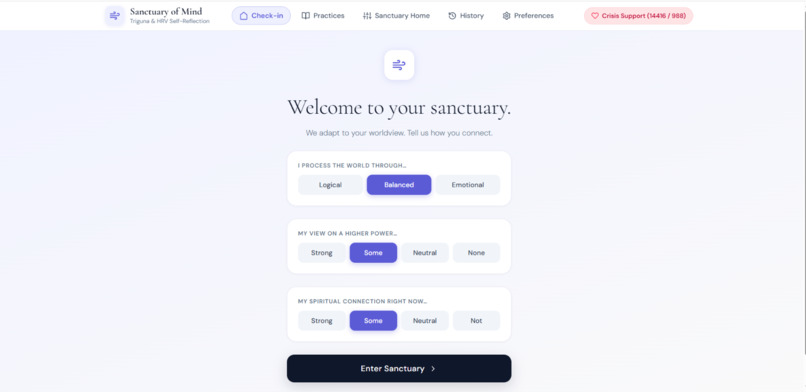
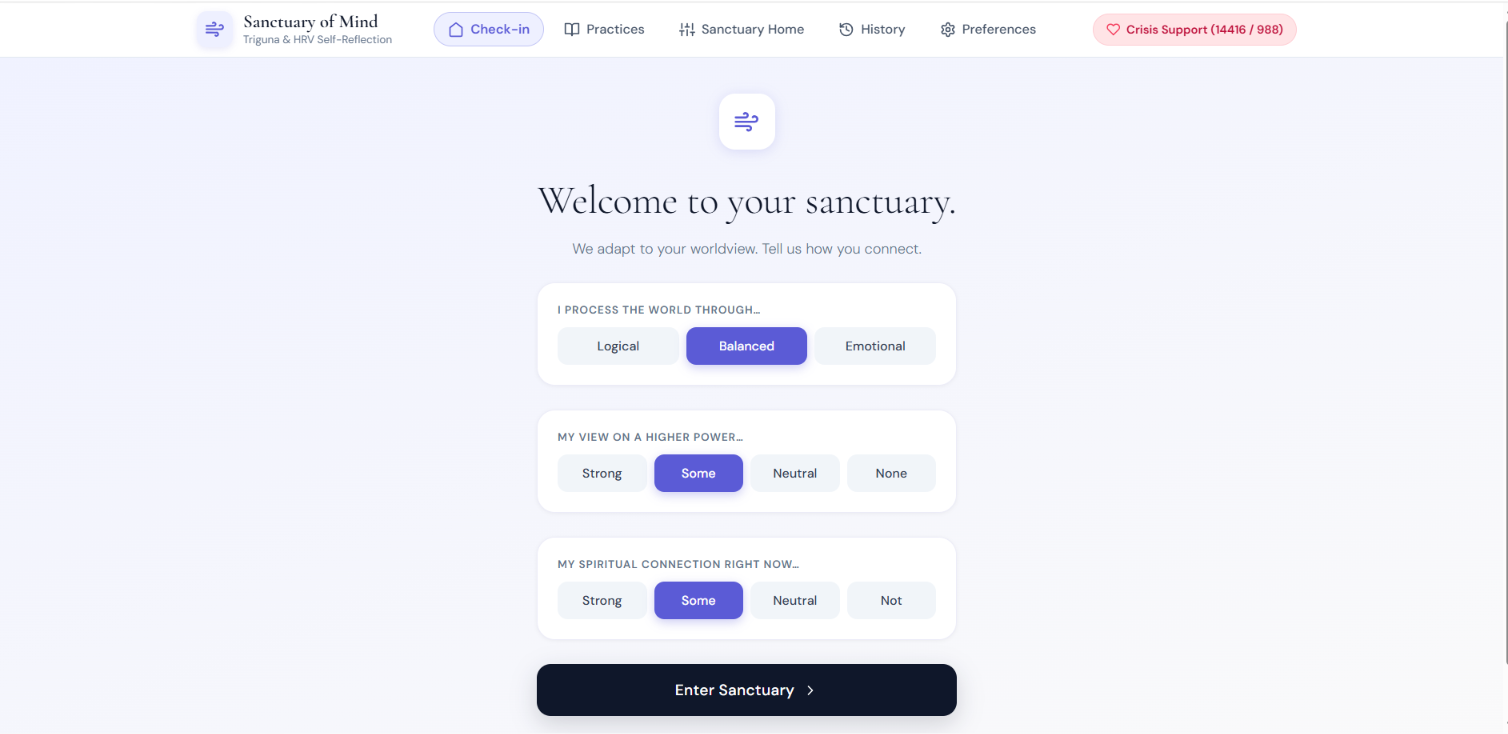
1. Welcome to Your Sanctuary Personalise your wellness journey around your worldview, thinking style, and spiritual connection.
-
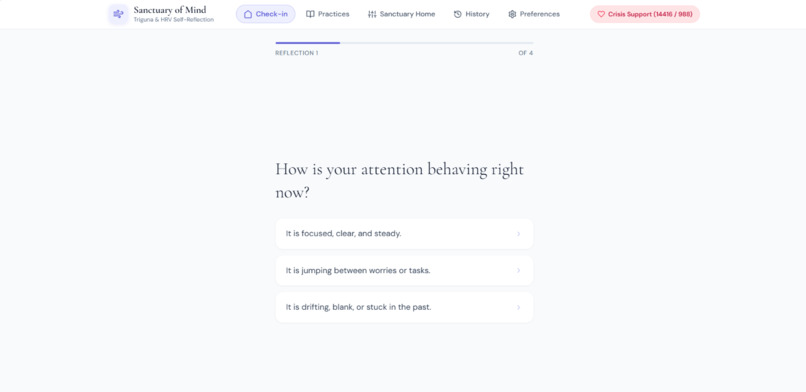
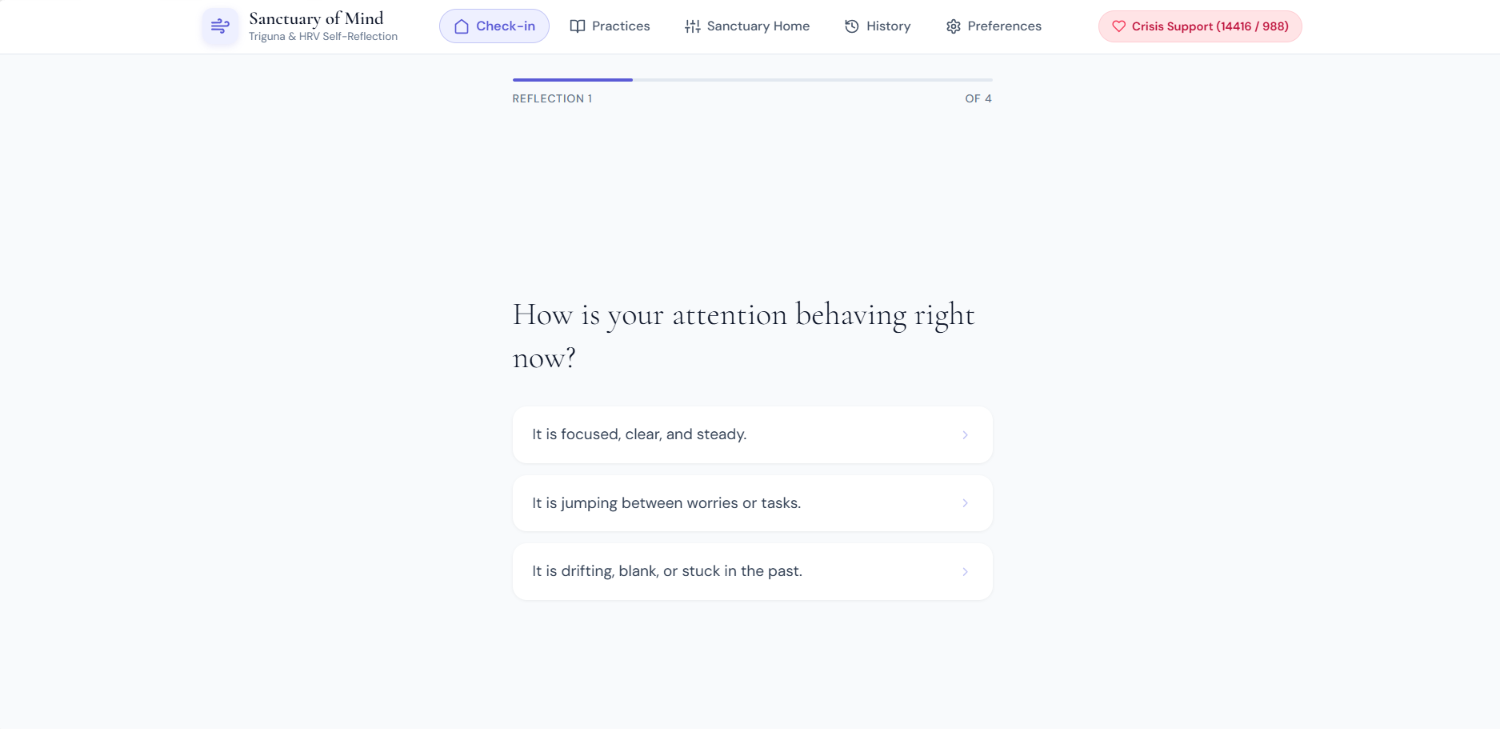
2. A Moment of Self-Reflection Reflect on your attention and recognise whether it feels focused, restless, or unsettled.
-
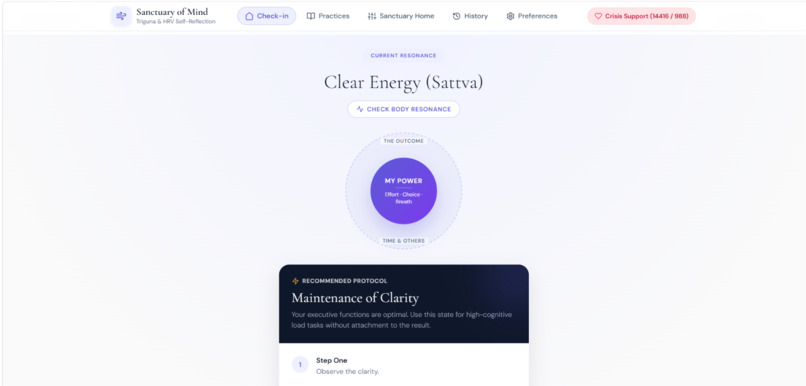
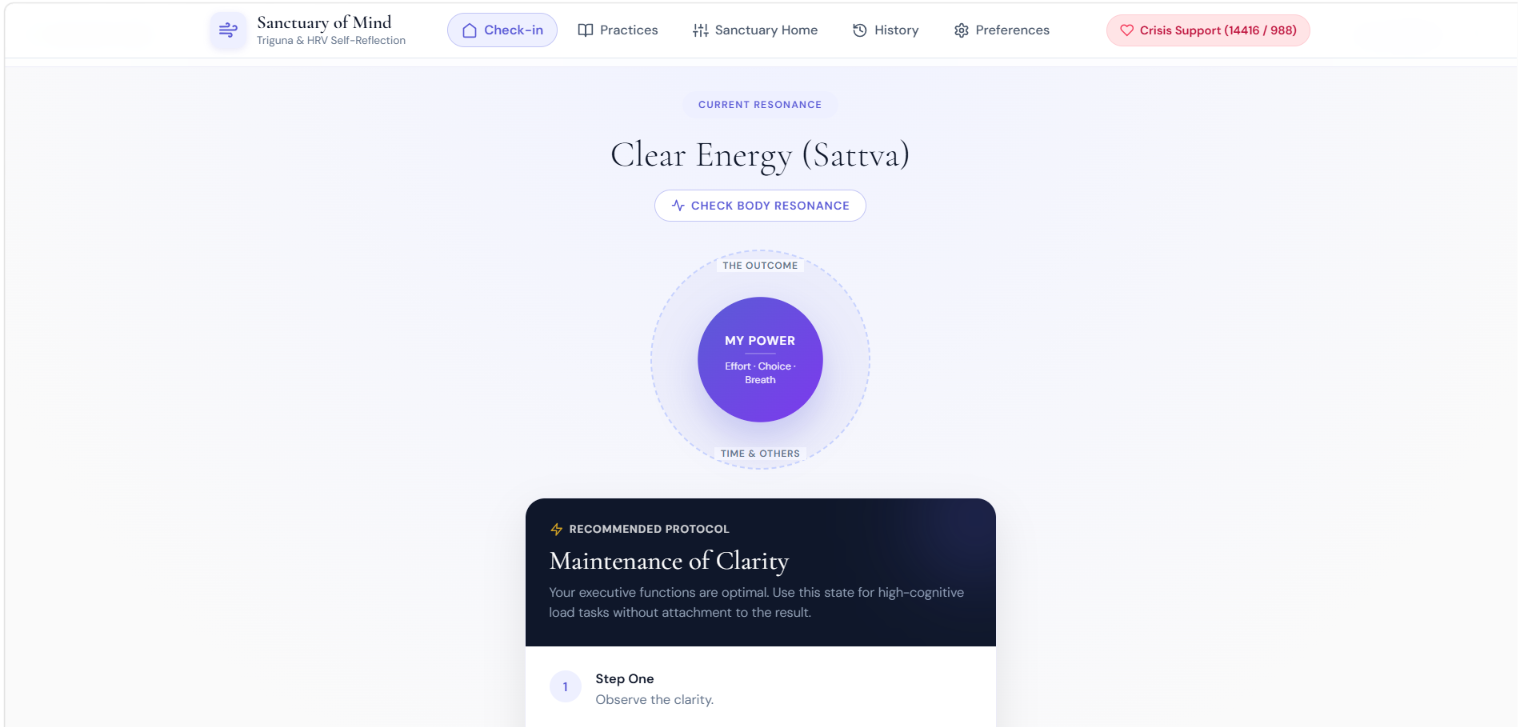
3. Understanding Your Present State Explore Triguna-inspired self-reflection and discover a suggested practice based on your responses.
-
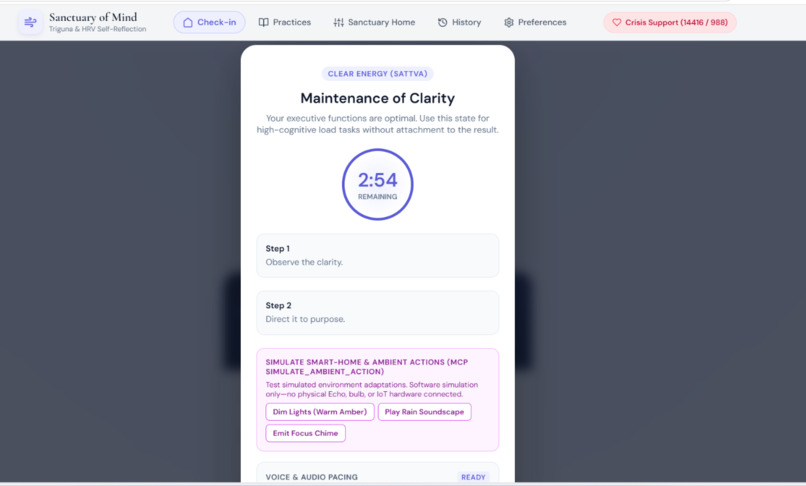
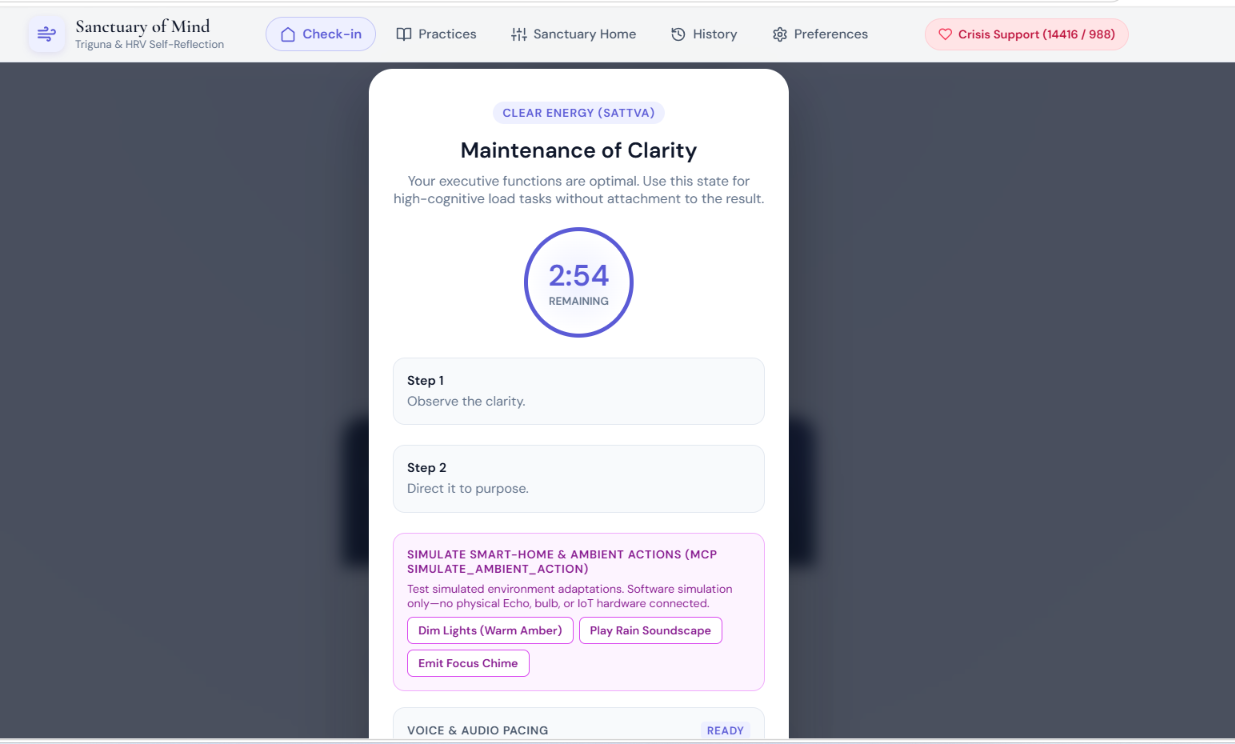
4. Guided Practice for the Moment Follow simple guided steps to pause, refocus, and reconnect with the present moment.
-
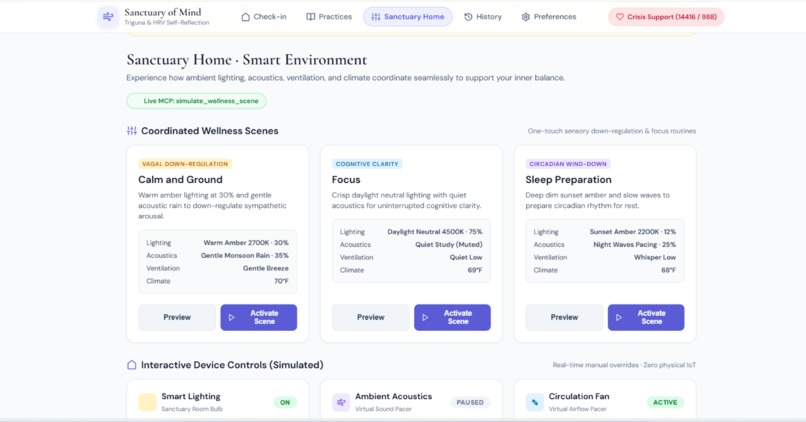
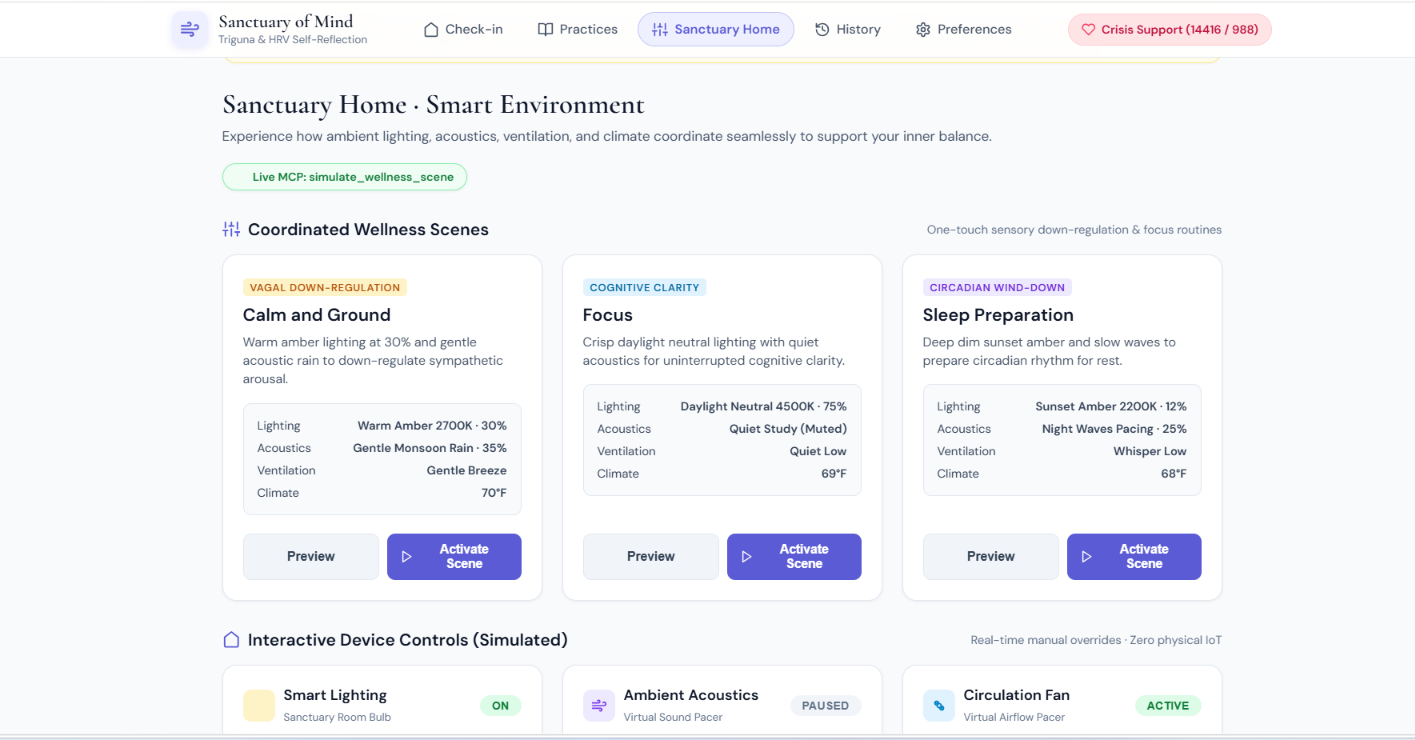
7. Sanctuary Home: A Simulated Wellness Environment The MCP-powered interface demonstrates coordinated lighting, ambient audio, ventilation
-
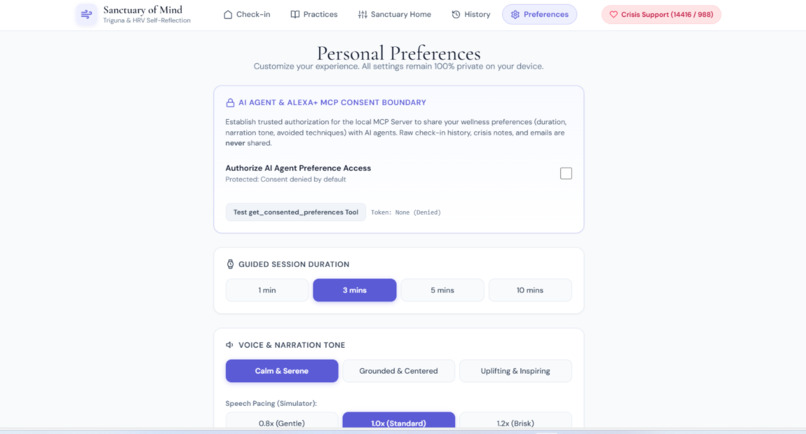
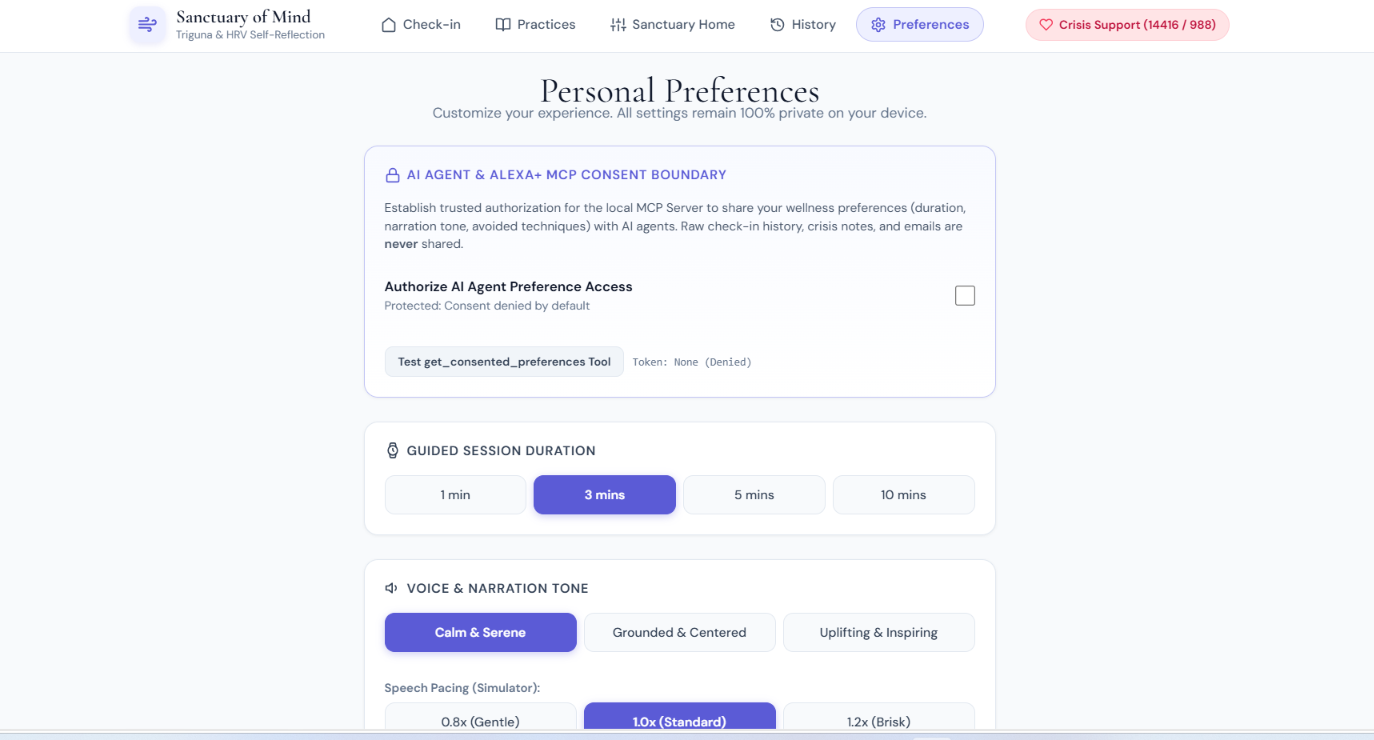
6. Personalised Preferences and Consent Customise session duration and narration style while controlling AI agent access to preferences.
-
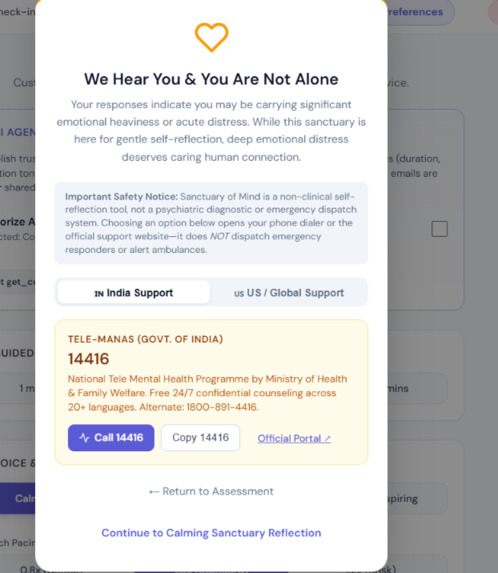
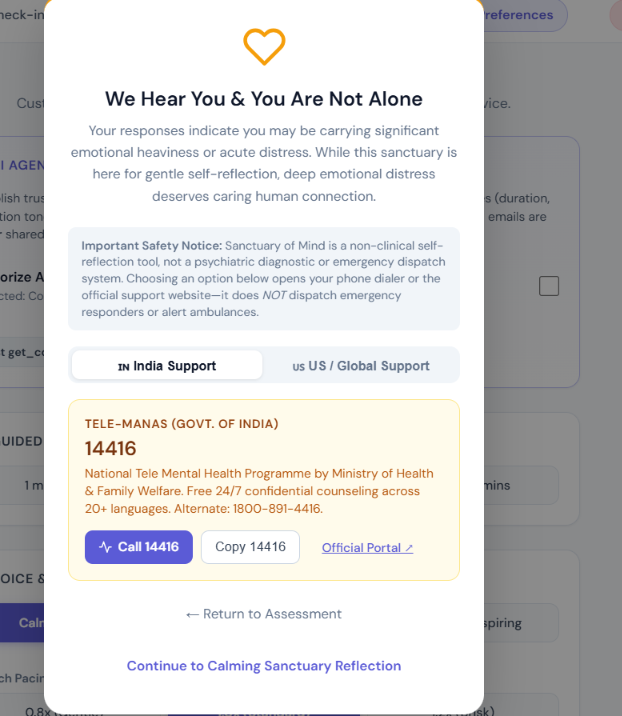
7. Compassionate Safety Support Access supportive guidance and mental-health resources when experiencing significant emotional distress.
Sanctuary of Mind
A personal space to understand the mind, one moment at a time.
Inspiration
My journey with Sanctuary of Mind began with a simple question:
What if, instead of judging our emotions or trying to escape them, we learned to observe and understand them?
For me, this question comes from both meditation and life.
Since beginning my daily study of the Bhagavad Gita in February 2025, I have explored the relationship between the mind, awareness, attachment, action, and inner balance. Through my journey as a meditation teacher, I have tried to approach the mind not only as something to control, but as something to observe with patience, curiosity, and compassion.
One idea that has stayed with me is the Bhagavad Gita's discussion of the three gunas: Sattva, Rajas, and Tamas. I see them as a meaningful framework for reflecting on clarity, restlessness, and inertia—different tendencies that can influence how we experience a moment.
At the same time, I noticed a gap between the wisdom we discuss in meditation and the support people can access in everyday life. A student overwhelmed by academic pressure, someone struggling to focus, or a person who simply cannot explain what they are feeling may not know where to begin.
I began asking myself: Could technology help people pause, recognise their present state, and find a small, practical step toward well-being?
That question became Sanctuary of Mind.
My goal is not to replace human connection, professional mental-health care, or the depth of meditation. It is to build an accessible space where technology can encourage self-awareness rather than distract us from ourselves.
What it does
Sanctuary of Mind is a mental-wellness prototype that brings together self-reflection, guided practices, personal preferences, and a simulated smart-home experience.
Instead of treating every user and every moment the same way, the experience is designed around the idea that support should respond to what a person needs.
Key features include:
- Personalised check-ins: Users can reflect on how they feel and what they need in the present moment.
- Triguna-inspired reflection: The experience draws on Sattva, Rajas, and Tamas as a non-diagnostic framework for self-understanding—not as medical categories.
- Guided wellness practices: Users can explore grounding, breathing, mindfulness, reflection, focus resets, and preparation for sleep.
- Personal preferences: The experience can account for preferred guidance styles, duration, language, spiritual or secular framing, and disliked techniques.
- Sanctuary Home: Users can explore simulated environmental changes, such as adjusting lights, ambient audio, fan settings, and temperature, to accompany a wellness practice.
- MCP-powered interactions: A Model Context Protocol server exposes structured tools for guided practices, preferences, session summaries, and simulated home-scene actions.
- Feedback and reflection: The prototype supports a more personal experience by considering preferences and feedback over time.
The smart-home experience is explicitly simulated. No physical smart-home devices are required or claimed to be connected, and simulated physiological values are not presented as clinical measurements.
The larger vision is simple: help people move from “I don't know what I am feeling” toward “I can pause, observe, and choose my next step.”
How we built it
I approached Sanctuary of Mind as an exploration of how personal reflection and modern technology might work together.
The product combines ideas from Indian philosophical traditions, modern well-being practices, and an interactive software experience. The Triguna framework provides inspiration for reflection, while the application focuses on practical actions a user can explore in everyday life.
The prototype uses:
- React and JavaScript for the interactive web experience.
- Node.js for the backend services.
- The official Model Context Protocol SDK to expose structured tools through Streamable HTTP.
- Zod for validating tool inputs and simulated device states.
- Browser-based speech and interaction features to support a more accessible, guided experience.
- Automated tests to verify core workflows, consent boundaries, MCP interactions, simulated scene activation, restoration, and offline fallback.
One important part of the implementation is the connection between the user-facing experience and the MCP tools. The goal is to demonstrate more than a static wellness interface: a user action can lead to a structured tool call, a response, and a visible change in the simulated environment.
I also worked on privacy and security improvements, including request-size limits, consent-session expiry and revocation, stricter input validation, safer local development-server behaviour, and reducing personal information in anonymous feedback submissions.
The current project is a prototype, not a clinically validated mental-health system. Its physiological sensing concepts and future integrations require further implementation and validation.
Challenges we ran into
One of the biggest challenges was bringing together ideas that belong to very different worlds.
1. Connecting ancient wisdom with modern technology
The Bhagavad Gita and the Triguna framework offer ways to reflect on the mind, but translating those ideas into a digital experience requires care. I did not want to turn a philosophical concept into an unsupported medical diagnosis. The challenge was to preserve the spirit of self-observation while making the experience practical and understandable.
2. Building a useful experience instead of another chatbot
A wellness product should do more than respond with comforting words. I wanted the experience to connect reflection with an action: selecting a practice, exploring an environmental scene, and understanding what the application did. MCP helped me explore this structured interaction model.
3. Demonstrating smart-home experiences without physical hardware
Access to connected devices is a practical limitation. Instead of claiming an integration I could not demonstrate, I built a simulated home environment with scene previews, device-state changes, activity history, and restoration. This allowed me to demonstrate the intended workflow while being transparent about its current limitations.
4. Making privacy and safety part of the engineering
Wellness applications may handle sensitive reflections and personal preferences. Building the interface was only one part of the work; validating inputs, managing consent, limiting requests, and reviewing data transmission were equally important. Security testing also revealed edge cases that needed further attention.
5. Balancing ambition with a working prototype
The long-term vision includes deeper personalisation, physiological signals, and more capable environmental integrations. The challenge was deciding what could be implemented and demonstrated reliably now, rather than presenting every future idea as an existing capability.
Accomplishments that we're proud of
We are proud to have developed a working prototype that connects a personal wellness journey with an interactive technical experience.
- Built a web-based Sanctuary of Mind experience with check-ins, guided practices, personalisation, and wellness-oriented interactions.
- Implemented an MCP server with structured tools and input validation.
- Created a simulated smart-home experience with scene activation, activity tracking, and restoration.
- Added clearer consent and privacy controls and improved the handling of potentially unsafe inputs.
- Added regression tests for security issues and important application workflows.
- Reported 43 passing unit and integration tests, passing smoke and end-to-end suites, and zero known dependency vulnerabilities in the latest local verification.
Beyond the implementation, I am proud that the project reflects a question I genuinely care about: how can technology help people become more aware of their inner experience without pretending to understand them better than they understand themselves?
For me, the prototype is not the finish line. It is a foundation to test, question, improve, and validate.
What we learned
This project has taught us that building wellness technology requires more than a good interface or an interesting idea.
It requires humility about what we know, transparency about what the system actually does, and care for the people who may use it.
We learned that:
- Personalisation should begin with listening. A helpful practice for one person may not suit another.
- Reflection is not diagnosis. Philosophical frameworks can inspire self-understanding without being treated as clinical measurements.
- Trust is an engineering requirement. Consent, data minimisation, validation, and honest communication belong in the design from the beginning.
- A simulation can demonstrate a workflow, but not prove a real-world integration. The next step is to test the experience with actual users and, where appropriate, real devices.
- Scientific ideas need scientific validation. Any future connection between Triguna-inspired reflection, physiological signals, and psychological outcomes must be evaluated rather than assumed.
Most importantly, I have learned that building something meaningful is an iterative process. An idea becomes more valuable when it is exposed to questions, tested against reality, and improved through feedback.
What's next for Sanctuary of Mind
The next chapter is about moving from a working prototype toward a more reliable, accessible, and evidence-informed product.
Our priorities are:
- User research: Work with students and other potential users to understand their needs, assess usability, and learn which practices they find helpful.
- Scientific collaboration: Explore research partnerships to evaluate the relationship between Triguna-inspired self-reflection, psychological frameworks, and physiological indicators.
- Responsible physiological sensing: Investigate camera-based PPG and heart-rate variability estimation with appropriate signal-quality checks, clear limitations, and validation.
- Real smart-home integration: Explore authorised integrations that could allow users to coordinate their environment with a chosen wellness practice, with explicit consent and safe defaults.
- Improved accessibility: Expand language options, guidance styles, and approaches for users with different preferences and needs.
- Privacy and safety: Continue strengthening consent, data minimisation, security, and clear boundaries around the product's capabilities.
- Sustainable real-world adoption: Explore how the experience could become useful and accessible to students and communities that may have limited access to well-being resources.
I envision Sanctuary of Mind as a companion for moments when someone needs to pause—not an authority that tells them what they are feeling, and not a substitute for professional care.
As a meditation teacher and an observer, I keep returning to one principle: awareness begins when we create a little space between what we experience and how we respond.
Sanctuary of Mind is my attempt to bring that space into everyday technology.
A moment to pause. A chance to understand. A more conscious next step.

Log in or sign up for Devpost to join the conversation.