Inspiration
Alerts that repeat stop being heard. One ICU study counted an audible alarm burden of 187 per bed per day (Drew et al., PLoS One 2014, doi:10.1371/journal.pone.0110274). In primary care, the likelihood of accepting a reminder dropped by 30% for each additional reminder per encounter (Ancker et al., BMC Med Inform Decis Mak 2017, doi:10.1186/s12911-017-0430-8). Neither study measures Sanad.
Workload matters too: a study across general hospital wards in nine European countries found that higher nurse workload was associated with higher adjusted odds of 30-day inpatient death (OR 1.068 per additional patient; Aiken et al., Lancet 2014, PMID 24581683). That finding does not measure Sanad or establish an effect for it. It motivated a narrower design question: can a demonstration keep review rules, missing inputs, late documentation and response workflows visibly distinct instead of hiding them behind a single alert or reassuring status?
Sanad explores that question with fictional adult ICU scenarios. It is a software demonstration, not a clinical service.
What it does
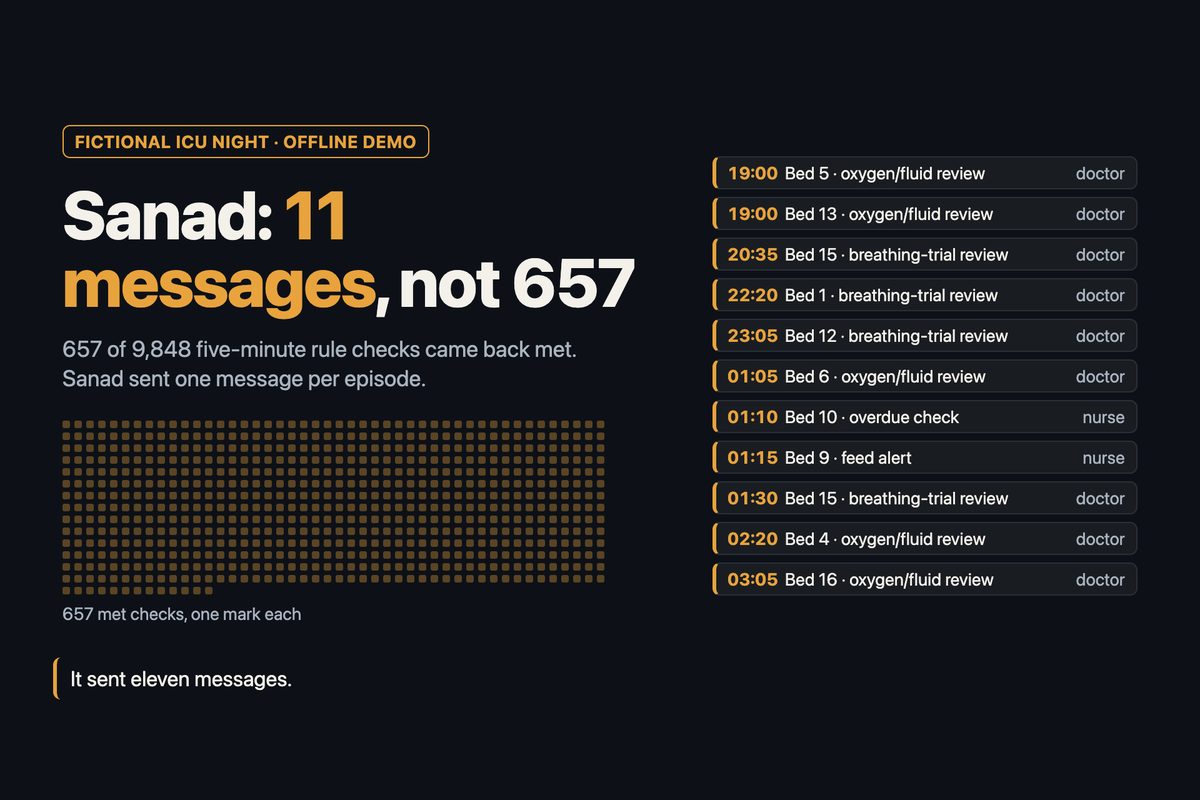
On the fixed fictional night, Sanad's rules were met 657 times in 9,848 five-minute checks, and it sent 11 messages: one per episode, 9 to the on-call doctor and 2 to the night nurse. This is software behaviour on fictional data, not a clinical result. python3 -I scripts/alert_burden.py --check reproduces it from the public repository, and JUDGES.md maps each judging criterion to its evidence.
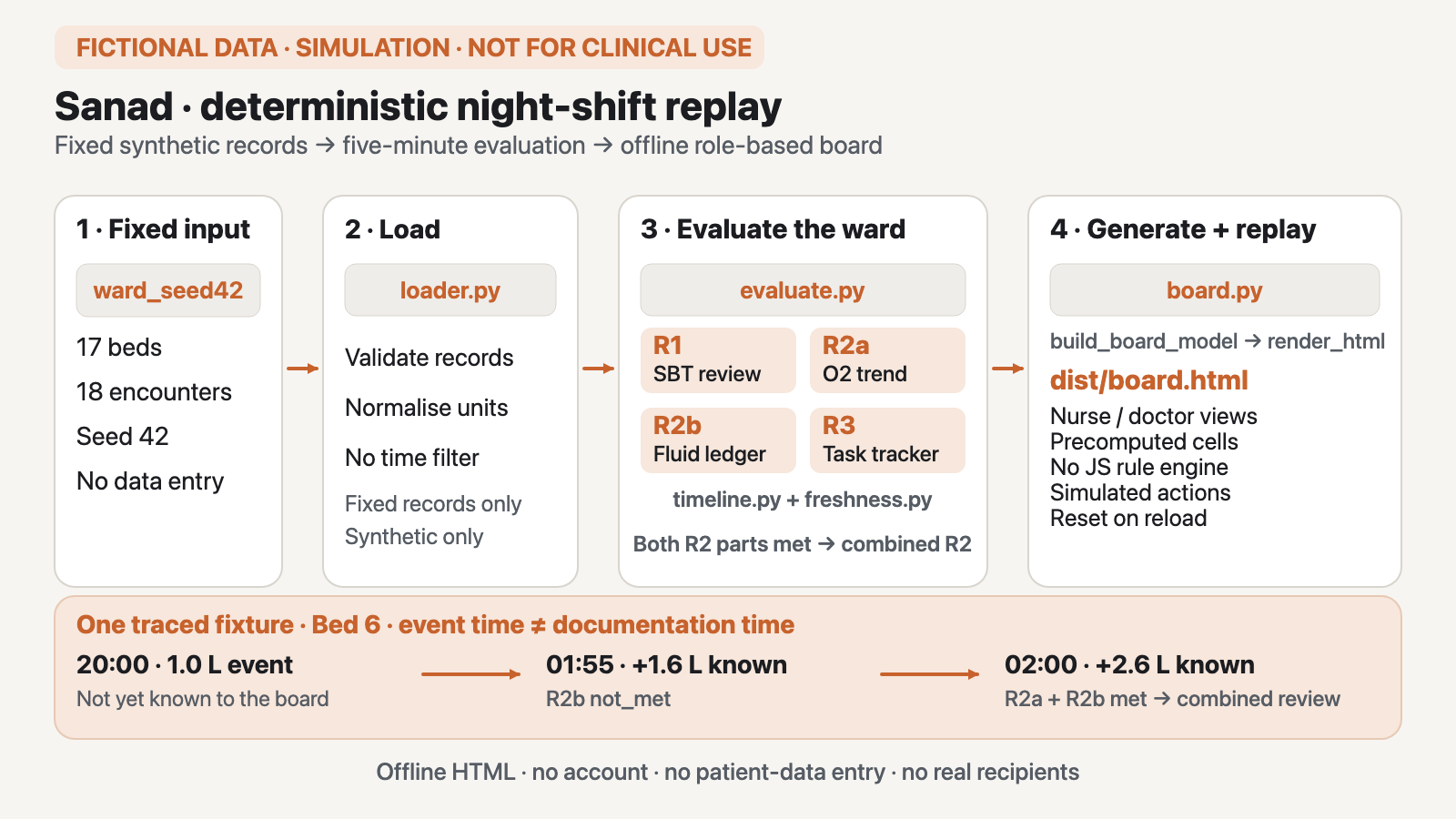
Sanad replays a fixed synthetic ward: 17 beds, 18 fictional encounters and a night shift from 19:00 to 07:00, preceded by 12 hours of synthetic history. Bed 13 changes encounter during the night. The application evaluates on a five-minute grid using only records documented by the selected time.
Four configured rule modules drive the demonstration:
- R1 — SBT screen review candidate: combines a documented SAT prerequisite, ventilator settings and comparison, neuromuscular-blocker status, clinician confirmations, haemodynamics, a context gate and a duration requirement. Its approved message is verbatim: “Available data match the configured SBT screen. Clinician review required; this does not establish SBT or extubation readiness.”
- R2a — oxygenation trend review: evaluates separate settings and good-quality SpO2 branches while retaining independent oxygenation results when fluid data are missing. Its thresholds are labelled as DESIGN demo values, not emergency alarm thresholds.
- R2b — fluid-accounting review: uses a rolling, deduplicated transaction ledger as known at the selected time. Missing urine/drain output becomes
unknown, never zero; charting-day totals and gross CRRT volumes are not used. - R3 — task and response tracker: follows valid ventilation checks per encounter. Acknowledgement changes workflow only; it does not turn an overdue evaluation into a completed check.
The night-nurse view shows 17 ordered bed tiles and a simulated inbox. The on-call-doctor view shows open R1/R2 episodes in time-raised order and approved review wording. Results use the five state words: met, not_met, unknown, suppressed and not_applicable. Non-met chips display their reason codes; met chips use the approved content without displaying the engine's default ok_not_met reason. Stale observations produce a visible feed alert and unknown/stale_data; a non-triggering bed displays exactly “No configured rule triggered on the available data”.
There is no patient-data entry, upload, import, external feed or real recipient. Simulated actions use fixed choices, occupy browser memory only and reset on reload.
How I built it
The engine is Python 3.12 standard-library code, split into typed records, unit handling, an as-known-at timeline, freshness checks, one module per rule and a ward orchestrator. A deterministic generator serialises the engine's precomputed cells into one HTML file with inline CSS and vanilla JavaScript. The browser replays those cells; it does not reimplement a clinical rule. The generated page has no remote resources, network API, cookies, browser storage or third-party runtime package.
Kiro CLI implemented individual spec tasks through a constrained custom agent. Two requirement/design/task sets—one for the engine and one for the ward board—trace implementation and tests back to the signed baseline and the prewritten scenario oracle. Product, safety and technology steering remain in /.kiro, alongside agent hooks and specs.
Challenges
Time mattered twice. A fluid record has an event time and a documented time. In fictional bed 6, 1.0 L given at 20:00 is documented at 02:00; the known rolling net changes from +1.6 L at 01:55 to +2.6 L at 02:00, when the combined R2 review first appears.
Acknowledgement was not assessment. In fictional bed 10, R3 is met at 01:10. Pressing Acknowledge (simulated) changes the workflow chip to acknowledged while R3 remains met.
Failure could not look like silence. In fictional bed 9, observations are absent from 01:00 through 02:25. At 01:15 the board displays feed alert · beds 9 and observation rules become unknown/stale_data; fresh data return at 02:30.
A bed was not an encounter. Bed 13 changes encounter at 23:00/23:15. The implementation keeps task history and evaluation history with the correct encounter rather than inheriting them across the reassignment.
Verification and accomplishments
The public MIT repository DrAhmed7887/sanad-public is at dd74b60. It holds the sanitized snapshot (b9cd35c), a display fix built by Kiro (b81c205), the judge-ready README, JUDGES.md and committed count (2a23808), and a keyboard-access fix (dd74b60: bed tiles, inbox rows and episode rows operable by keyboard, one hidden heading; no change to rules, data or default look). The display fix decodes the embedded text before parsing it, renders criterion emphasis, and lays out each R1 criterion with its source on its own line; it changes the display only (decision D30). The repository retains the root .kiro specs, steering and hooks, the application source, tests and documentation. Its commit metadata uses the noreply identity.
Public CI run 44531871856 passed on dd74b60: 379 passed in 503.87 seconds and all data checks passed (29 logged data checks, DC01–DC25 including per-bed cases). Pages run 44531871709 deployed the same commit. The earlier commits' runs also passed: 42866956202 (375 tests) and 42866956289 on 2a23808, 42738538590 and 42738538474 on b9cd35c, and 42822126772 (369 tests) and 42822126741 on b81c205.
Anonymous interaction QA of the deployed application exercised the Start/17-bed view, Bed 1's eight criterion/source rows, Bed 10 workflow separation, Bed 9 stale feed, Bed 6 combined R2 and Bed 15 deferral/reload. No console errors occurred; there is no application login.
The suite includes eleven executed offline Chromium regression cases: nine earlier ones and two added with the display fix. After the fix, the film's scripted captures re-ran every judge flow on the live page, and all their page assertions passed. These engineering checks and reviews are not clinical validation.
Synthetic scenarios and automated checks exercise the demonstration's configured logic. They do not establish clinical performance, safety or benefit.
What I learned
A useful agent workflow needs boundaries that survive unattended execution. EARS acceptance criteria made each implementation task specific; the scenario oracle protected expected outputs; read/write-only tools narrowed the agent's authority; and hooks checked frozen hashes, refused protected writes and warned about banned public wording. Human review and a separate exact-commit review remained necessary.
Property-based tests complemented the hand-authored scenarios by expressing 12 invariants, including unit equivalence, missing/stale inputs, one prompt per episode, rolling-balance invariance, per-encounter task isolation, visible failures and non-reassuring silence. I do not claim that these software properties demonstrate clinical effectiveness.
What's next
Keep this submission within its demonstrated scope: deterministic replay of a fixed fictional dataset. Any future rule, threshold, expected-outcome or public-wording change requires a new reviewed baseline and clinical-lead sign-off. No live-patient integration or clinical-performance claim is part of this submission.
Intended use
Offline software demonstration using fictional adult ICU scenarios. Illustrates configurable rules and notification workflows. Not intended to monitor people, assess SBT readiness, detect deterioration, prioritise clinical care, or support diagnosis or treatment. Do not enter patient data. No clinical performance has been established.
Built With
- css
- github-actions
- html
- hypothesis
- javascript
- kiro-agent-hooks
- kiro-cli
- kiro-custom-agents
- kiro-specs
- kiro-steering
- playwright
- pytest
- python-3.12
