-
-
Logo of Sampah.id
-
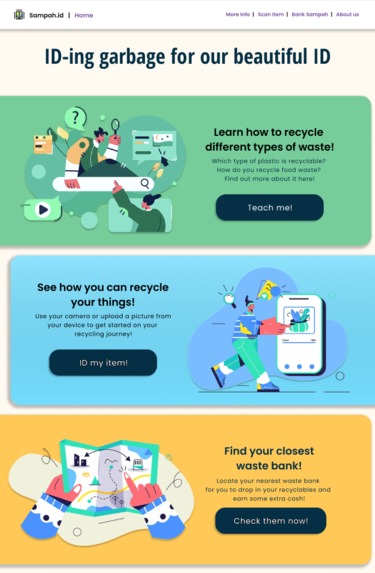
Home page

Inspiration
In 2020, Indonesia produced 68 million tons of waste, with less than 10% of it being recycled. This waste includes recyclables, which were left piling up in landfills instead of being recycled into useful products such as recycled bottles and packaging. Our team endeavors to provide a tool to help educate the general public about the different types of waste, and even a waste detection system that is able to categorise waste based on a picture uploaded to the site, as well as where to drop the sorted recyclables.
Our mission for this project is to equip people with the knowledge to recycle and be sustainable in their own households, and our vision is to increase the recycling rate from household waste and make Indonesia a cleaner place.
What it does
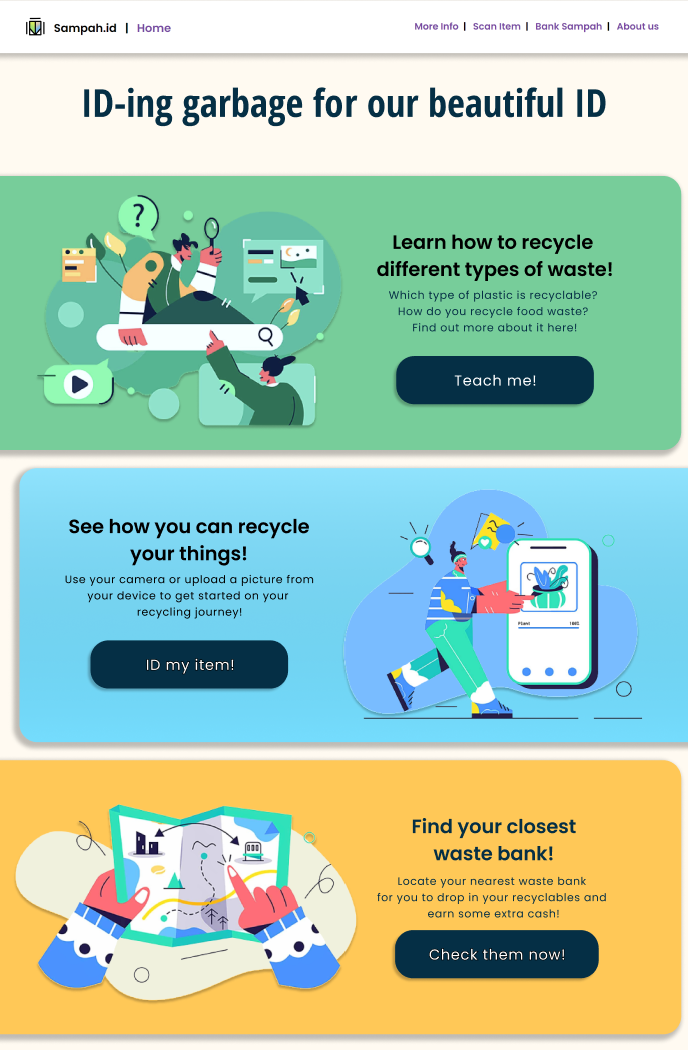
Sampah.id is an all-in-one tool for people to learn about recycling. In the website, users would be able to access different features including:
- Information: Comprehensive information about the categories of waste and which types of waste are recyclable, as well as how to recycle them
- Item detector: Allows user to upload or snapshot a picture of an object, in which an AI would detect the type of waste, as well as redirect users to the relevant recycling method
- Trash bank locator: Provides the nearest trash bank locations relative to the user’s current location. Also contains basic information regarding trash banks and how they work in general
How we built it
We used Figma for design, and built the website through Node.js, html, and css for both frontend and backend. For the item detection we used Google Vision API (https://cloud.google.com/vision). This API takes a image file and able to detect their labels (the object name, label, etc), and for the trash bank location detector we used Google Maps API (https://developers.google.com/maps).
Challenges we ran into
We ran into both technical and non-technical challenges during the course of this hackathon. Our technical issues include our inability to incorporate the APIs into our prototype webpage due to the lack of knowledge as we did not have enough time to properly learn about the framework. In addition, some of us were inexperienced and unfamiliar with the languages used in this hack.
As for non-technical issues, it was the first hackathon for all of us. We have little knowledge on app development and we lacked the organisational skills and preparation for the event, leading to a lackluster team management and work distribution, with each member of the team doing whatever they want out of the tasks that need to be done. Furthermore, we overestimated how much time we actually had to do the project, and so we were very pressed for time with this project.
Accomplishments that we're proud of
As a team, we were able to complete our first hackathon and create our first website from scratch. In addition, we were able to learn and troubleshoot issues regarding node.js. Moreover, for some of us it was the first time doing website development and also the tools such as Git, Visual Studio, and node.js.
What we learned
This project was a new experience for us, equipping the team with better understanding and knowledge as to the preparation before the hack starts. For example, with a strict time constraint, proper scheduling and planning as well as realistic MVP goals should be set. Furthermore, we learned how to develop a website and use different tools to do it.
What's next for Sampah.id
We plan to make the API work, or if time allows we may build and teach an AI to detect the waste instead of using an API. If the base website is complete, we have thoughts of providing the incentive for people to use our object detection system, in which using it once generates an amount of money, possibly from ads, in which the proceeds can be donated to a non-profit organization geared towards sustainability or waste management in Indonesia.

Log in or sign up for Devpost to join the conversation.