Inspiration / problem and intended users
Words alone do not tell the whole story. The same sentence can sound calm, angry, excited, sad or uncertain depending on its delivery. SameWords turns that contrast into a short listening game for people who enjoy language, sound and communication.
The goal is to make those differences easy to hear and compare. It is a game, not a test of someone's social understanding or an emotion detector.
What it does
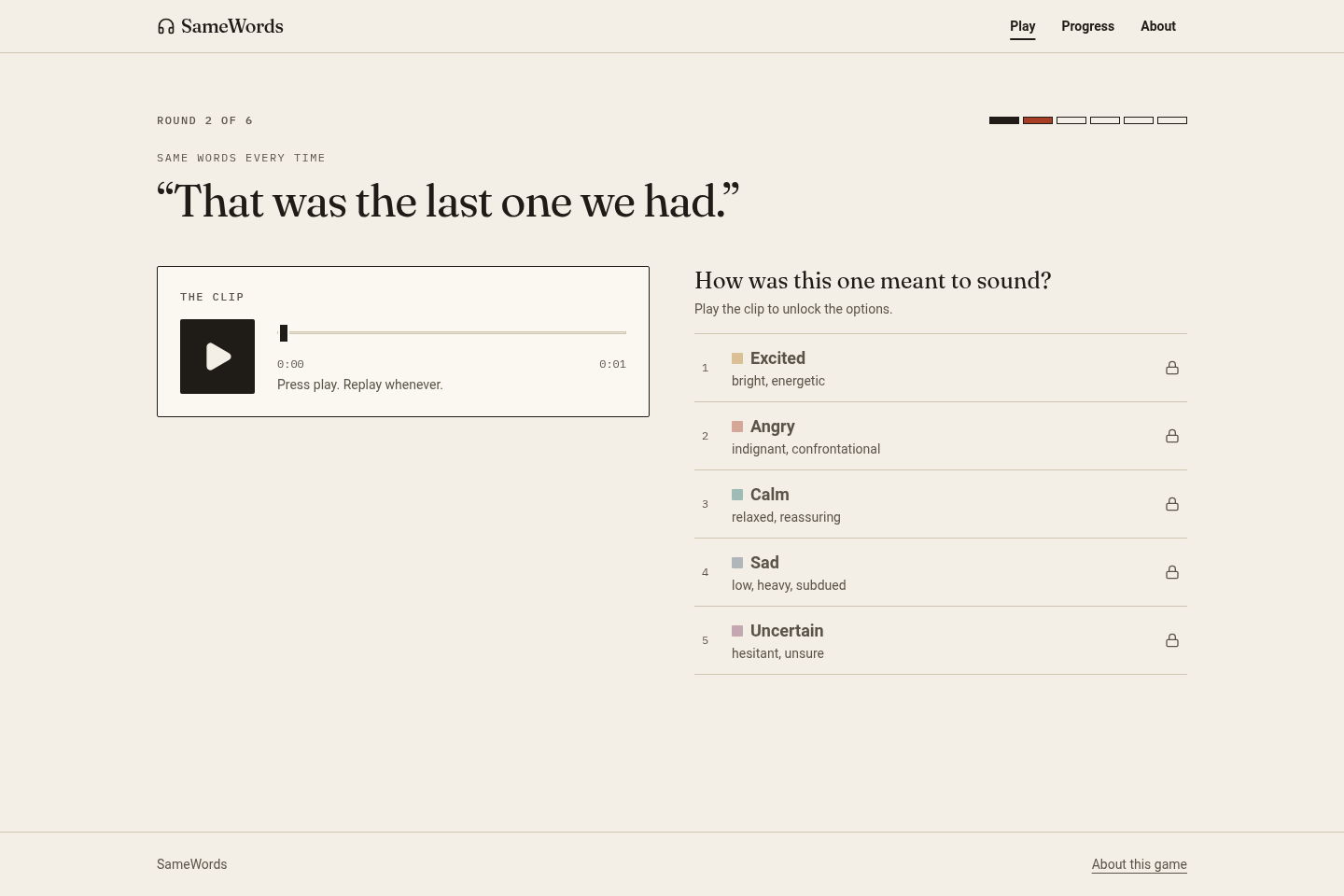
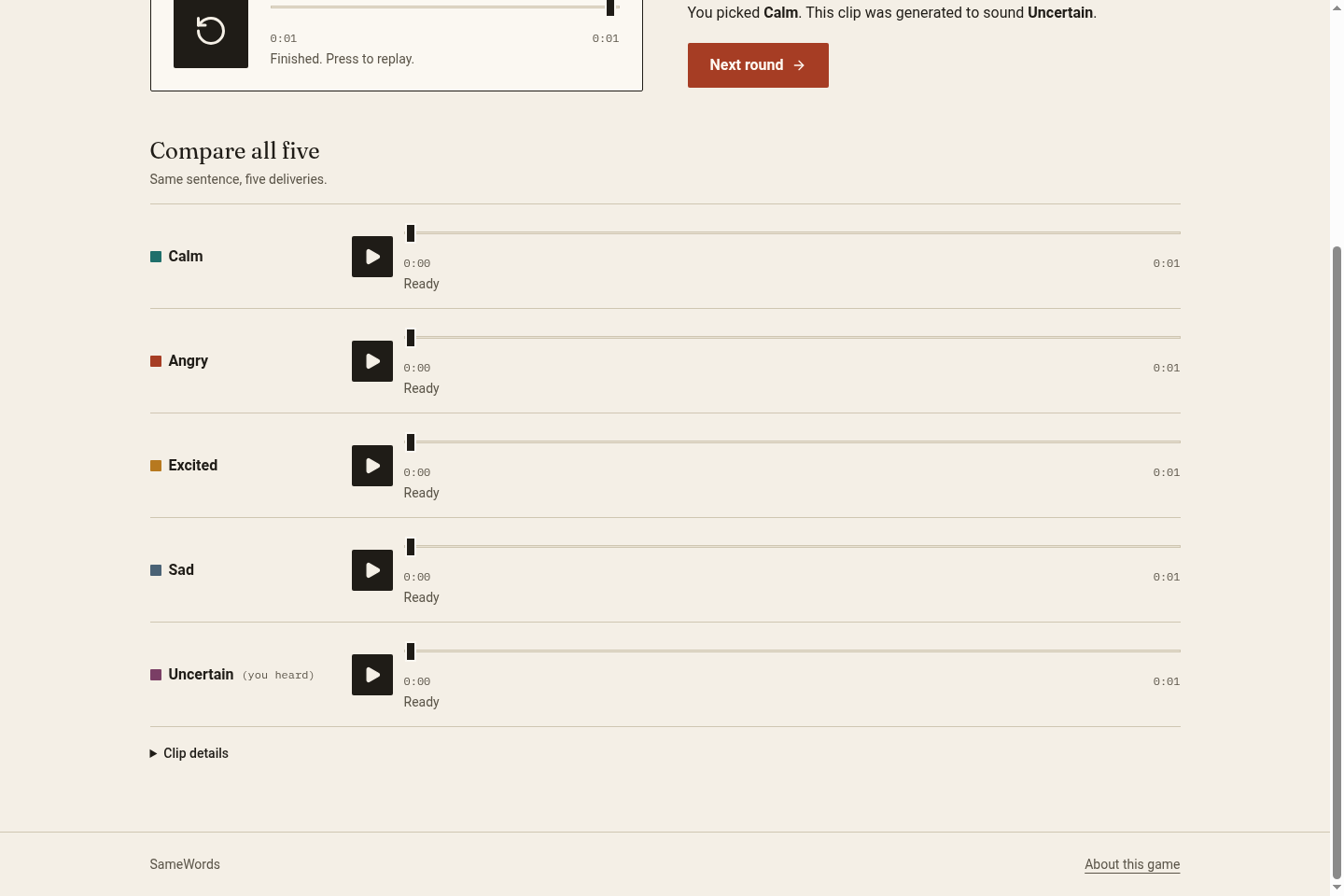
Players hear a sentence and choose its intended delivery. After answering, they can replay and compare all five versions of the exact same words with the same speaker.
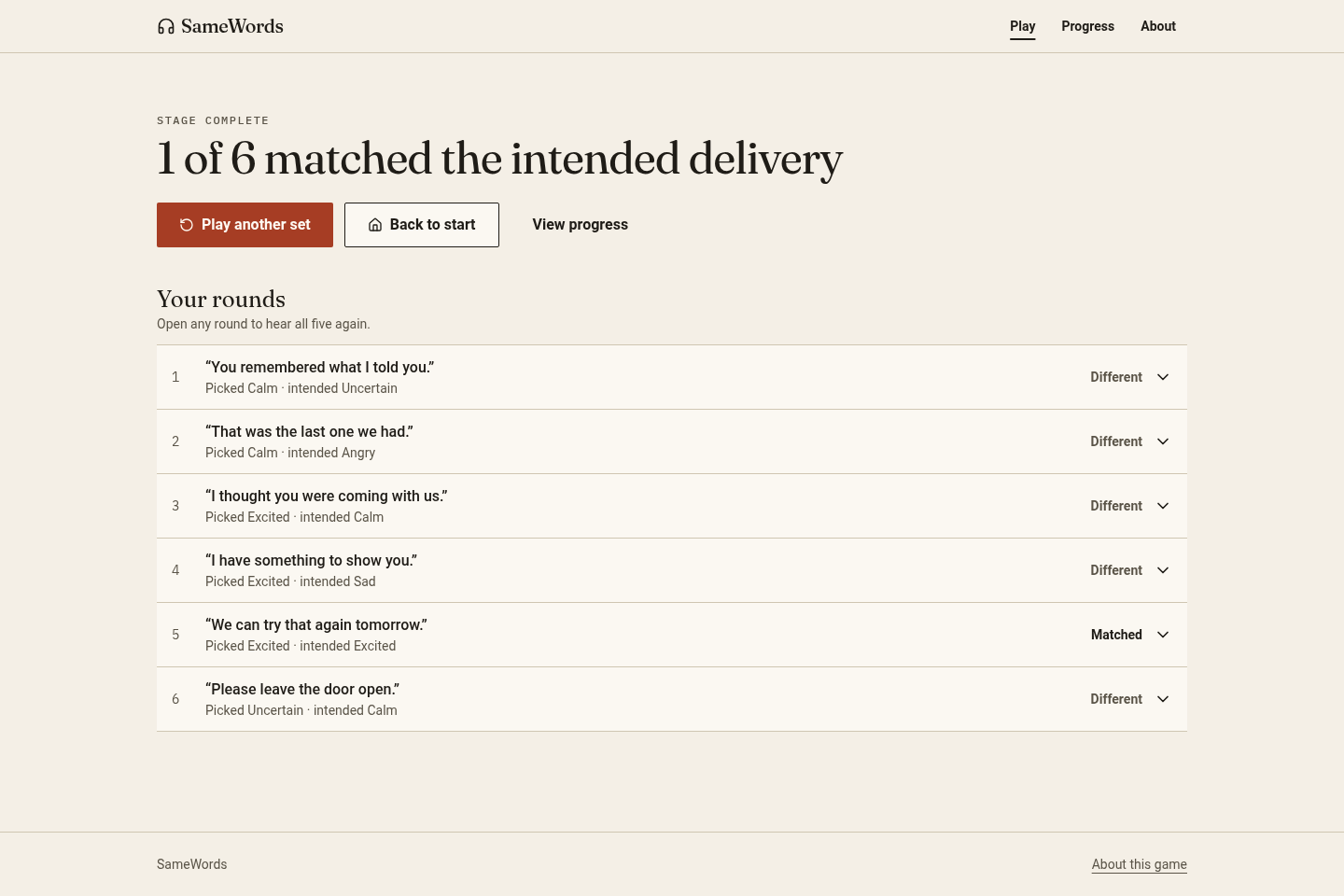
There are three practice stages of 6, 8 and 10 rounds: 24 distinct sentences and 120 generated clips. Each stage uses one voice, Aiden, Serena or Ryan. Finishing a stage unlocks the next one regardless of accuracy. Scores, results, local progress, reset and progress export make it a complete browser experience without an account.
Stage directions become more restrained as the game progresses. That progression is authored game design, not scientifically calibrated difficulty.
How we built it
The web app uses Next.js, React, TypeScript, Tailwind CSS, shadcn/ui patterns and Lucide icons, with Vitest tests and deployment on Vercel.
All voices generated with deAPI using Qwen3 TTS CustomVoice.
The exact generation model is Qwen3_TTS_12Hz_1_7B_CustomVoice. deAPI generates the different delivery styles from a fixed sentence, speaker and style direction. The selected clips form a versioned audio bank. The public app plays that bank; it does not make live billable generation requests or expose provider credentials to players.
Each selected clip passed an independent automated word-sequence check. SHA-256 hashes bind the checks to the selected audio. This checks wording, not whether every requested tone sounds convincing.
deAPI sponsor challenge - meaningful integration
The generated speech is the core game material, not background narration or a sponsor logo. deAPI lets SameWords hold the sentence and speaker constant while changing the requested delivery. Players can hear the contrast directly by comparing five versions after each round.
The fixed-bank approach makes those comparisons repeatable and keeps public play fast and free of inference charges. The generation workflow includes job handling, selected-asset validation and a versioned catalog that the game consumes.
Challenges
The central constraint was changing delivery without changing the words. A convincing-sounding clip is not enough if it adds or drops a word, so the selected bank has automated word checks and hash-bound evidence.
Other challenges were separating generation from public playback, keeping browser-local progress tied to the correct bank, and making the full answer/reveal/compare/results loop usable on narrow screens and with a keyboard.
Accomplishments
SameWords has a deployed, playable three-stage game with all 120 selected clips bundled, five-way comparisons after each round, completion-based unlocks and browser-local progress. The release was checked with type checks, tests, build checks, audio-asset checks and real Chrome playthroughs, including a narrow mobile layout.
What we learned
Identical words are a useful control when comparing delivery. Automated transcription can check that control, but it cannot certify emotional meaning. That distinction shaped both the validation workflow and the wording shown to players.
Limits and honest disclosures
- All speech is synthetic. No clip in the 120-clip bank has been human-tone-reviewed.
- Labels describe the requested generation delivery, not objective emotion. Different listeners may hear a clip differently.
- The stages are an authored progression, not a validated learning intervention or calibrated difficulty scale.
- SameWords is not an emotion detector, lie detector, clinical tool or validated measure of social understanding.
- Progress is stored in the current browser. Clearing browser data removes it. Legacy answers do not earn credit in the current bank.
- iOS Safari has not been validated.
What was built during LovHack / pre-existing work
SameWords was built during the LovHack Season 3 build window, September 26 through October 4, 2026. The work includes the sentence and delivery bank, generation and validation workflow, three-stage game, comparison playback, results and progress handling, responsive interface, tests and deployment.
Pre-existing third-party tools and libraries include Next.js, React, TypeScript, Tailwind CSS, shadcn/ui patterns, Lucide, Vitest, Vercel and the deAPI service and speech model. AI-assisted development tools were used. These are dependencies and development tools, not previously completed SameWords product work.
What's next
Human listening review of the full bank, iOS Safari testing, and user feedback on the clarity of the comparisons and interface are next. Any future learning or difficulty claims would need evidence beyond the game as it stands.
Built With
- deapi
- lucide
- next.js
- qwen3-tts-customvoice
- react
- shadcn-ui
- tailwind-css
- typescript
- vercel
- vitest

Log in or sign up for Devpost to join the conversation.