What it does
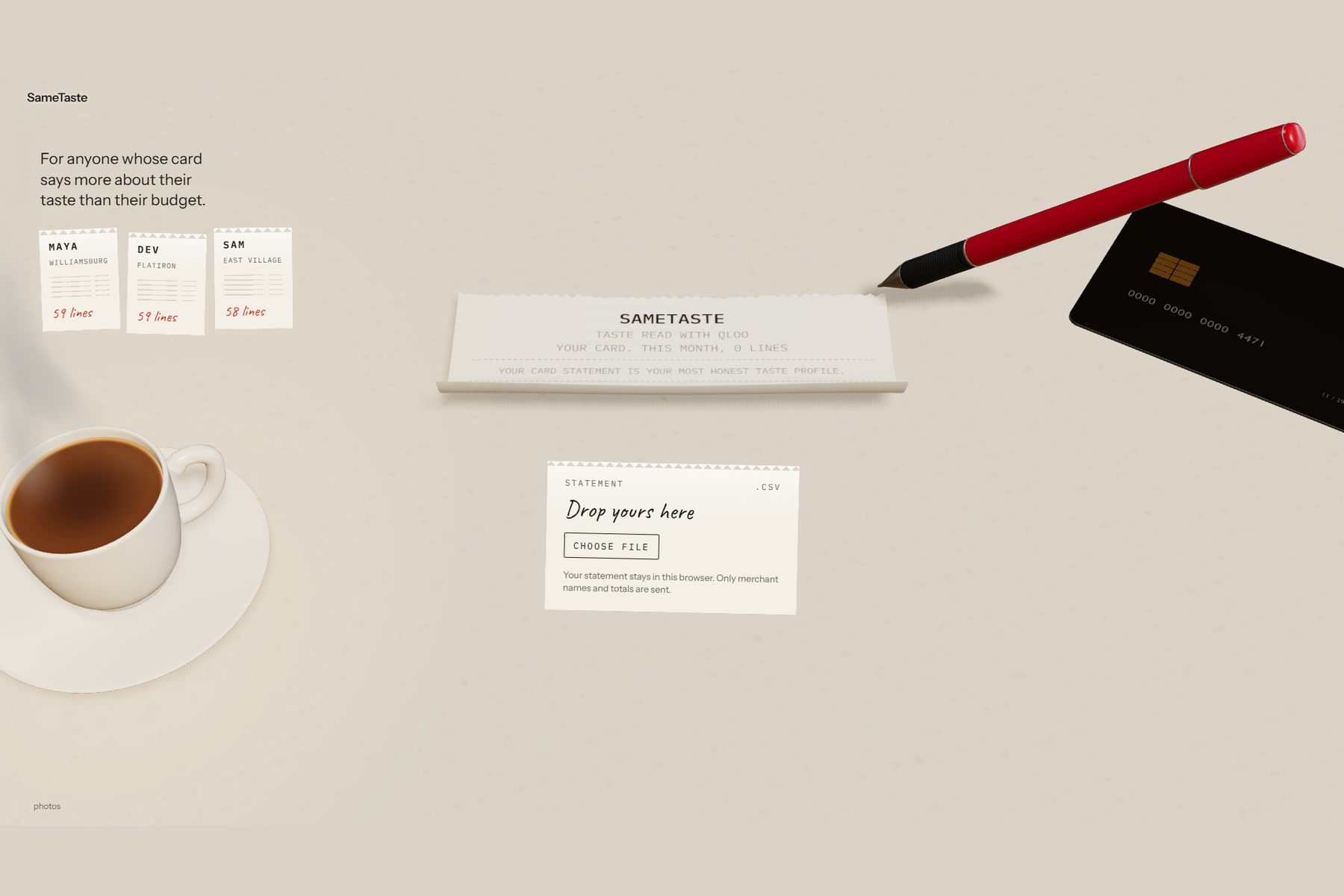
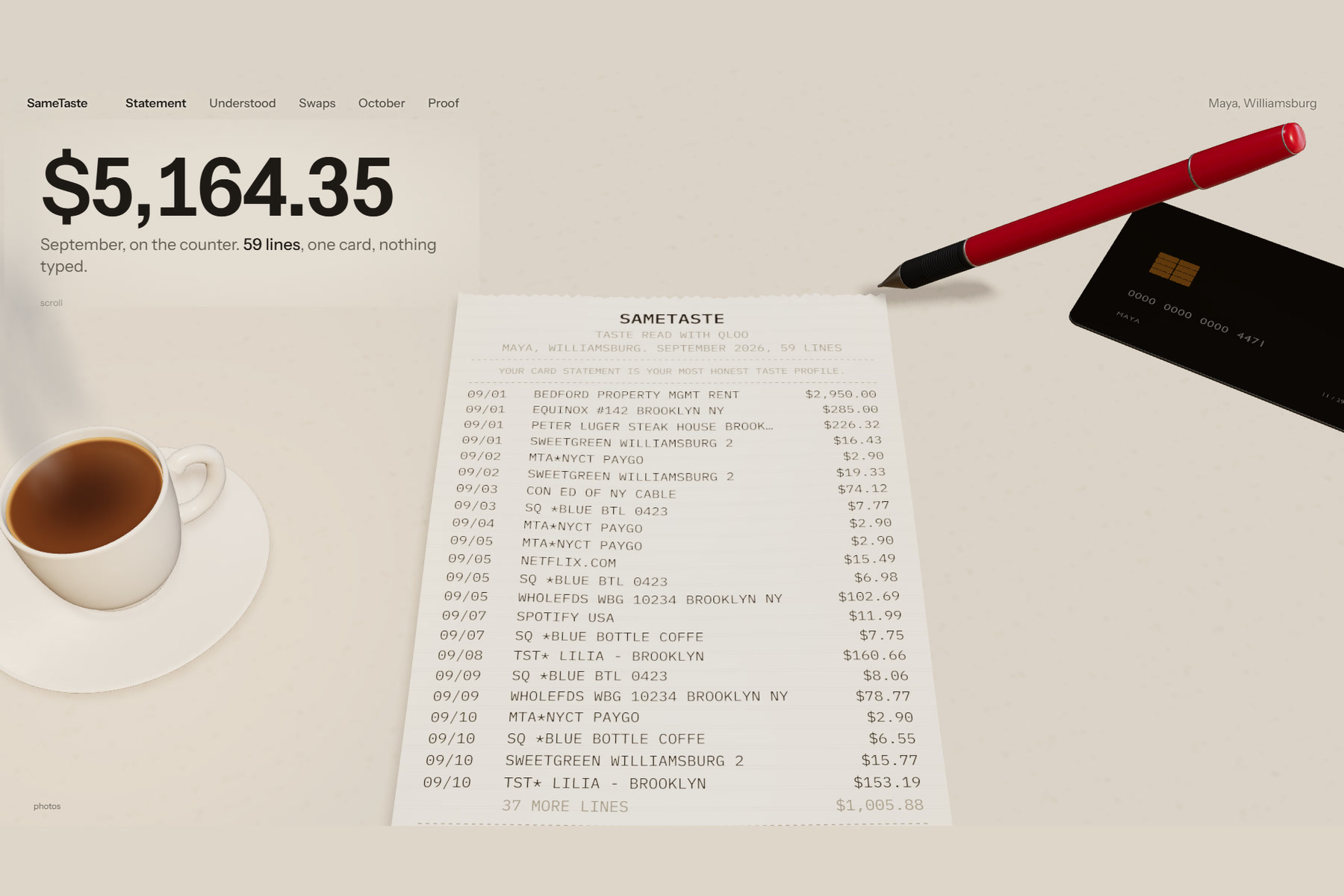
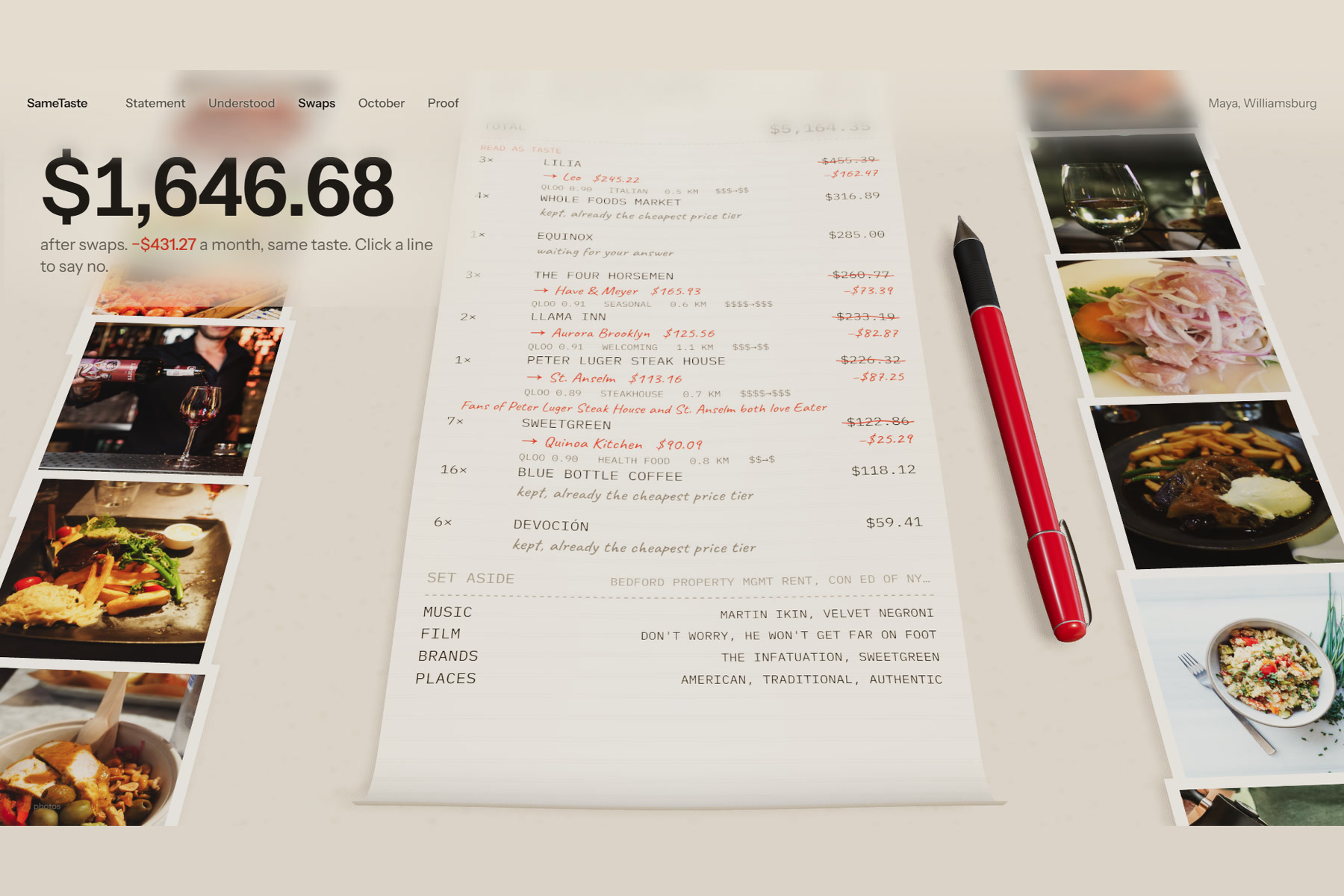
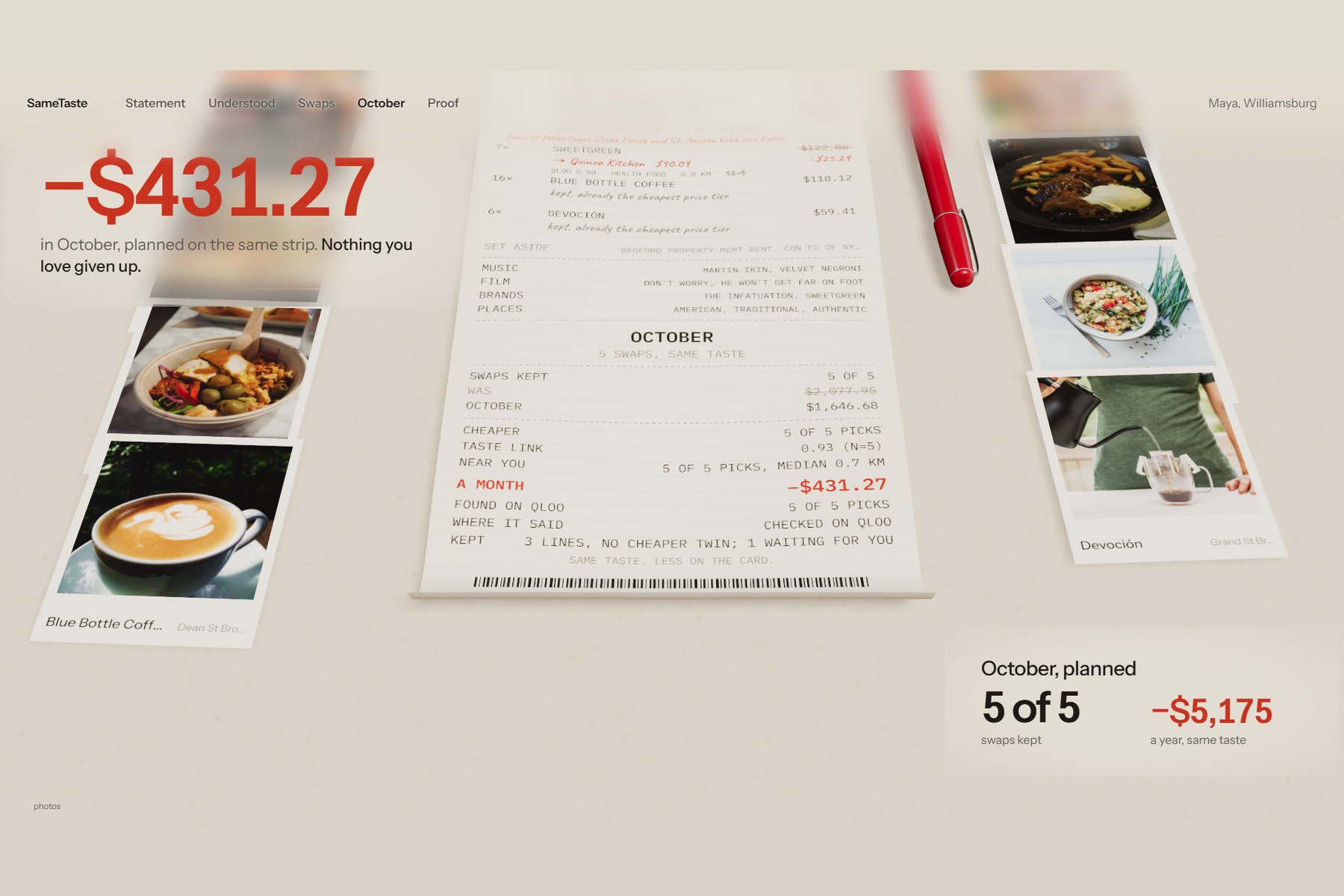
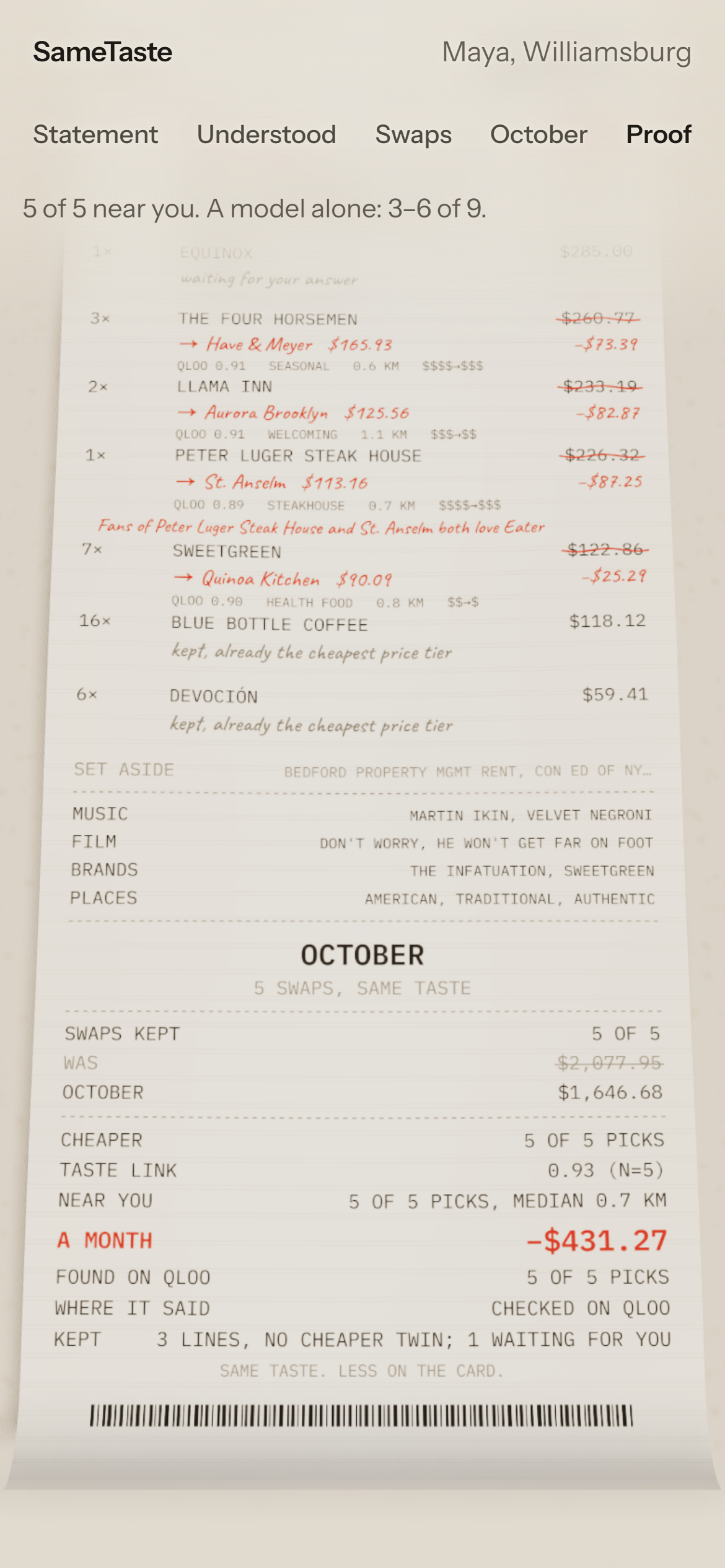
Drop in a month of card transactions and SameTaste prints them as a receipt. An agent finds each merchant on Qloo and writes a twin in red pen under it: a place near you that people with your taste love as much, for less. Click a red line to say no and it writes another. The receipt ends with next month, planned.
Maya's live run (a sample statement, Williamsburg): 5 swaps, $431.27 a month less out of $2,077.95 (20.8%). 3 lines are kept because no cheaper twin shares her taste, and 1 waits for her answer. One swap explains itself with Qloo's graph: "Fans of Peter Luger Steak House and St. Anselm both love Eater".
Technological Implementation
Finding a cheaper place is easy. Finding a cheaper place you would choose is a taste question, and Qloo answers it.
- Resolve: messy descriptors ("TST* LILIA - BROOKLYN") are cleaned in
the browser and by Claude Haiku 5.5, then Qloo
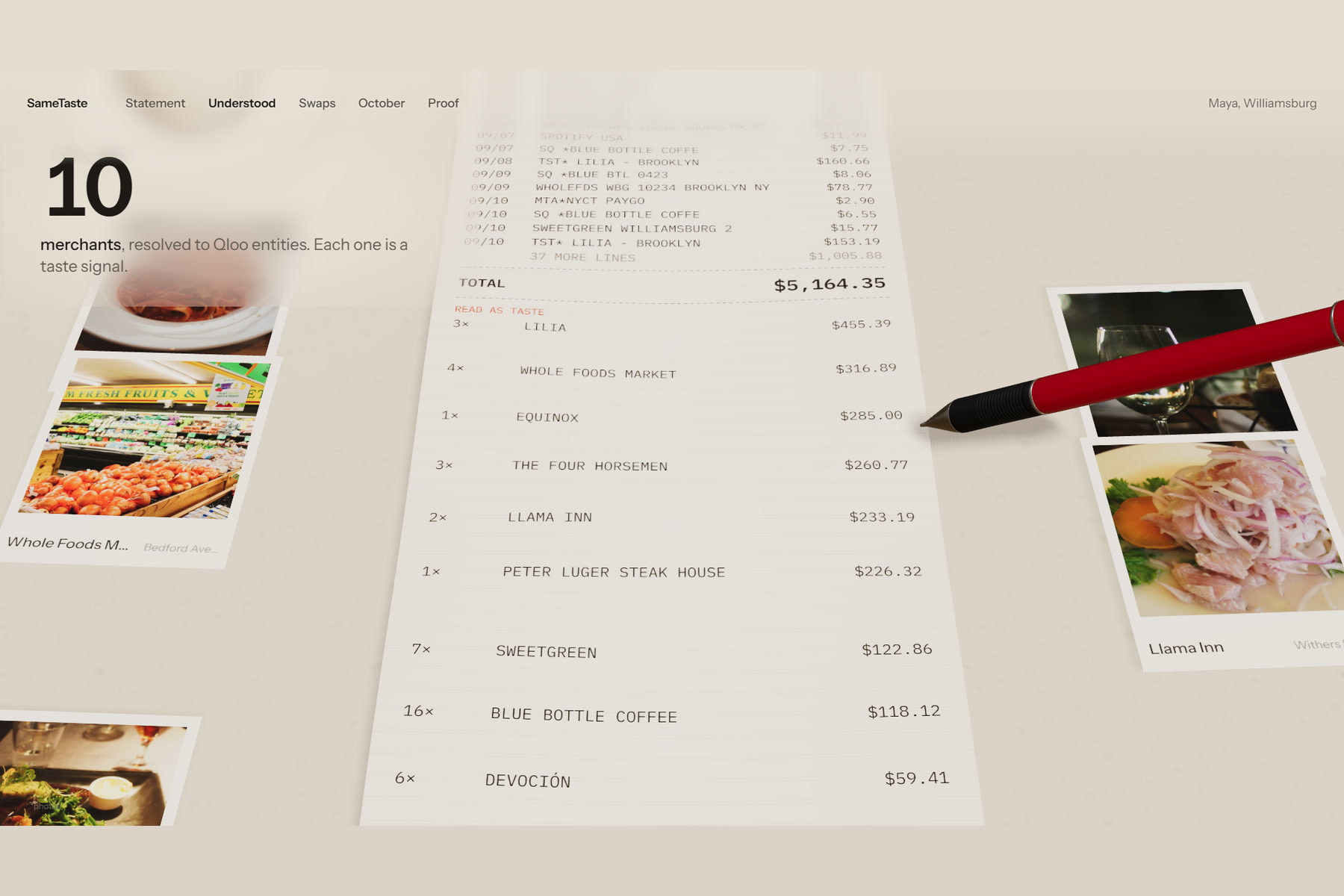
/searchmaps each to an entity near the user. When two fit, the agent asks ("Which Joe's?"). - Twin: Qloo Insights for places, with the merchant as the taste signal, the user's location, and a lower price level. The search widens when nothing comes back. The taste tags a twin shares with the original are printed under it.
- Taste read: cross-domain Insights (music, film, brands) show what the statement says about you.
- Agent: a Claude Sonnet 5.5 tool loop (Vercel AI SDK) with nine typed tools, four of them Qloo calls. After a no it re-plans that one merchant.
- Money: a deterministic engine (price tier × your ticket × visits). No model does arithmetic.
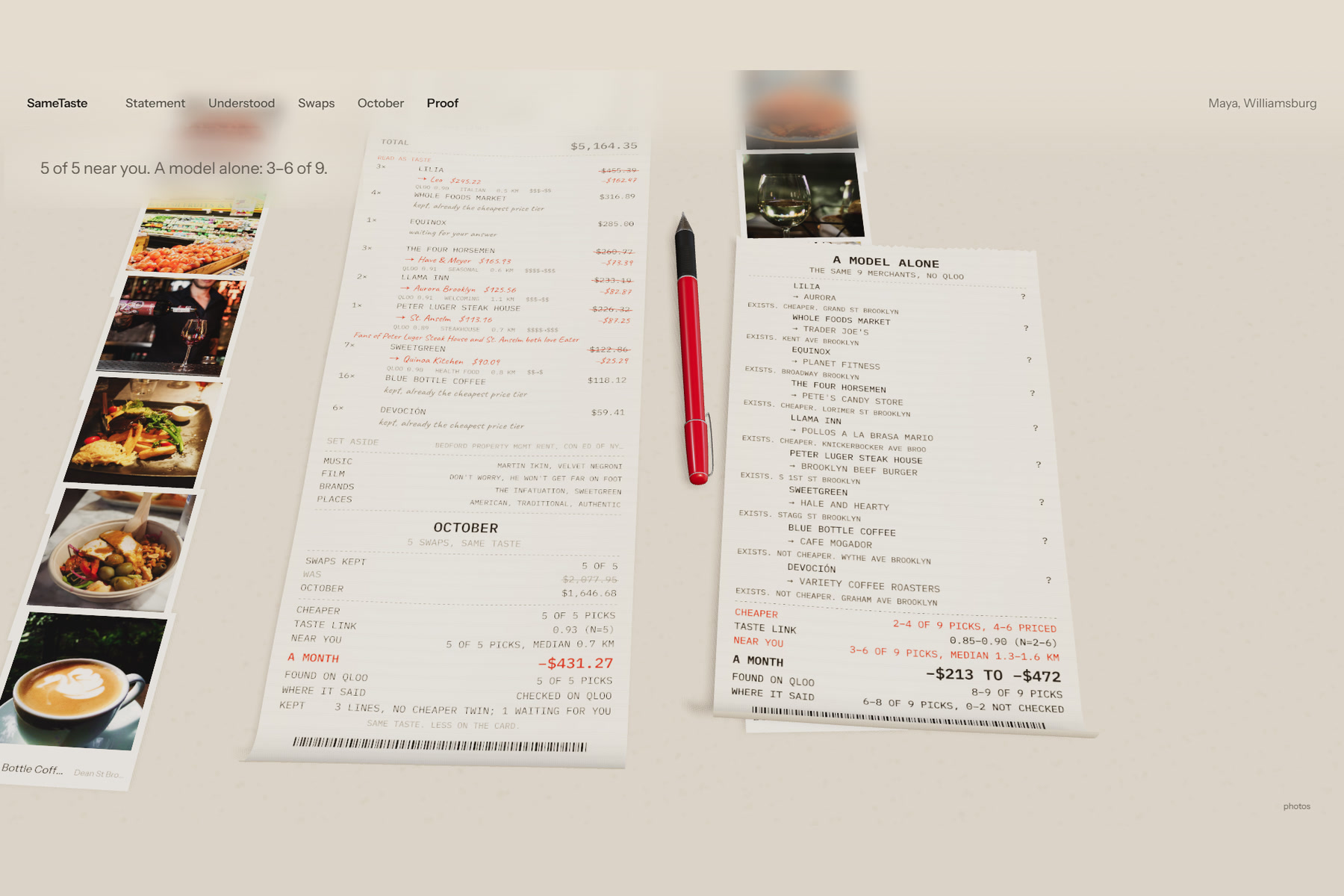
- Proof: the same merchants go to the model alone, with no Qloo, 5 times. Each of its picks is resolved to its nearest real branch, then both sides are scored with the same Qloo calls and the same engine:
| Maya | SameTaste | Model alone, 5 runs |
|---|---|---|
| Near you (≤ 1.5 km) | 5 of 5, median 0.7 km | 3–6 of 9, 1.3–1.6 km |
| Cheaper | 5 of 5 picks | 2–4 of 9 |
| Taste link (Qloo affinity) | 0.93 | 0.85–0.90 |
| A month | −$431 | −$213 to −$472 |
The monthly saving overlaps: a model alone can save as much in a good run. The claim is that SameTaste is same taste, nearby and actually cheaper, every run.
- Guards: rate limit, call caps, daily and total spend caps. Qloo responses are cached server-side only.
Design
One object, one gesture. The app is a receipt on a counter (three.js); you scroll down it and the agent's work appears as pen on paper. Every number is printed on the receipt, and the overlay repeats only those. A no is a click on the red line; a question is a paper slip. It works on a phone, and a full text version (the first Tab stop) works by keyboard.
Potential Impact
When money is tight, eating out, coffee and classes go first, and cheaper replacements found by hand rarely feel the same. SameTaste keeps the taste and lowers the price, from a statement people already have, with no quiz or account. Banks and card issuers hold that statement and could offer it in their apps; card-linked offers could pay per redirected visit.
Quality of the Idea
Budget apps say "spend less"; recommendation apps say "try this". SameTaste starts from what you already chose with your own money. The statement is the taste signal, and Qloo's graph makes the twin a twin rather than a cheaper guess.
Privacy
The statement is parsed in the browser. Only merchant names, counts and totals are sent; nothing is stored.
Testing instructions for judges
- Open https://qloo-sametaste.vercel.app. No login.
- Click Maya and scroll. The twins are written in red (this first pass replays Maya's recorded live run).
- Click a red written line to say no. That re-plan, like any answer to a question, runs the live agent.
- Scroll on to the plan and the proof.
- Optional: drop your own CSV (
date,description,amount).
If the spend cap is reached the page says so; recorded runs still play.
Built With
- claude
- next.js
- qloo
- react
- tailwind-css
- three.js
- typescript
- vercel
- vercel-ai-sdk
- vitest
- zod

Log in or sign up for Devpost to join the conversation.