-

SameSpace: Duplicate Image Detection using Siamese Neural Networks
-
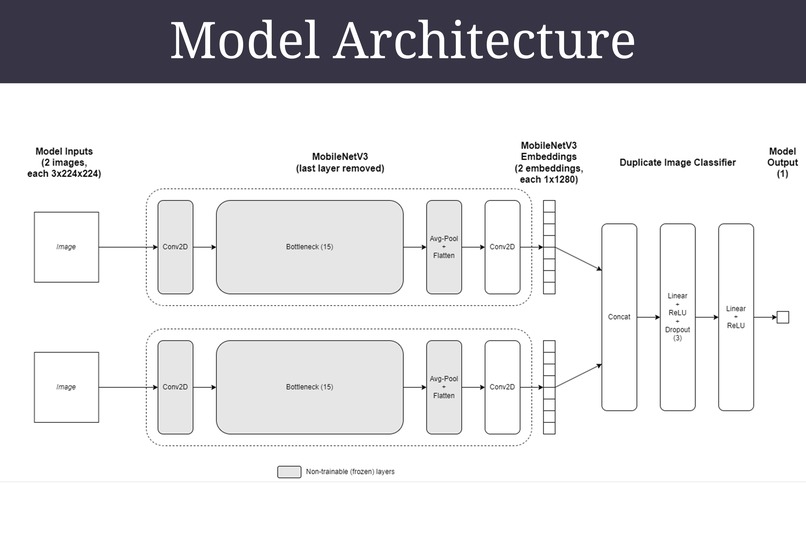
Dual MobileNetV3 models in Siamese Neural Network
-
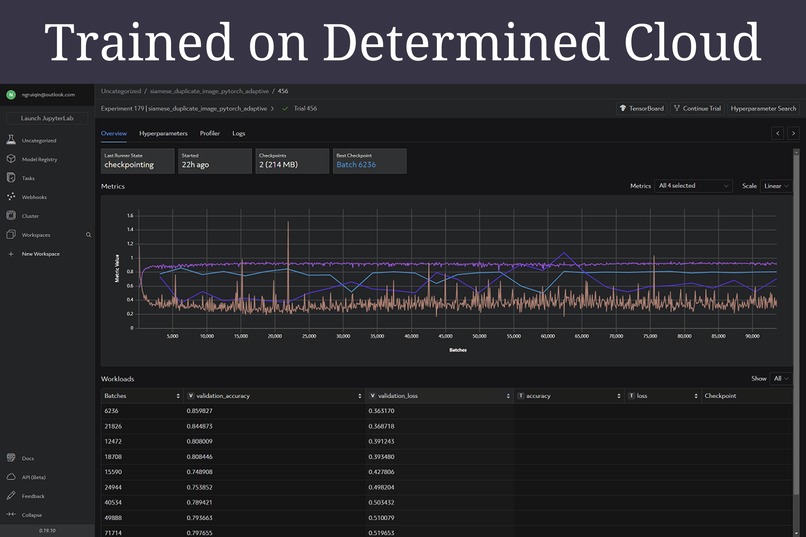
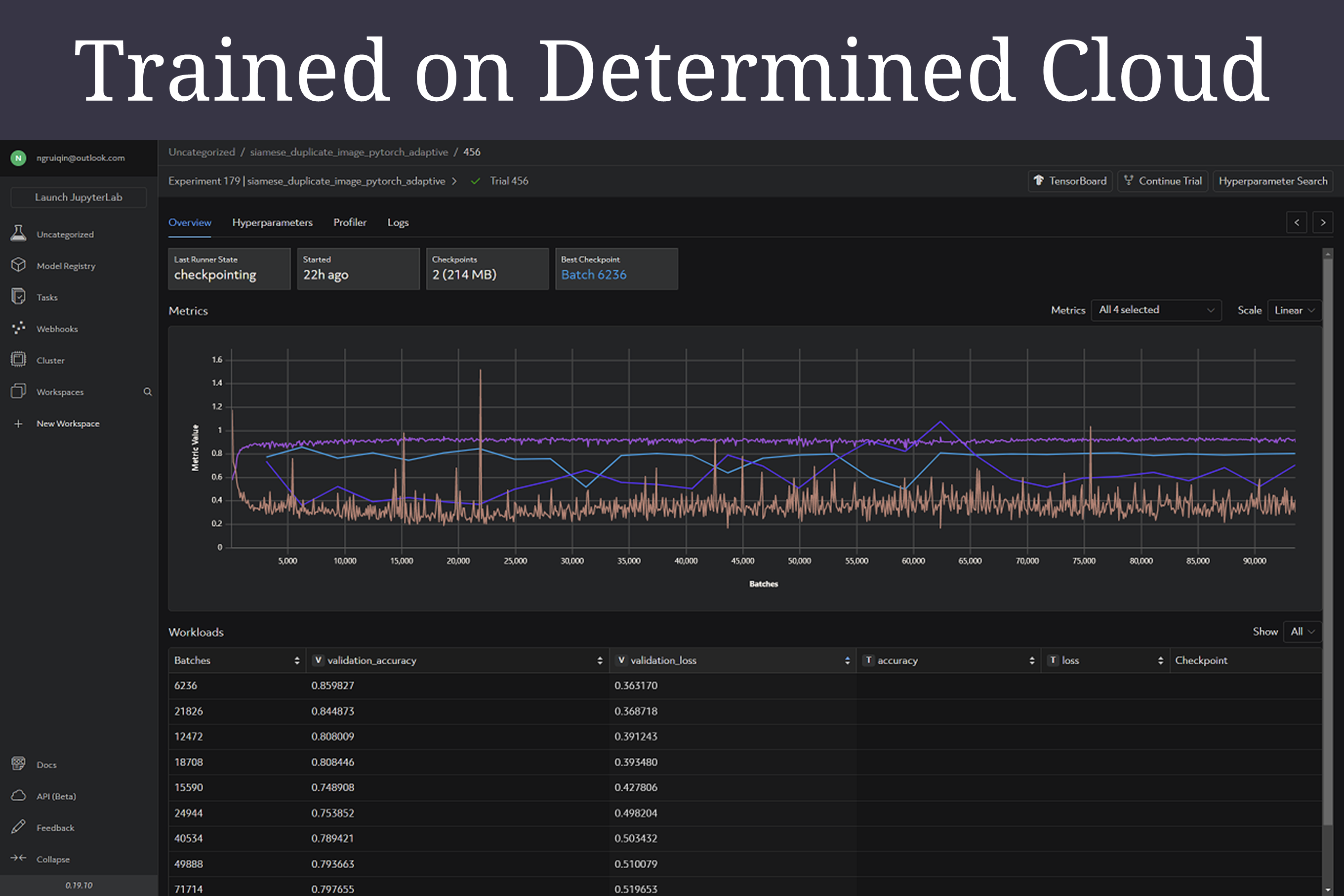
Monitored and tuned on Determined Cloud

SameSpace: Duplicate Image Detection using Siamese Neural Networks
We take many, many photos. These photos are stored on our devices and can be time-consuming to clean up. At times we may forgo choosing photos, instead uploading all of them online for sharing. This can create issues for the recipient, who will be the same photo multiple times. In a non-trivial scenario, viewing accommodation photos can be frustrating when there are duplicates of the same space, affecting the user experience.
On a technical angle, duplicate photos is a double edged sword. On one hand, it can be useful in having multiple sources of information that serves as evidences for information retrieval systems. (Paul, 2021) On the other hand, it is a concern when it comes to removing copyrighted images (Podolak, 2021), optimising storage costs on the cloud, or when using them for machine learning (Lee, 2021).
Project Objective
SameSpace is a deep learning model that detects if two home images are similar, utilising transfer learning in a Siamese network developed using PyTorch.
SameSpace can be embedded into systems to detect duplicate images of accommodation spaces, useful in cases such as:
- Reducing candidate images during image curation
- Optimising (cloud) storage space
- Computer vision model training
Dataset
The Airbnb Duplicate Image Dataset by Sunkaraneni et al., hosted on Kaggle, is used for model training and validation. (Sunkaraneni et al., 2019) The authors collected images that show the same space/room, organised in folders for each space type (e.g. living-room, kitchen) and tagged them in the <city>_<room_id>_<match_number>.jpg format. This meant that images with the same folder, city and room_id can be inferred as duplicate images.
The images are also organised in separate Training Data and Test Data folders.
The dataset can be accessed on Kaggle: https://www.kaggle.com/datasets/barelydedicated/airbnb-duplicate-image-detection
Feature Engineering
The target variable (label) is derived from the image filename, where the filename is split and the city and room_id are retrieved and matched. Duplicate images have the same city and room_id.
The training and validation dataset is created by first retrieving all image paths, then pairing them up and deriving the target. This amounts to 1,559 duplicate (positive) and 396,602 non-duplicate (negative) samples in the training dataset, with an extreme class imbalance.
The class imbalance presents an issue on model training - the model does not generalise well and results skew towards the negative class. The negative class can be simply downsampled closer to the positive class, but this will lead to a small training dataset. Upsampling the positive class and downsampling the negative class was done instead, and will be detailed in the following paragraphs.
Upsampling is done on the positive class through image transformations - horizontal flipping, clockwise rotation by 5 degrees and anti-clockwise rotation by 5 degrees. These transformations will then applied in all permutations (e.g. image 1 rotated anti-clockwise and image 2 horizontally flipped then rotated clockwise). The augmented images will then be presented as new images to the model, increasing the positive samples by a factor of 64 to 99,776. It is worth noting that to improve memory efficiency, these transformations will not be immediately applied.
Downsampling on the negative class is performed through weighted sampling. The aim is to give image pairs that are similar a higher weight, so that they are more likely to be sampled. The metric we used for similarity is the hamming distance between the image hashes (more similar image hashes have a lower hamming distance). The weights are engineered to be inversely exponential to the similarity score of each image pair. First, the weighted hash of each image (downsized to 256x256) is calculated (using ImageHash). Next, the similarity score (hamming distance) between each non-duplicate pair is calculated. (Levengood, 2020) Lastly, the weights used for sampling is calculated by taking the inverse exponential function of the similarity score: 1/e^x where x is the similarity score. These weights are then used to sample without replacement with a seed of 0 for consistency across runs. The same number of non-duplicate pairs (99,776) is being sampled.
With the dataset in place, all images are loaded into memory, with the resize and normalisation transformations applied in accordance to the input specifications for pre-trained models on PyTorch. (PyTorch, 2022)
The aforementioned steps are applied separately to both training and validation datasets with the DuplicateImageDataset class that inherits torch.utils.data.Dataset. The transformations used for upsampling are applied in __getitem__().
Data Sample
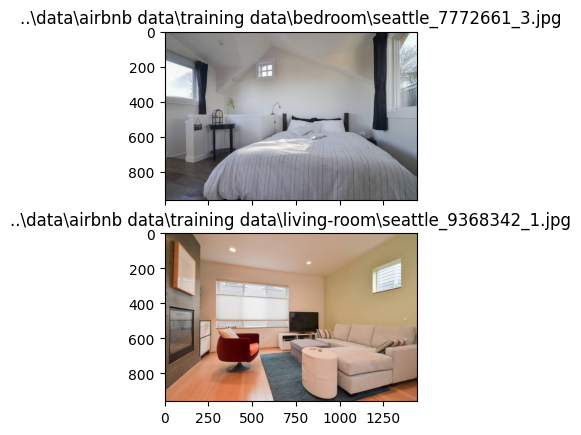
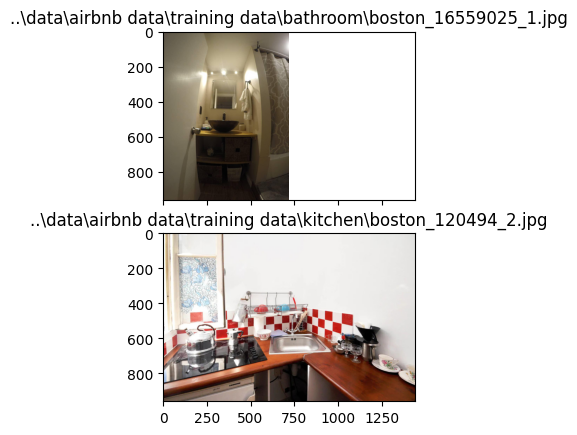
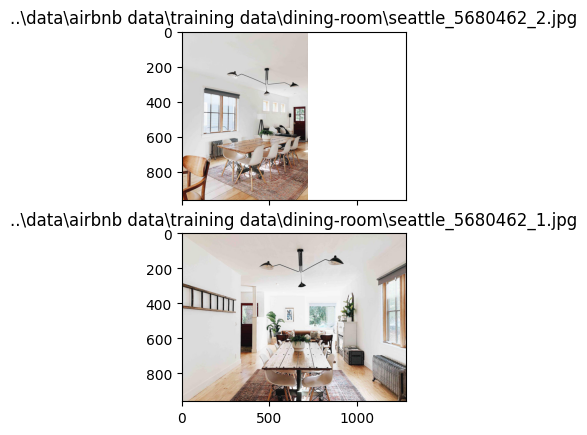
The following is a sample of the underlying DataFrame that DuplicateImageDataset creates, and some samples of the image inputs before transformations.
| image1 | image2 | class | img1_hflip | img2_hflip | img1_anticlockwise_rot | img2_anticlockwise_rot | img1_clockwise_rot | img2_clockwise_rot |
|---|---|---|---|---|---|---|---|---|
| ..\data\airbnb data\training data\dining-room\seattle_5680462_1.jpg | ..\data\airbnb data\training data\living-room\seattle_3584790_3.jpg | 0 | 0 | 0 | 0 | 0 | 0 | 0 |
| ..\data\airbnb data\training data\living-room\boston_16288361_1.jpg | ..\data\airbnb data\training data\living-room\seattle_1686930_2.jpg | 0 | 0 | 0 | 0 | 0 | 0 | 0 |
| ..\data\airbnb data\training data\kitchen\boston_1369349_3.jpg | ..\data\airbnb data\training data\living-room\boston_121799941_2.jpg | 0 | 0 | 0 | 0 | 0 | 0 | 0 |
| ..\data\airbnb data\training data\dining-room\seattle_5680462_2.jpg | ..\data\airbnb data\training data\dining-room\seattle_5680462_1.jpg | 1 | 1 | 0 | 1 | 0 | 1 | 0 |
| ..\data\airbnb data\training data\dining-room\seattle_1110749_2.jpg | ..\data\airbnb data\training data\kitchen\seattle_3269390_2.jpg | 0 | 0 | 0 | 0 | 0 | 0 | 0 |
| ..\data\airbnb data\training data\bedroom\seattle_7772661_3.jpg | ..\data\airbnb data\training data\living-room\seattle_9368342_1.jpg | 0 | 0 | 0 | 0 | 0 | 0 | 0 |
| ..\data\airbnb data\training data\bedroom\seattle_6361863_4.jpg | ..\data\airbnb data\training data\bedroom\seattle_6361863_4.jpg | 1 | 0 | 1 | 1 | 1 | 1 | 0 |
| ..\data\airbnb data\training data\bathroom\boston_16559025_1.jpg | ..\data\airbnb data\training data\kitchen\boston_120494_2.jpg | 0 | 0 | 0 | 0 | 0 | 0 | 0 |
| ..\data\airbnb data\training data\bedroom\seattle_4218733_1.jpg | ..\data\airbnb data\training data\bedroom\seattle_4218733_1.jpg | 1 | 0 | 1 | 0 | 1 | 1 | 1 |
| ..\data\airbnb data\training data\bathroom\boston_20309505_1.jpg | ..\data\airbnb data\training data\bathroom\boston_20309505_2.jpg | 1 | 0 | 1 | 0 | 1 | 0 | 0 |
Model Architecture
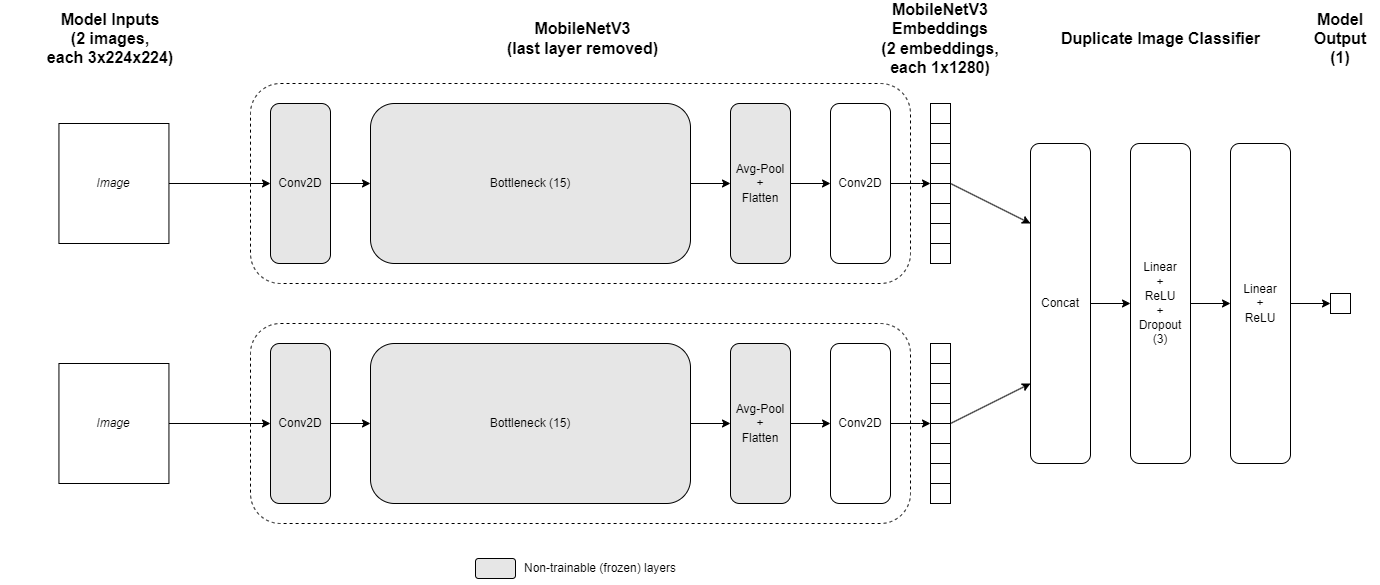
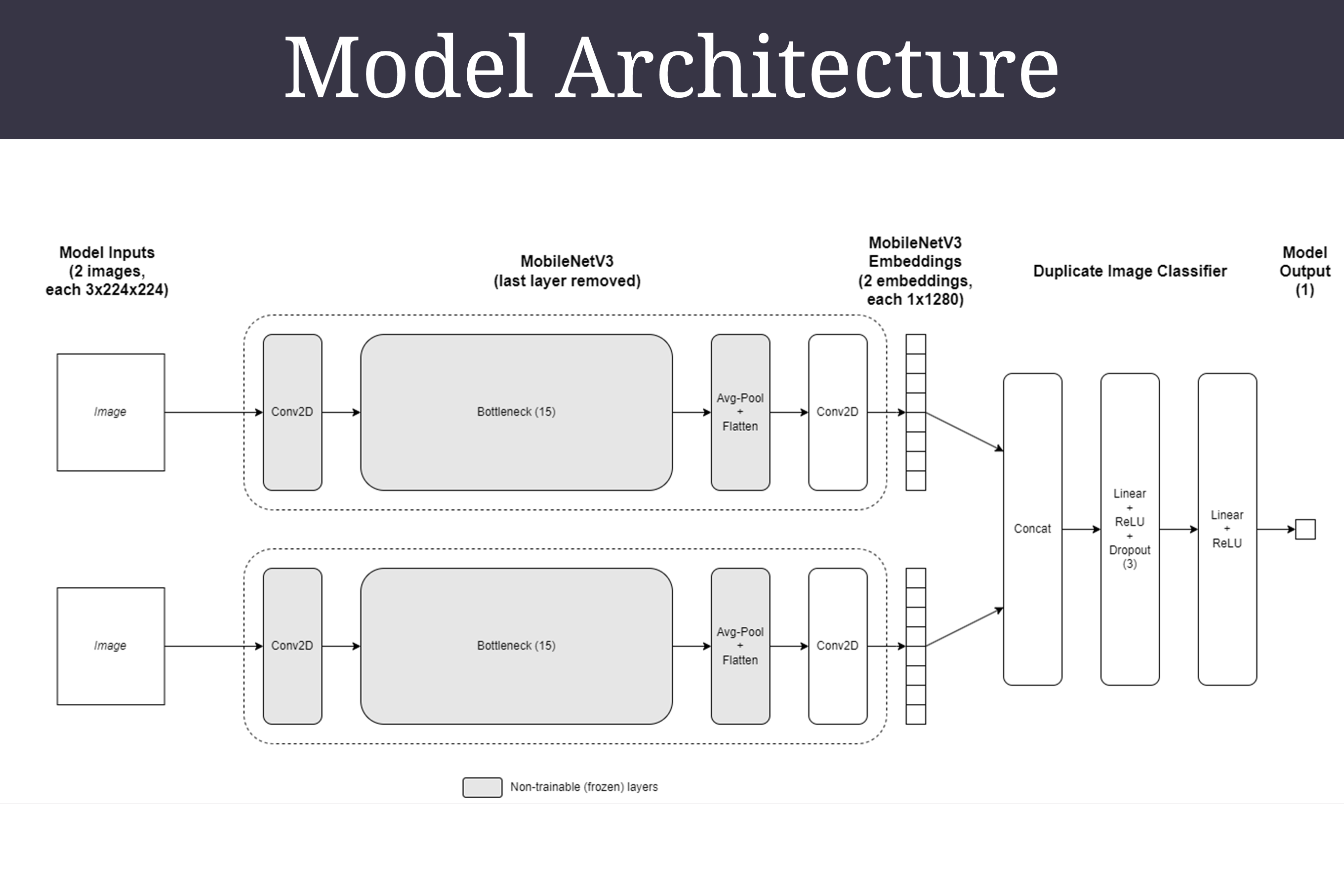
SameSpace adopts a Siamese network architecture consisting of two MobileNetV3 large models, each with their last layer removed. The layers prior to the last convolution layer are frozen. The outputs of the MobileNetV3 models are concatenated and passed through the duplicate image classifier.
The model’s output is a nested list of floating point numbers, which will then be passed through the sigmoid function to return probabilities between 0 and 1. The probabilities are then binned into two equal bins for evaluation.
MobileNetV3 is selected for transfer learning as it is appropriate for the problem, and is designed to be used in resource limited scenarios. This allows SameSpace to be deployed and run (inference) on a large variety of platforms.
Features and Hyperparameters
SameSpace is trained with the root mean square propagation (RMSProp) optimizer with the following hyperparameters:
- Learning rate
lr - Smoothing constant
alpha
In addition, there are 3 dropout rates dropout1, dropout2 and dropout3 each representing the number of neurons to drop after each linear and ReLU layers in the duplicate image classifier.
The global_batch_size is set to 64, epochs set to 30 and max_trials set to 16. The searcher algorithm used is adaptive_asha.
| hparam | min | max |
|---|---|---|
| lr | 0.0001 | 0.01 |
| alpha | 0.6 | 0.99 |
| dropout1 | 0.2 | 0.6 |
| dropout2 | 0.2 | 0.6 |
| dropout3 | 0.2 | 0.6 |
Running the Training Job
Before running training job, a Kaggle API key is required to download the dataset. (Cherian, 2020) This is required as the directory size will be more than 96MB with the dataset. (Determined AI, 2023)
- Login to Kaggle and go to the account tab https://www.kaggle.com/settings/account
- Click "Create New Token"
- Download the
kaggle.jsonfile and move it to the repository's root directory (same folder asdata.pyandmodel_def.py)
The dataset will then be downloaded into the data folder in __init__() in model_def.py. Then, the following commands are run in order to start the training job on Determined Cloud:
export DET_MASTER=<master ip>det auth logindet experiment create adaptive.yaml .
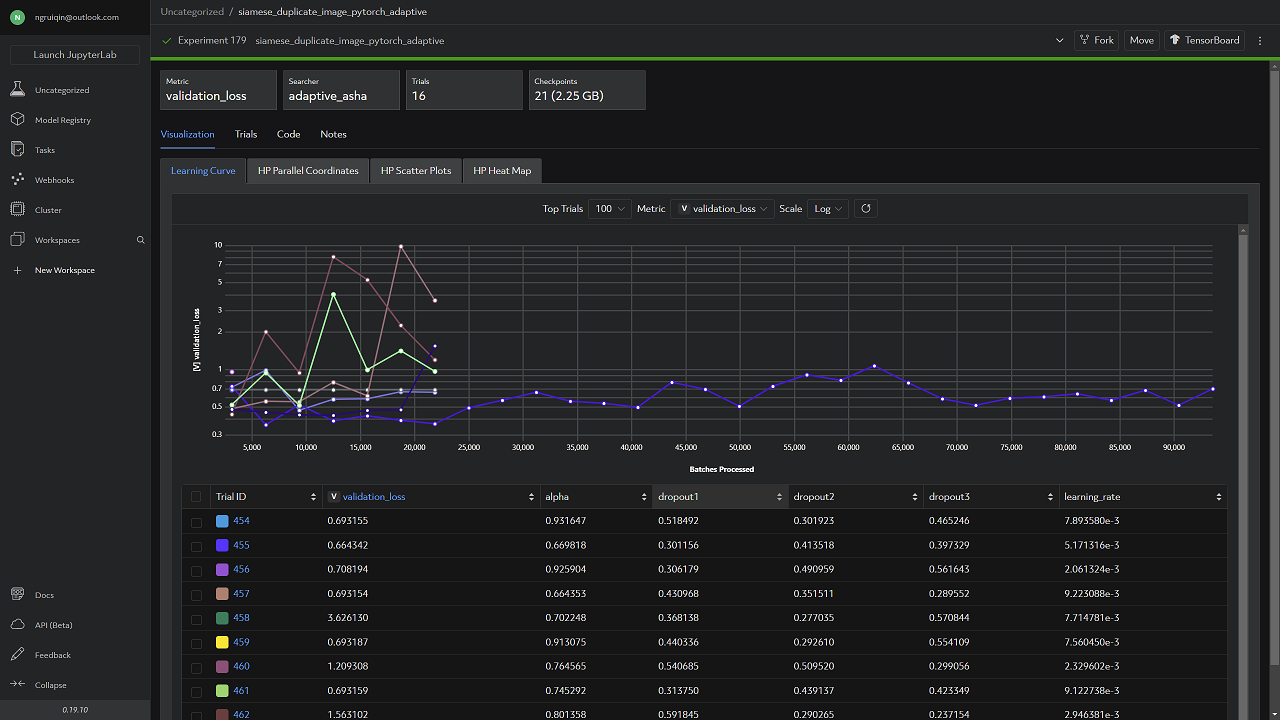
Best Metrics from Determined Web UI
Experiment
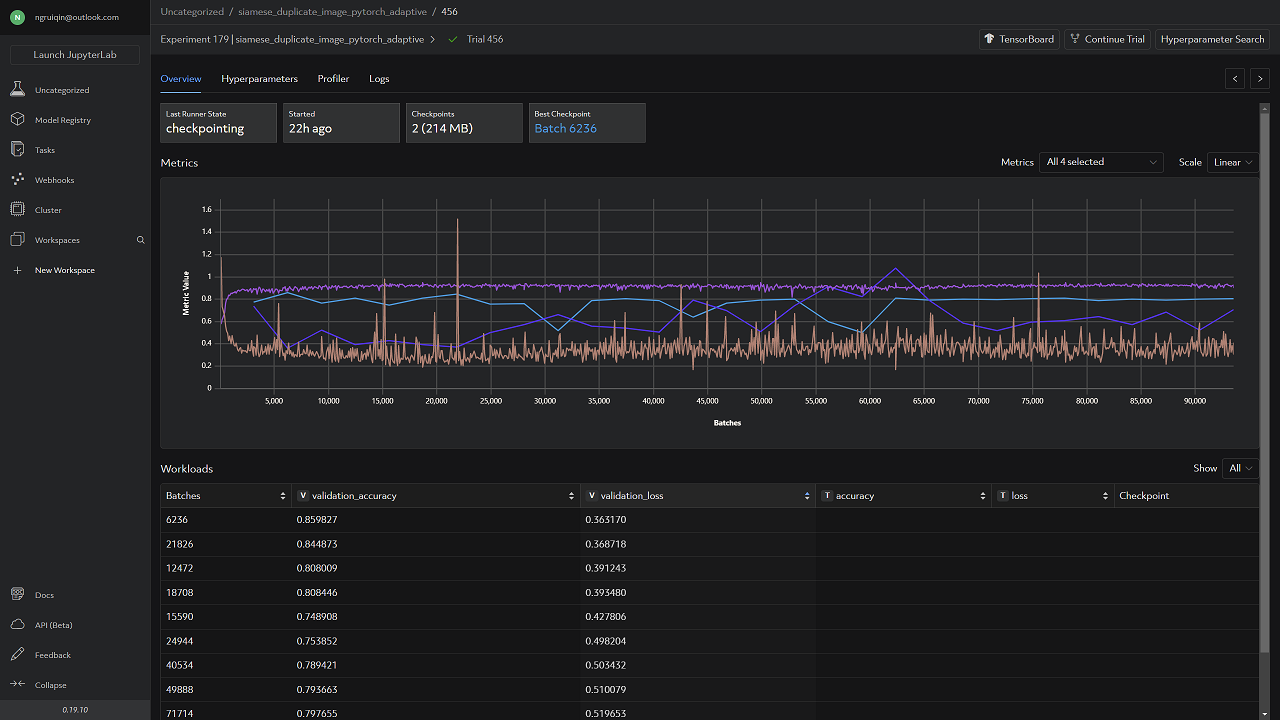
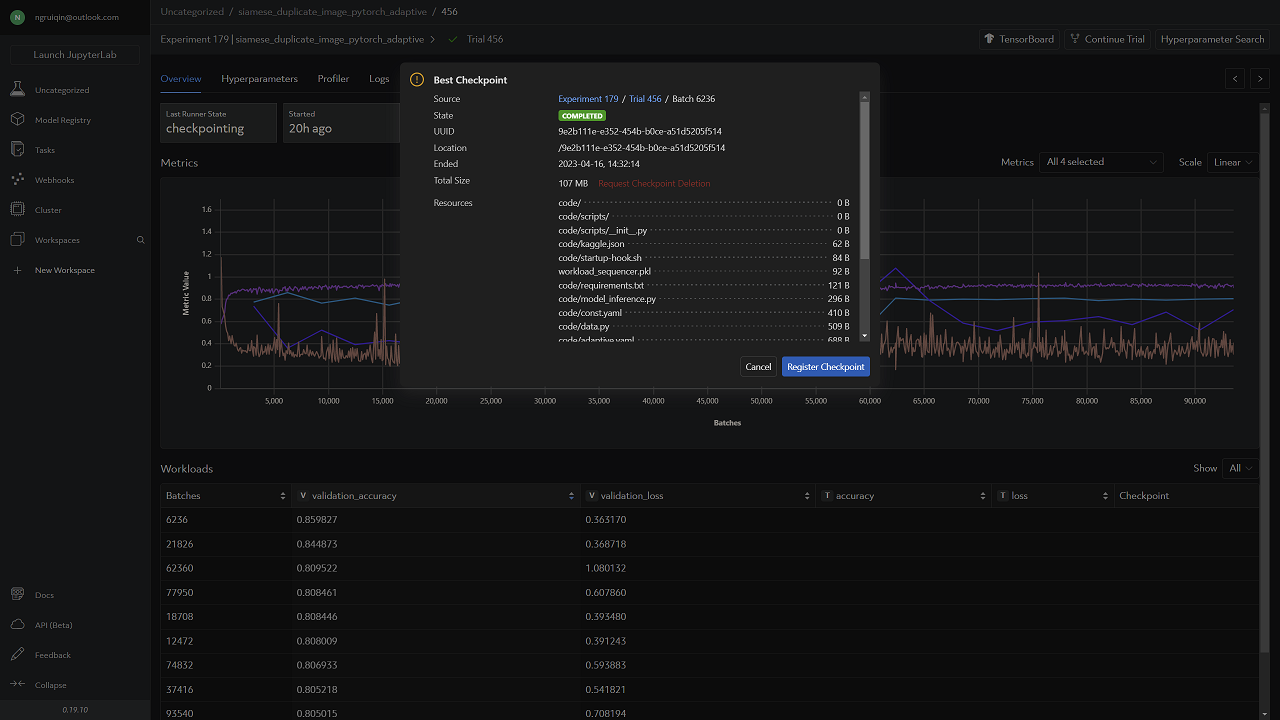
Model with Best Metrics
Evaluation Metrics
The metrics used to evaluate the model are binary cross-entropy loss (using binary_cross_entropy_with_logits) and accuracy calculated from the validation dataset.
The metric used for the searcher to determine the best model is thevalidation_loss (binary cross-entropy loss on the validation dataset).
Evaluation Results
These are the hyperparameters with the that produced the validation_loss of 0.363170 and accuracy of 0.859827:
| hparam | value |
|---|---|
| lr | 0.002061 |
| alpha | 0.926 |
| dropout1 | 0.306 |
| dropout2 | 0.491 |
| dropout3 | 0.562 |
Reproducing Evaluation Results
The evaluation results can be reproduced by loading the model checkpoint files, running the validation dataset through the model, and calculating the binary cross-entropy loss in model_inference.py. The evaluation metrics will likely vary from the aforementioned evaluation results as the dataset is shuffled.
The final model weights can be accessed from https://drive.google.com/file/d/1FhAUlhNjSD_IT85LmyGKPQxiA2Ut2mWD/view?usp=sharing (download and copy the checkpoints folder to the root folder of the repository)
The code used to download the model checkpoint files and for calculating the evaluation metrics can be found in model_download.py and model_inference.py respectively. model_download.py is not required to be run as the checkpoint file can be downloaded in the link above. Before running model_inference.py, ensure that the dataset is downloaded into the data folder and the checkpoints folder is copied to the root folder of the repository.
References
Cherian, 2020. Kaggle API – The Missing Python Documentation: https://technowhisp.com/kaggle-api-python-documentation/
Determined AI, 2023. Prepare Data: https://docs.determined.ai/0.19.10/training/load-model-data.html
Lee, 2021. A Scalable Solution to Detect Duplicate Images: https://medium.com/mlearning-ai/a-scalable-solution-to-detect-duplicate-images-97d431c2726d
Levengood, 2020. Determining how similar two images are with Python + Perceptual Hashing: https://lvngd.com/blog/determining-how-similar-two-images-are-python-perceptual-hashing/
Paul, 2021. Near-duplicate image search: https://keras.io/examples/vision/near_dup_search/
Podolak, 2021. How to Create a Duplicate Image Detection System: https://towardsdatascience.com/how-to-create-a-duplicate-image-detection-system-a30f1b68a2e3
PyTorch, 2022. torchvision.models: https://pytorch.org/vision/0.11/models.html
Sunkaraneni et al., 2019. AirBnB Duplicate Image Dataset: https://www.kaggle.com/datasets/barelydedicated/airbnb-duplicate-image-detection
Built With
- determined-ai
- imagehash
- kaggle
- pytorch
- torchvision


Log in or sign up for Devpost to join the conversation.