-
-
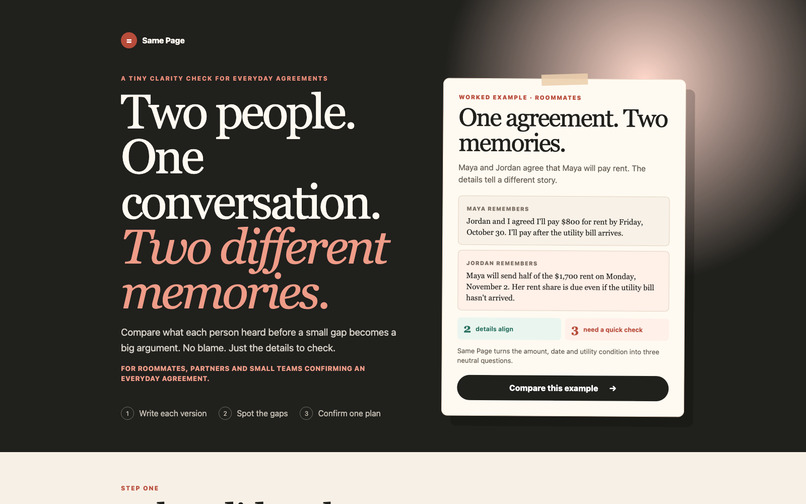
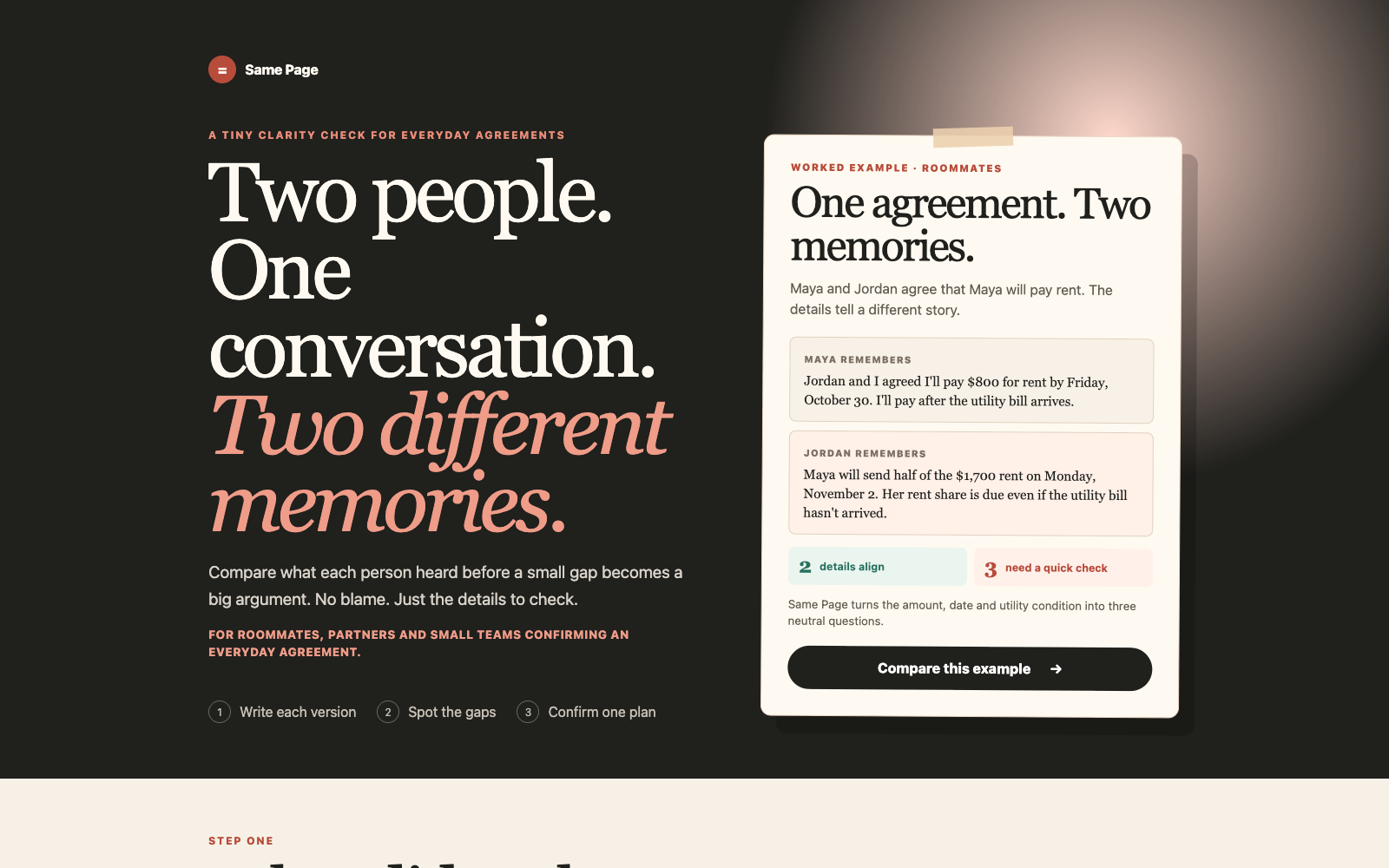
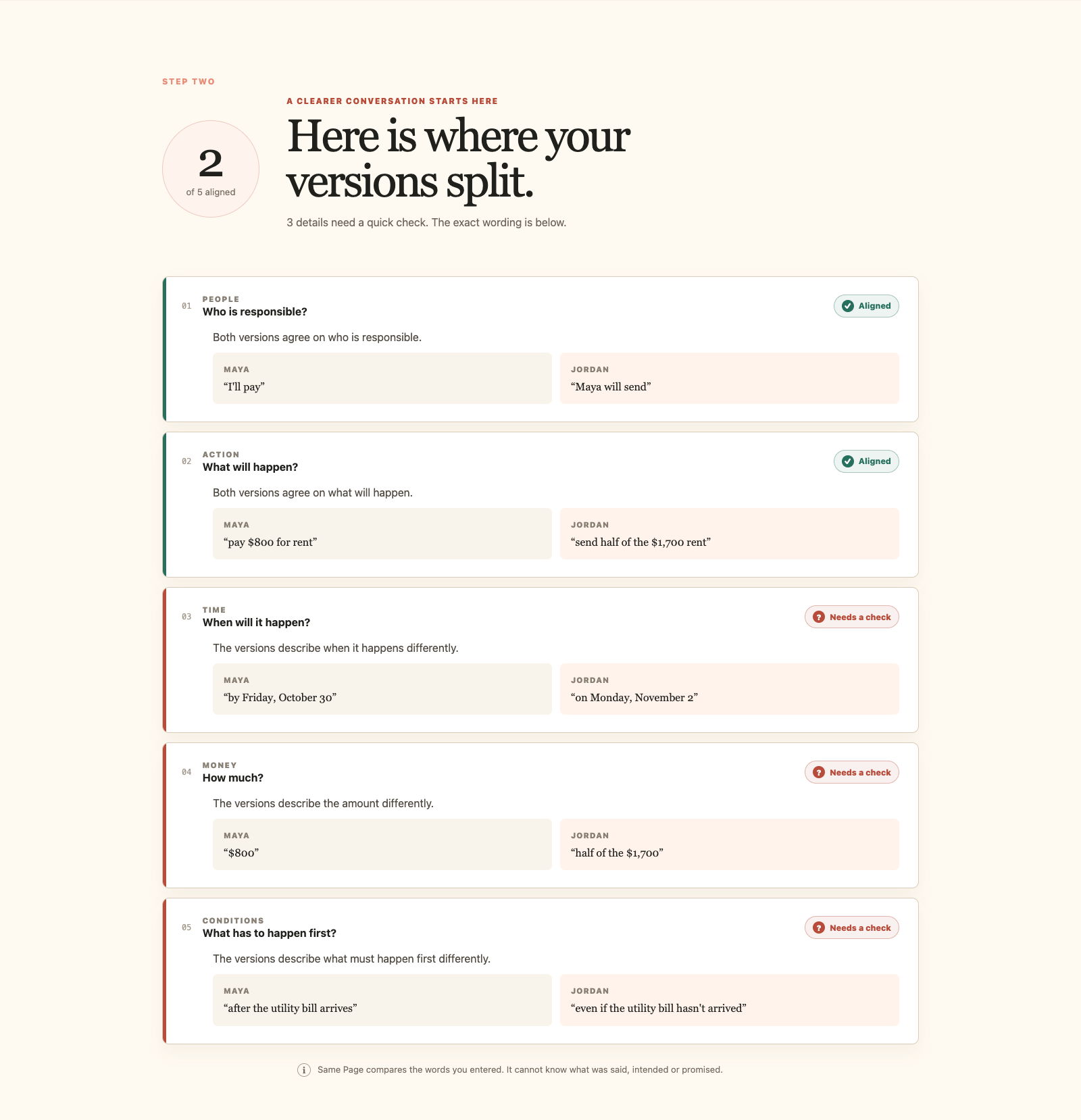
Two memories, one worked roommate example and the expected 2-aligned/3-check result.
-
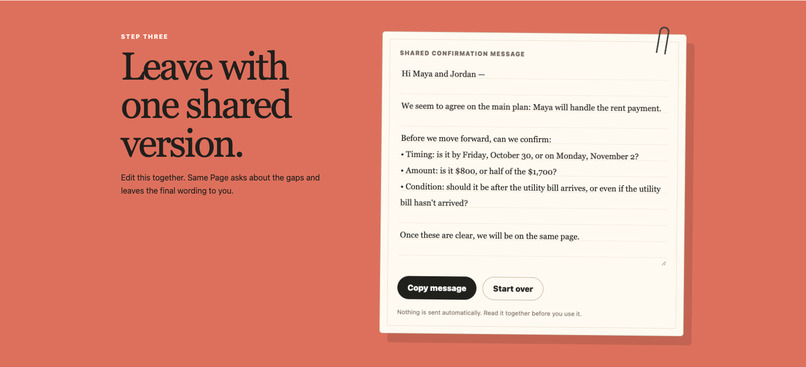
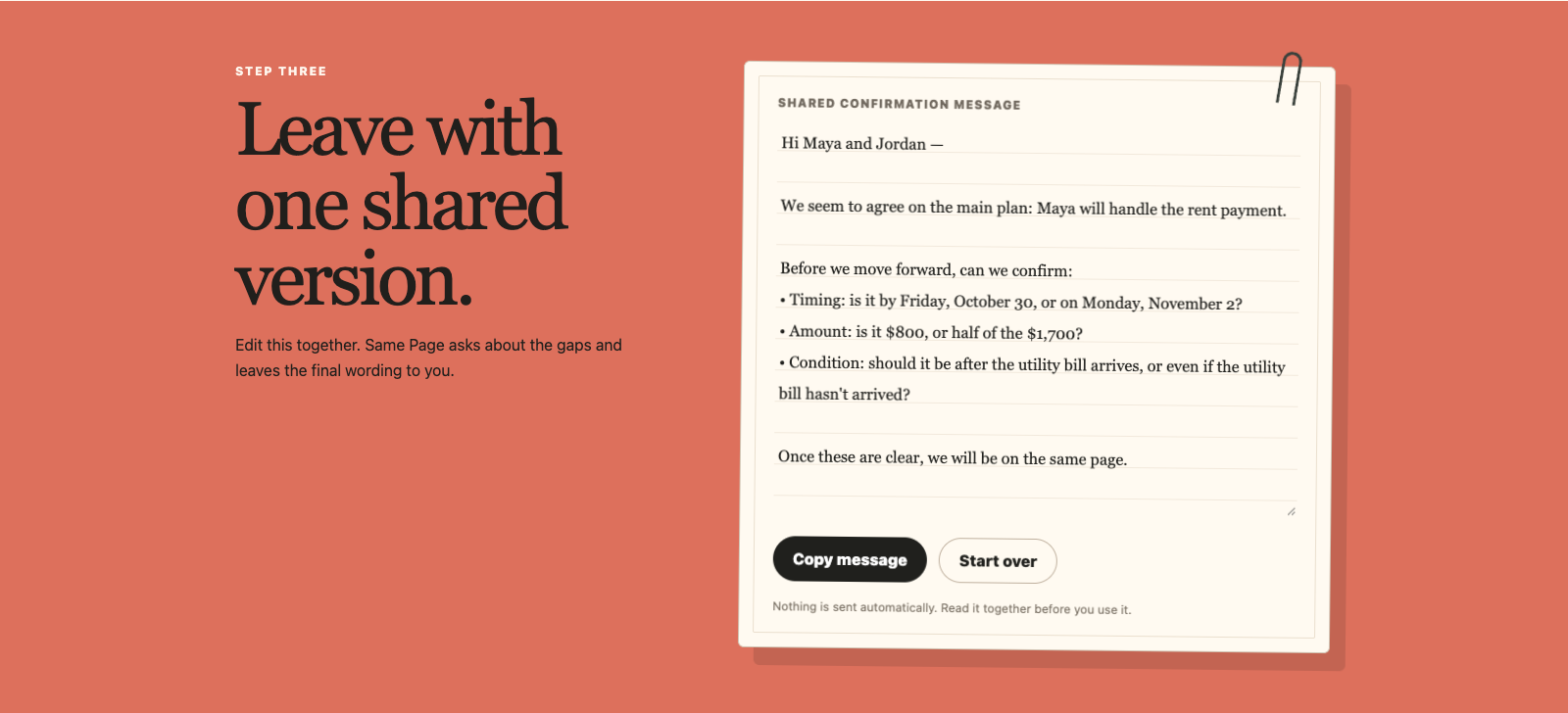
Three gaps become one editable confirmation message. Nothing is sent automatically.
-
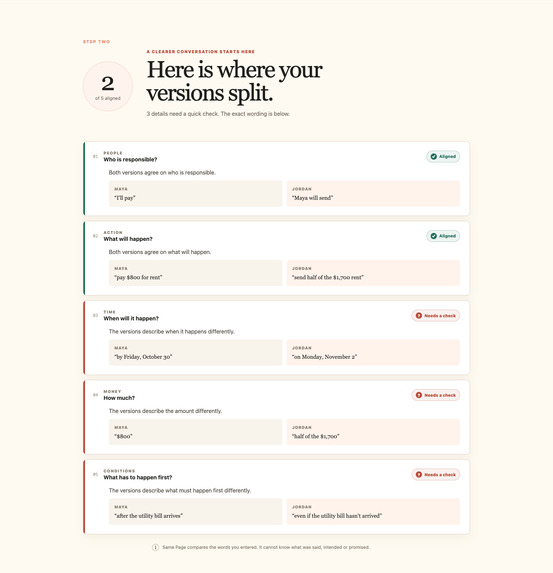
Five evidence-backed checks keep both people's original phrases visible.
Inspiration
Small arguments often start with two people honestly remembering the same conversation differently. One roommate heard "$800 by Friday." The other heard "half the rent on Monday, after the utility bill arrives." A normal summary can hide those gaps. Same Page puts them where both people can see them.
What it does
Each person enters their version of an everyday agreement. Same Page keeps both accounts separate and compares five concrete details: people, action, time, money and conditions.
Every result cites the phrases that caused it. Matches are marked as aligned. Differences become neutral questions. Missing details stay missing. The app never calls either person wrong and never pretends to know what was really said.
The final step turns the open questions into one editable confirmation message. People can change the wording and copy it. Same Page does not send anything for them.
Judge snapshot
- Audience: roommates, partners and small teams confirming an everyday agreement
- Input: 2 independent memories of one conversation
- Comparison: 5 concrete dimensions with source phrases kept beside every verdict
- Worked result: 2 details align and 3 need a quick check
- Automated checks: 5 comparison tests and 3 browser journeys
- Privacy boundary: 0 accounts, 0 servers, 0 API keys and no saved personal text
These are reproducible proof points, not user or adoption claims. Click Compare this example to see the complete path without typing.
Why it matters
Most writing tools merge two accounts into one summary. That can erase the exact disagreement. Same Page does the opposite: it preserves both versions, points to the split and turns each mismatch into a question the people can answer together.
The result is intentionally small. It gets the pair from "I thought we agreed" to a message they can actually confirm.
How we built it
The app uses React, TypeScript and Vite. A local phrase engine follows four inspectable steps:
- Extract evidence for people, action, time, money and conditions.
- Normalize dates and amounts into comparable values.
- Apply fixed aligned, check and missing rules.
- Explain the verdict with phrases from both versions.
Keeping that engine deterministic makes the proof private, fast and testable. It also keeps the claim honest: this version is a conversation aid, not a universal language model or truth detector.
Vitest checks aligned, different, missing and unrecognized details. Playwright checks the audience-first opening, full roommate example and editable reset flow. Remotion assembles the 89-second demo from the real app screens.
How we used the Devpost Learn Skill Pack and Codex
We started with the Learn Skill Pack's flipped-interaction flow. Codex asked about the intended audience, the one memorable product moment and what had to stay outside the first version. Those answers became a learner profile, scope, PRD, technical spec and ordered build checklist before code was written.
Codex then built one checked slice at a time: the two-account comparison, evidence cards and editable shared message. The public repository keeps the planning documents beside the code, plus an app map that connects product decisions to the files that implement them.
Challenges
The hard part was making the result useful without acting like a judge. A vague "these messages differ" warning would not help. A confident verdict would be worse. We kept the original wording visible, limited the comparison to five answerable details and used "Needs a check" instead of blame language.
The second challenge was first-glance clarity. The live page now names the audience and shows both roommate memories, the expected 2/3 result and the primary action before asking a judge to type anything.
Accomplishments
- The roommate example makes two matches and three gaps clear within seconds.
- Every decision points back to evidence from both accounts.
- Text stays in browser memory. There is no account, server or API key.
- Five unit tests, three browser tests and the production build pass.
- The full planning trail and image-capture script are public in the repository.
What we learned
Planning around one visible moment made the project smaller and better. The important feature was not broad text generation. It was the instant shift from two fuzzy paragraphs to five specific checks and one message people can act on.
What's next
A later version could collect each account through a private link, add more agreement templates and use a model that returns validated structured data. The evidence and uncertainty rules would stay: quote the source, admit when a detail is missing and never decide who is telling the truth.
Built With
- codex
- devpost-learn-skill-pack
- playwright
- react
- remotion
- typescript
- vite
- vitest

