-
-
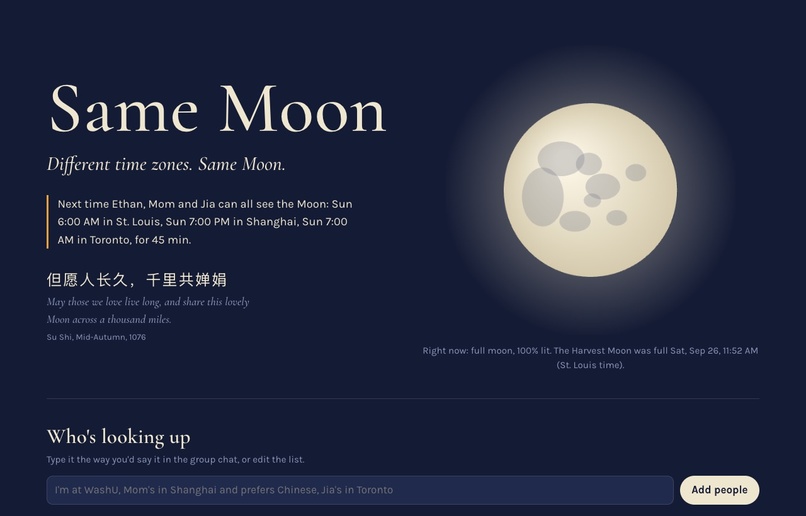
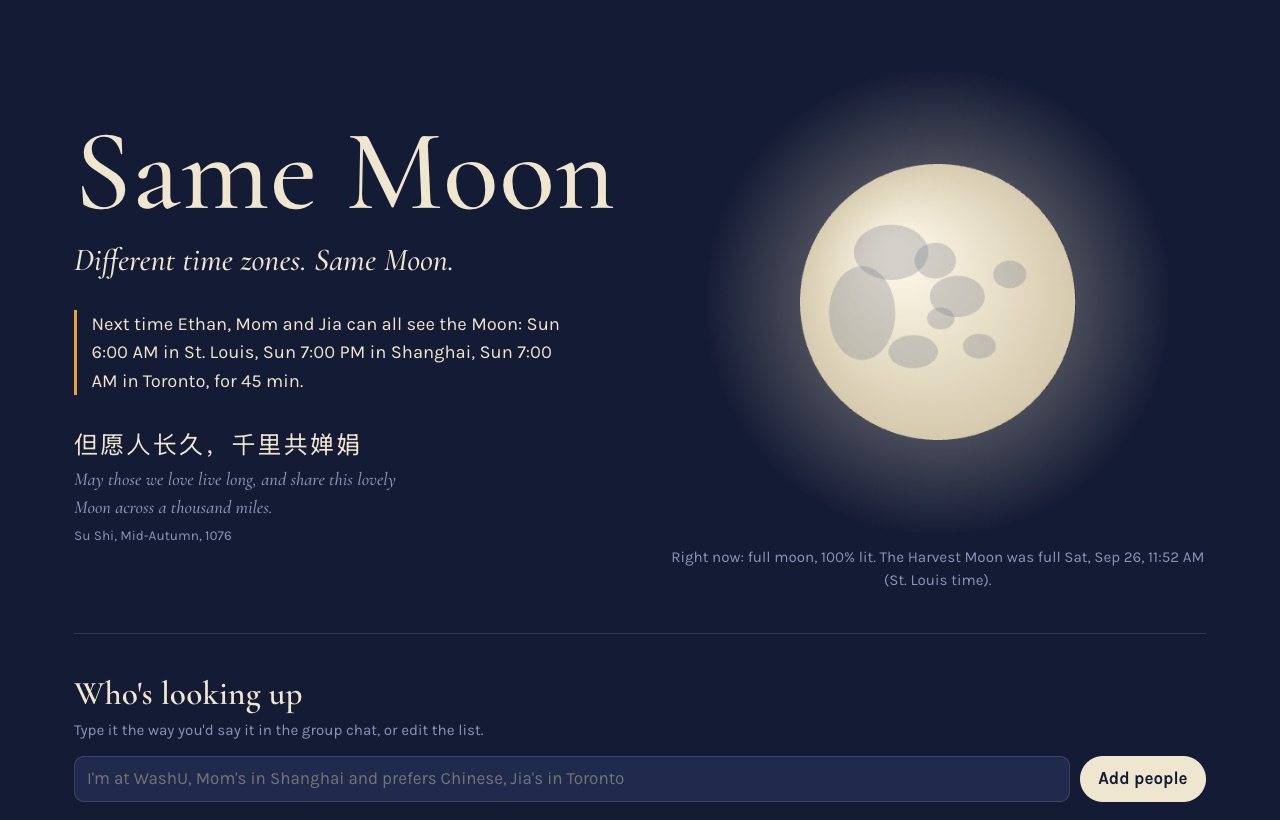
Same Moon web demo: shared viewing windows for a family across time zones.
-
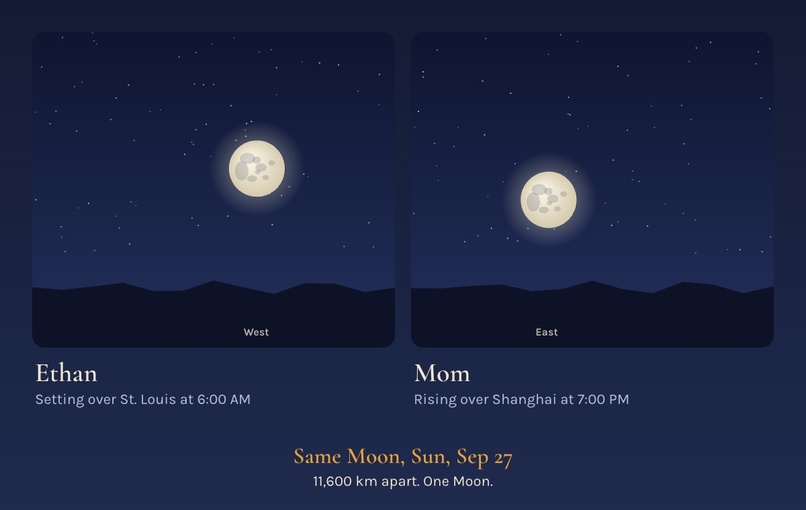
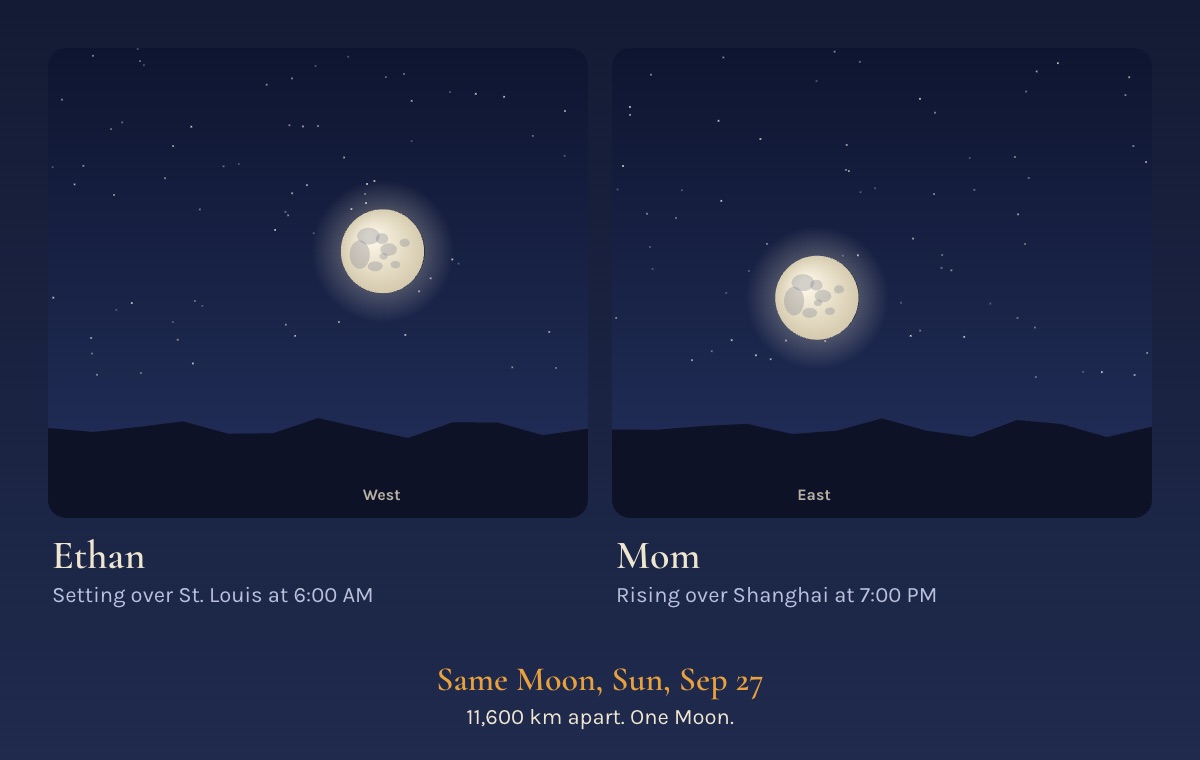
Example shared-Moon postcard in the web demo.
-
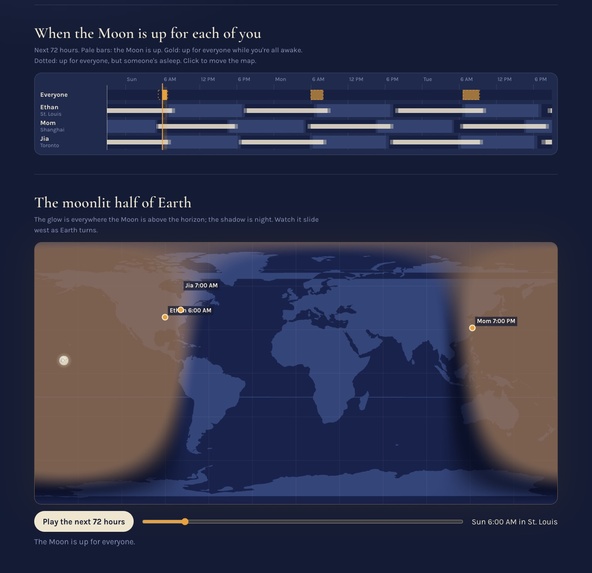
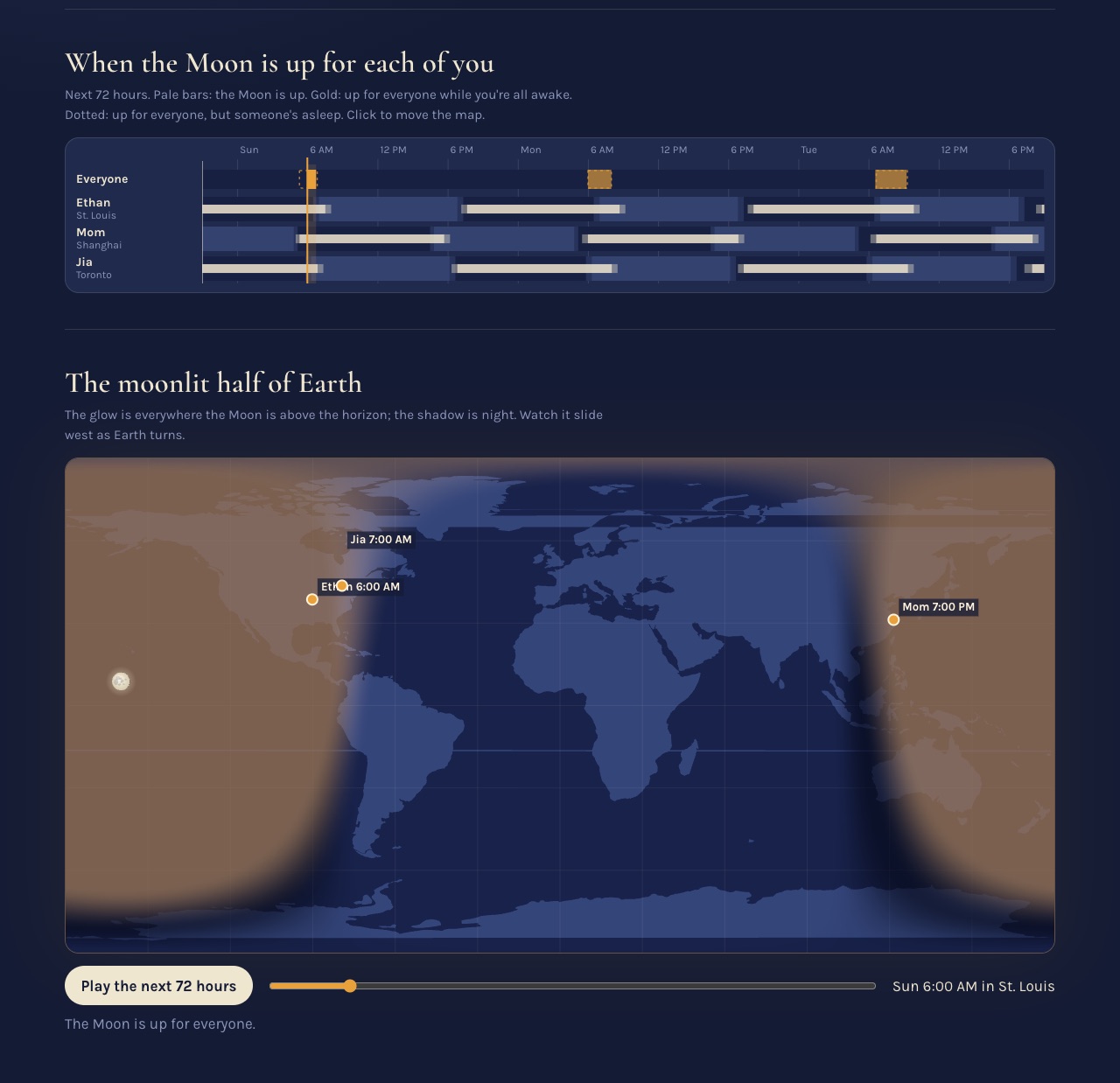
Moon visibility timeline and world map, calculated by the astronomy engine.
-
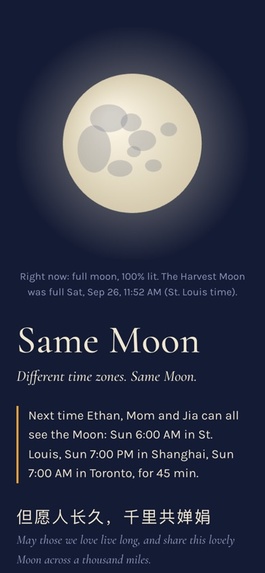
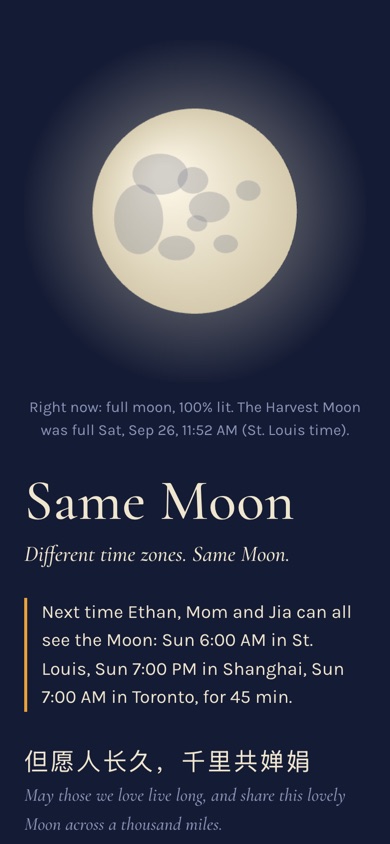
Same Moon web demo on a phone.
Inspiration
The kickoff fell on Mid-Autumn Festival, when families apart comfort themselves that they're looking at the same moon. Su Shi wrote it in 1076: 但愿人长久,千里共婵娟. We checked the physics: often they aren't. For a student in St. Louis and a parent in Shanghai this weekend, the overlap was about two hours: setting at dawn in St. Louis while it rises over dinner in Shanghai.
What it does
- Lives in a family's iMessage group. Someone types it the way they'd say it: "I'm at WashU, Mom's in Shanghai and prefers Chinese, Jia's in Toronto."
- Finds the next times the Moon is up for everyone during waking hours (skipping cloudy ones when online), and offers them as a numbered list and a native poll.
- At that moment, tells each person where to look in their own language (7 languages): which direction, how many fists above the horizon, rising or setting.
- Shares photos live ("that's the same Moon setting in your west right now"), then sends a postcard image made from both photos: names, cities, local times, "11,600 km apart. One Moon."
- Then goes quiet until the next shared Moon. City names only; phone numbers are hashed before anything is stored.
How we built it
- Moon engine: a dependency-free Sun/Moon engine. Moonrise and moonset match six published St. Louis times to within a minute; the full-moon time is within 3 minutes.
- Windows and messages: a shared-window finder plus message templates in 7 languages. Every time, direction and height comes from the engine, never from the model.
- Photon Spectrum (spectrum-ts) for iMessage: we checked our adapter against the SDK's type definitions and tested the whole flow through Spectrum's terminal provider, including two family members sending photos.
- Claude Haiku 4.5 (Anthropic SDK): understands messages our rules can't parse and answers questions from engine facts. A basic numeric consistency check rejects some mismatched clock times, angles and percentages; it does not guarantee that a free-form answer is correct. This layer has been tested with a mocked API, not yet with live Claude calls.
- The postcard: one drawing function shared by the web demo and the agent (@napi-rs/canvas on the server, with iPhone HEIC support).
- Open-Meteo for geocoding and cloud cover; a Canvas web demo with a live moonlit world map.
- 24 automated tests that run with no accounts or API keys.
Challenges we ran into
- Making times trustworthy: viewing instructions come from deterministic engine templates. Free-form AI answers still need stronger validation.
- Getting the Moon's parallax and refraction right.
- Writing natural lines in seven languages.
- iMessage doesn't give bots anyone's name, so the agent has to ask.
Accomplishments that we're proud of
- Moonrise and moonset match published tables to within about a minute.
- The full group-chat flow runs end to end through Photon's terminal provider, from the first message to the postcard image. Real iMessage delivery and a real family run remain untested.
- The web demo works on phones and desktops with zero console errors.
What we learned
- "The same Moon" is rarer than the saying suggests: for St. Louis and Shanghai it's a two-hour window, at dawn for one person and dinner for the other.
- Keeping an AI honest about numbers takes checking, not just prompting.
- Chat platforms hide a lot, like names, so the conversation has to be designed around what the bot can actually know.
What's next for Same Moon
- Pilot with WashU international students on October's Hunter's Moon.
- WhatsApp support.
- Voice calls for grandparents.
- A printed "year of shared Moons" book.

Log in or sign up for Devpost to join the conversation.