-
-
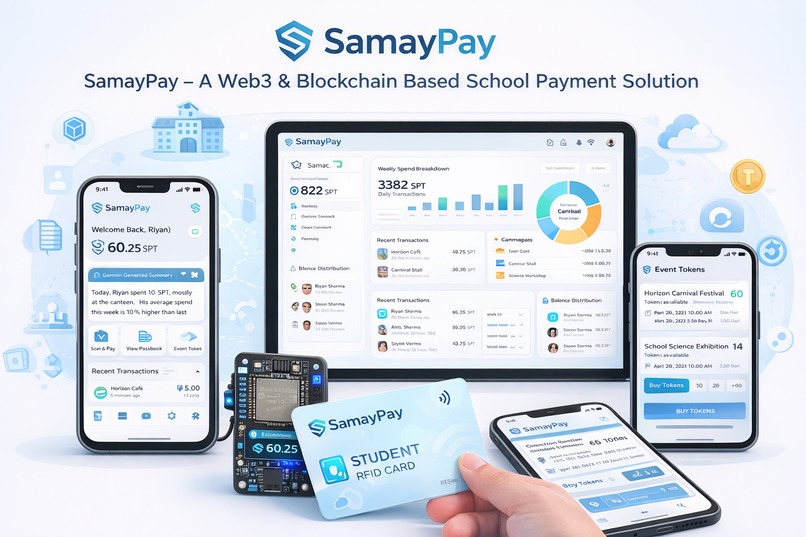
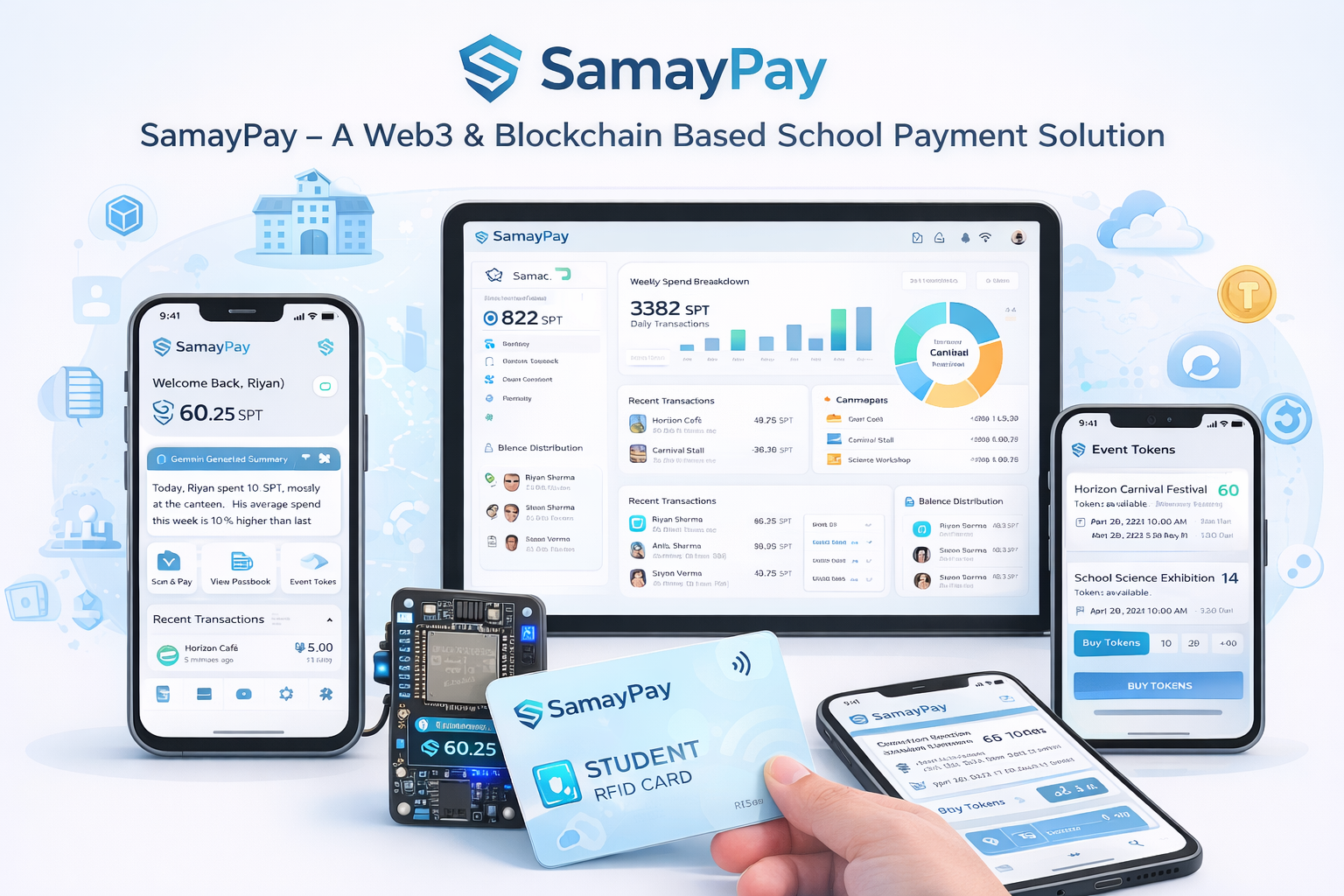
SamayPay system overview showing student, parent, and vendor dashboards with RFID-based Web3 payments and event tokens
Inspiration
Our inspiration came from observing how schools still depend heavily on cash for daily transactions such as canteen purchases, stationery payments, and school events. During cultural programs, sports days, and music events, we noticed recurring issues like cash mismanagement, counterfeit coupons, lack of transparency, and difficult post-event reconciliation.
Parents also have no real-time visibility into student spending, and schools rely on centralized systems that offer limited trust and accountability. This inspired us to explore how Web3, blockchain, and AI could create a transparent, secure, and intelligent alternative tailored specifically for educational ecosystems.
What It Does
SamayPay is a Web3-based cashless payment and event ecosystem for schools.
Enables RFID-based contactless payments for students
Stores all transactions on a blockchain ledger for immutability and trust
Provides real-time dashboards for students, parents, and vendors
Allows parents to define spending limits and receive instant alerts
Supports event-specific tokens for school fests, workshops, sports days, and music programs
Uses Gemini-powered intelligence to analyze spending and generate insights
How We Built It
SamayPay integrates cloud, blockchain, hardware, and AI technologies:
Frontend: Flutter (cross-platform mobile app)
Backend: Firebase (Authentication, Firestore, Cloud Functions, Notifications)
Blockchain Layer: Solana Smart Contracts
Hardware: ESP32 with RFID
AI Layer: Gemini for analytics and natural-language insights
System Flow RFID Tap → Backend Validation → Smart Contract Execution → Blockchain Ledger → Dashboard Update RFID Tap→Backend Validation→Smart Contract Execution→Blockchain Ledger→Dashboard Update
Parents can define a monthly spending limit:
$$ S_{\text{monthly}} \le L_{\text{parent}} $$
Transactions are approved only if:
$$ \text{Balance}{\text{student}} \ge \text{Amount} \;\land\; S{\text{current}} + \text{Amount} \le L_{\text{parent}} $$
Challenges We Ran Into
One major challenge was ensuring real-time user experience while using blockchain, which is inherently asynchronous. We optimized this by separating UI confirmation from on-chain settlement.
Another challenge was converting raw transaction data into meaningful insights. Parents do not want complex charts, so we used Gemini to transform analytics into simple natural-language summaries.
Hardware integration with ESP32 and RFID also required careful synchronization with backend and blockchain layers.
Accomplishments That We're Proud Of
Built an end-to-end Web3 system, not just a prototype
Successfully integrated RFID hardware, cloud backend, blockchain, and AI
Designed event-specific tokenization, extending beyond daily payments
Created a solution that balances innovation with real-world feasibility
What We Learned
This project helped us learn:
How to design scalable Web3 architectures
How AI (Gemini) can convert blockchain data into actionable insights
The importance of role-based access control in financial systems
How to collaborate efficiently under hackathon time constraints
We learned that intelligence + transparency matter more than simple digitization.
What’s Next for SamayPay
Next, we plan to:
Pilot SamayPay in real schools
Expand event tokens for large-scale school and campus events
Add sign-in, attendance, and access control systems Gemini is used for predictive analytics such as estimating event budgets.
$$ E_{\text{event}} = \frac{1}{n} \sum_{i=1}^{n} E_i $$
This helps schools plan token distribution and spending limits based on historical event data.
Scale the platform to colleges, hostels, and multi-campus institutions
Our long-term vision is to build a Web3-powered digital ecosystem for education, not just a payment platform.
Built With
- cloud-functions
- esp32
- fcm)
- firebase-(auth
- firestore
- flutter
- google-gemini-api
- rfid
- smart-contracts
- solana-blockchain


Log in or sign up for Devpost to join the conversation.