-
Logo
-
Web App Frontend

Inspiration
Have you ever seen those clothing donation bins in parking lots outside your local grocery store or shopping mall? Have you ever wondered where all that clothing goes once donated? It goes to massive sorting warehouses where people pick through the bins and decide if the clothing is good enough to be given to those in need or sold in a thrift store. There are currently over 2000 not for profit thrift stores in the united states who generate over 5.36 billion in sales every year; 1200 of those thrift shops are owned and operated by the salvation army. The proceeds from those stores fund the largest free alcohol and drug rehabilitation program in the united states which helps over 216,000 people every year. In Canada, in 110 years of operation, the salvation army has kept over 80 million pounds of clothing and textiles out of landfills, saving our planet and those who share it. Today we offer a solution to dramatically increase the efficiency of those sorting warehouses, thereby keeping our earth clean and increasing the profits that fund these life-saving programs.
What It Does
Salvation Sorter is a machine learning algorithm that is trained to recognize the difference between clothing that can be sold and clothing that has been damaged. Previously in a sorting warehouse, people would have to manually pick clothing from large bins and sort it into bins of reusable and soiled clothing. This program is the first step toward a system that does exactly what people used to do in a manner that’s faster and cheaper, which reduces warehouse overhead and increases profit margins. Salvation Sorter would be part of a converger system that categorizes clothing and puts into its respective bins. The algorithm itself takes input from a camera and compares it to its database to decide where the clothing belongs.
How We Built It
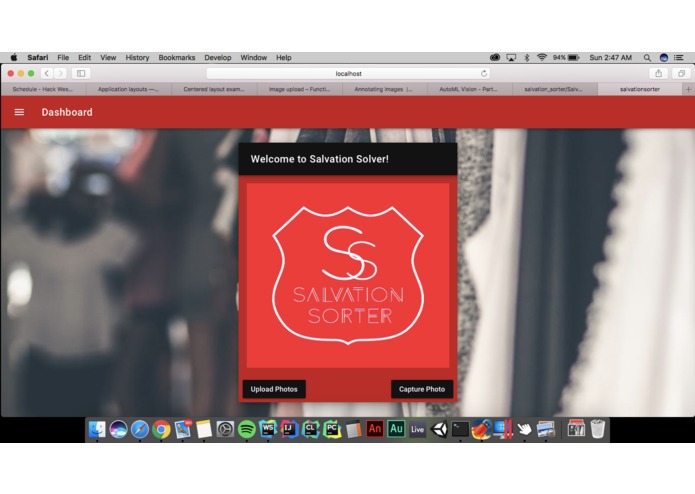
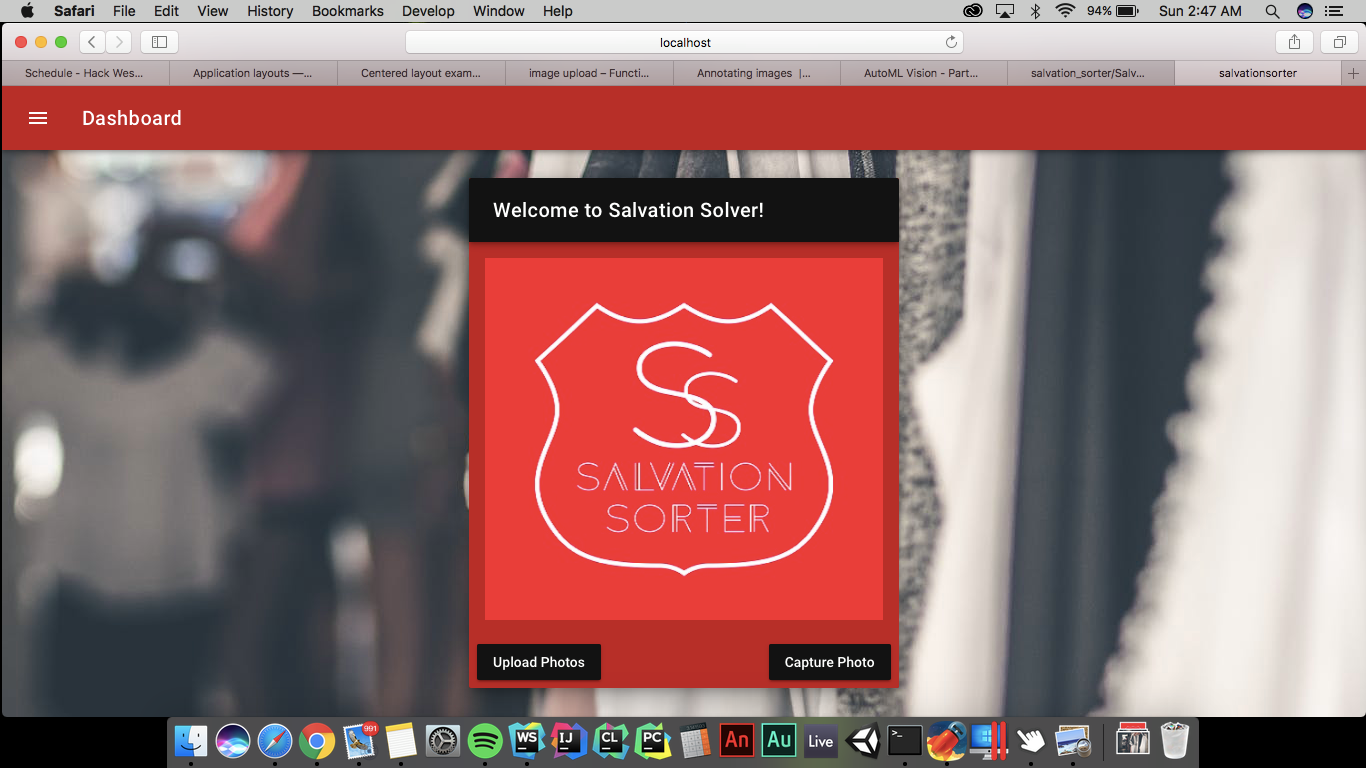
We used the Google Cloud Platform Auto Machine Learning Vision Studio to train a multiclassification machine learning algorithm to determine the category that clothing will fall into based on the tags given when uploaded. The categories we had were damaged, non-damaged, and denim. We included denim as a category to make sure that the vision algorithm will account for ripped jeans as a sellable clothing item. Further to that for demonstration purposes, we built a web application hosted on link so that anyone can take a picture of clothing and it will tell you if its viable for sale or not.
Challenges We ran Into
Trying to implement google API and understanding googles documentation. We tried to implement the Google API but it failed due to post request errors and google authentication errors.
Accomplishments that We Are Proud Of
Coming into this competition half our team were first-time hackers and coming out of it we feel like we learned so much. None of us had any experience with machine learning and we were able to create a functioning product we can be proud to attach our names to.
What's Next For Salvation Sorter
The future for salvation sorter is more recognition categories. What we mean by that is not only sorting clothing by its viability for sale but also into other categories such as long sleeves, t-shirts, pants, colors, and styles. Having these extra classes will allow for more accurate distribution of inventory to stores that need it. Further to that this project has unlimited possibilities in the retail clothing industry.
Built With
- automl-computer-vision-api
- computer-vision
- css3
- google-cloud
- html5
- javascript
- machine-learning
- python
- vue.js


Log in or sign up for Devpost to join the conversation.