Inspiration
The idea came from watching people get overwhelmed in high-pressure sales situations, especially older adults, first-time buyers, and anyone who doesn't know what questions to ask in the moment. A confusing car loan, a hidden fee buried in the paperwork, a warranty upsell that sounds mandatory: these things have real financial consequences. We wanted to build something that could sit beside the buyer and quietly have their back.
What it does
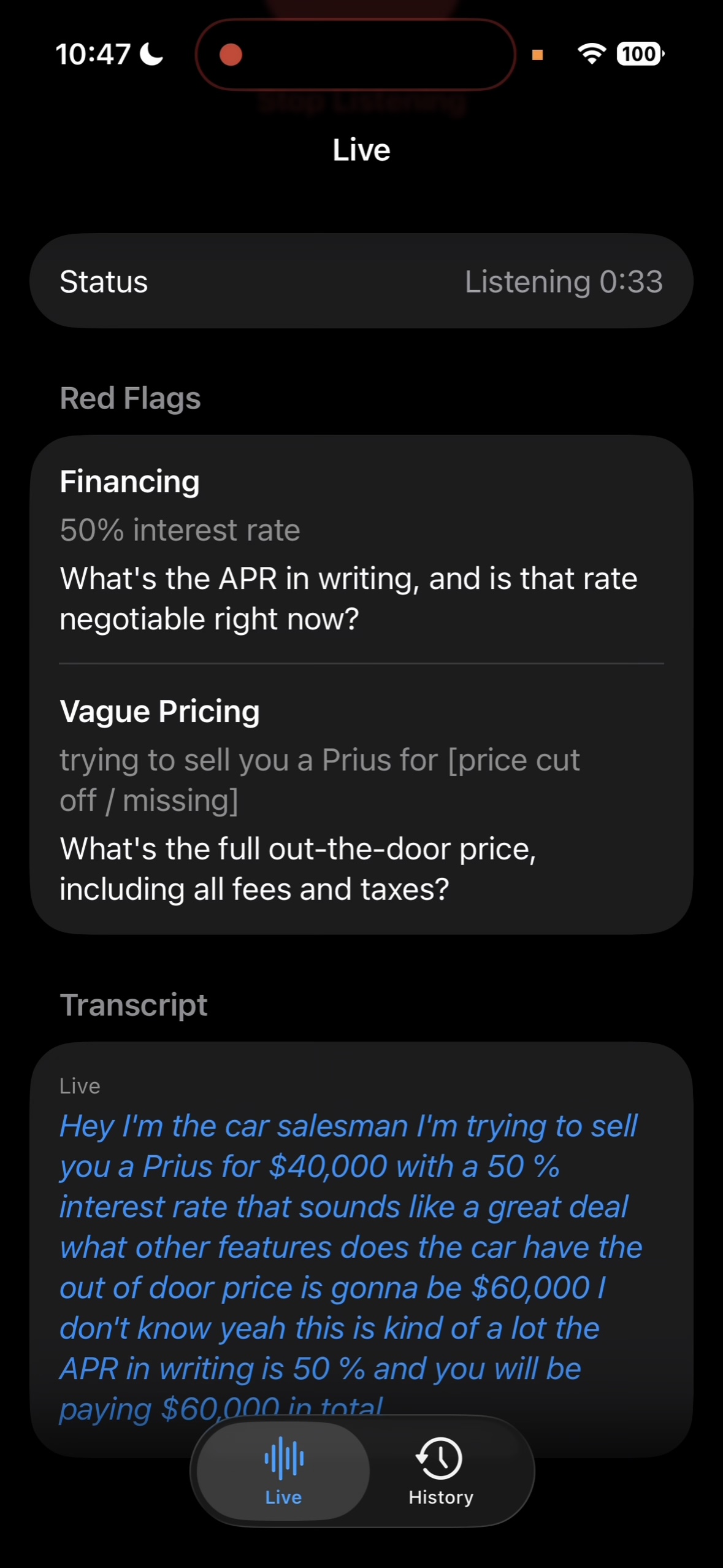
SalesGuard listens during a live sales conversation and watches for the kinds of things that tend to trip people up: vague pricing, hidden fees, confusing financing terms, warranty ambiguity, and "sign today" pressure. When it catches something worth flagging, it speaks a short, calm reminder out loud, like asking about the APR, confirming the total repayment, or checking whether that add-on is actually optional. After the conversation, it puts together a plain-language summary with the key terms, any risks worth knowing about, and suggested follow-up questions. The goal isn't to replace the buyer's judgment. It's to give them a second set of ears when things get stressful.
How we built it
We built a native iOS app in SwiftUI with live speech recognition and audio playback. The backend runs on FastAPI with PostgreSQL for storing sessions, transcripts, alerts, and conversation history. Live transcript snippets stream over WebSockets for mid-conversation analysis. Claude handles real-time risk detection. ElevenLabs handles the spoken alerts. Gemini powers the embeddings and history search, with pgvector for semantic recall. Users can also revisit past sessions and summaries through a built-in history view.
Challenges we ran into
The hardest part was making the assistant genuinely helpful without making it annoying. Early versions fired too many alerts, repeated themselves, or spoke in a way that felt intrusive. We spent a lot of time tuning the prompts, tracking what had already been said, suppressing redundant alerts, and figuring out the right threshold for when to actually speak up. Beyond the AI behavior, we also worked through a lot of real-world engineering: mobile networking, iOS speech permissions, backend tunneling, WebSocket reliability, and voice playback latency. Getting the live experience to feel smooth took longer than we expected.
Accomplishments that we're proud of
Most consumer AI tools work after the fact. You upload a document, you get a summary. SalesGuard works in the moment. It listens, detects risk, speaks out loud, avoids repeating itself, and builds a record of the conversation in real time. Getting all of that to work together in a live loop felt like a real accomplishment. We're also proud of what it's actually for. It was designed specifically around protecting people who might be vulnerable to financial pressure, confusing contracts, or predatory tactics, people who could genuinely use a calm and knowledgeable voice in the room.
What we learned
Real-time AI products are as much about restraint as intelligence. Knowing when to stay quiet is just as important as knowing what to say. We also learned that prompt design, product behavior, and interface design have to work together. If any one of those is off, the whole thing starts to feel untrustworthy.
What's next for SalesGuard
We want to expand beyond car dealerships into phone scams, medical billing calls, insurance sales, and rental agreements. We're also planning to add trusted contact sharing, stronger scam pattern detection, multilingual support, and an accessibility-first mode built specifically for older adults. Long term, the vision is a personal consumer protection companion that helps people make safer decisions whenever a conversation gets stressful or high-stakes.
Built With
- alembic
- claude-api
- cloudflare
- docker
- elevenlabs-api
- fastapi
- gemini-api
- ios-speech-framework
- pgvector
- postgresql
- python
- sqlalchemy
- swiftui
- websockets

Log in or sign up for Devpost to join the conversation.