-
-
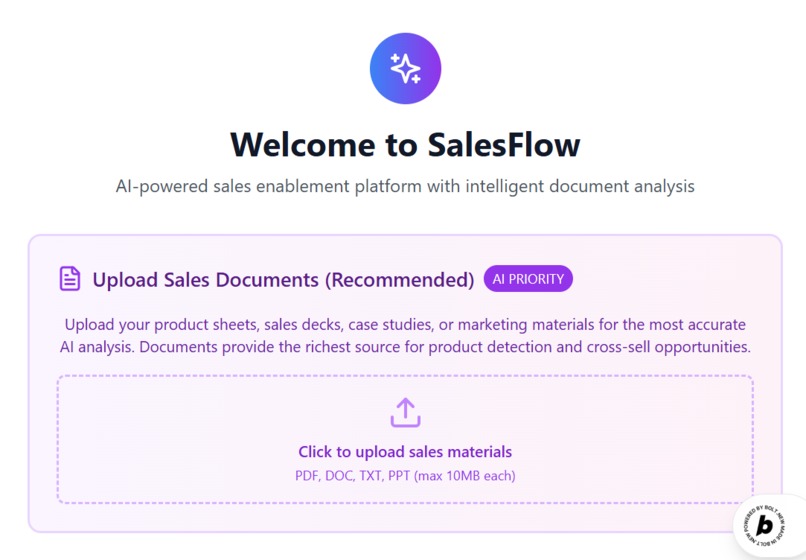
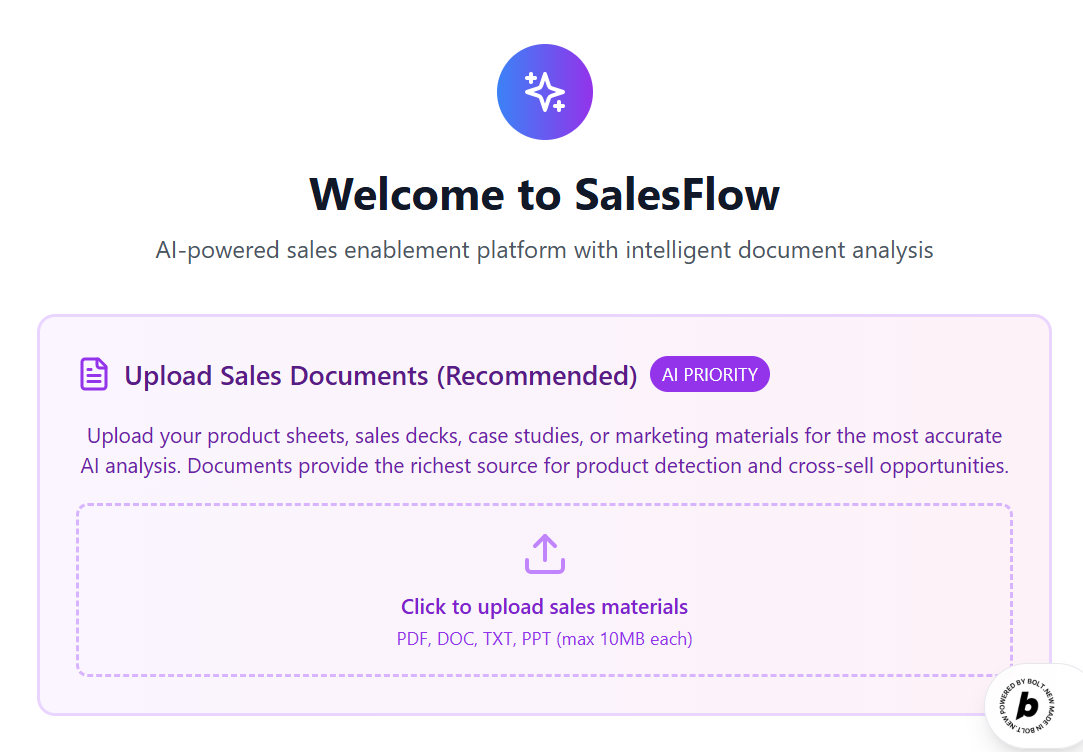
Introduction and onboarding screen
-
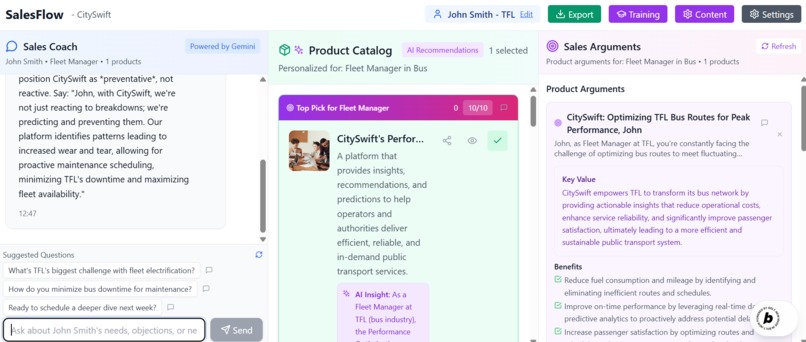
Salesflow in action!

Inspiration
Sales teams in B2B companies face a common problem: siloed knowledge, inconsistent messaging, slow onboarding, and missed upsell opportunities. As someone who's seen the gap between what salespeople need and what tools actually deliver, I was inspired to create something smarter. I wanted to build a tool that doesn't just store information, but helps use it — guiding conversations, aligning messaging, and surfacing the right product at the right time, especially for new or cross-functional reps.
What it does
SalesFlow is an AI-powered sales enablement tool built for B2B organisations. It helps salespeople:
- Understand who they're speaking to and what to recommend
- View interactive product and service information
- Get real-time, tailored sales argumentation
- Identify and present upsell and cross-sell opportunities
- Generate brochures or summaries based on the conversation
Behind the scenes, SalesFlow uses AI to pull structured content from a company’s website and uploaded materials. It builds a content management system (CMS) of products, personas, and industries — intelligently linking them. A training mode allows experienced sales reps to improve recommendations over time, without manual input or complex admin.
How we built it
The tool was built entirely in Bolt.new, using a structured, component-based approach. The process started with an onboarding flow that pulls in a website URL and optional documents. This is analysed by an AI API to extract product information, target industries, and personas. The CMS was then designed to make these editable and linkable — with the AI handling most of the initial organisation.
The user interface was built in three parts:
- Left panel: Real-time AI chat assistant with contextual prompts
- Middle panel: Interactive visual browser for products/services
- Right panel: AI-generated sales argumentation, including space to note interest or questions
The system saves information locally for the MVP
Challenges we ran into
The biggest challenge was working with the AI API. I assumed it would be plug-and-play, but quickly realised I needed to:
- Learn how to use an API, get keys etc.
- Handle authentication properly
- Manage rate limits and usage quotas
- Optimise when and how calls were made to avoid maxing out my allocation
Another major learning curve was prompt engineering. I had to iterate constantly to get useful, structured outputs from the AI. Bolt.new itself is very flexible, but only if you’re disciplined — trying to build everything at once just caused confusion and errors. I learned to work iteratively, build flows first, test them, then move onto the interface.
Accomplishments
- Built a functional AI-integrated tool in a no-code platform from scratch
- Created an intelligent CMS that learns over time, not just stores data
- Designed a usable interface that mirrors real sales conversations
- Learned how to manage AI prompts and APIs efficiently
- Turned a broad idea into a structured, working MVP
What we learned
- Specs are everything: You can’t build with AI unless you define the problem clearly
- AI isn’t magic: You need to work with it — from prompt design to usage management
- Prompt engineering is a craft: Small changes made big improvements
- No-code doesn’t mean no planning: Bolt.new rewards structured thinking and test-driven workflows
What's next for SalesFlow – Sales Enablement Tool
- Integrating with CRM/email tools to make SalesFlow a true part of the daily sales workflow
- Refining the AI further to personalise sales recommendations by deal stage or persona profile
- Moving from local-only to cloud-based multi-user support
Built With
- bolt.new
- gemini

Log in or sign up for Devpost to join the conversation.