-
-
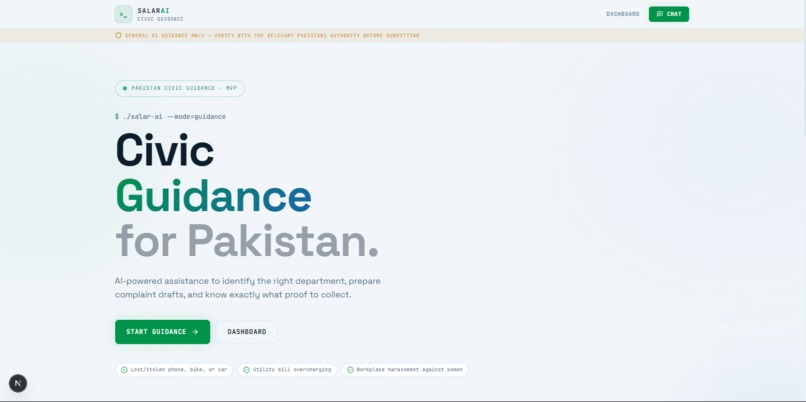
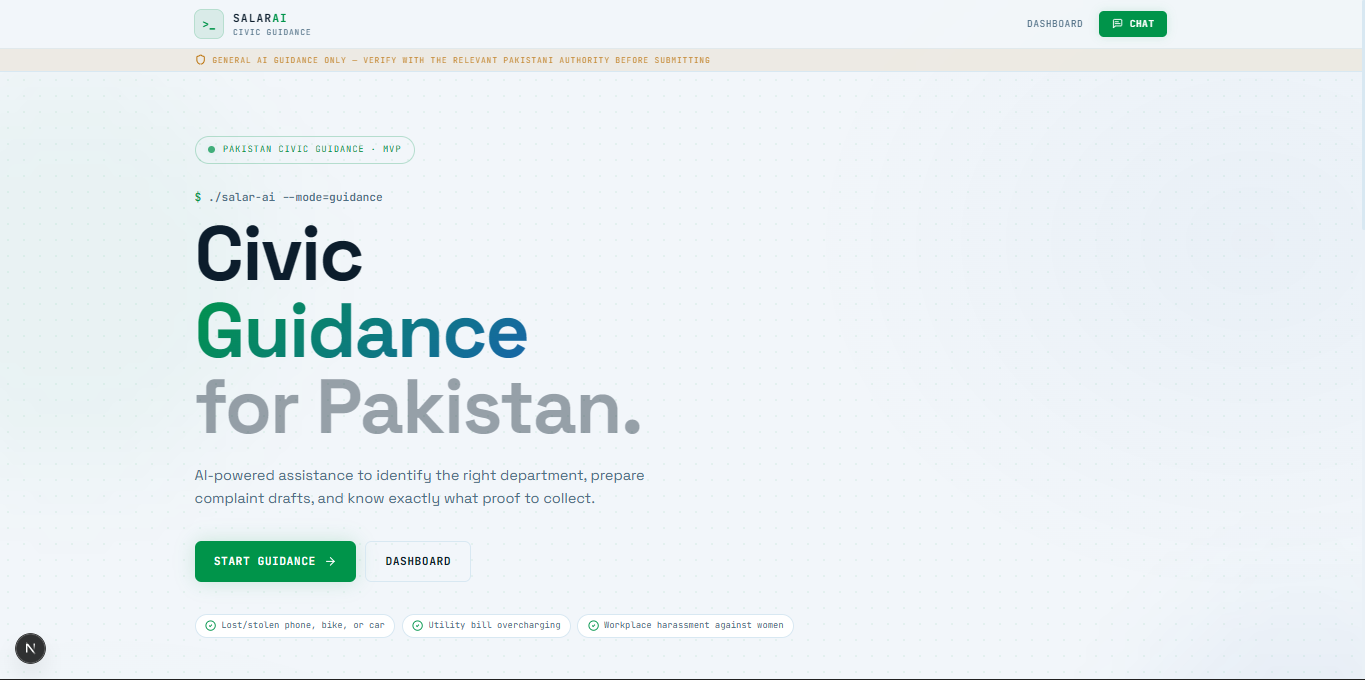
landing-page
-
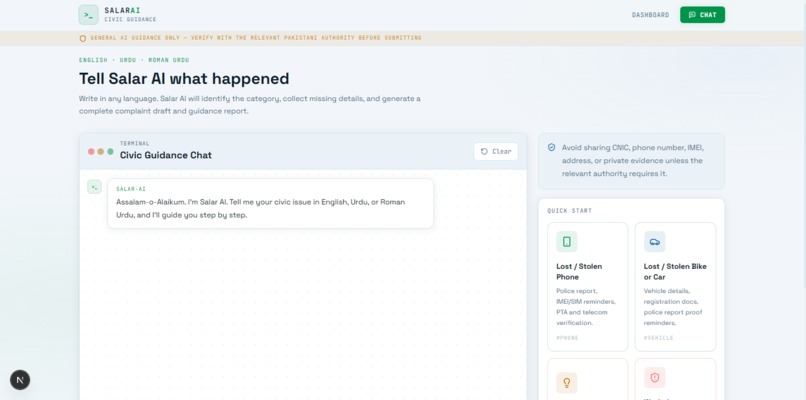
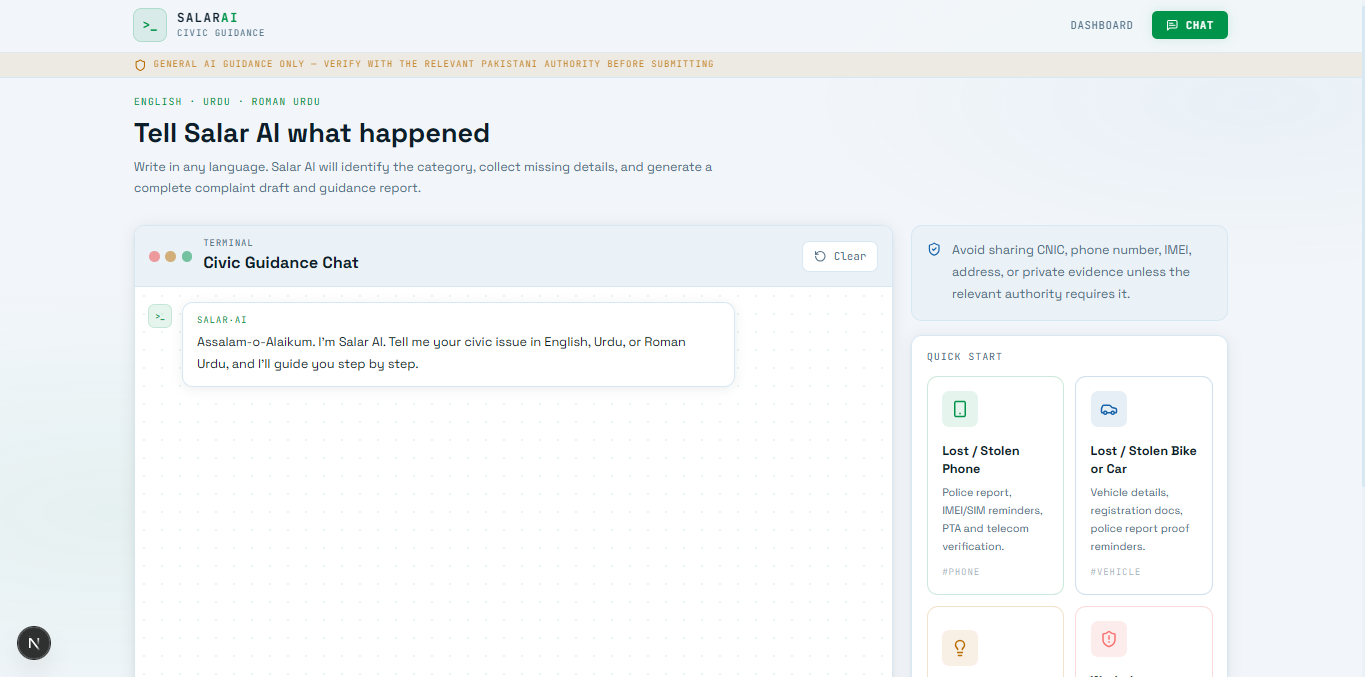
chat
-
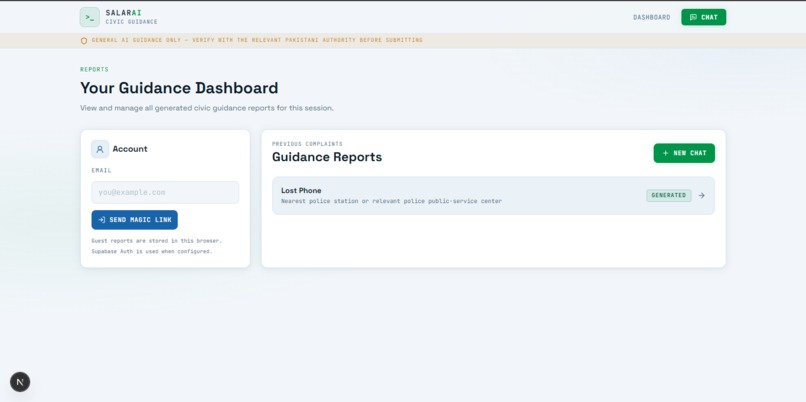
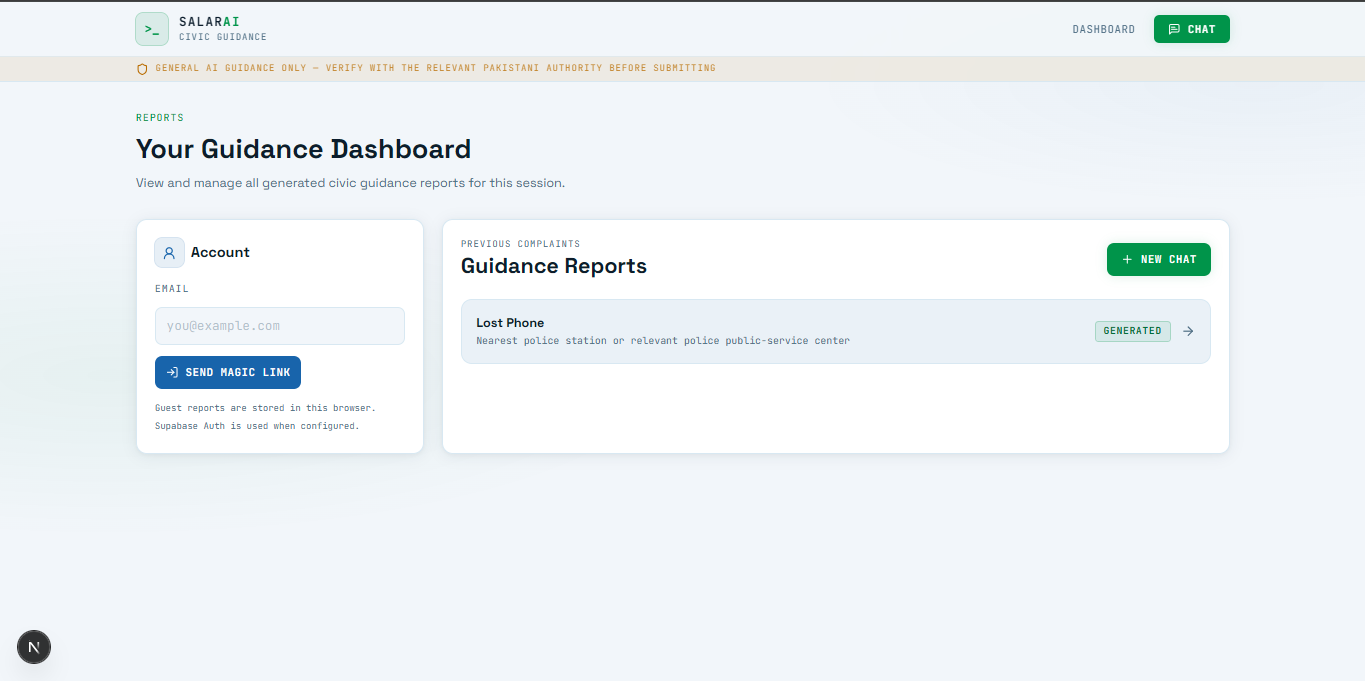
dashboard
-
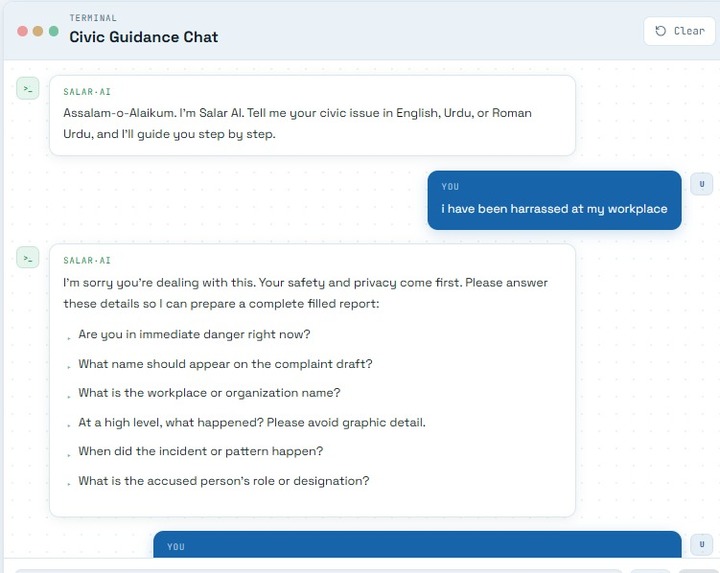
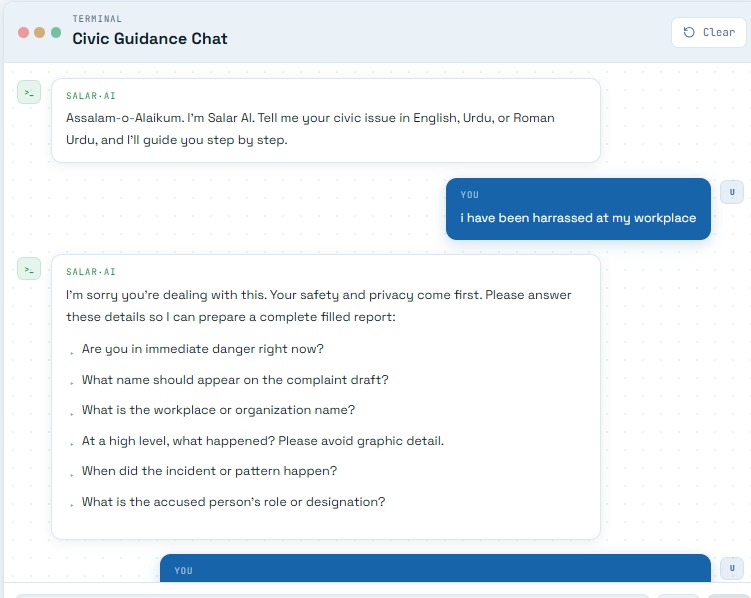
MVP3 (workplace-harassment) - AI response 1
-
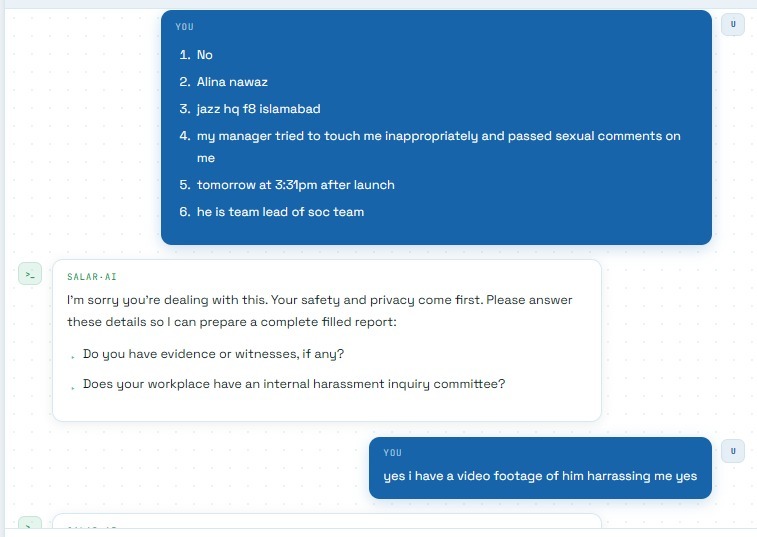
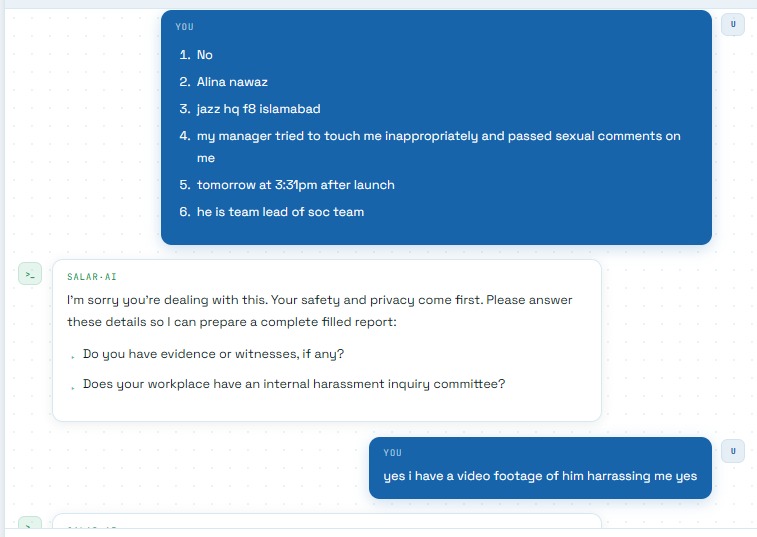
MVP3 (workplace-harassment) - AI response 2
-
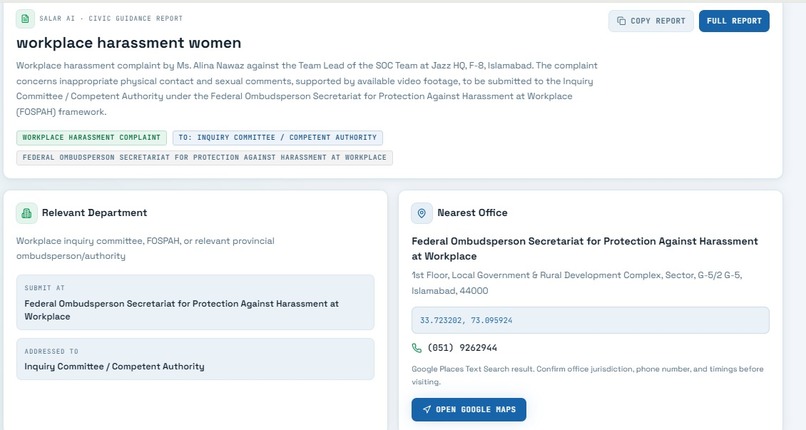
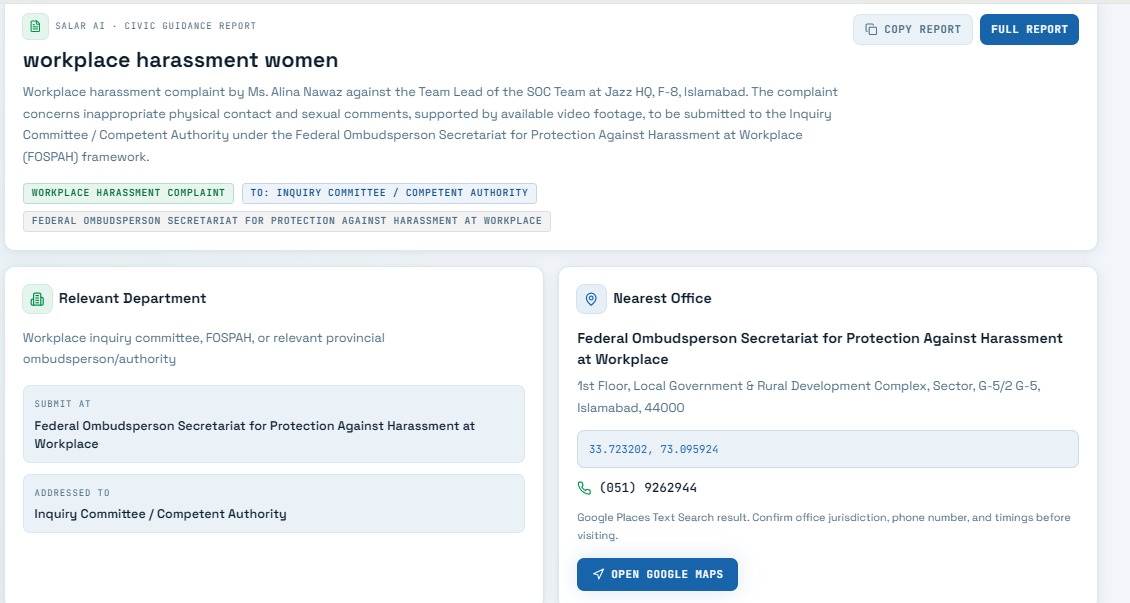
MVP3 (workplace-harassment)- Generated detailed response
-
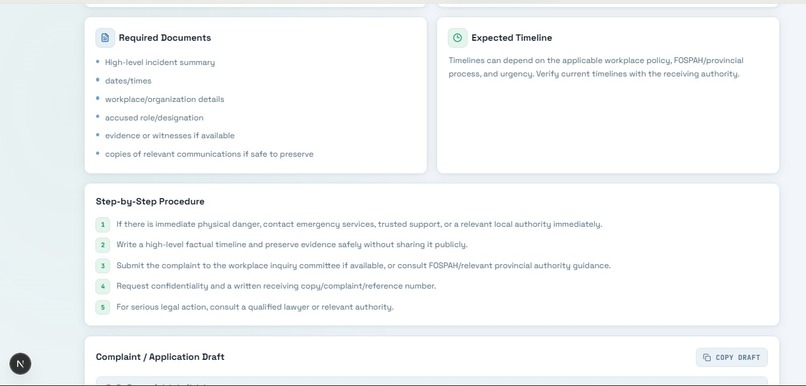
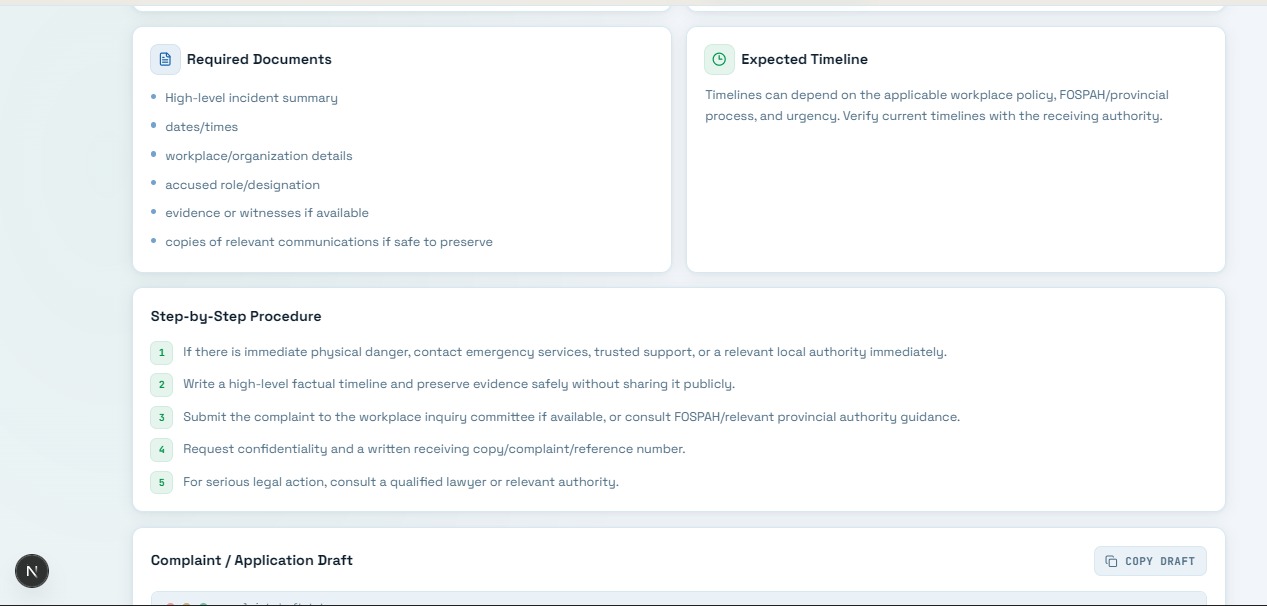
MVP3 (workplace-harassment) - List Required documents and expected-timeline
-
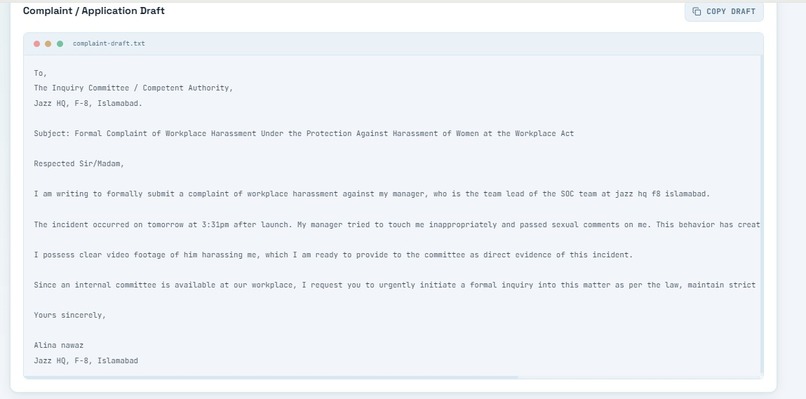
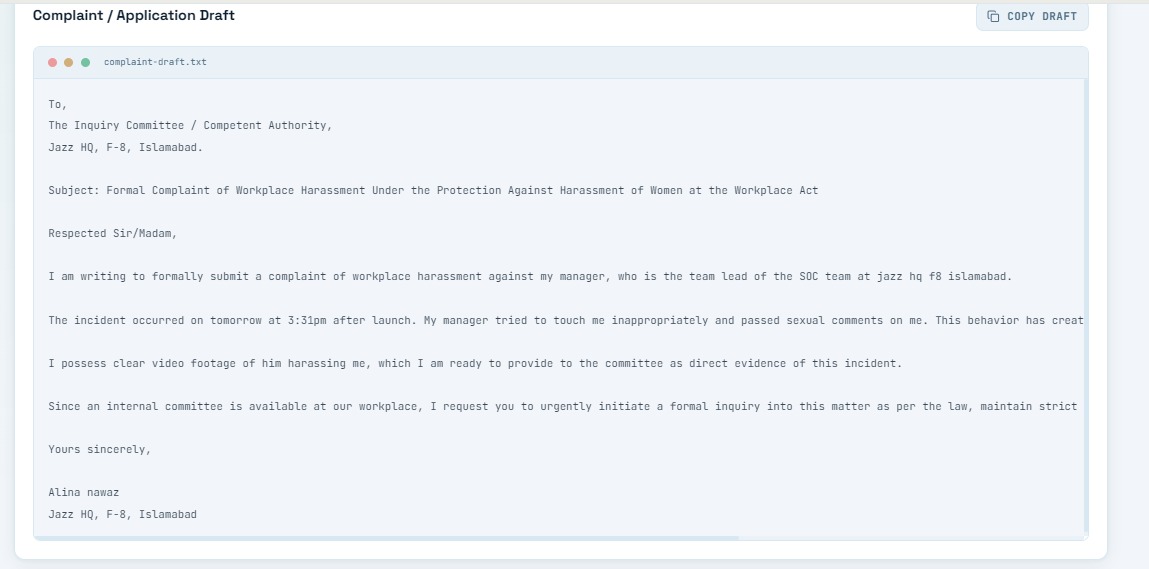
MVP3 (workplace-harassment) - Complete complain report with all required info
-
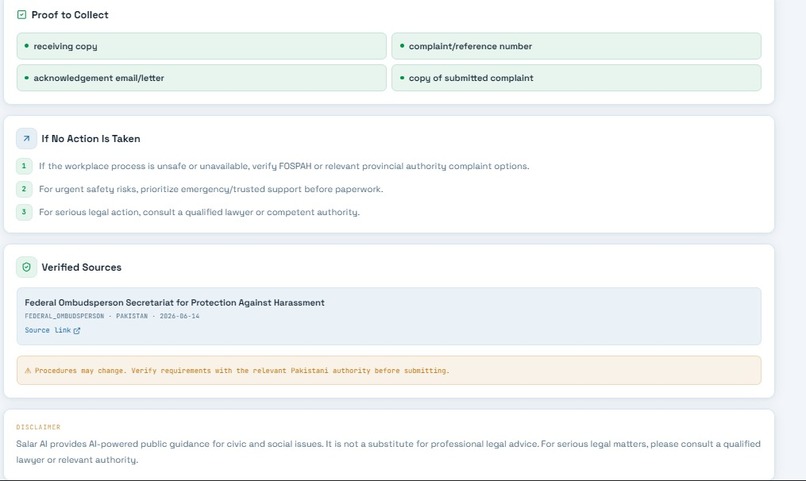
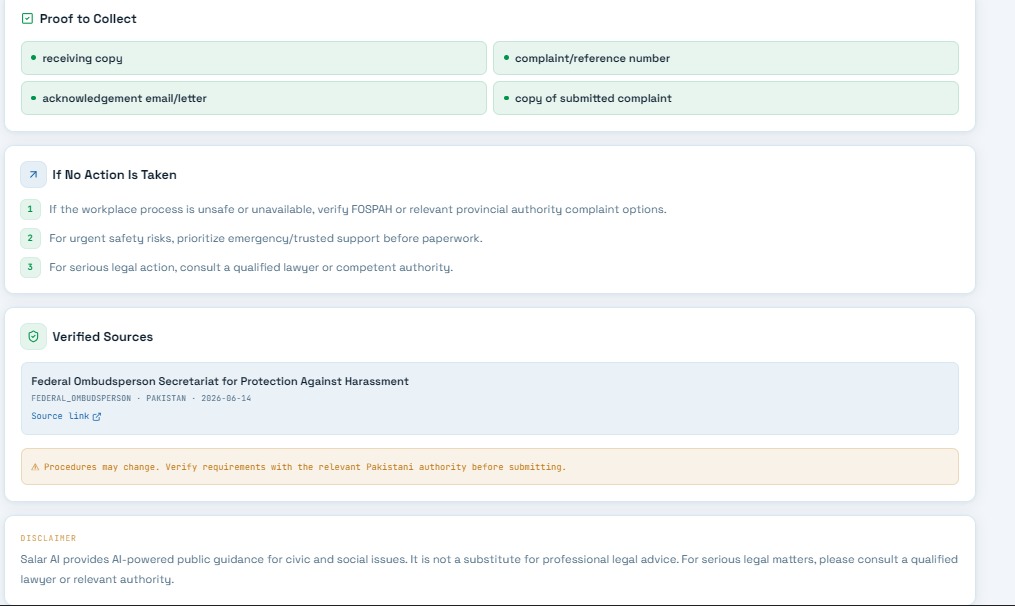
MVP3 (workplace-harassment) - what proofs to be collected, verified resources, and disclaimer
Inspiration
In Pakistan, many people face civic and social problems but do not know the correct procedure to follow. A lost phone, a stolen bike an overcharged electricity bill or workplace harassment can become even more stressful when the person does not know where to report, what documents are required or what proof they should collect after submitting a complaint.
The inspiration behind Salar AI came from this common gap between citizens and public-service procedures. We wanted to build an AI assistant that can guide people in simple language, especially English, Urdu, and Roman Urdu, so they can understand the right next step without feeling confused or helpless.
Our goal was not to replace lawyers or government departments but to make civic guidance more accessible, understandable and organized for everyday Pakistanis.
What it does
Salar AI is an AI-powered civic guidance assistant for Pakistani citizens.
Users can explain their problem in English, Urdu, or Roman Urdu and Salar AI helps identify the type of issue, asks for missing details and generates step-by-step guidance.
For the MVP, Salar AI focuses on three important domains:
- Lost or stolen phone, bike, or car
- Utility bill overcharging
- Workplace harassment support for women
For example, if a user says, “Mera phone kho gaya hai,” Salar AI can understand that the issue is related to a lost phone. It then asks important follow-up questions such as the phone model, last known location, time of incident, IMEI number, city, and whether the phone was lost or stolen.
After collecting the required details, Salar AI generates a structured guidance report that may include:
- relevant department or authority
- required documents
- step-by-step procedure
- complaint/application draft
- Google Maps search/location guidance
- reminders to collect complaint number, diary number, report number, token number, or receiving copy
- expected response timeline
- escalation guidance if no action is taken
- safety and privacy notes
- disclaimer that the guidance is AI-generated and not legal advice
How we built it
We designed Salar AI as a full-stack civic-tech web application.
The frontend was built using Next.js, React, TypeScript, and Tailwind CSS. We focused on creating a clean, responsive, and trustworthy interface with a chat-based experience. The UI includes issue cards, a disclaimer banner, chat messages, final report preview, and source/verification notes.
For the backend, we used FastAPI because it gives clean control over the AI pipeline, complaint classification, missing information collection, report generation, privacy filtering, and future voice-to-text support.
We used Supabase for database, authentication, and storage. The database design includes tables for complaint categories, departments, required documents, complaint templates, chat sessions, chat messages, user complaints, feedback, and knowledge base chunks.
For the AI layer, we planned a modular provider system using Gemini/Grok, with Gemini as the default model for cost-effective responses and a stronger model for more complicated cases. We also designed the system to support RAG using Supabase pgvector so the assistant can ground its answers in Pakistan-specific civic knowledge.
For location support, we integrated the design with Google Maps API and also added fallback Google Maps search links, such as finding the nearest police station or relevant office based on the user’s city and area.
Challenges we ran into
One major challenge was making the assistant useful without making it sound like a legal authority. Since the project deals with civic and social issues, we had to be careful with wording, disclaimers and safety guidance.
Another challenge was handling Roman Urdu. Many Pakistani users naturally explain problems in Roman Urdu, so the assistant needed to understand phrases like “Mera phone kho gaya hai” or “Mera bijli ka bill bohat zyada aa gaya hai” and map them to the correct issue category.
We also had to think carefully about privacy. Some cases may involve CNIC numbers, phone numbers, workplace harassment details, or other sensitive information. Because of that, the system was designed to ask only necessary questions and avoid collecting unnecessary personal details.
Another challenge was source reliability. For a civic guidance app in Pakistan, random internet content is not enough. We designed the knowledge base to rely on authentic Pakistani sources such as official regulator websites, police portals, utility provider websites, and relevant government/public-service sources.
Accomplishments that we're proud of
We are proud that Salar AI focuses on a real public problem and provides a practical solution that can help people in everyday situations.
We built the project around a clear civic workflow: understand the issue, classify it, ask missing questions, generate guidance, prepare a complaint draft, and remind the user to collect official proof after submission.
We are also proud of supporting Roman Urdu and Urdu-style communication, because accessibility is very important for Pakistani users. The project is not just a chatbot; it is designed as a civic guidance system with structure, safety, and source-awareness.
Another accomplishment is the focus on women’s workplace harassment support. Many victims may feel uncomfortable discussing such issues directly with another person, so an AI-powered first-step guidance assistant can help them understand options in a more private and respectful way.
What we learned
We learned that building an AI civic assistant is not only about connecting an LLM to a chatbot. It requires careful system design, privacy handling, safety instructions, source grounding, and a clear understanding of public-service workflows.
We also learned the importance of asking the right follow-up questions. A good civic assistant should not immediately generate a generic answer. It should first collect key missing details like location, date, department, document numbers, ownership proof, bill reference number, or safety risk depending on the case.
We also learned how important it is to keep AI responses grounded in reliable sources, especially when the topic involves legal or civic procedures. This helped us design a Pakistan-specific knowledge base and a RAG-based architecture for future improvements.
What's next for Salar AI
Next, we plan to expand Salar AI beyond the current MVP domains.
Future improvements include:
- adding more civic categories such as CNIC, passport, FIR, land records, university complaints, tax/FBR issues, and water supply complaints
- adding Urdu voice input and speech-to-text support
- improving the Pakistan-specific knowledge base with more verified official sources
- adding city and province-specific guidance
- improving Google Maps integration for nearby department locations
- adding complaint tracking reminders
- allowing users to export reports as PDF
- adding multilingual complaint drafts in English, Urdu, and Roman Urdu
- improving privacy controls and sensitive-data masking
- adding an admin panel to update civic knowledge sources
Our long-term vision is to make Salar AI a reliable digital civic guidance companion for Pakistan, helping people move from confusion to the right action.
Built With
- codex
- fastapi
- gemini
- nextjs
- rag
- railway
- react
- supabase
- tailwind
- typescript
- vercel


Log in or sign up for Devpost to join the conversation.