-
-
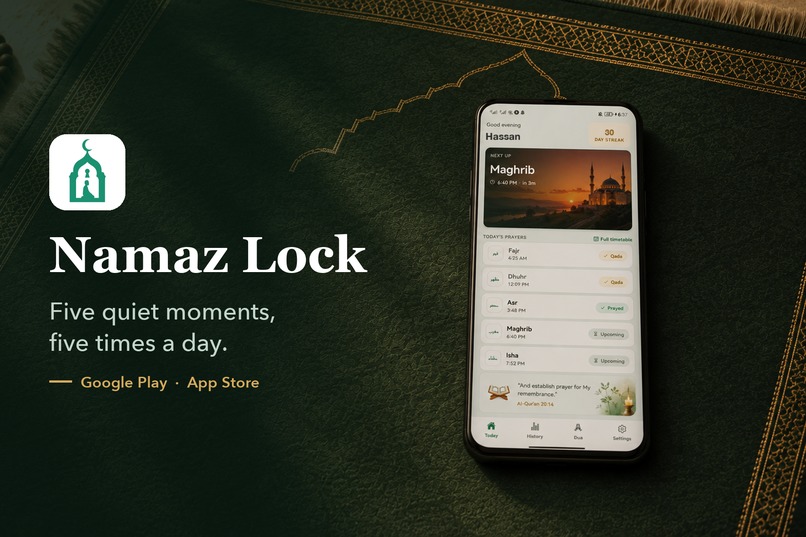
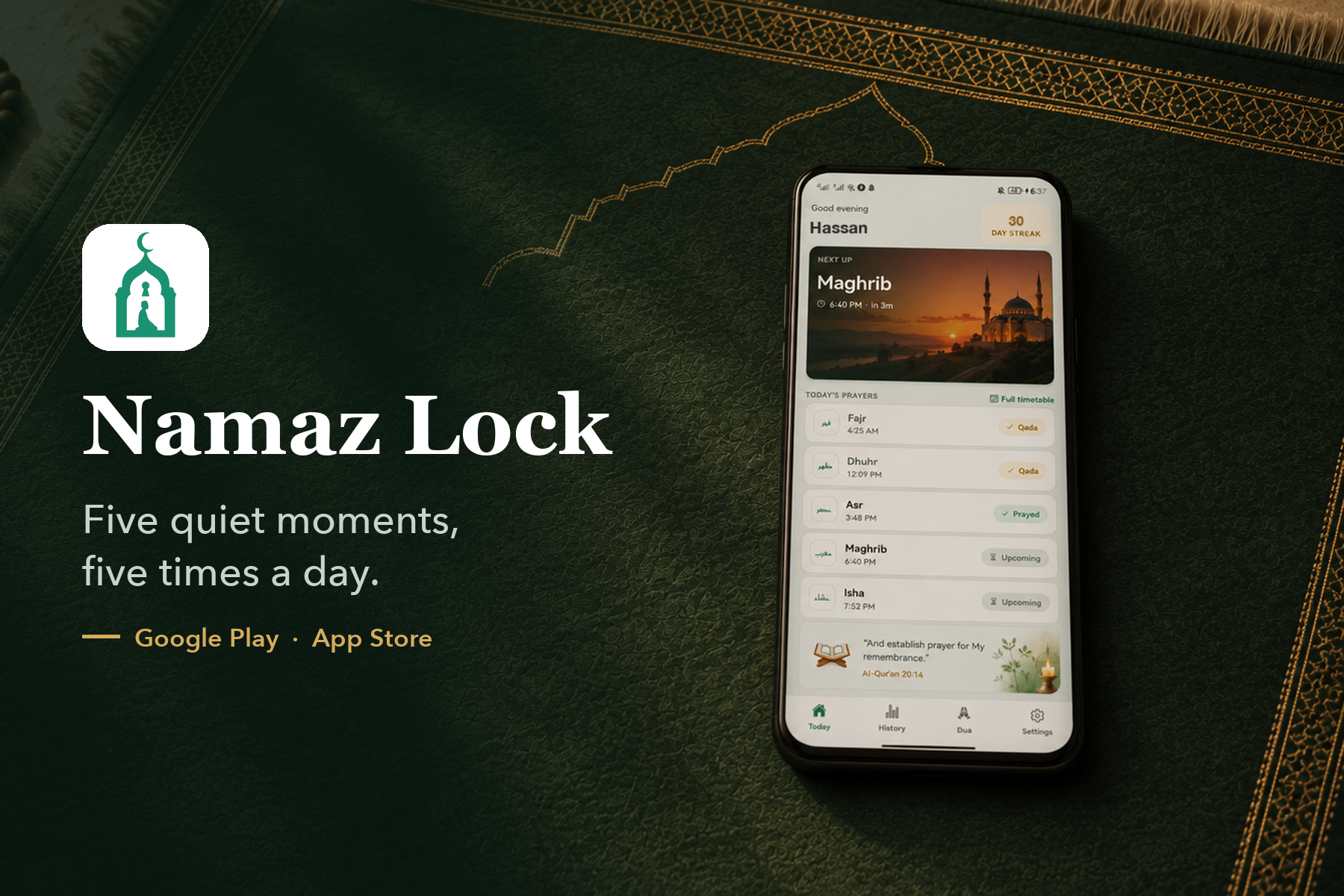
Namaz Lock: five quiet moments, five times a day.
-
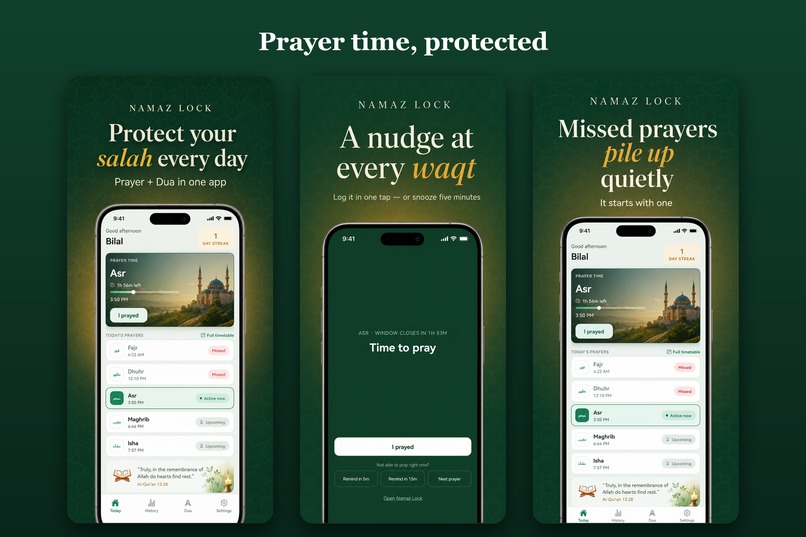
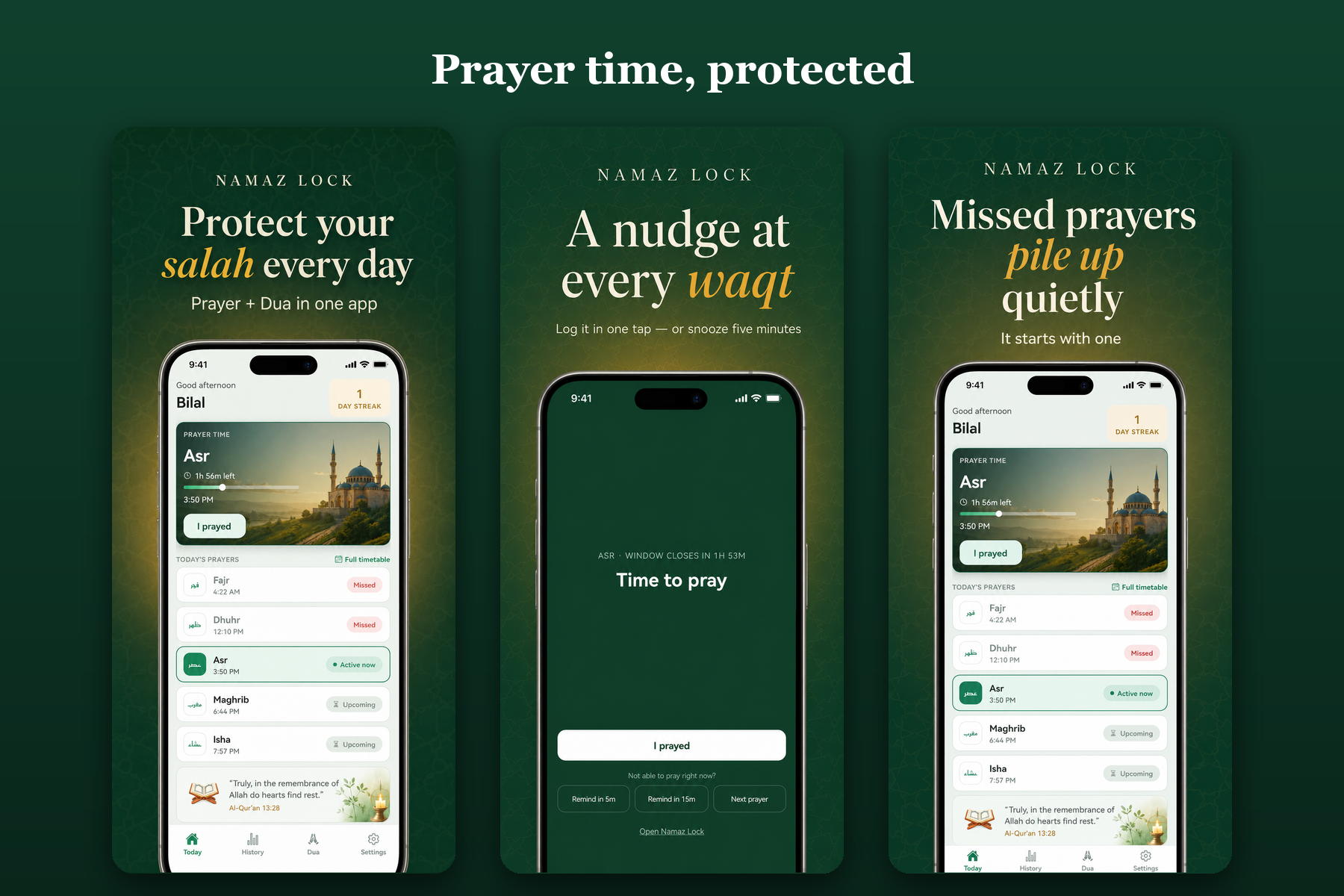
At prayer time, the apps you choose lock. Tap "I prayed" to release them.
-

App icon, 1024 x 1024.
-
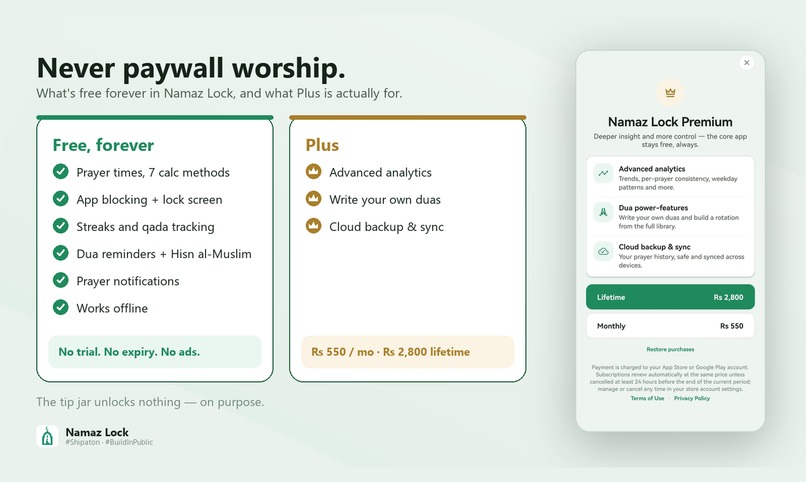
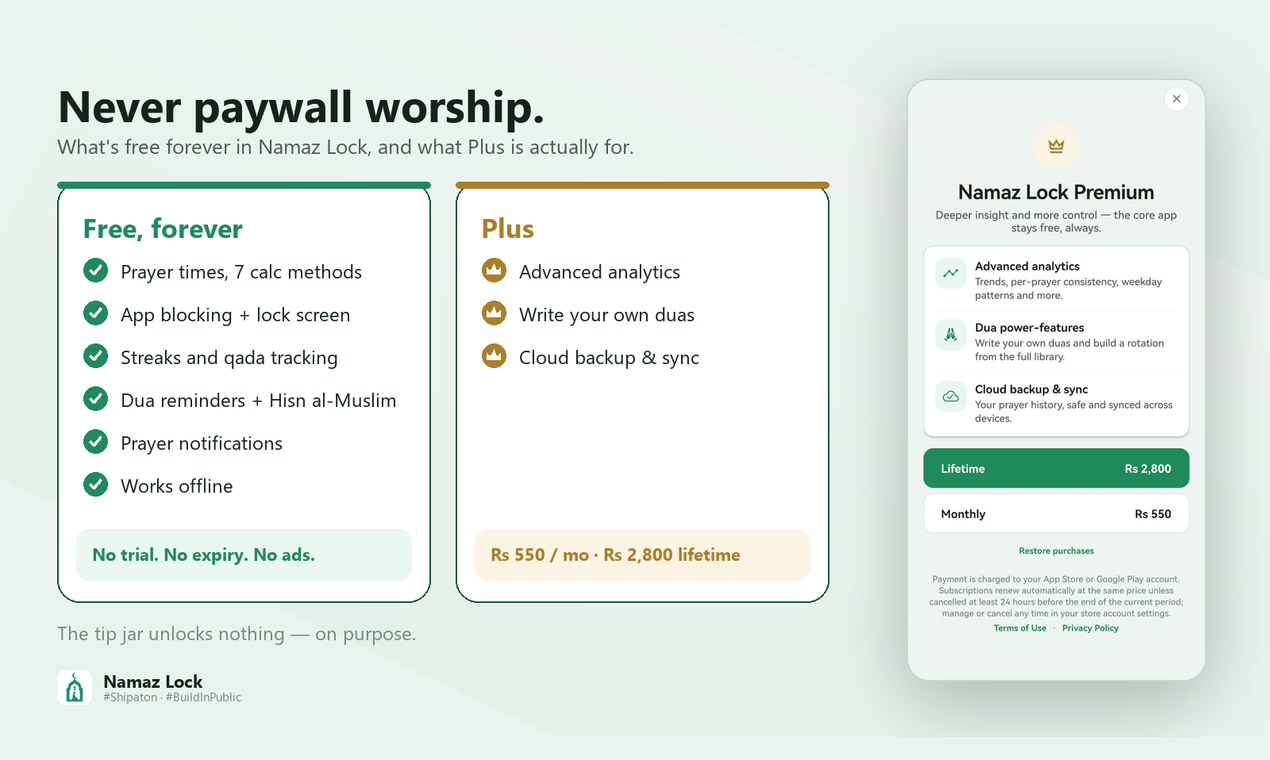
Never paywall worship: what's free forever, and what Plus is for.
-
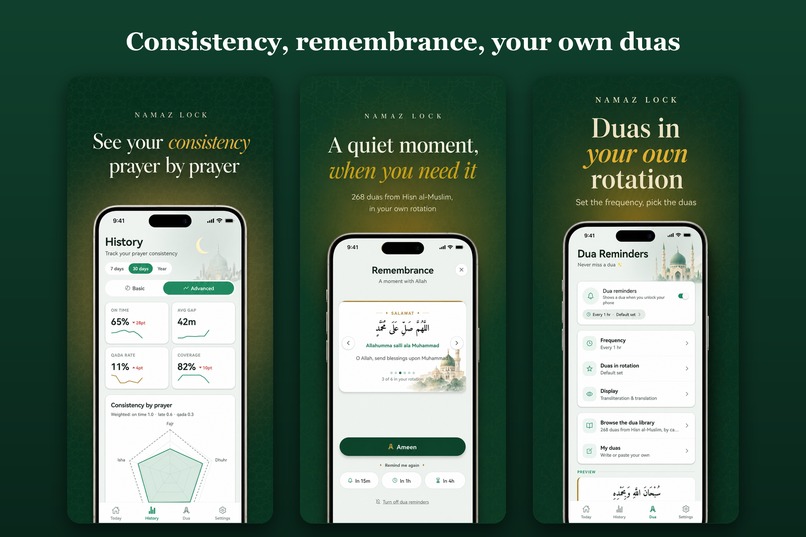
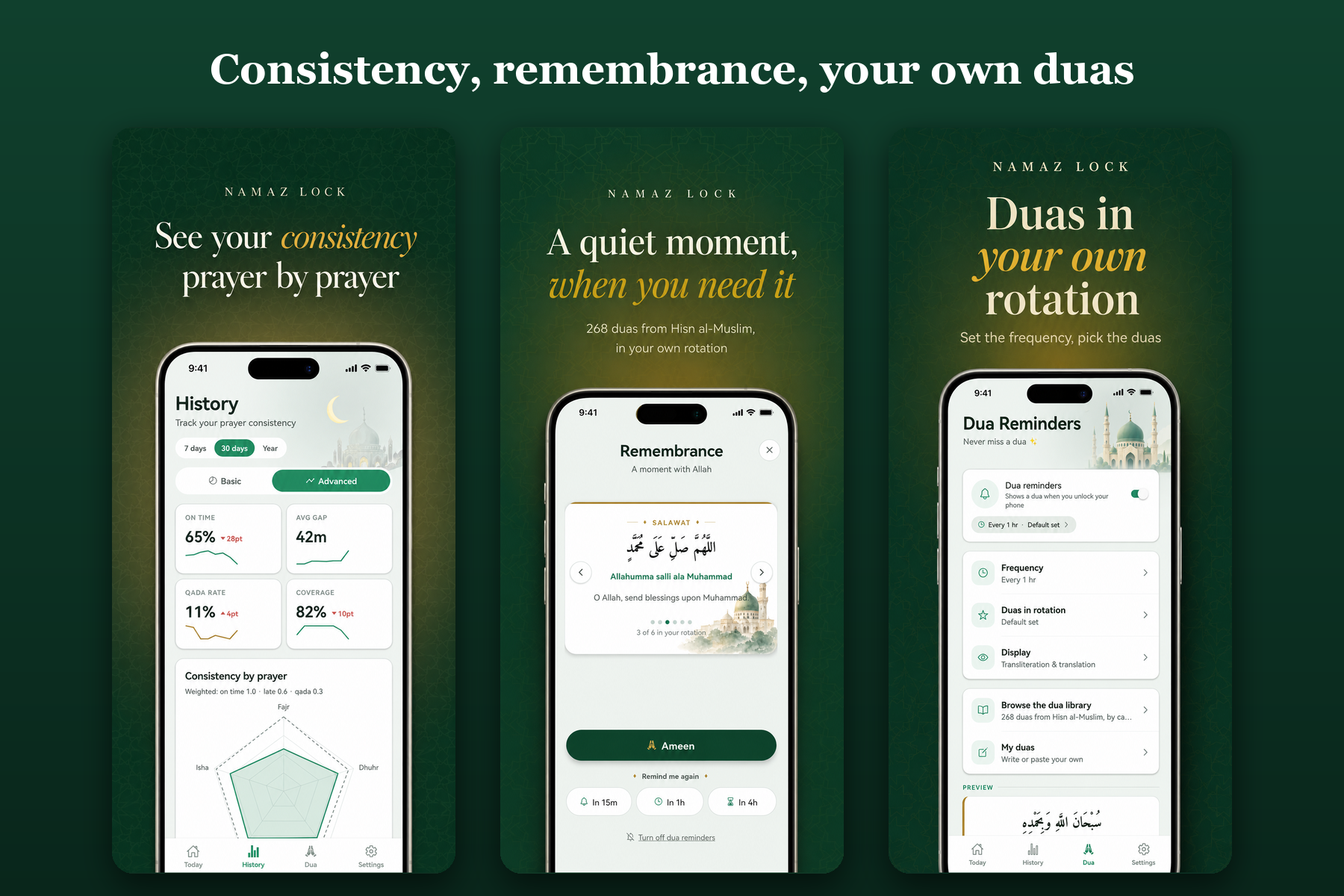
A gentle history, a dua when you need it, and your own dua rotation.
-
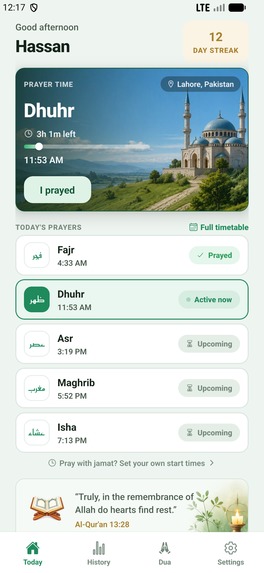
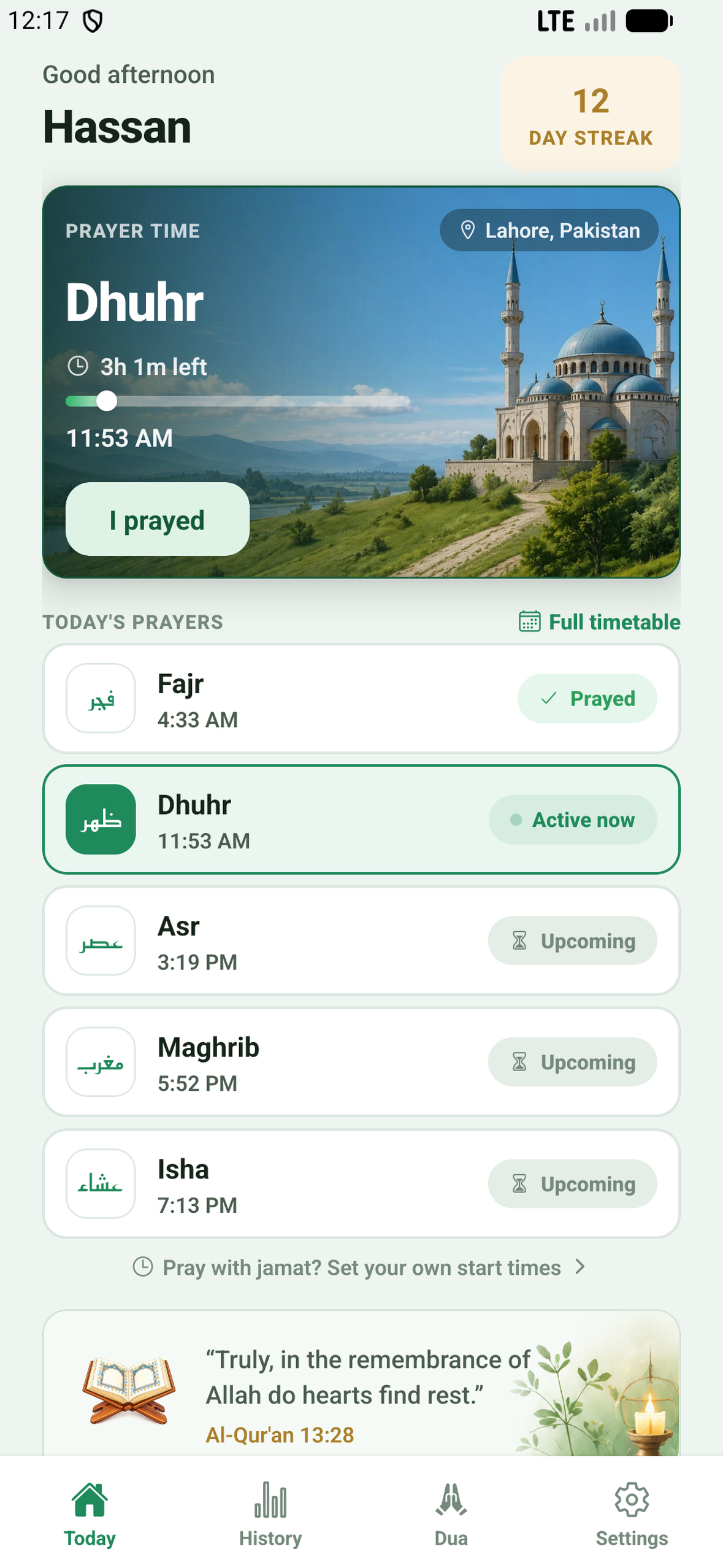
The Today screen (raw screenshot, no device frame).

Inspiration
For Muslims, prayer (Salah) happens five times a day, at times set by the sun. It is meant to be a pause: a few quiet minutes away from everything else. For a lot of us, the phone is what breaks that pause. The call to prayer goes off, and twenty minutes later we are still scrolling.
Prayer apps tell you the time. Almost none of them help you act on it. We wanted an app whose success is measured by how quickly you close it.
What it does
At prayer time, the apps you choose lock. Instead of a feed, you see which prayer it is, how long its window has left, and a short line of remembrance (dhikr) in Arabic with a translation. Tap "I prayed" and the phone is yours again. There is no verification; it runs on trust.
It follows real prayer windows. Each lock lasts only as long as that prayer's window (Dhuhr until Asr, and so on), so a missed prayer never locks your phone for the rest of the day. You can set your own mosque's congregation (jamat) times, and the lock follows your community's schedule instead of only the sun.
It is built for the people who need it. Six languages (English, Urdu, Arabic, Turkish, Indonesian and French) with right-to-left layouts done properly. Prayer times work fully offline.
It treats women's practice with care. Women do not pray during menstruation or after childbirth. A streak counter would normally punish that. Namaz Lock has excused days: blocking pauses, the streak is kept, and the information never leaves the phone. It is off by default and never synced.
A gentle history. Streaks, on-time rates, made-up (qada) prayers, and which prayer slips most, so you know where to start rather than where you failed. Every Sunday a weekly recap arrives through OneSignal.
On both platforms. Android uses a native Kotlin blocking module; iPhone uses Apple's Screen Time APIs, with a shield that sends you straight back to mark your prayer.
How we built it
- Expo SDK 57 / React Native 0.86 / TypeScript, expo-router, Zustand, i18next.
- Android blocking: a local Expo module in Kotlin. It detects the foreground app with
UsageStatsManagerand draws aWindowManageroverlay. Our first version used anAccessibilityService; banking apps flag those as a security risk, so we rebuilt it onUsageStatsManager. - iOS blocking: FamilyControls, ManagedSettings and DeviceActivity, with custom Shield Configuration and Shield Action extensions.
- Prayer times: Aladhan API with 7 calculation methods, plus on-device calculation as an offline fallback.
- RevenueCat for the Plus entitlement (lifetime and monthly) and a tip jar.
- OneSignal for the weekly recap, with per-user prayer tags for re-engagement. Everything time-critical (prayer alerts and locks) stays local, so it works with no network.
- Firebase Auth and Firestore for optional backup and sync, and Analytics for the numbers below.
Challenges we ran into
- Blocking kept failing on testers' phones. Android's background-launch restrictions, and full-screen intents that silently downgrade when the screen is on, broke our first approach. We rewrote it overlay-first; the best fix was deleting the clever part. A guided permission flow and a foreground-service heartbeat keep the lock working through reboots and battery savers.
- iOS gives you a shield, not an app. The Screen Time shield cannot open your app. We added a Shield Action that posts a notification, so one tap takes you from the blocked app to marking your prayer.
- Getting prayer windows right. Using the real Islamic window boundaries, rather than arbitrary grace periods, touched every screen, and it is what makes the lock feel fair instead of punishing.
Accomplishments that we're proud of
- Live on Google Play and the App Store within the Shipaton period.
- Since launching in August: 470 people in 32 countries, 1,168 prayers logged, and 916 times the lock stepped in (Firebase Analytics, Aug 1 – Sep 28).
- We never paywall worship. Prayer times, blocking, streaks, reminders and the Hisn al-Muslim dua library are free forever, with no ads.
What we learned
That a social-good app still has to earn its place on the phone. A lock that feels like punishment gets uninstalled, so we made it release on its own when each prayer's window ends, and kept the core free.
What's next
- Family and friend circles with shared, gentle accountability.
- A Ramadan mode: suhoor and iftar countdowns and taraweeh tracking.
- Home-screen widgets and a Galaxy Store release.
Built With
- aladhan-api
- expo.io
- familycontrols
- firebase
- firestore
- i18next
- kotlin
- onesignal
- react-native
- revenuecat
- screen-time-api
- swift
- typescript
- usagestatsmanager
- zustand


Log in or sign up for Devpost to join the conversation.