-
-
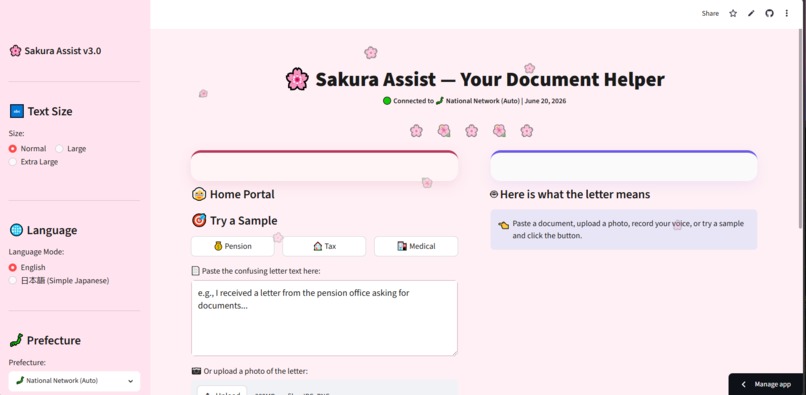
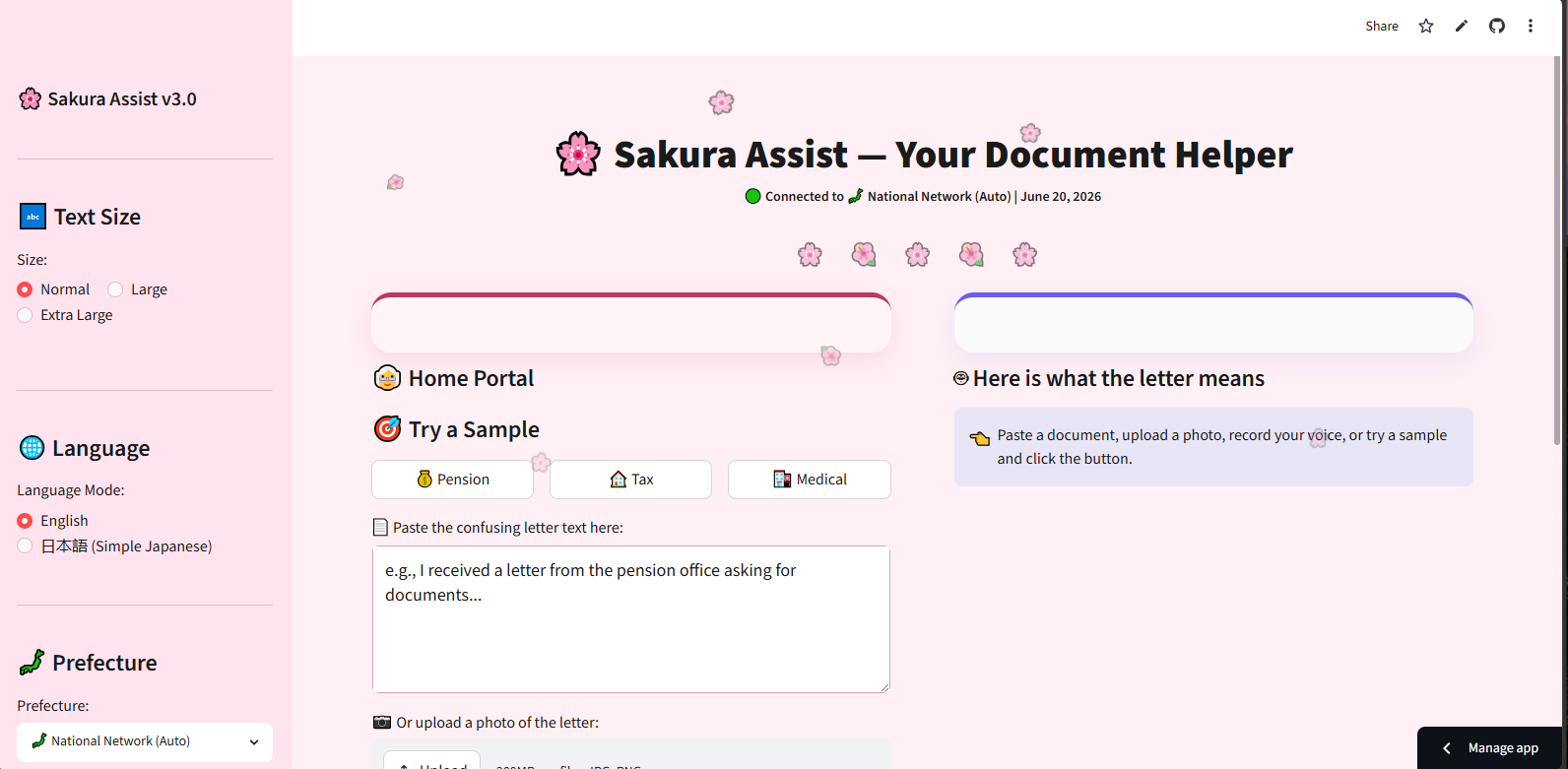
Sakura Assist Dashboard
Inspiration
In Japan, millions of elderly individuals living alone—along with a growing population of foreign residents—face a hidden crisis: navigating complex government bureaucracy. Every day, they receive dense, jargon-heavy notices regarding pensions, healthcare, and taxes. Trying to decipher these documents causes severe anxiety, and missing a deadline can result in massive financial penalties. I realized we didn't just need another translation app; we needed an empathetic, accessibility-first assistant that translates anxiety into action. Sakura Assist was inspired by Japan’s "Society 5.0" vision—using AI to solve real physical problems for our most vulnerable populations.
What it does
Sakura Assist is a privacy-first AI web application that turns scary government paperwork into peace of mind. A user simply pastes text or uploads a photo of a confusing letter. The system automatically detects their prefecture, reads the document, and generates a comforting, jargon-free summary in English or simple Japanese.
It highlights the urgency level using a color-coded UI and extracts critical deadlines. Because it is accessibility-first, users can adjust the text size or use the built-in Text-to-Speech (TTS) audio player to listen to their summary. Finally, it features a "Family PIN" gateway, allowing users to securely text the translated summary and deadlines to a caretaker or bilingual friend.
How we built it
I built the application using Python and Streamlit for a clean, responsive frontend. The core reasoning engine is powered by Gemini 3.5 Flash.
Instead of just asking the LLM to translate, I engineered a highly constrained prompt that forces Gemini to output a strict JSON schema. This allowed the frontend to predictably parse document types, deadlines, and action steps. I also integrated gTTS for the audio generation and sqlite3 for a local fallback database.
Challenges we ran into
The biggest challenge was Responsible AI and Data Privacy. Handling government documents means dealing with highly sensitive Personal Identifiable Information (PII). If an AI leaks a My Number ID or banking detail, the harm is catastrophic. To solve this, I engineered a local "PII Guard" using Regex patterns that hard-redacts sensitive identifiers before the API payload is ever sent to the cloud.
Another challenge was infrastructure reliability. What happens if the AI hits a rate limit or goes offline? An elderly user seeing a broken error screen would panic. I solved this by building an offline-fallback database. If the API fails, the app instantly serves generalized, comforting offline templates based on keyword matching so the user is never abandoned.
Accomplishments that we're proud of
I am incredibly proud of designing the Human-in-the-Loop gateway. I firmly believe AI should not make final financial or healthcare decisions for vulnerable users. Building the secure Family PIN system ensures that while AI does the heavy lifting of translation, a trusted human is always looped in to make the final decision. I am also proud of completing this entire stack—from the PII guard to the dark-mode accessible UI—as a solo developer.
What we learned
I learned a massive amount about prompt engineering, specifically how to constrain an LLM to output predictable JSON formats without hallucinating or translating the JSON keys themselves. I also learned that building for the elderly requires extreme empathy in UX design—large fonts, high contrast, and clear, non-technical language.
What's next for Sakura Assist
Sakura Assist is built to scale. Our immediate next step is expanding language support to include Vietnamese, Korean, and Tagalog to assist Japan's growing foreign workforce. From there, the goal is to partner directly with local city halls to integrate this technology into their official smart city infrastructures, ensuring no resident ever feels helpless checking their daily mail.

Log in or sign up for Devpost to join the conversation.