-
-
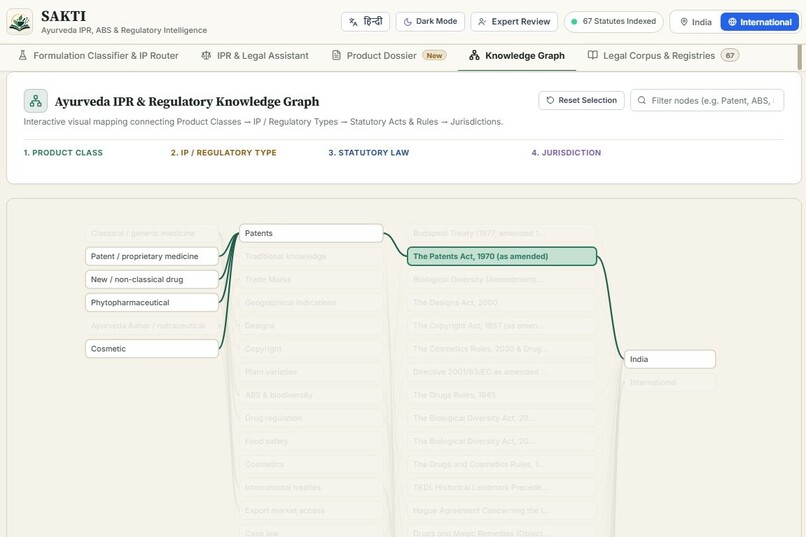
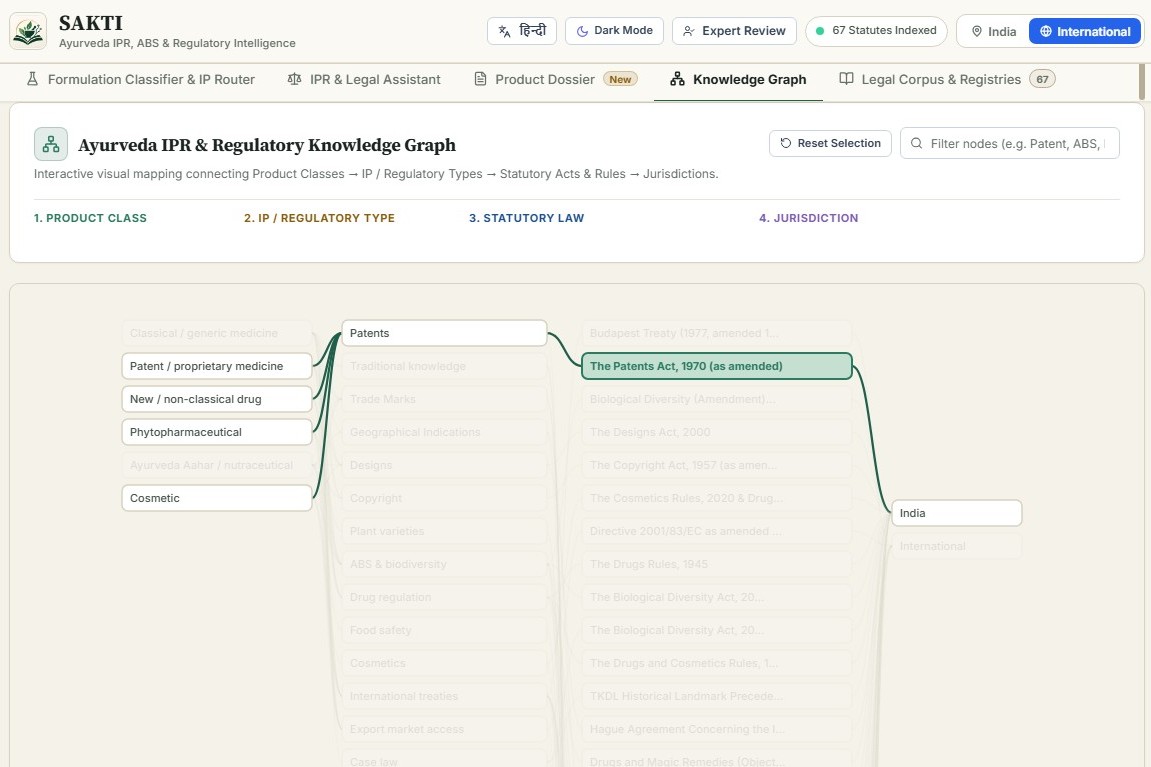
Interactive knowledge graph linking Ayurvedic product classes, intellectual-property laws, regulatory frameworks, and jurisdictions.
-
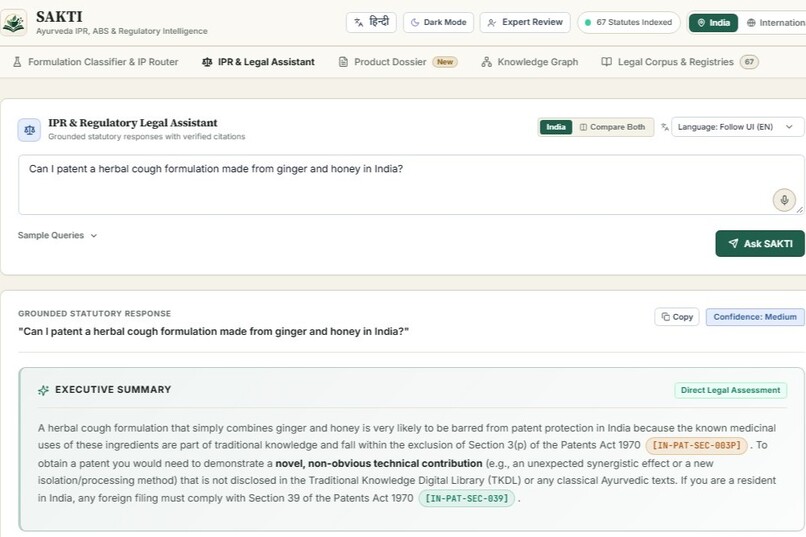
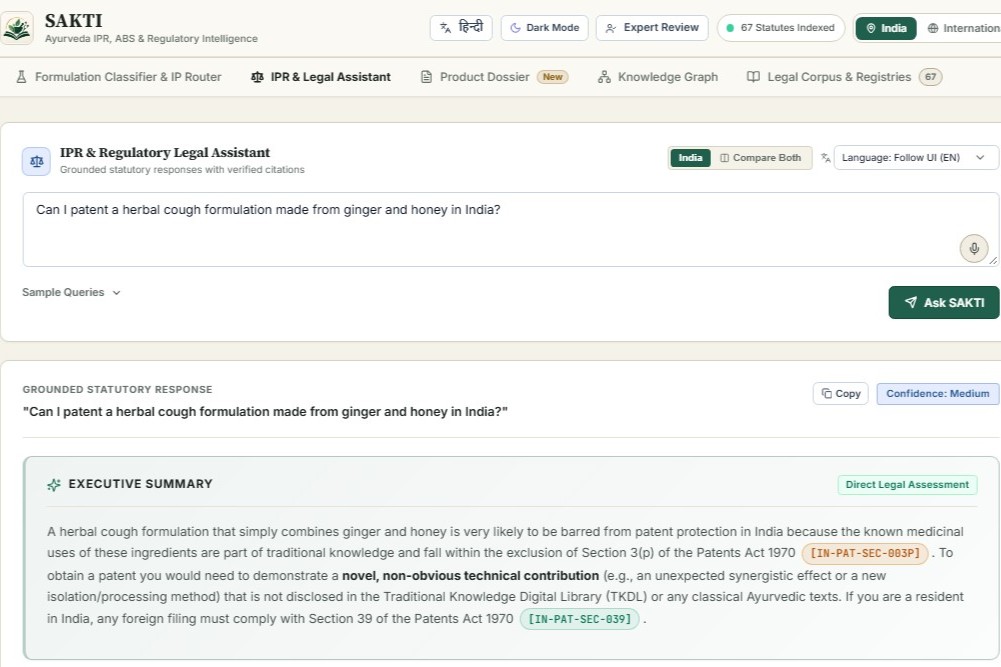
AI-powered legal assistant delivering source-cited Ayurvedic IP guidance and patentability assessments across regulatory frameworks.
-
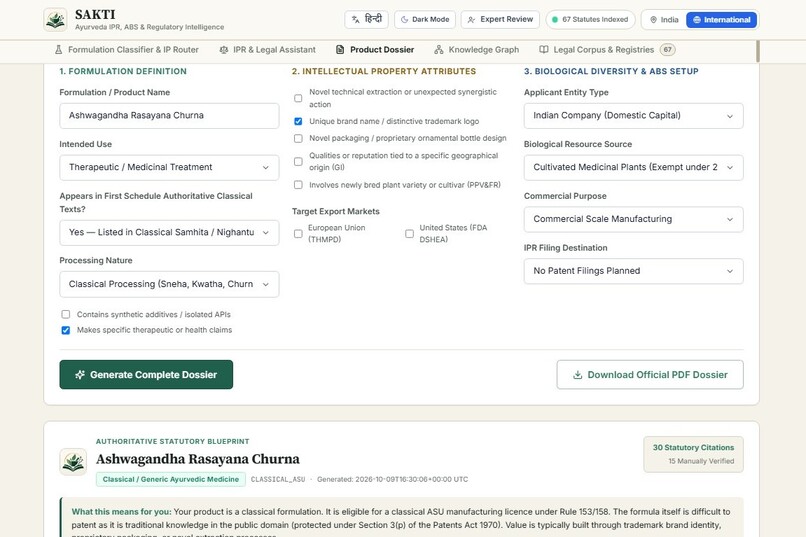
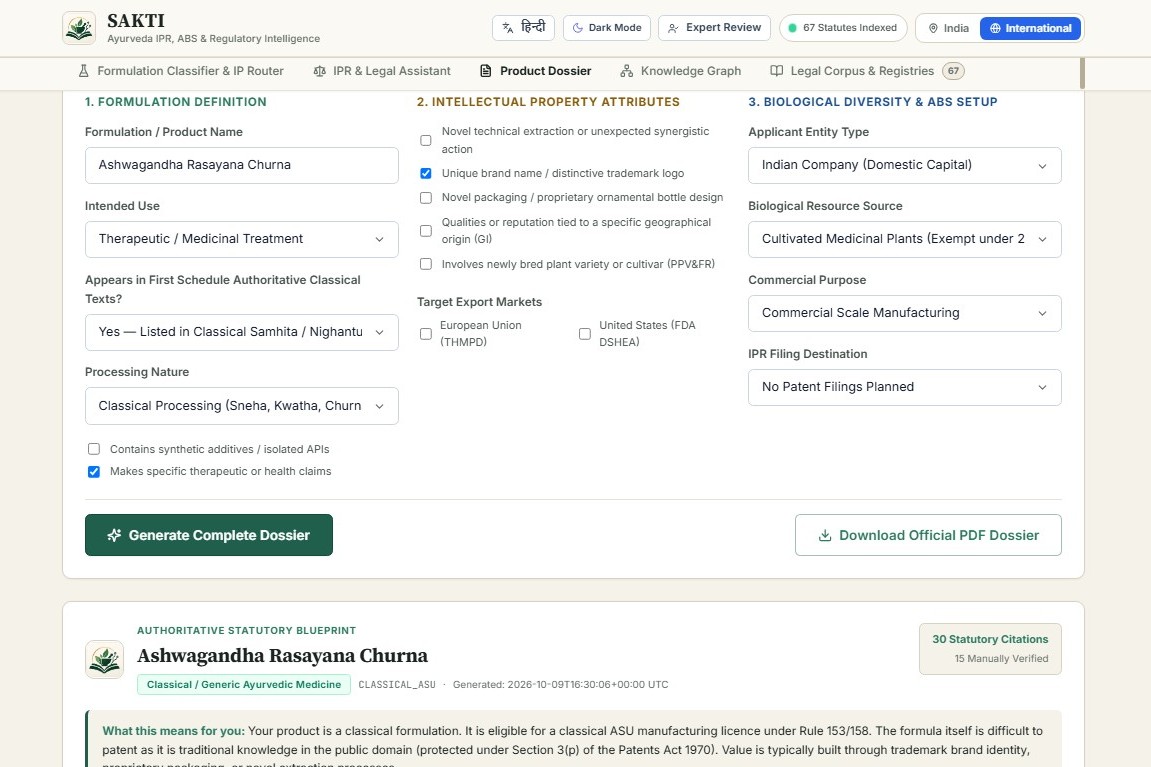
Comprehensive Ayurvedic product dossier generation with IP assessment, statutory citations, and biodiversity compliance guidance.
-
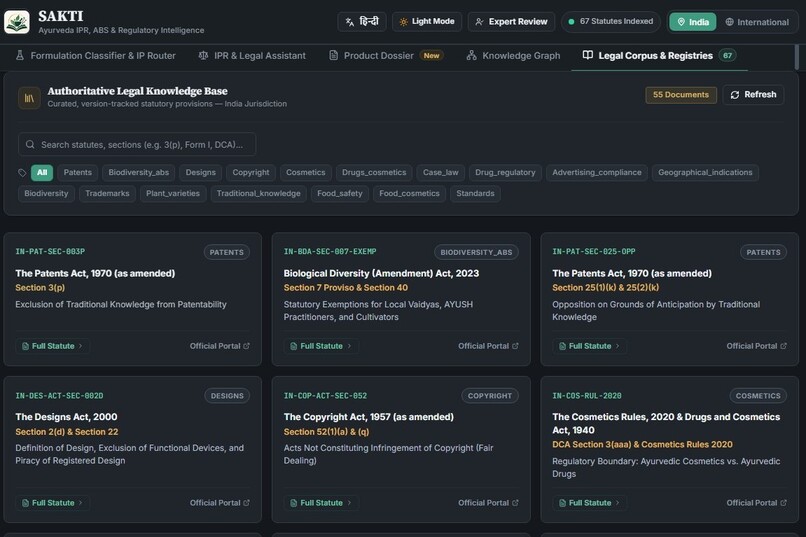
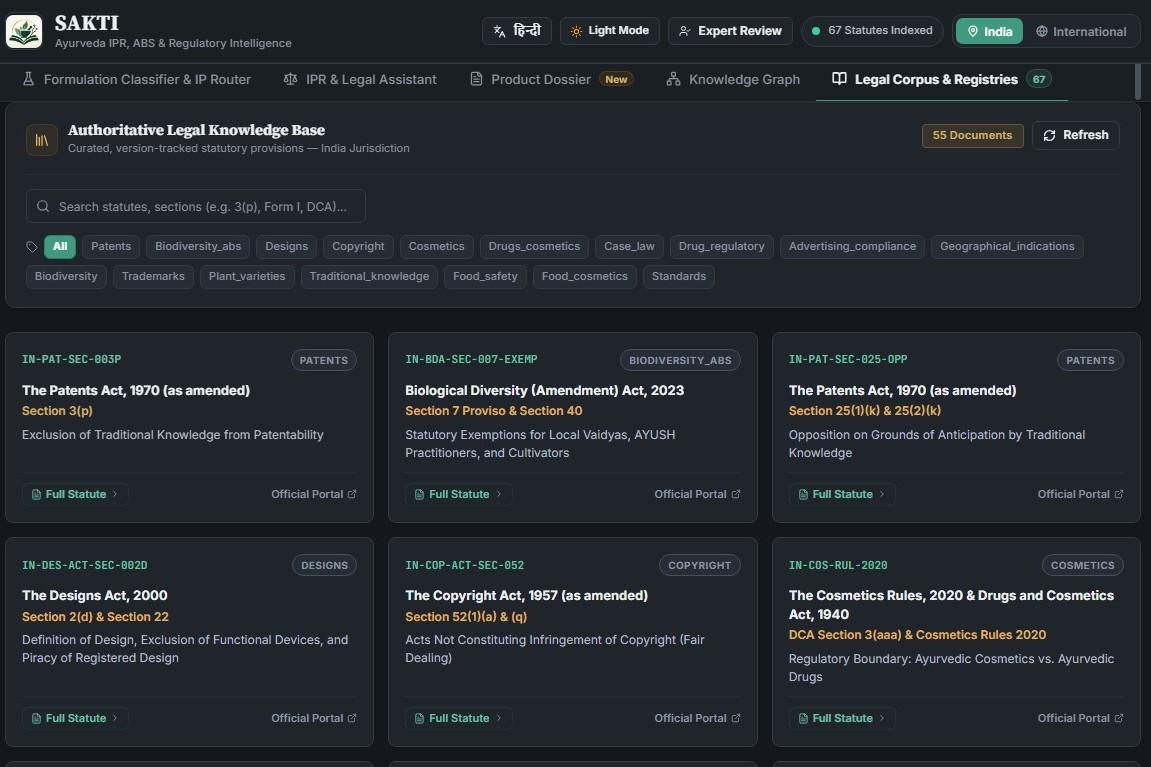
Searchable legal knowledge base featuring curated statutes, regulatory provisions, and authoritative references for Ayurveda IP compliance.
-
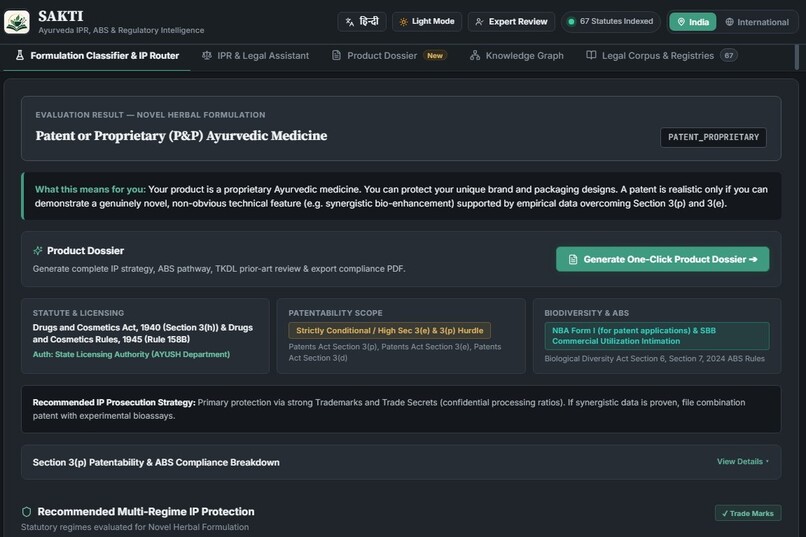
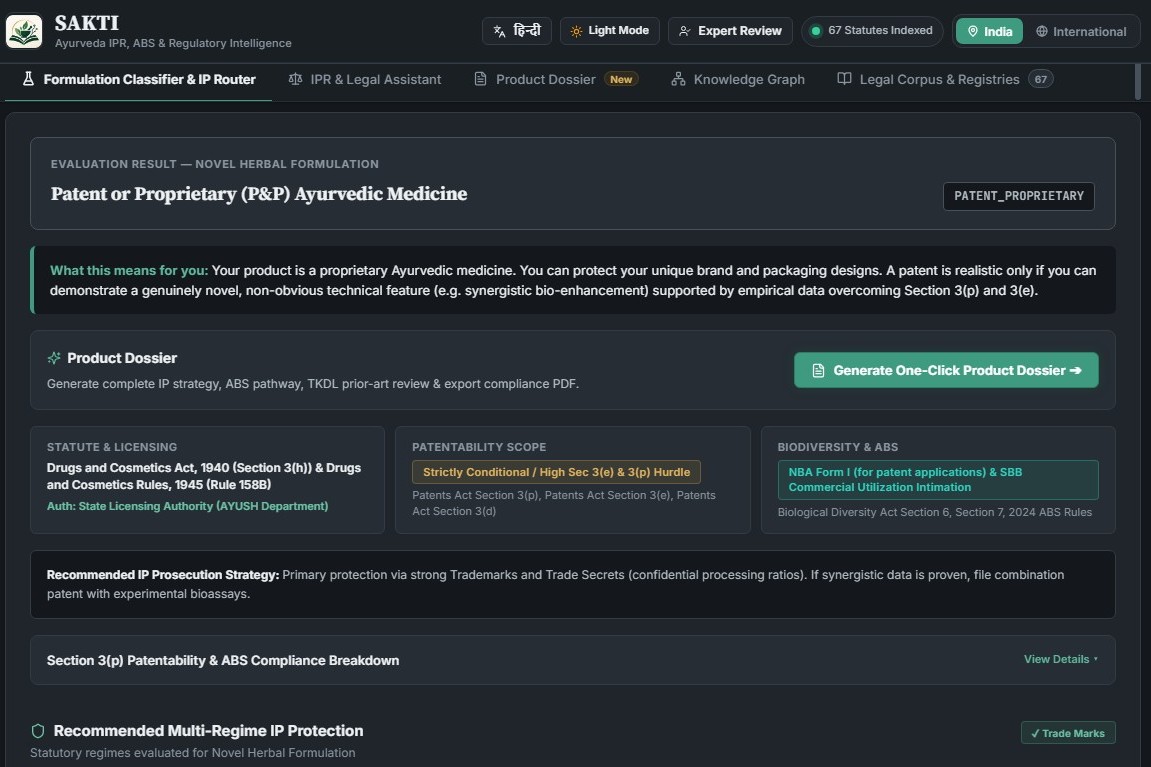
AI-powered Ayurvedic formulation classification, patentability analysis, and regulatory compliance guidance.
Inspiration
Ayurveda has a rich tradition of knowledge, but protecting, developing, and commercialising Ayurvedic formulations can involve navigating complex intellectual-property laws, traditional knowledge databases, biodiversity regulations, and national and international regulatory frameworks.
For researchers, practitioners, and startups, finding the right information across scattered sources can be time-consuming. Generic AI assistants may also generate answers without reliable evidence or clear references.
This inspired us to develop IP-SAKTI Sahayak, an AI-powered assistant designed to make Ayurveda-related intellectual-property and regulatory information more accessible, traceable, and easier to understand.
What It Does
IP-SAKTI Sahayak aims to connect Ayurveda-related questions with relevant authoritative documents and regulatory information.
Key capabilities include:
- Formulation Classification: Uses formulation details, intended use, and processing information to classify products through a rule-based engine.
- IP Intelligence: Helps users explore potential intellectual-property considerations and relevant traditional knowledge resources.
- Regulatory Guidance: Identifies potentially relevant regulatory frameworks, licensing requirements, and compliance considerations.
- Evidence-Based Retrieval: Uses document retrieval and RAG-based generation to help ground answers in relevant source material.
- Biodiversity and ABS Awareness: Helps identify potentially applicable biodiversity and access-and-benefit-sharing considerations.
- Multilingual Accessibility: Full bilingual support (English & Hindi) across all interfaces, with regional language expansion planned.
The project is intended for preliminary research and decision support, not as a substitute for qualified legal advice or official regulatory decisions.
How We Built It
We developed the initial SAKTI foundation using a modular architecture:
- Backend: FastAPI for application endpoints and backend services.
- Frontend: A web interface for user interaction.
- Document Retrieval: A curated corpus of structured JSON documents and a FAISS vector index for retrieving relevant information.
- Classification: A rule-based engine for formulation classification and routing.
- AI Integration: An architecture for retrieval, answer synthesis, and interaction with a language model.
- Testing: Separate tests for retrieval, classification, synthesis, live integration, guardrails, and predefined scenarios.
The existing foundation allows us to focus on improving the end-to-end experience, source traceability, and reliability rather than starting from scratch.
Challenges We Faced
One of the main challenges is the fragmented nature of Ayurveda-related intellectual-property and regulatory information. Different questions can involve different laws, authorities, jurisdictions, and source documents.
Another challenge is reliability. A fluent AI-generated response is not necessarily a correct one, particularly when legal or regulatory decisions are involved. Retrieval quality, source relevance, uncertainty handling, and safeguards therefore matter as much as the generated response itself.
We also had to approach the problem from both a technical and a domain perspective: classification rules, document organization, retrieval, and user experience must work together to produce useful results.
What We Learned
Building SAKTI reinforced that a useful AI application requires more than connecting a language model to a user interface. The quality of the underlying knowledge base, retrieval pipeline, validation strategy, and safeguards directly affects the usefulness of the system.
We also learned the importance of separating evidence from interpretation, testing components independently, and designing for cases where the available information is insufficient.
What's Next
Our next priorities are to improve source-level citations, validate answers against authoritative documents, strengthen multilingual support, and evaluate the system using realistic Ayurveda-related scenarios.
We also aim to make the workflow more actionable by helping users identify relevant documents, understand potential requirements, and determine when expert advice is necessary.
Our Vision
IP-SAKTI Sahayak aims to bridge traditional Ayurvedic knowledge and modern intellectual-property and regulatory intelligence.
By making reliable information easier to discover and understand, we hope to help researchers, practitioners, and entrepreneurs make better-informed decisions and explore responsible opportunities to develop and commercialise Ayurveda-related innovations.
Built With
- ai-agent
- artificial-intelligence
- ayurveda
- faiss
- fastapi
- genai
- information-retrieval
- large-language-model
- legaltech
- machine-learning
- multilingualai
- python
- rag
- regulatory-compliance

Log in or sign up for Devpost to join the conversation.