-
-
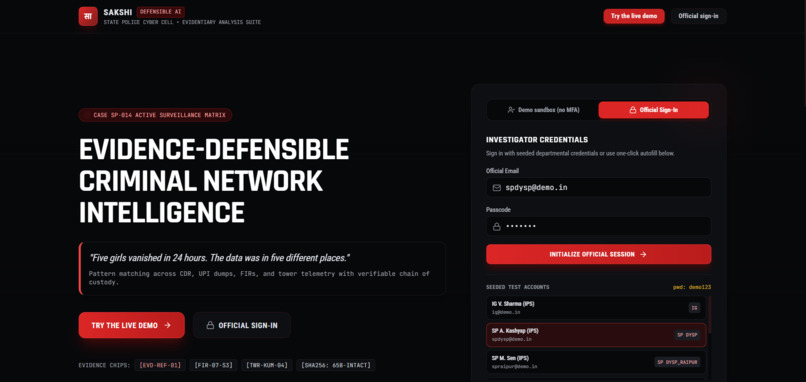
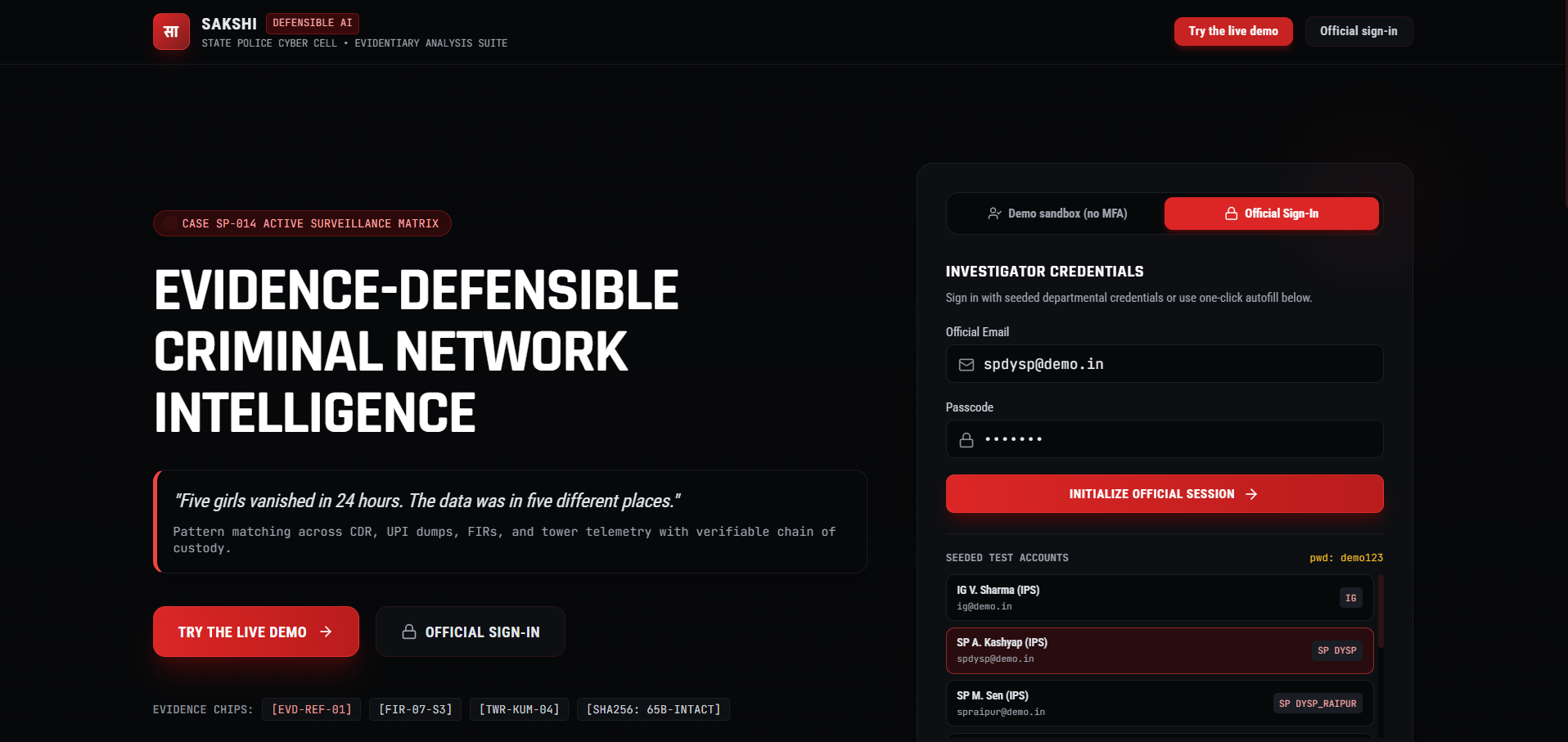
Provides a credential-based login interface for investigator roles.
-
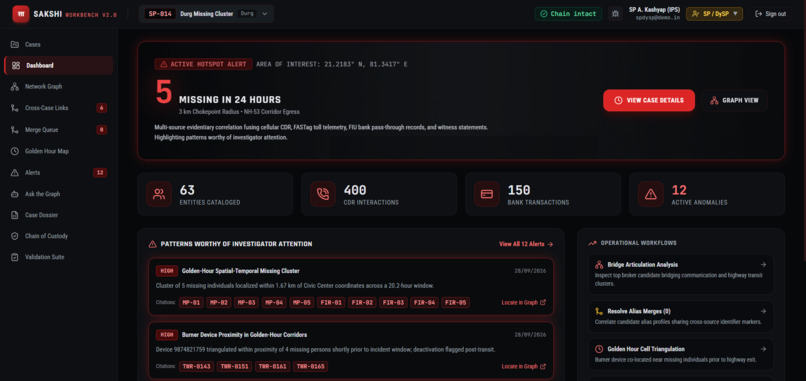
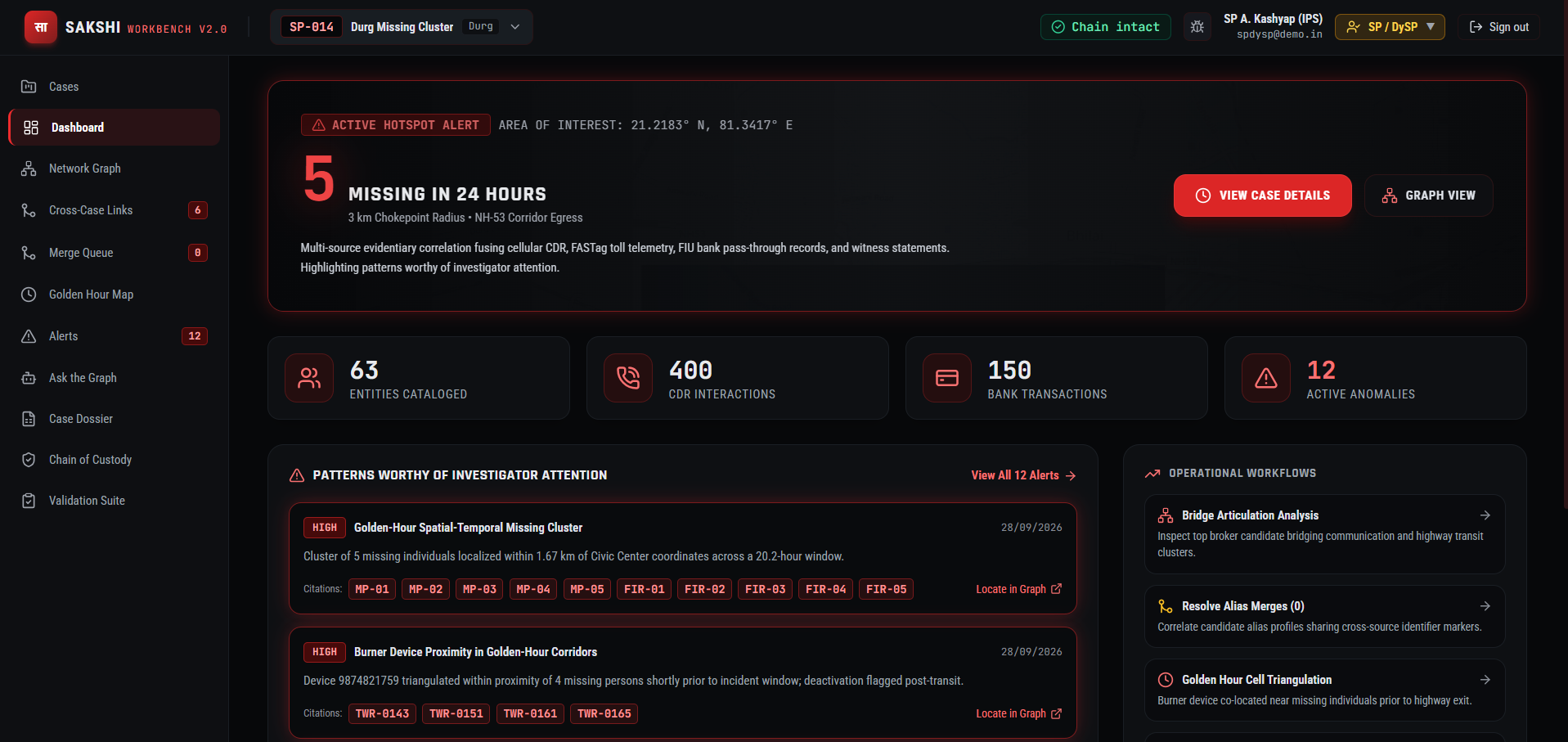
Summarizes case statistics, missing-person clusters, and priority alerts.
-
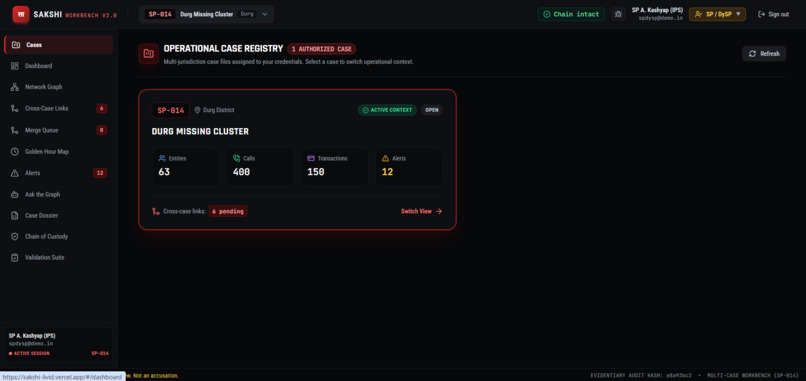
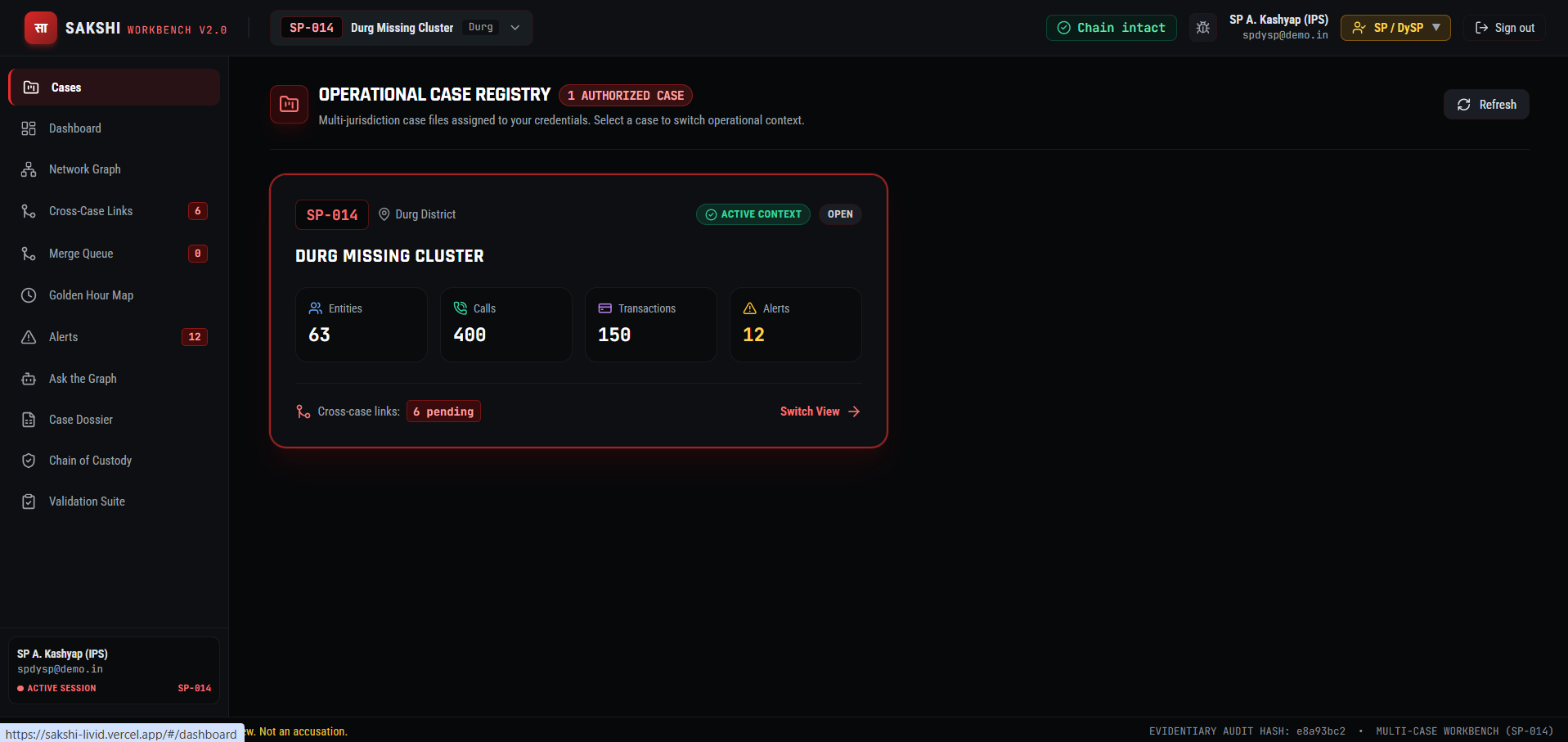
Displays available cases with entity counts, calls, transactions, and alerts.
-
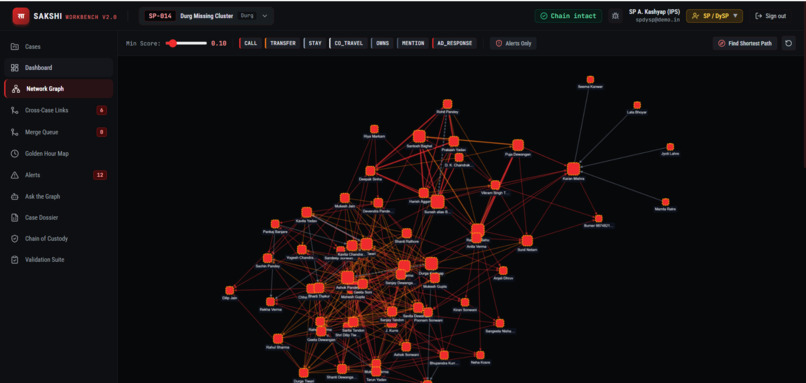
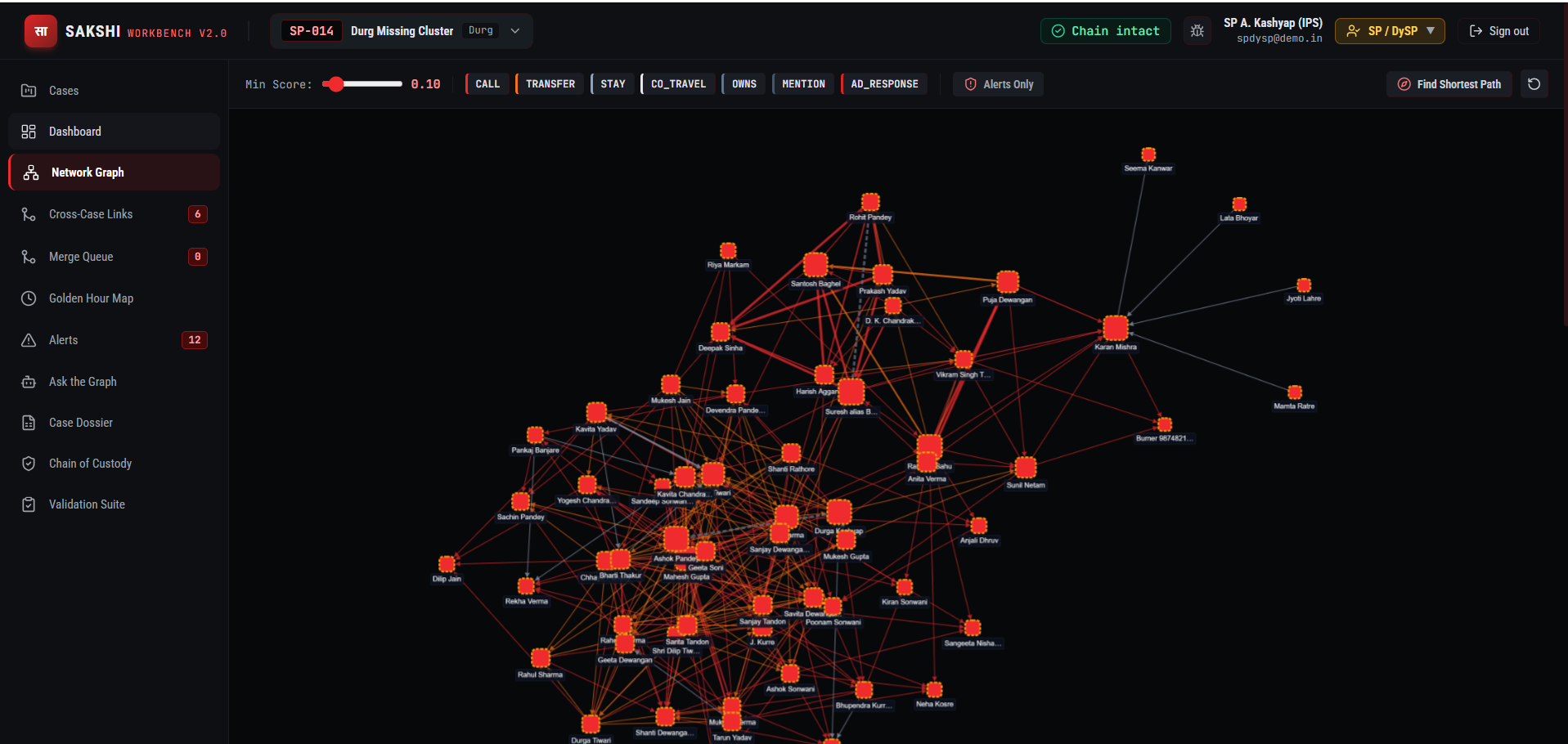
Visualizes relationships between people, phone numbers, and other connected entities.
-
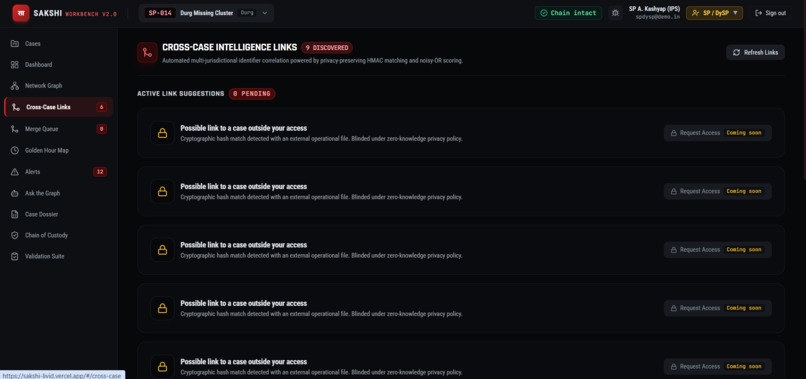
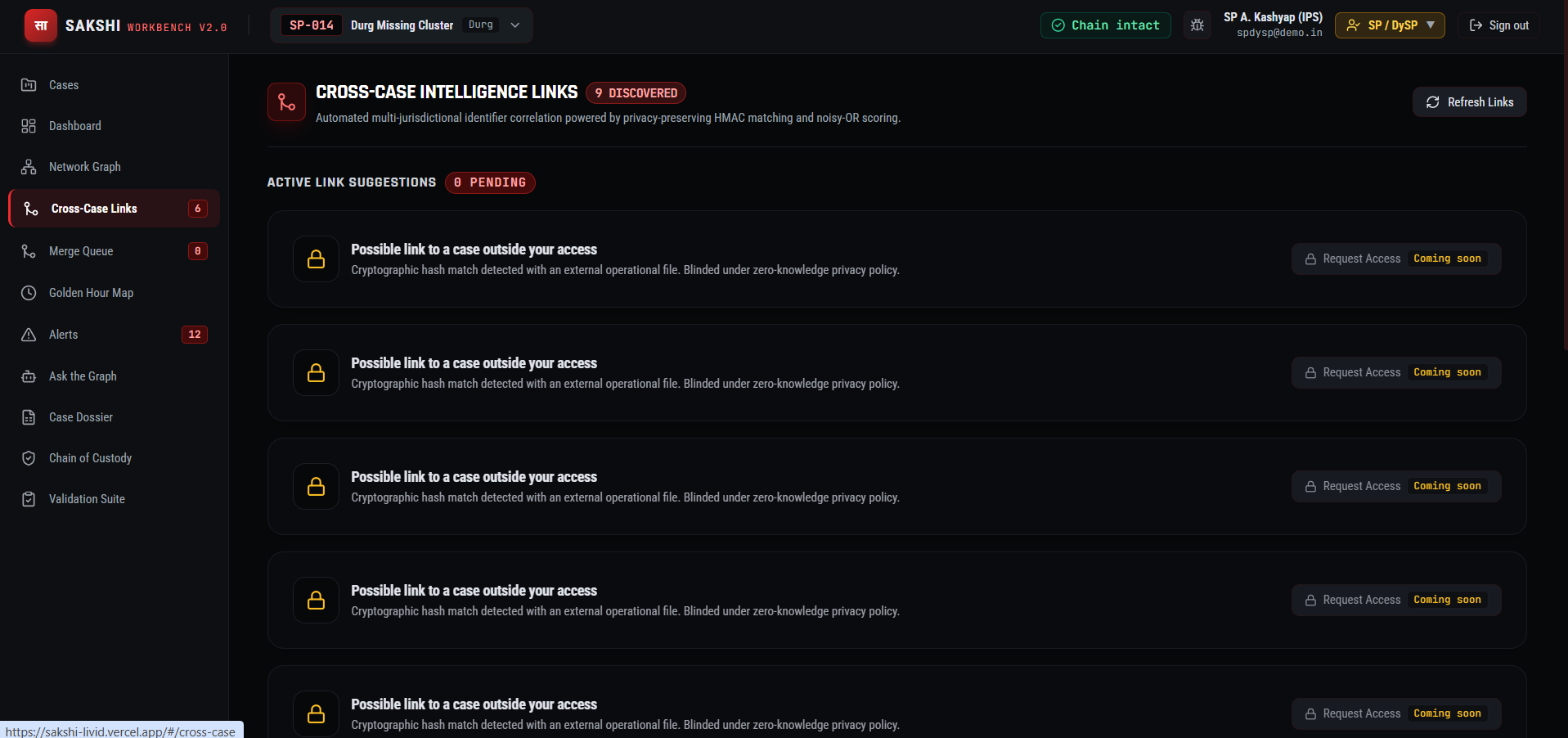
Identifies potential connections between separate cases while protecting restricted details.
-
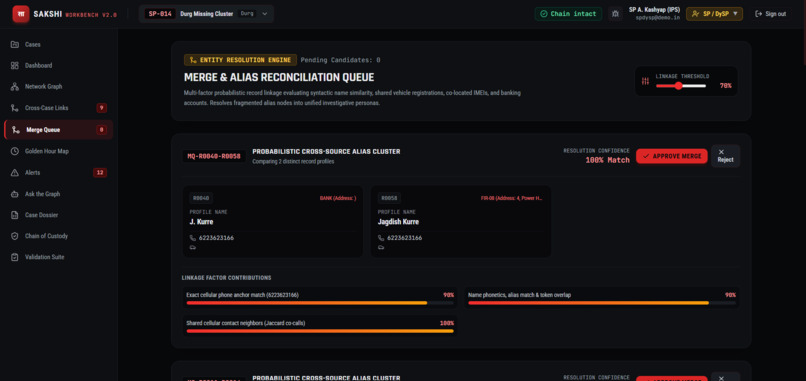
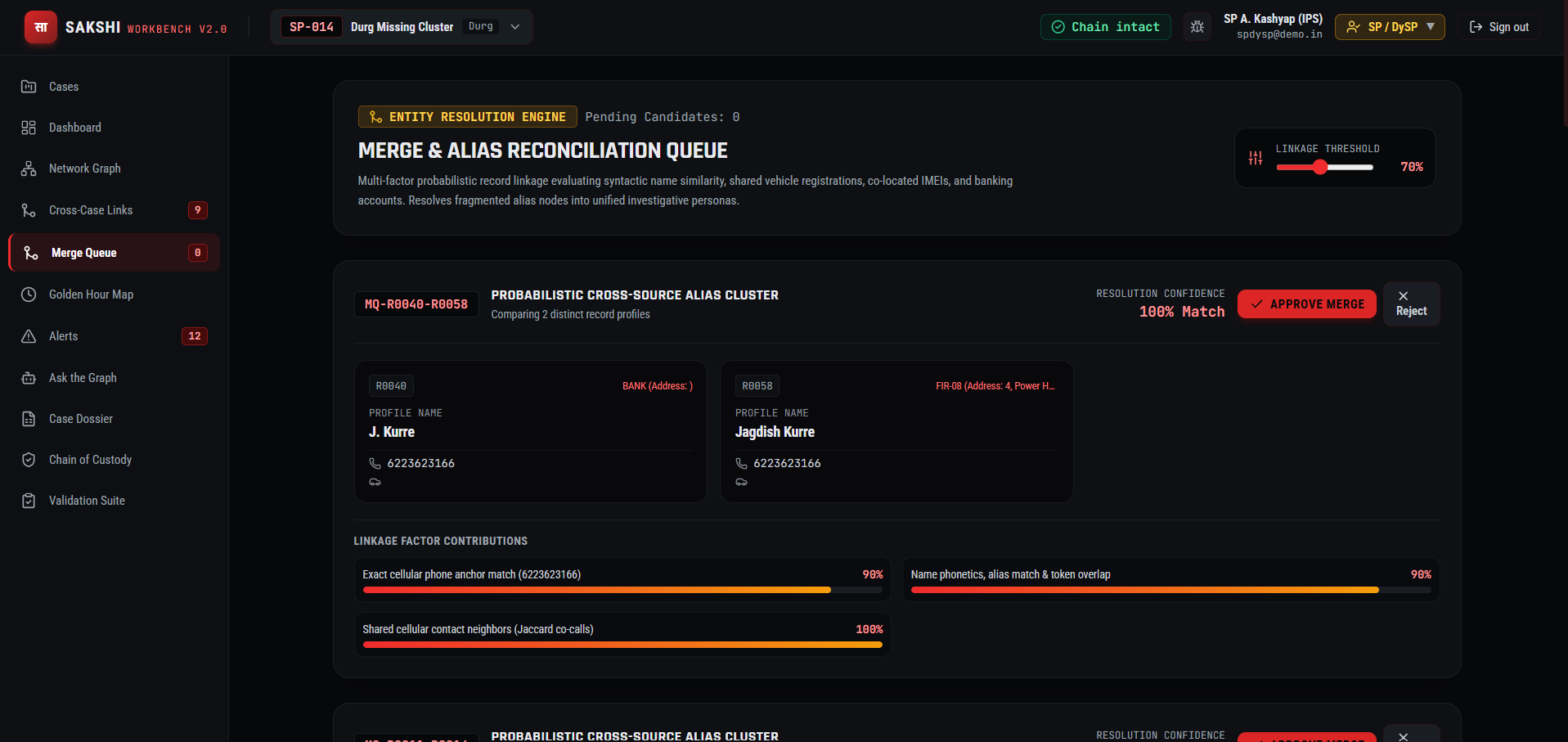
Reviews possible duplicate identities using matching identifiers and confidence scores.
-
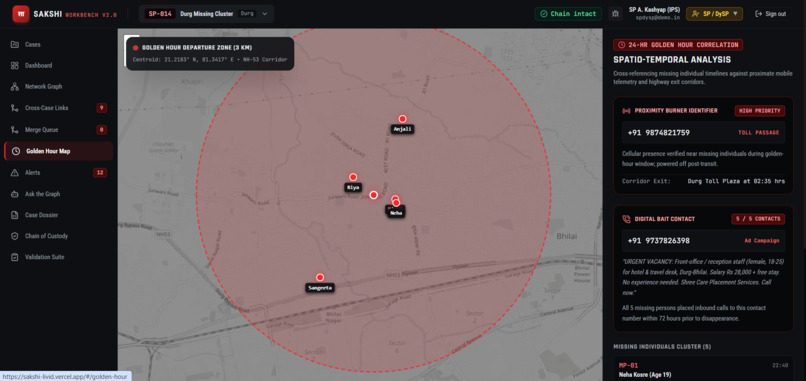
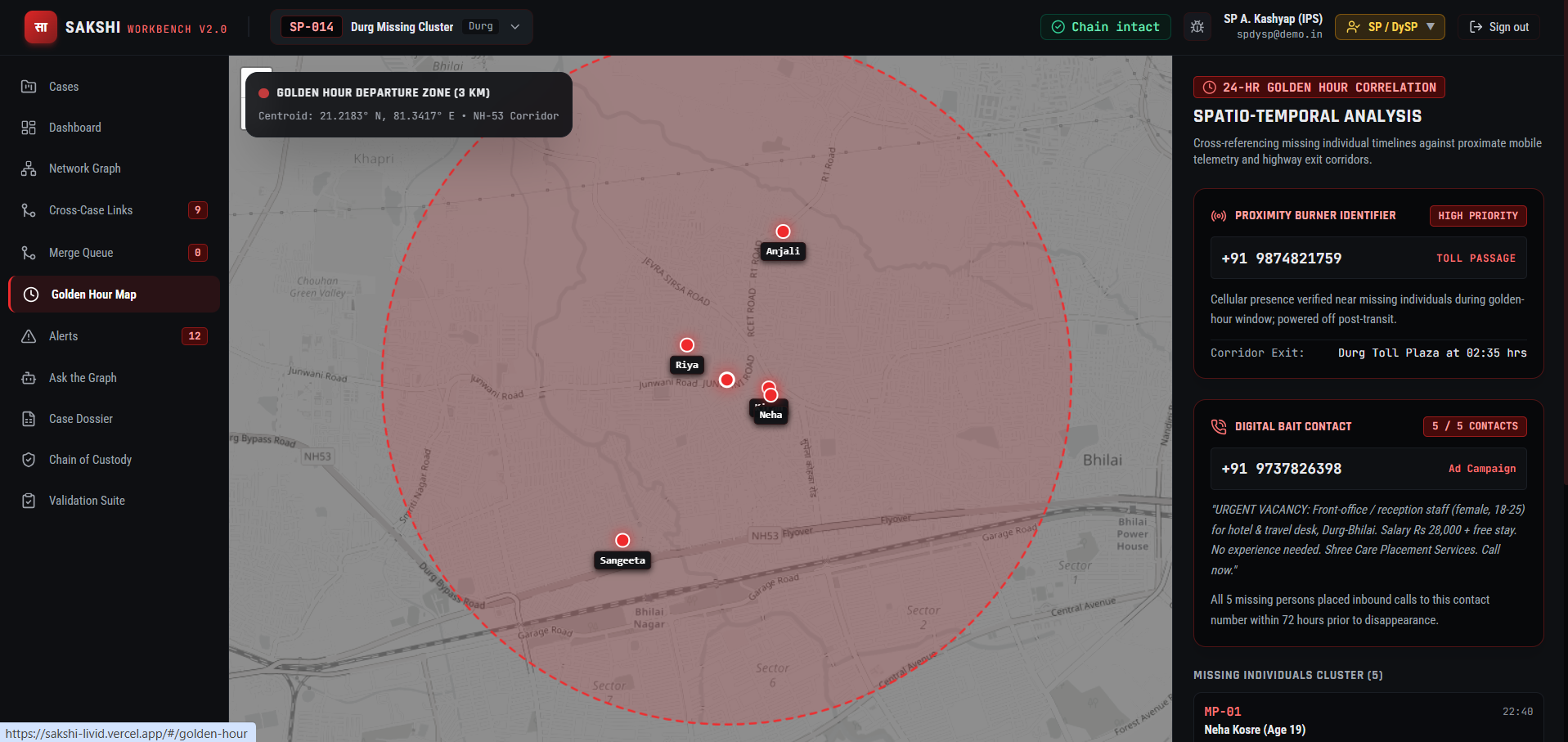
Maps missing-person locations and related phone activity across critical time windows.
-
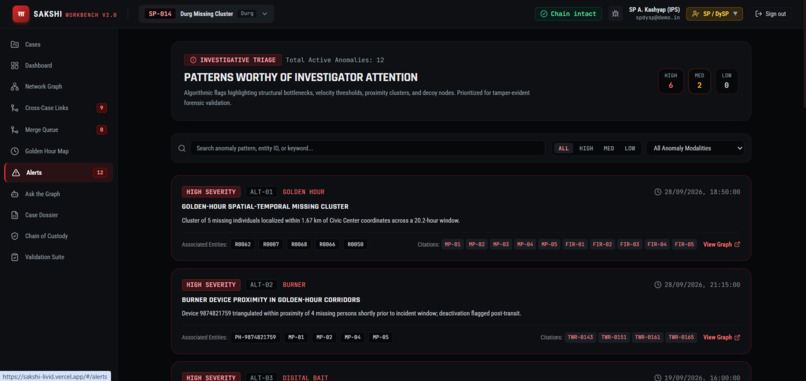
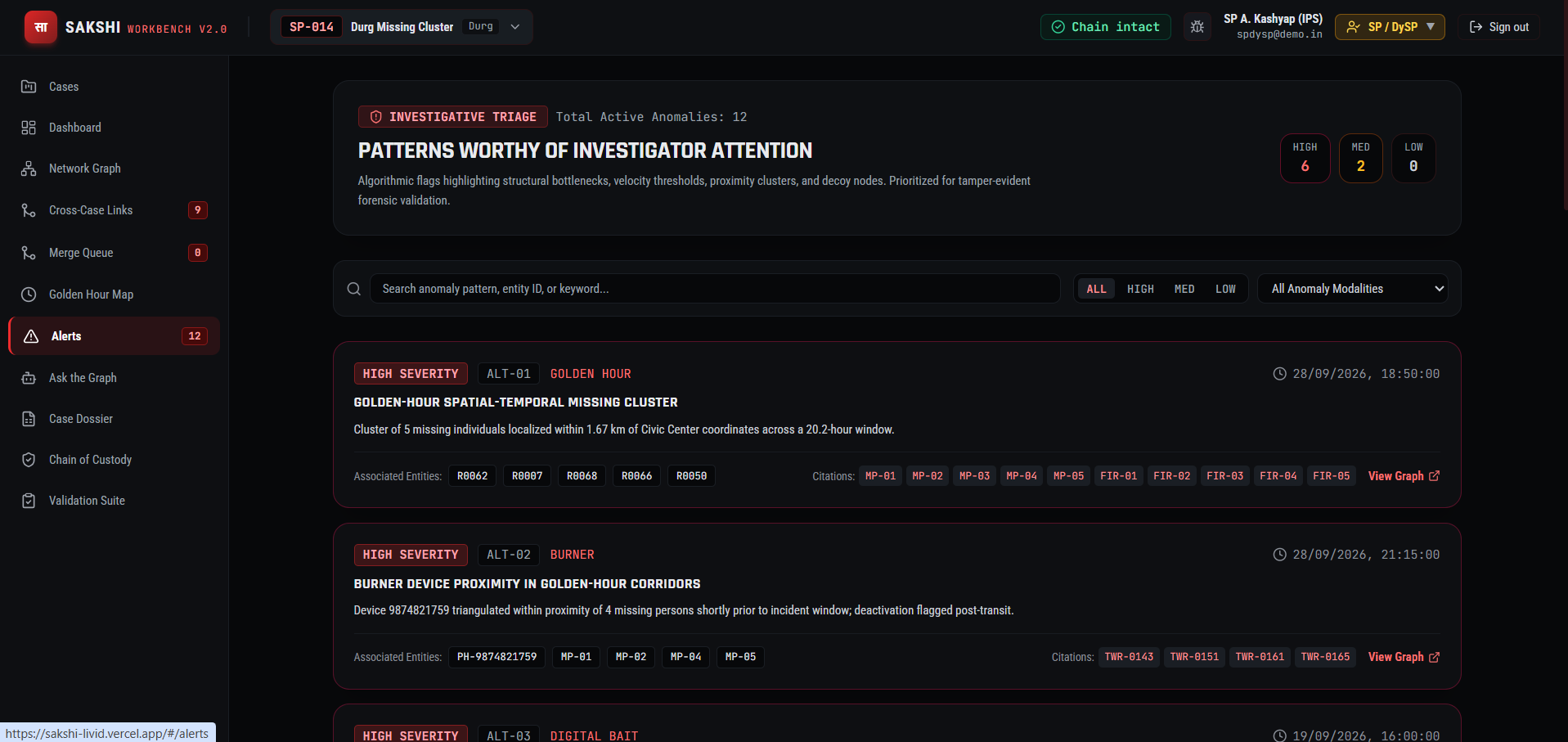
Highlights suspicious connections and patterns for investigator review.
-
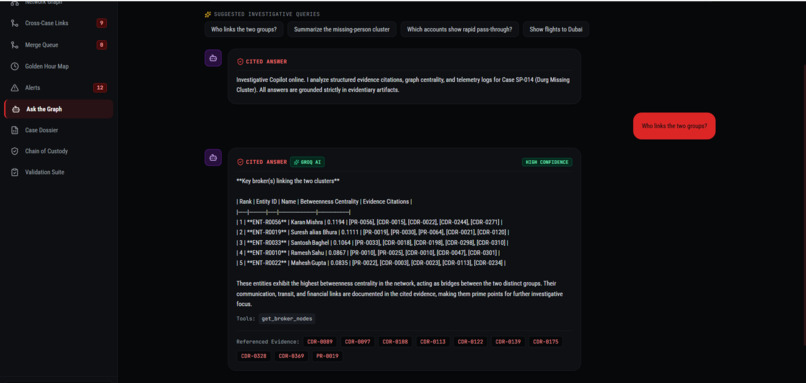
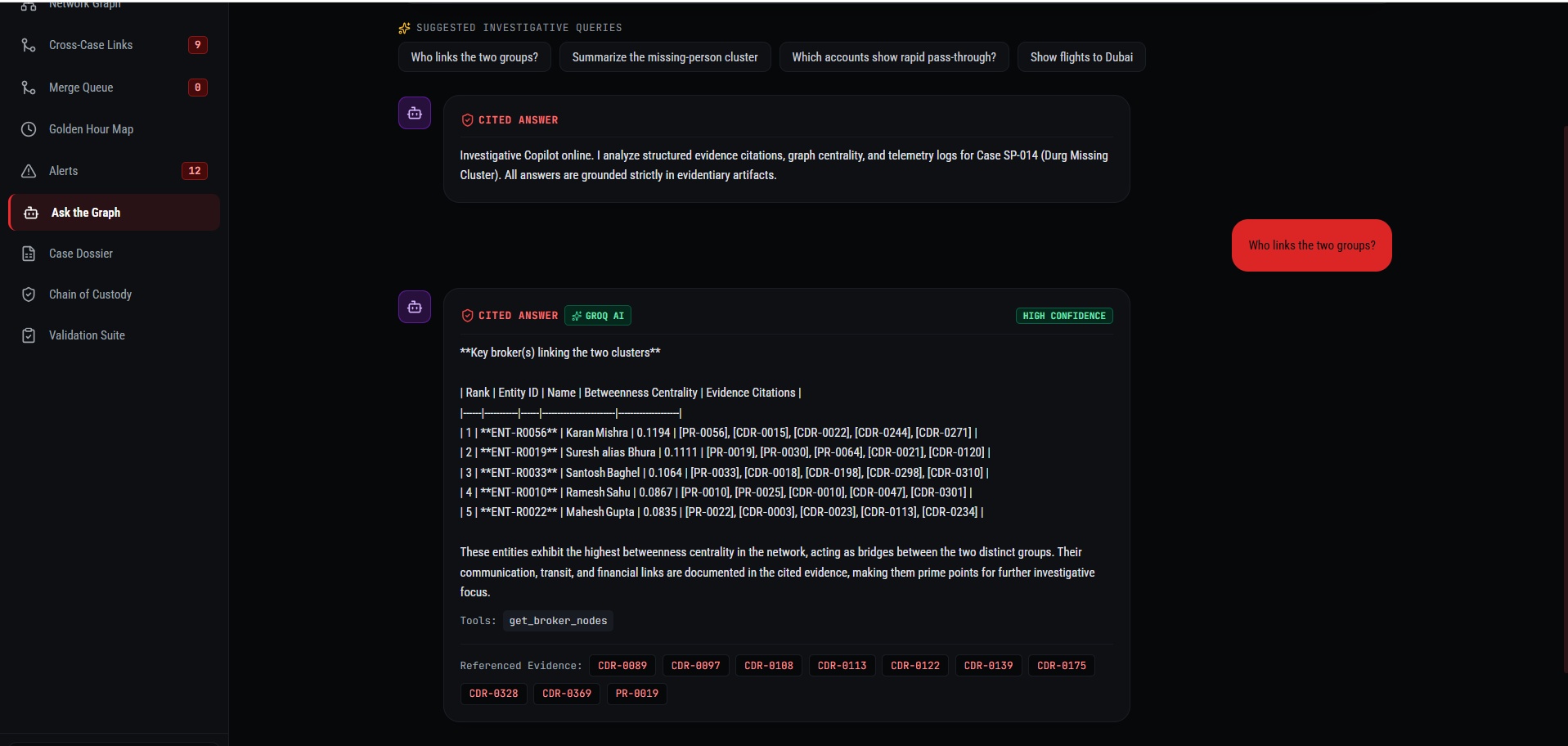
Ask investigative questions and explore AI-generated answers with evidence citations.
-
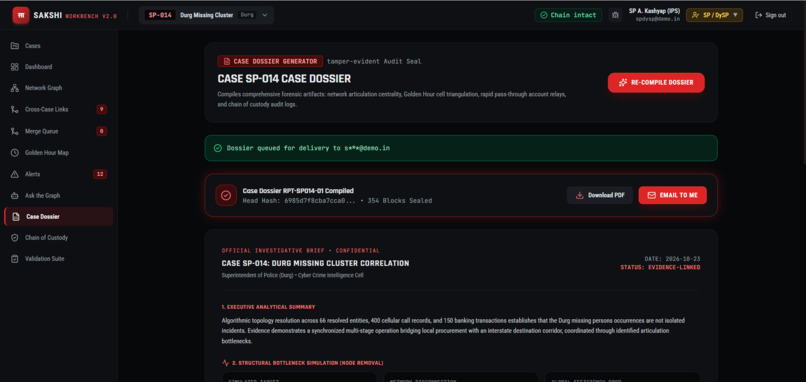
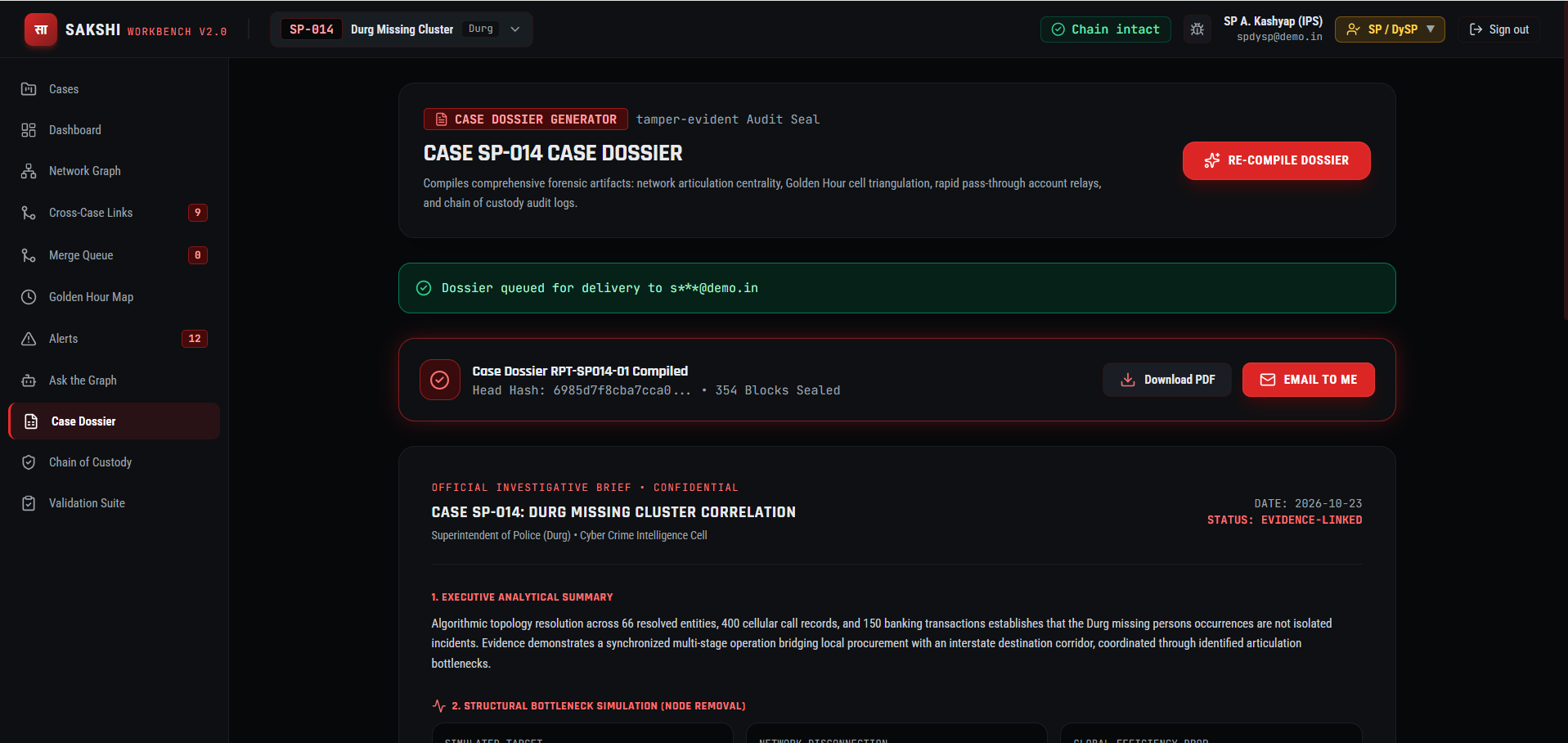
Compiles case findings and supporting evidence into a downloadable report.
-
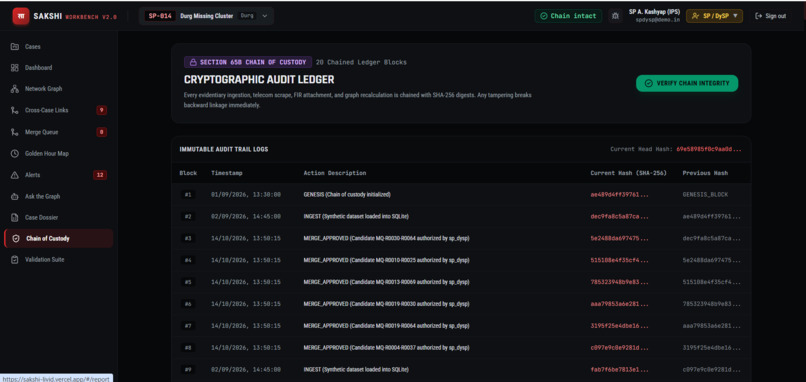
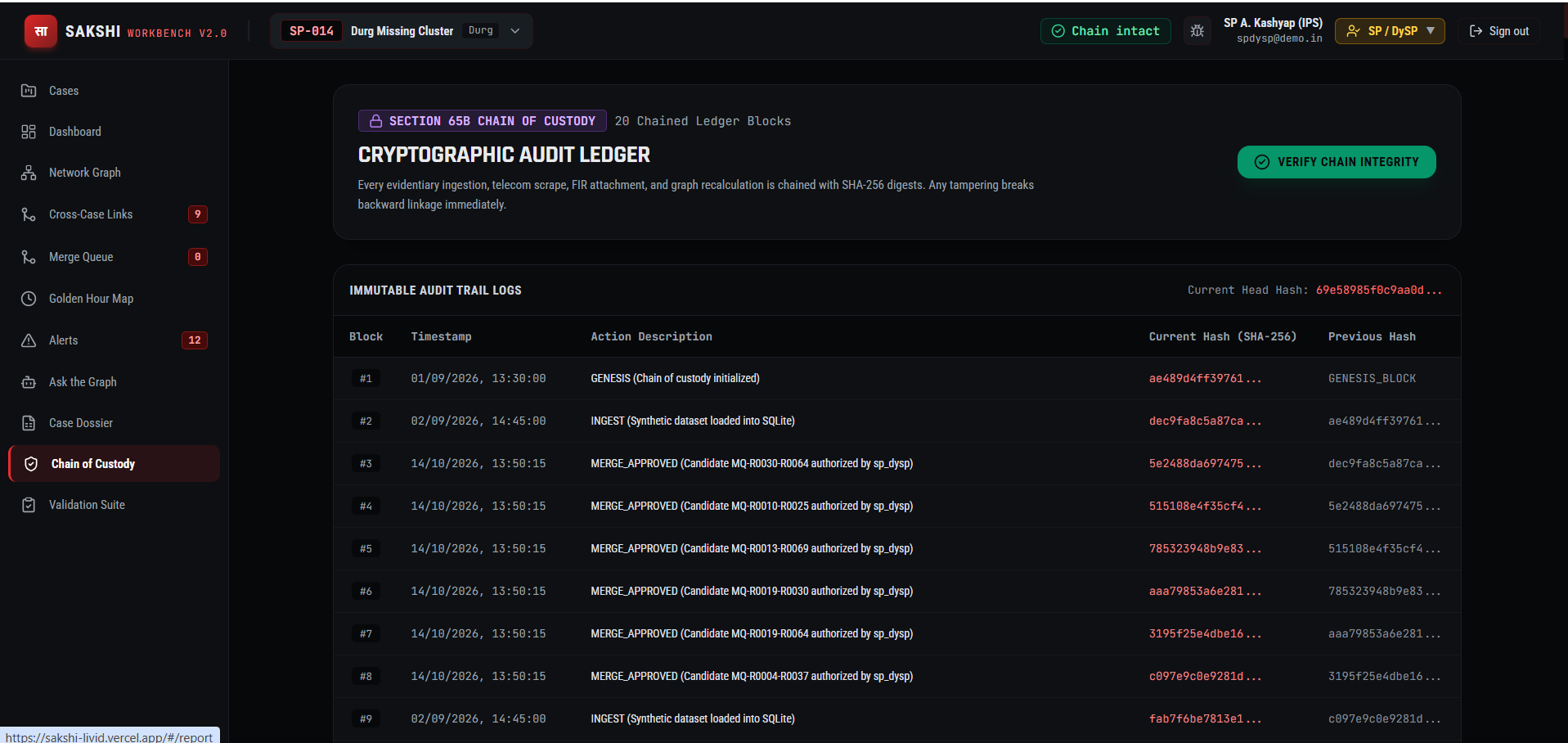
Reviews hash-linked audit records and verifies ledger integrity.
-
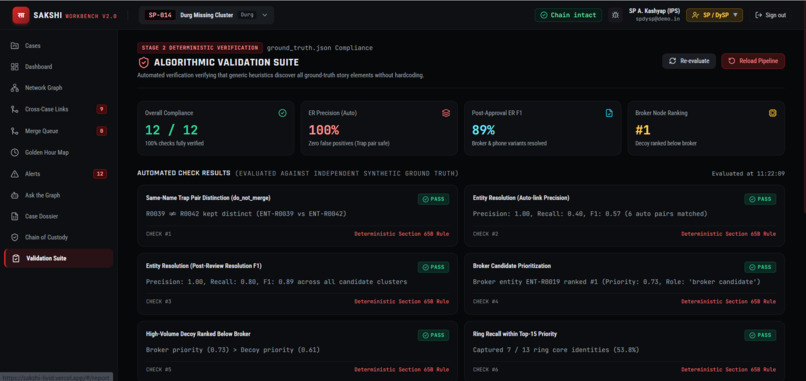
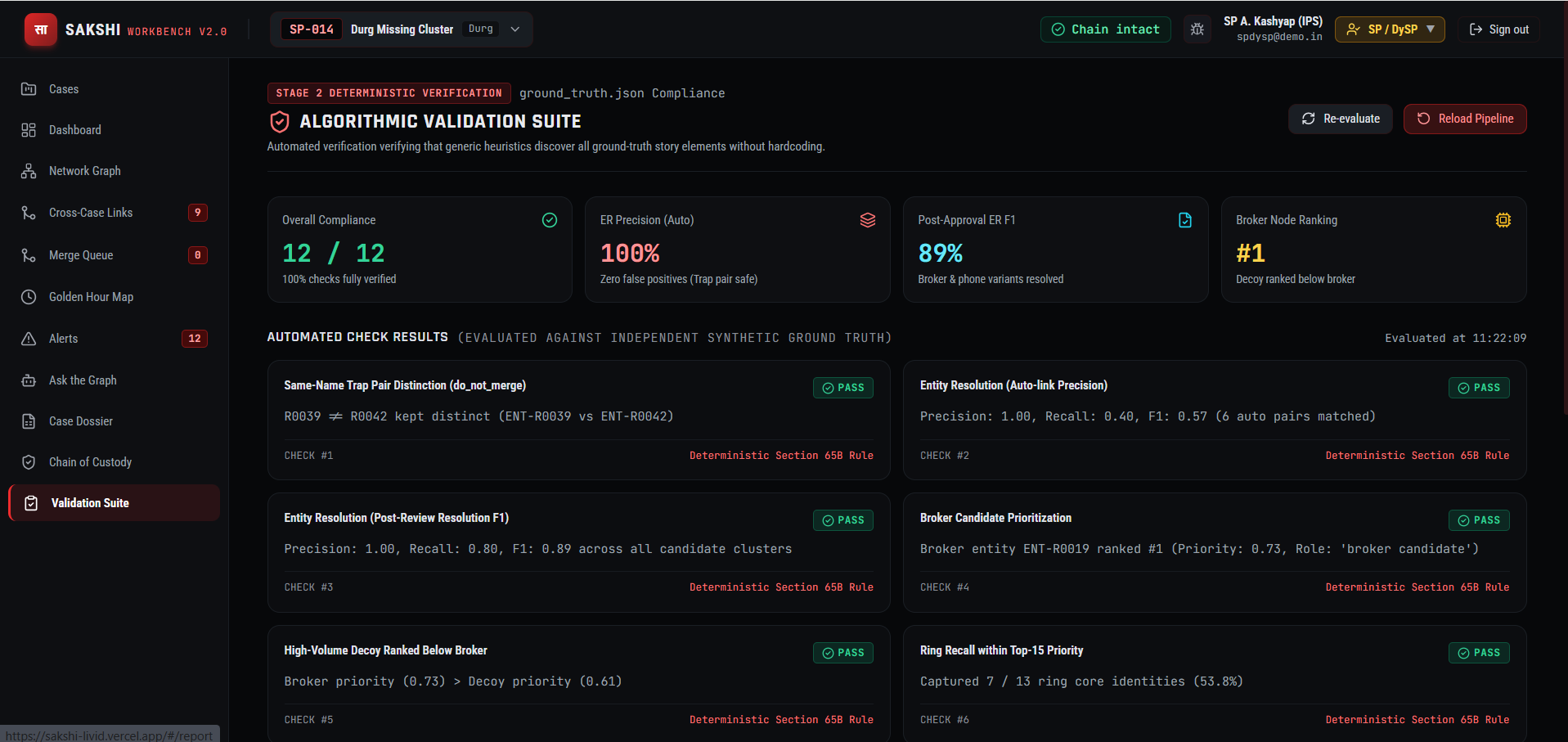
Tests entity matching, broker ranking, and patterns against synthetic ground truth.
Inspiration
Investigations often involve large amounts of scattered information, including incident reports, call records, financial transactions, phone numbers, vehicle details, and location records. When this information is reviewed separately, important connections can be difficult to identify.
We built SAKSHI to explore a simple but powerful idea: What if investigators could bring these records together, visualize their relationships, and understand exactly which evidence supports a finding?
Our goal is to make complex investigative information easier to explore, understand, and review through a unified, evidence-first intelligence platform.
What It Does
SAKSHI is an evidence-first intelligence workbench that organizes investigation records into an interactive relationship network.
Its key capabilities include:
- Interactive Relationship Graph: Visualize connections between people, phone numbers, vehicles, organizations, locations, and financial records.
- Entity Resolution: Identify possible duplicate identities when names or identifiers appear differently across records.
- Pattern Detection: Highlight unusual connections, shared contacts, suspicious transaction patterns, and location overlaps for further investigation.
- Evidence-Based Analysis: Help users inspect the records supporting a relationship or finding rather than relying on unexplained alerts.
- Investigation Support: Make it easier to explore complex networks and prioritize potentially relevant leads.
- Tamper-Evident Auditability: Support verification of recorded audit events so investigators can better review changes and actions.
For our demonstration, we use a fictional missing-person investigation set in the Durg region. The case contains deliberately designed patterns that demonstrate how separate pieces of information can connect through shared identities and relationships.
How We Built It
SAKSHI uses a modular architecture that separates the user interface, database, backend, and analysis logic.
- Frontend: React and Vite provide the user interface, while Tailwind CSS supports the design and styling.
- Backend: Python and FastAPI connect the frontend to the application's data and analysis functions.
- Database: SQLite stores structured investigation records.
- Graph Analysis: NetworkX helps analyze relationships and identify potentially important connecting entities.
- Pattern Detection: Rule-based checks and graph metrics help surface unusual patterns for further review.
- Data Visualization: Interactive network visualizations help users explore relationships between connected entities.
The workflow starts with structured investigation records. The system organizes the data, connects related entities, analyzes the resulting network, and presents relevant relationships for inspection.
We designed the demonstration around synthetic data so that we could test specific investigative scenarios without exposing real people's personal information.
Challenges We Faced
One of our biggest challenges was determining how to represent information from different sources in a single, understandable network. The same individual may appear under slightly different names, and a connection that looks important in one dataset may be misleading without supporting evidence.
Another challenge was distinguishing a genuinely useful connecting entity from a person who simply has many connections. A high number of calls or relationships alone should not automatically make someone the most important lead.
We focused on relationship context, supporting evidence, and explanations that allow users to inspect the underlying records. We also designed synthetic scenarios to demonstrate how connections across multiple data sources can reveal potentially relevant patterns.
What We Learned
Building SAKSHI helped us understand how frontend visualization, backend APIs, structured databases, and graph algorithms can work together to address complex information-management problems.
We also learned that detecting a pattern is only part of the solution. Explaining why that pattern matters and making its supporting evidence accessible are equally important.
Our approach emphasizes transparency, traceability, and human review rather than treating an algorithmic result as a final conclusion.
Future Scope
Our long-term vision is to expand SAKSHI into a more comprehensive investigation support platform.
1. Criminal Records Database Integration
We plan to integrate authorized and verified criminal records databases, where legally permitted, to help investigators check whether a person has a documented criminal history.
When an investigator examines a person in a case, SAKSHI could compare available identifying information against authorized records and display possible matches alongside their supporting details and confidence levels.
Any potential match would require verification by an authorized human reviewer. A name similarity or database match would not, by itself, establish identity, guilt, or involvement in a crime.
2. Advanced Identity Matching
We plan to improve identity resolution using names, aliases, phone numbers, and other legally accessible identifiers. This could help identify records that may refer to the same person across multiple sources while flagging uncertain matches for human review.
3. Cross-Case Intelligence
SAKSHI could connect relevant information across separate investigations to help identify recurring phone numbers, vehicles, organizations, financial links, and other relationships that might otherwise remain unnoticed.
4. Real-Time Data Integration
We aim to support authorized data feeds so that newly received records can be analyzed for potentially relevant connections to existing cases. The system could generate alerts when new information matches a known investigative pattern.
5. Advanced Graph Intelligence
Future versions could incorporate improved community detection, relationship scoring, temporal analysis, and multi-source evidence correlation to help identify important connecting entities and patterns across larger networks.
6. AI-Assisted Investigation Reports
We plan to enhance AI-assisted reporting so investigators can generate structured summaries, timelines, relationship explanations, and evidence-linked reports more efficiently.
Generated reports would distinguish verified records from inferred relationships and uncertain findings.
7. Geospatial Intelligence
We aim to expand location-based analysis to help investigators explore incident clusters, relevant location overlaps, and movement patterns using authorized and appropriately collected location records.
8. Stronger Security and Accountability
Future development will focus on stronger role-based access controls, secure authentication, sensitive-data masking, detailed audit trails, and improved integrity verification to help protect confidential investigative information.
Responsible Use
SAKSHI is designed as an investigation support tool, not an automated crime-prediction or guilt-determination system.
Its purpose is to help authorized investigators discover and examine potentially relevant relationships. Findings must be reviewed against reliable evidence, and any future integration with criminal records would require lawful access, appropriate privacy safeguards, careful identity verification, and human oversight.
All data used in our demonstration is synthetic.
Our Vision
We envision SAKSHI as a unified, evidence-first intelligence platform that brings scattered information together, reveals potentially important connections, and explains findings through traceable evidence.
By combining relationship analysis, data visualization, and responsible AI assistance, we aim to help investigators explore complex cases more efficiently while keeping transparency and accountability at the center of every decision.
Built With
- cytoscape.js
- fastapi
- javascript
- networkx
- python
- react
- restapi
- sqlite
- tailwindcss
- vite

Log in or sign up for Devpost to join the conversation.