-
-
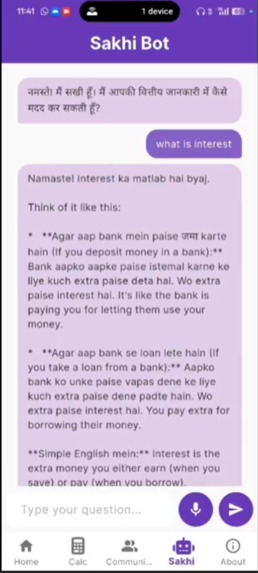
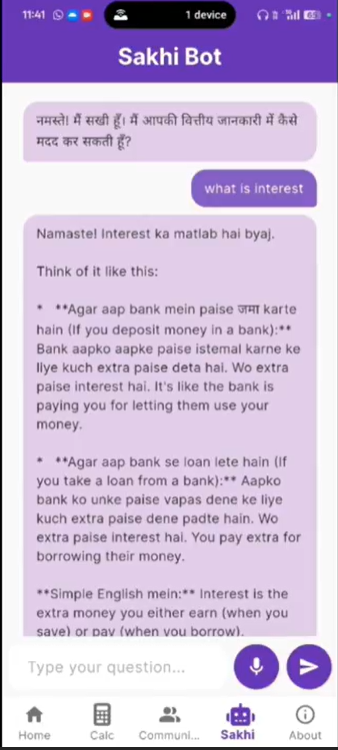
The AskSakhi AI which replies in the vernacular language of India, as selected By user
-
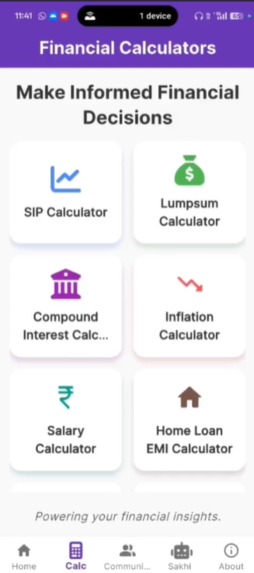
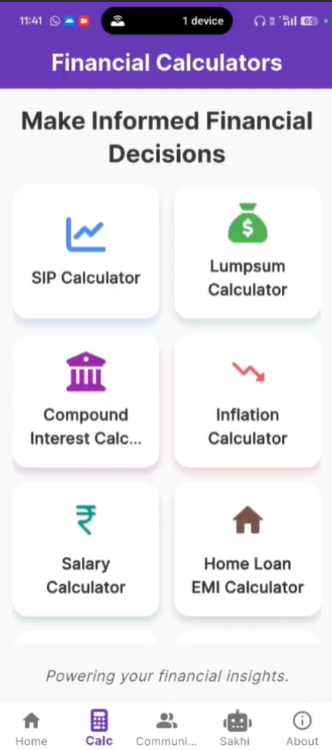
All sort of Financial Calculators
-
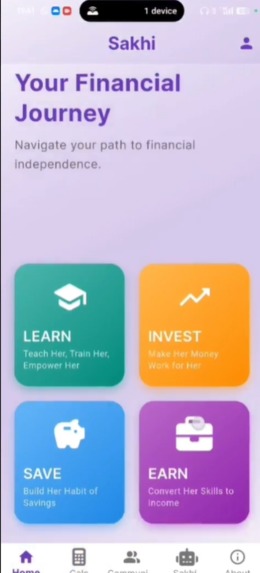
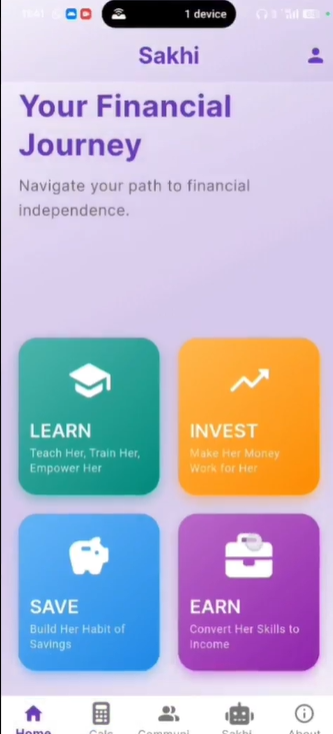
Dashboard of the App
Meaning of Sakhi
In Hindi, “Sakhi” means a trusted female friend or companion—someone who listens, supports, and stands by you in times of need. The name reflects our vision: a reliable, judgment-free financial companion for women.
Inspiration
I come from a rural part of India, where I have closely observed how financial decisions for women—whether related to savings, loans, healthcare, or education—are often made by male family members. This is rarely due to lack of capability, but rather due to limited access to financial knowledge, language barriers, and digital exclusion.
Many women in rural and semi-urban regions are uncomfortable with English-first financial tools, depend heavily on intermittent internet connectivity, and hesitate to ask questions due to social constraints. These realities highlighted a gap: financial systems exist, but they are not designed for women on the margins.
Sakhi was born from the belief that financial empowerment begins with understanding, and understanding begins when information is delivered in one’s own language, context, and environment.
What it does
Sakhi is an AI-powered financial guidance platform for women, designed with a strong focus on accessibility, inclusion, and autonomy.
The app provides:
- Personalized financial guidance on savings, budgeting, government schemes, and basic financial planning
- Support in 22 vernacular languages, enabling women to engage in their native language
- An offline-first experience, ensuring usability even in low-connectivity or no-connectivity environments
- A conversational interface that reduces intimidation and encourages learning at one’s own pace
Sakhi has already been used by over 1,000 women, validating the real-world need for a culturally aware and language-inclusive financial tool.
How we built it
Sakhi was built with a human-centered and systems-level approach.
From a technical standpoint:
- The application follows an offline-first architecture, using local storage and deferred sync mechanisms to ensure continuity without constant internet access
- A multilingual AI layer enables dynamic language switching and vernacular understanding across 22 languages
- Financial guidance logic is modular, allowing easy adaptation to region-specific rules, schemes, and literacy levels
- The frontend prioritizes low cognitive load and minimal navigation, suitable for first-time smartphone users
From a design standpoint:
- We focused on trust, simplicity, and non-judgmental interaction
- Content is contextualized rather than generic, reflecting real-life financial scenarios women face
Challenges we ran into
One of the biggest challenges was balancing technical sophistication with usability. Advanced AI systems often assume continuous connectivity and high digital literacy, which directly conflicts with rural realities.
Other challenges included:
- Ensuring accurate financial guidance while keeping explanations simple
- Handling multilingual nuances, dialects, and culturally specific phrasing
- Designing an interface that feels empowering rather than instructive or authoritative
- Building trust in communities where digital financial tools are still viewed with skepticism
Each challenge pushed us to rethink default assumptions and design for constraints rather than ideal conditions.
Accomplishments that we’re proud of
- Successfully enabling financial guidance in 22 vernacular languages
- Reaching and impacting 1,000+ women users, many of whom were first-time digital finance learners
- Designing an offline-capable financial guidance system
- Creating a platform that addresses not just access to finance, but agency in financial decision-making
What we learned
We learned that technology alone does not empower—context does.
True financial inclusion requires:
- Respect for language and culture
- Systems that work under real-world constraints
- Designing with users, not just for them
We also learned that women are eager to take control of their finances when given the right tools, environment, and trust.
What’s next for Sakhi
Going forward, we aim to:
- Expand offline capabilities further for ultra-low connectivity regions
- Partner with NGOs, SHGs, and CSR initiatives to scale adoption
- Introduce region-specific financial modules and government scheme integrations
- Strengthen data privacy and explainability to build deeper trust
Sakhi’s long-term vision is to become a globally adaptable model for women-centric financial empowerment, starting from rural India and extending to underserved communities worldwide.
