Inspiration
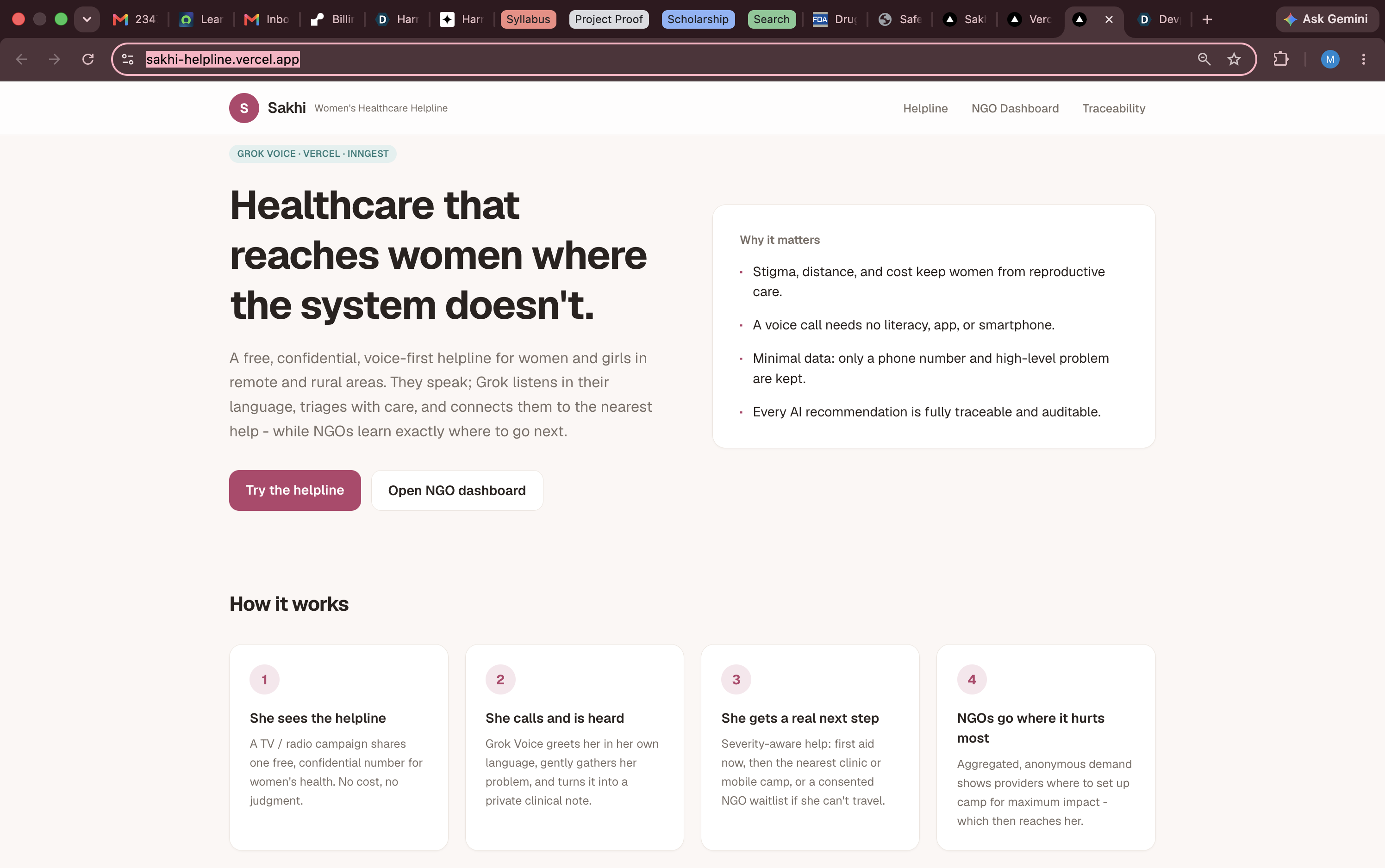
For women and girls in remote and rural areas, a simple health question can be blocked by distance, cost, and stigma all at once. Many never reach a clinic in time, and the NGOs trying to help are flying blind about where need is actually concentrated. We wanted one free, confidential phone number that meets a woman in her own language and, at the same time, tells providers exactly where to show up. Sakhi (meaning "friend") is that bridge between a quiet call for help and real care on the ground.
What it does
Sakhi is a voice-first healthcare helpline with two connected sides:
- For callers: A woman calls and speaks naturally in her own language. A Grok voice agent triages with care, builds a structured clinical note, assesses severity, and gives a ranked, escalating set of recommendations — first-aid guidance, a referral to the nearest capable clinic, and, with consent, a spot on an NGO outreach waitlist.
- For NGOs: An impact dashboard shows anonymized, aggregated demand on a live map, highlighting under-served areas as recommended camp locations. NGOs filter by need, request a camp (services, date, expected reach), and activate it.
- The loop: Activating a camp turns that area into "covered" and automatically notifies waitlisted callers nearby — so a single call becomes real care, and that care feeds back into what the helpline can offer the next person.
- Full traceability: Every AI tool call and recommendation is an append-only record, viewable as a care journey, formatted recommendations, and a complete audit timeline.
How we built it
- Next.js (App Router) + React on Vercel for the app and API routes.
- xAI Grok & Grok Voice Agent API for multilingual speech-to-speech intake with tool calling, plus structured note + severity generation. The browser mints a short-lived ephemeral token server-side, so the real API key never leaves the backend.
- Inngest durable workflows for post-call note distillation and waitlist notifications when a camp goes live.
- Drizzle ORM + PGlite (embedded Postgres) for zero-setup local data, swappable for Neon in production.
- Leaflet + OpenStreetMap for the demand heatmap, with privacy-preserving ~11km aggregation cells.
- Tailwind CSS for an interactive UI: filterable map, trend stat cards, a demand-by-need chart, a camp-request flow, and a redesigned traceability view with a journey stepper and audit timeline.
Challenges we ran into
- Privacy vs. usefulness: Showing NGOs enough to act without ever exposing an individual — solved with coarse geo-cells and minimal data capture (partial phone, region, high-level problem).
- Trustworthy AI: Making every AI decision auditable led us to an append-only design for recommendations and audit events, so nothing the system does is invisible afterward.
- Tooling gotchas: PGlite's WASM assets broke under the bundler until we marked it as a server-external package, and we had to pin the right Node version for the framework. Single-process file-backed DB also meant being careful about migrations vs. a running server.
- Demoability: We built a text-intake fallback that drives the exact same tools and data, so the whole product is demoable even without API credentials.
Accomplishments that we're proud of
- A genuine closed loop: need → recommendation → deployment → notification, end to end.
- AI you can hold accountable — full, human-readable traceability of every step.
- A polished, interactive NGO dashboard (live map, filters, trends, camp workflow) instead of a static report.
- Privacy-first by design, and fully functional with or without live credentials.
What we learned
- In sensitive health contexts, trust is the product — traceability and consent matter as much as the triage itself.
- Aggregation and minimal data capture can deliver real operational value without compromising privacy.
- Durable, append-only workflows make AI behavior debuggable, explainable, and safe to ship.
- Designing for an offline/fallback mode forces cleaner architecture and a far more reliable demo.
What's next for Sakhi: BestFriend
- Real telephony: Integrate with phone/SMS gateways so callers reach Sakhi on any basic handset, no smartphone required.
- More languages & dialects, plus a low-literacy, voice-only experience.
- Proactive follow-ups: Post-camp check-ins and medication/appointment reminders.
- Smarter routing: Predictive demand forecasting and optimal camp placement across multiple NGOs.
- Provider integrations: Two-way coordination with clinics and health workers, and outcome tracking to measure real impact.
- Safeguards & governance: Clinical review of escalation logic, bias monitoring, and consent/audit controls ready for partner deployment.
Built With
- cursor
- grok
- inngest
- vercel
- xai

Log in or sign up for Devpost to join the conversation.