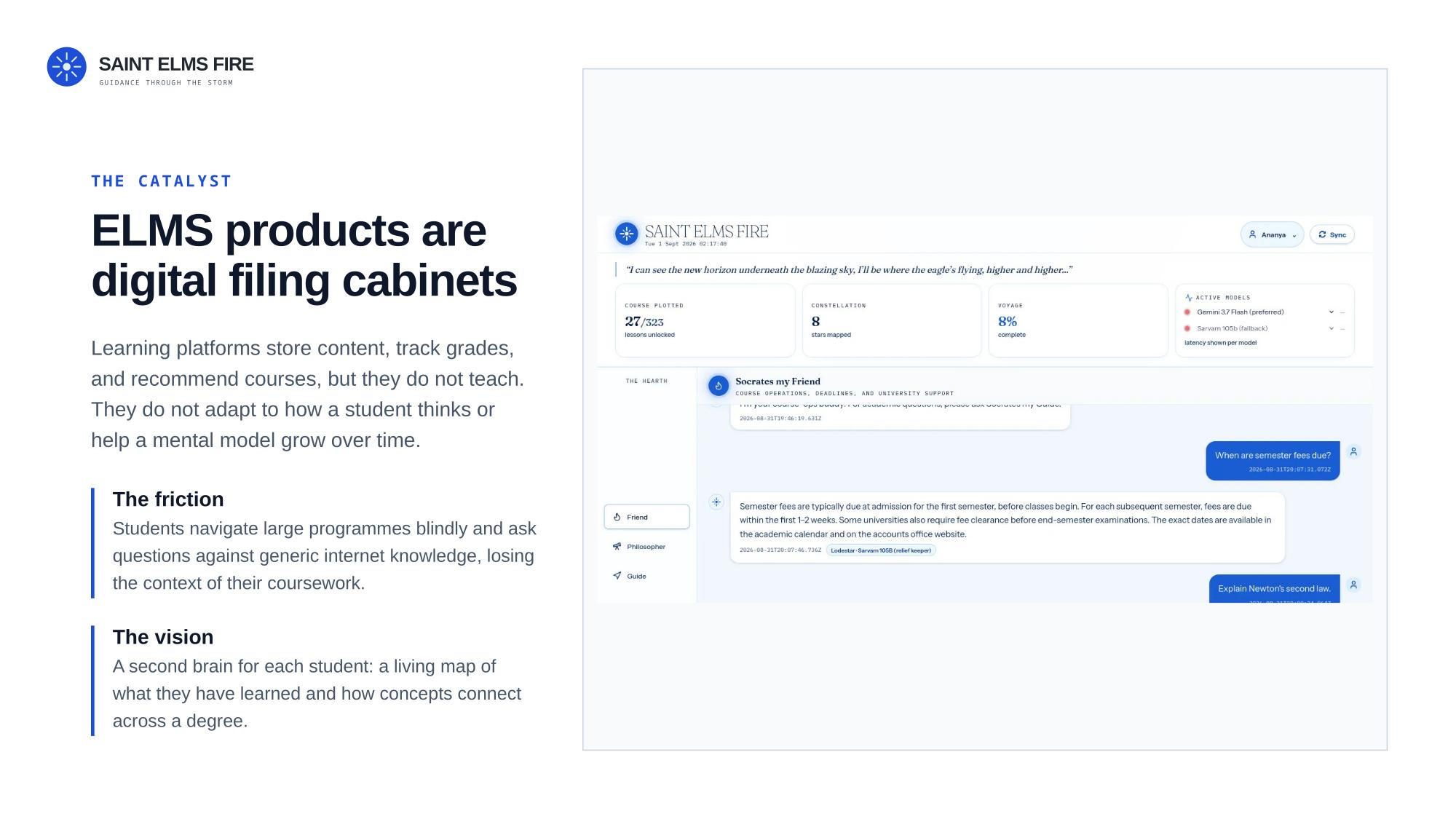
This project began about a week ago as a fallout of an argument I had with my wife Vidya, an ed-tech industry professional. She sees every day how learning platforms fail students. Most ELMS products today are digital filing cabinets — they store content, track grades, and maybe recommend a course. But they don't teach. They don't adapt to how a student actually thinks, or help them build a mental model that grows over time.
That argument stuck with me. I'm a documentary photographer turned data scientist — I've spent my career trying to make complex systems legible. And I realized: what if an ELMS could be different? What if it could build a "second brain" for each student — a living map of what they've learned and how concepts connect across their entire degree?
Saint Elms Fire is my implementation of that vision.
What it does
Saint Elms Fire is a next-generation e-learning management system (ELMS) built on Gemini and Google Cloud. It has four core capabilities:
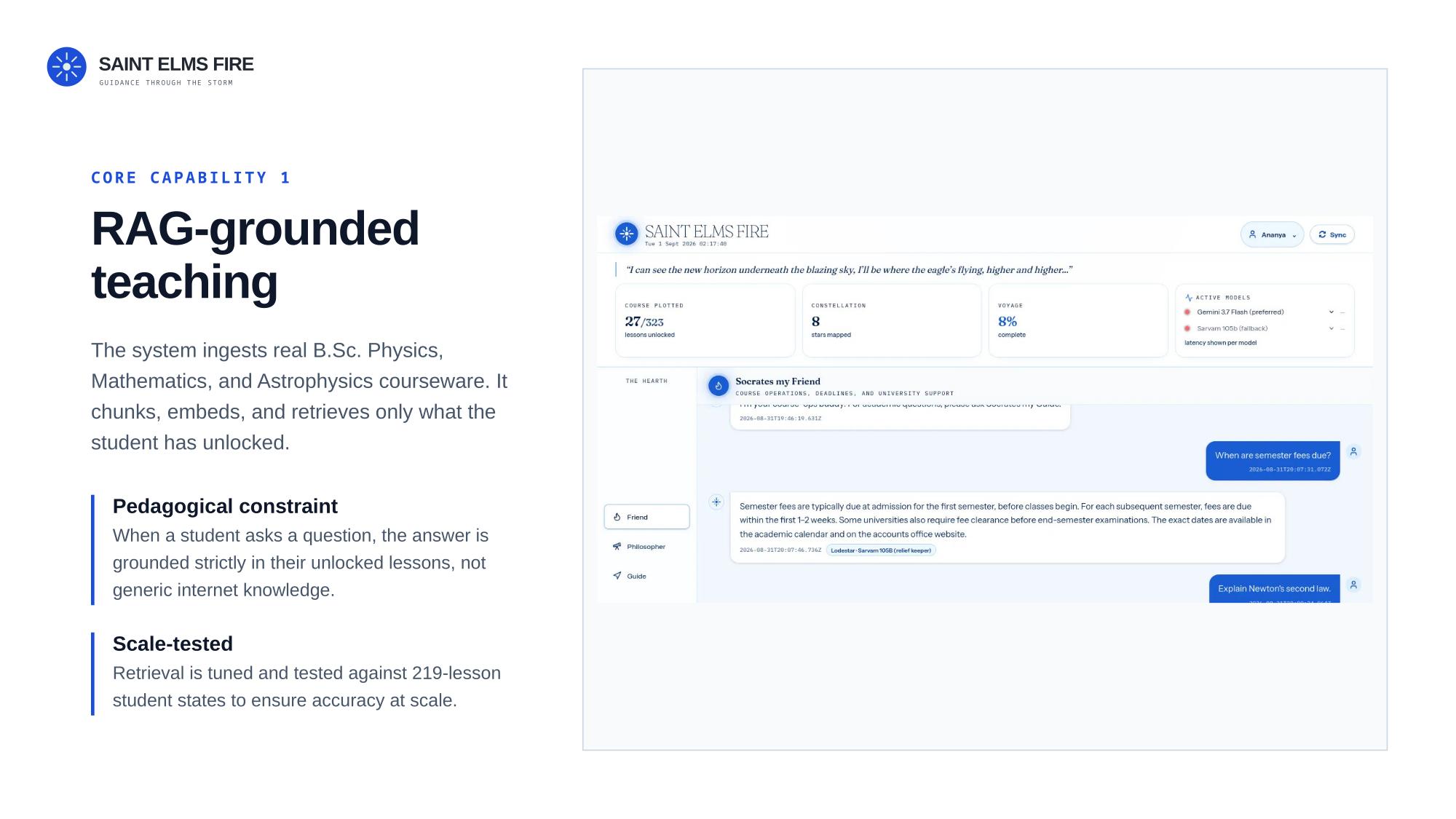
1. RAG-grounded teaching over real courseware. The system ingests courseware custom developed to meet the requirements of an actual programme — B.Sc Physics, Mathematics, Astrophysics as offered by Christ University in Bangalore. It chunks it, embeds it, and retrieves it when students ask questions. When Chetna (a first-year student in our demo) asks "What is resonance in a driven oscillator?", the answer is grounded in her 219 unlocked lessons, not generic internet knowledge. This is retrieval-augmented generation doing actual pedagogical work.
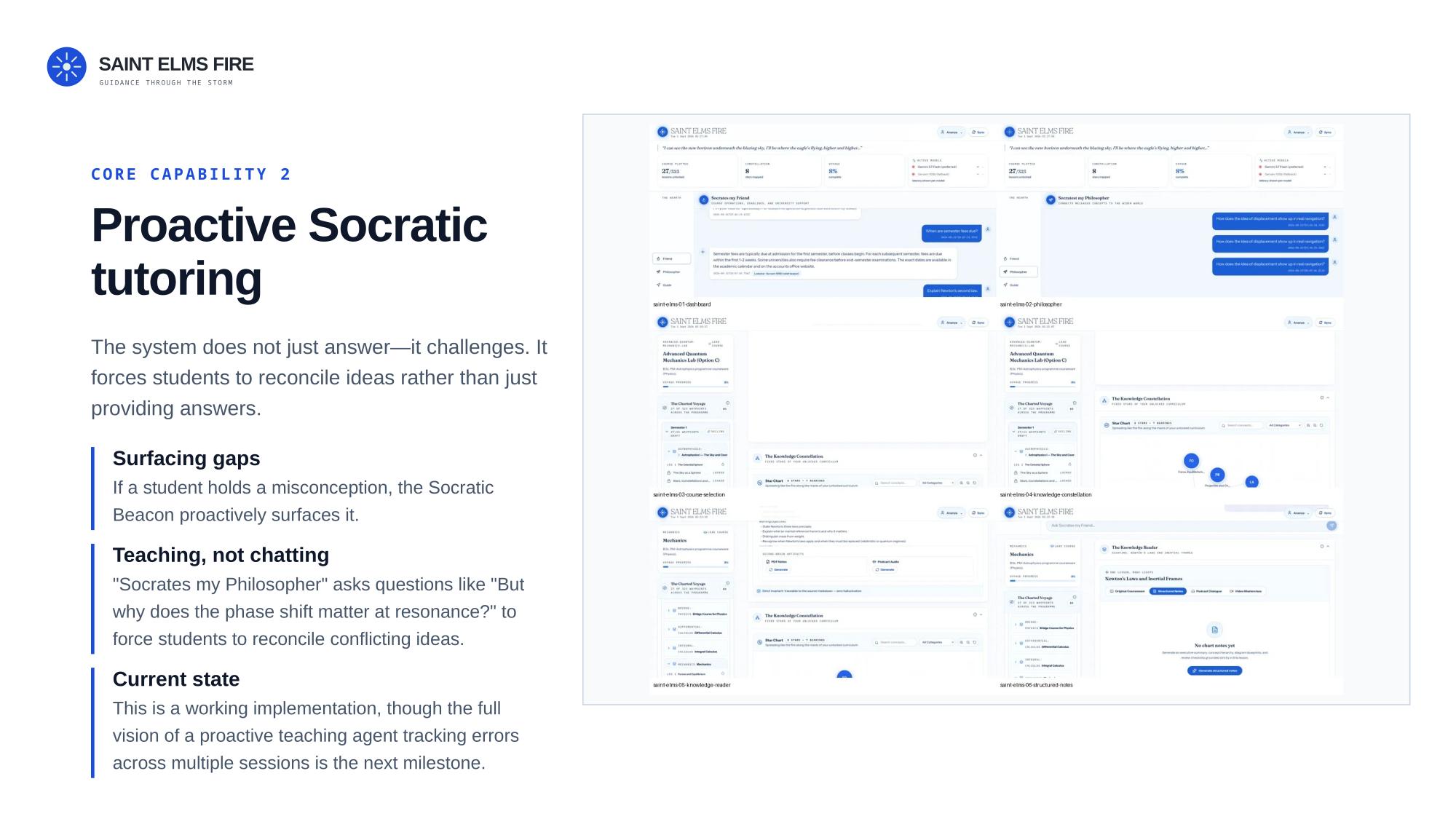
2. Proactive Socratic tutoring. The system doesn't just answer — it challenges. If a student holds a misconception, the Socratic Beacon proactively surfaces it. When Chetna thinks resonance is just about amplitude, "Socrates my Philosopher" asks: "But why does the phase shift matter at resonance?" — forcing her to reconcile conflicting ideas. This isn't reactive chat; it's a teaching agent that watches for gaps.
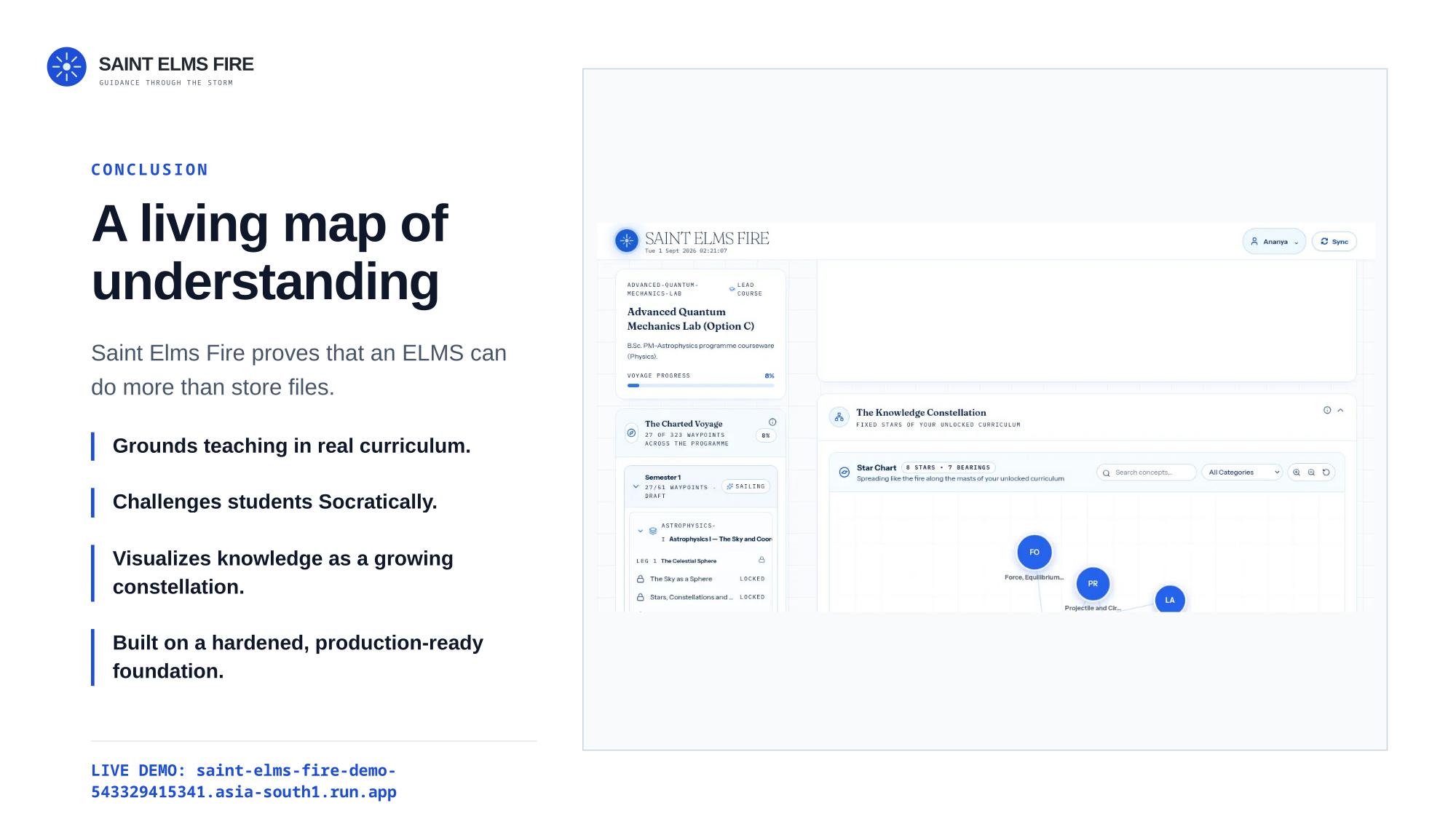
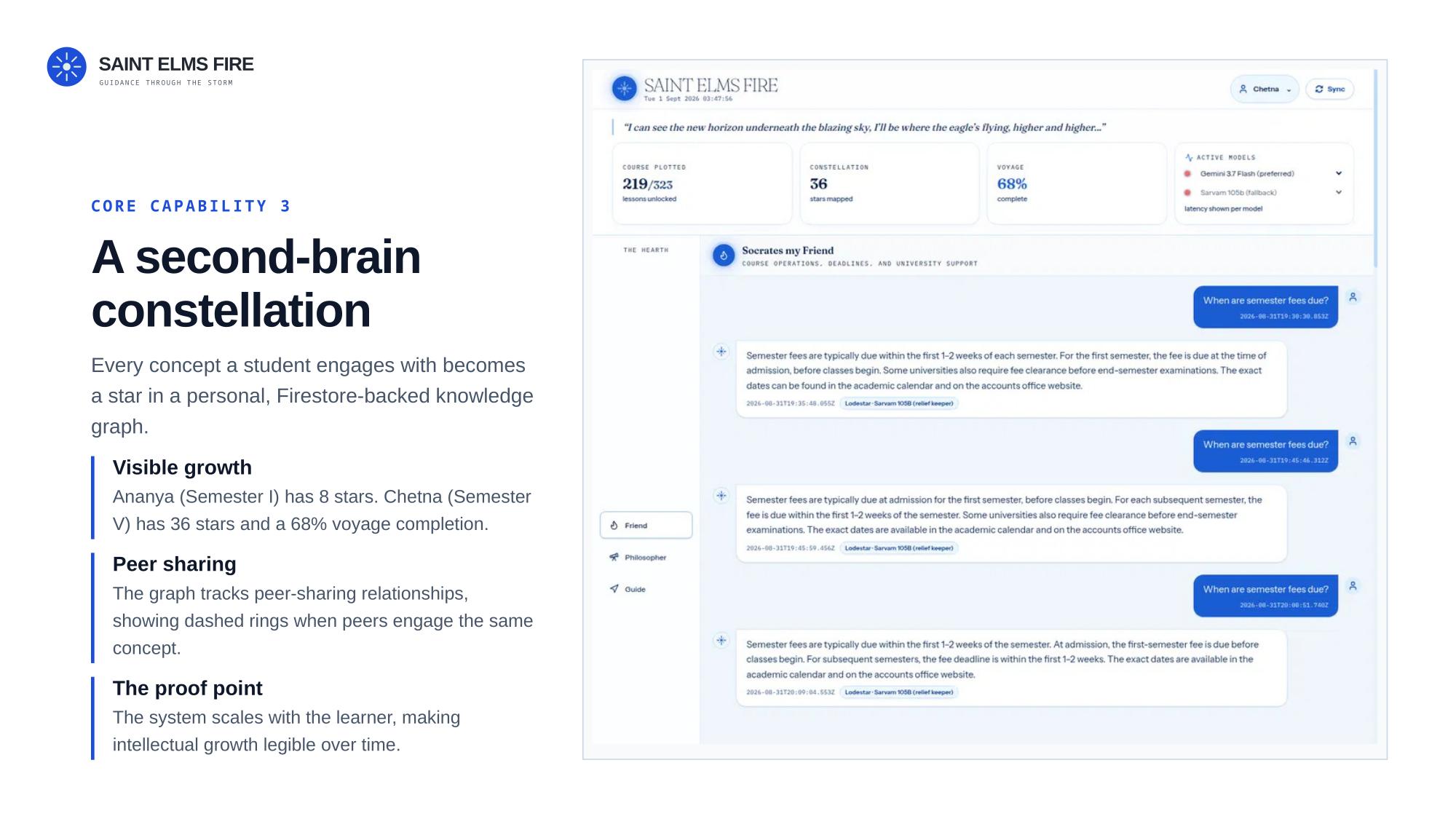
3. A second-brain constellation. Every concept a student engages with becomes a "star" in a personal knowledge graph. Ananya has 36 stars as a first-year student. Chetna, further along in her journey, has 236 stars. The constellation grows denser as they progress. Students can see their own intellectual growth visually — and they can see when a peer has engaged with the same concept (shown as a dashed ring around a star). This is the "second brain" made visible.
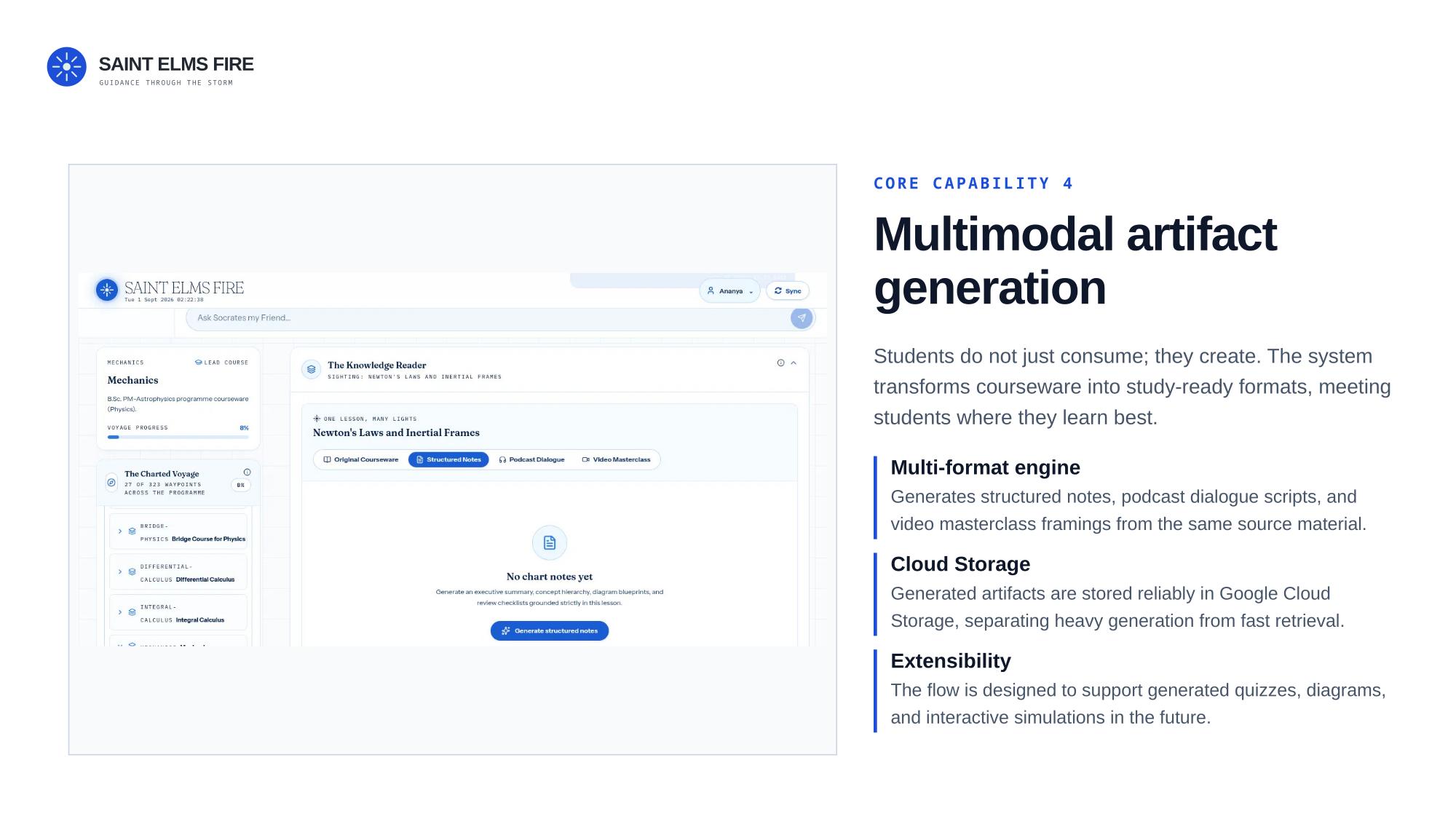
4. Multimodal artifact generation. Students don't just consume — they create. The system can generate structured notes, podcast episodes, and other artifacts from courseware. Chetna can ask for a podcast explaining resonance; the AI produces a script, converts it to audio, and stores it in Google Cloud Storage. This meets students where they are: some learn by reading, others by listening, others by doing.
How I built it
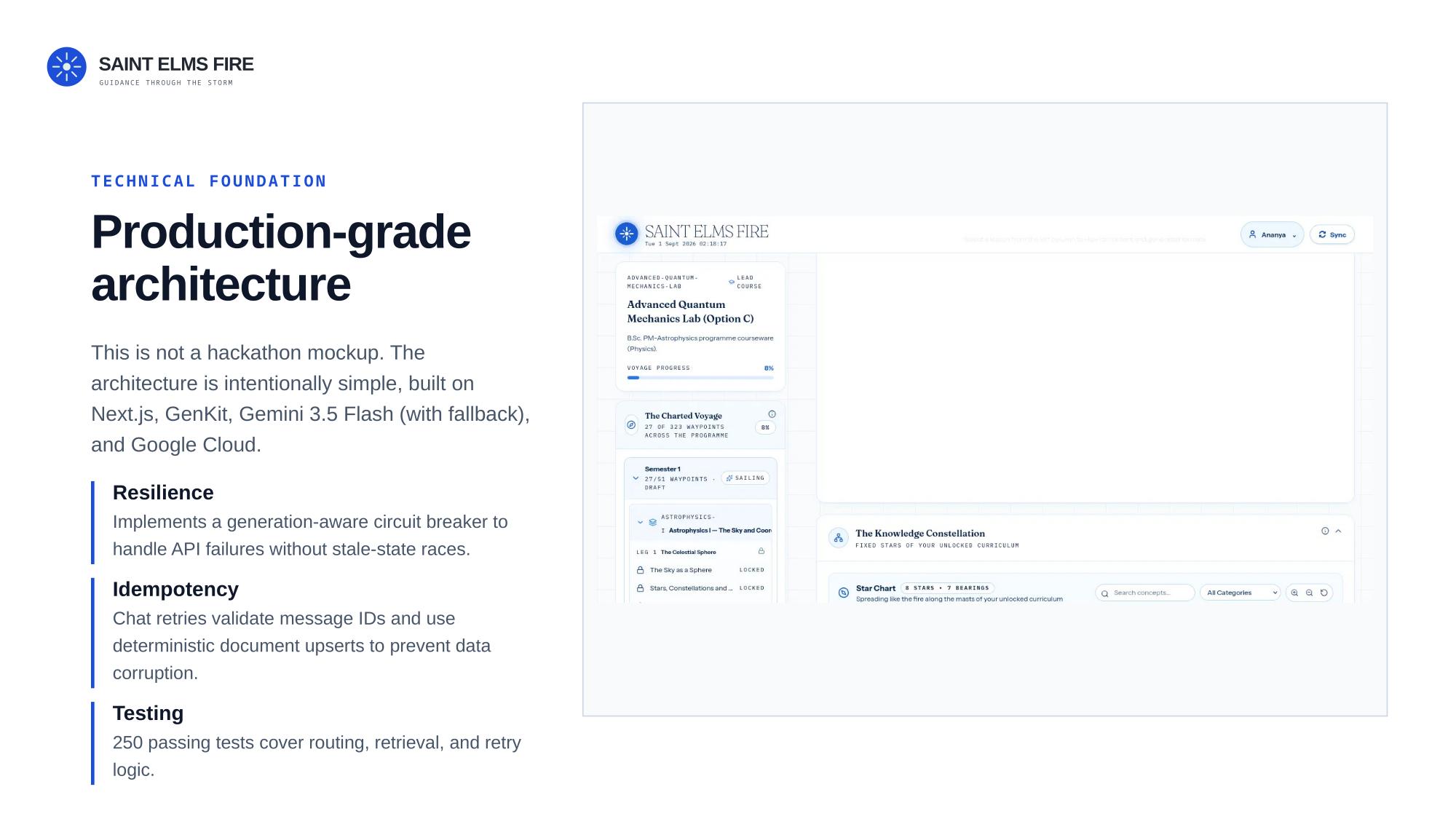
The architecture is intentionally simple and production-ready:
- Next.js hosts the frontend and API routes on Google Cloud Run.
- GenKit orchestrates AI flows:
guide-chatfor RAG-grounded Q&A,socratic-tutorfor proactive challenges,multi-formatfor artifact generation, andingestionfor courseware processing. - Gemini 3.5 Flash is the primary LLM, with a fallback model configured in GenKit for resilience.
- Firestore stores three things:
- Vector embeddings for RAG retrieval.
- Graph data for the constellation (stars, peer-sharing relationships).
- Course releases and student state (which lessons are unlocked for which student).
- Google Cloud Storage holds generated artifacts (audio files, PDFs, etc.).
- Secret Manager stores API credentials and auth secrets.
The system implements production patterns: a generation-aware circuit breaker to handle API failures, idempotent chat retries to prevent duplicate documents, and structured logging for observability. These aren't demo tricks — they're the kind of hardening you'd expect in a real product.
The entire codebase is public at https://github.com/thecont1/saint-elms-fire. It's built with TypeScript, Bun, and Tailwind CSS, with 250 passing tests covering routing, retrieval, and retry logic.
Challenges I ran into
RAG retrieval at scale. Midway through development, the system failed to retrieve answers for in-syllabus questions when tested against Chetna's full 219-lesson corpus — even though the same questions worked fine against small test fixtures. This was a scale-dependent bug: either the indexing pipeline was silently dropping embeddings in large batches, or the retrieval threshold was tuned too aggressively for a tiny corpus.
I spent an entire phase (Phase 9) triaging and fixing this. The root cause was a combination of factors: the retrieval threshold was over-filtering valid matches as the corpus grew, and there were edge cases in how the ingestion flow handled large batch releases. The fix involved adjusting the similarity threshold, adding a scale-aware regression test with hundreds of lessons, and building a smoke-test script to verify retrieval before any live demo.
Circuit breaker races and stale state. Early versions of the generation-aware circuit breaker had race conditions where stale pre-open results could incorrectly affect admission decisions. This was fixed by adding generation tags to admissions and guards to ignore stale results. The fix is now regression-tested with 250 tests passing.
Idempotent retries. Chat retries were initially creating duplicate documents in Firestore. This was fixed by validating message IDs and using deterministic document IDs with upserts (doc(id).set()). Tests cover both failure→retry and failure→failure durability.
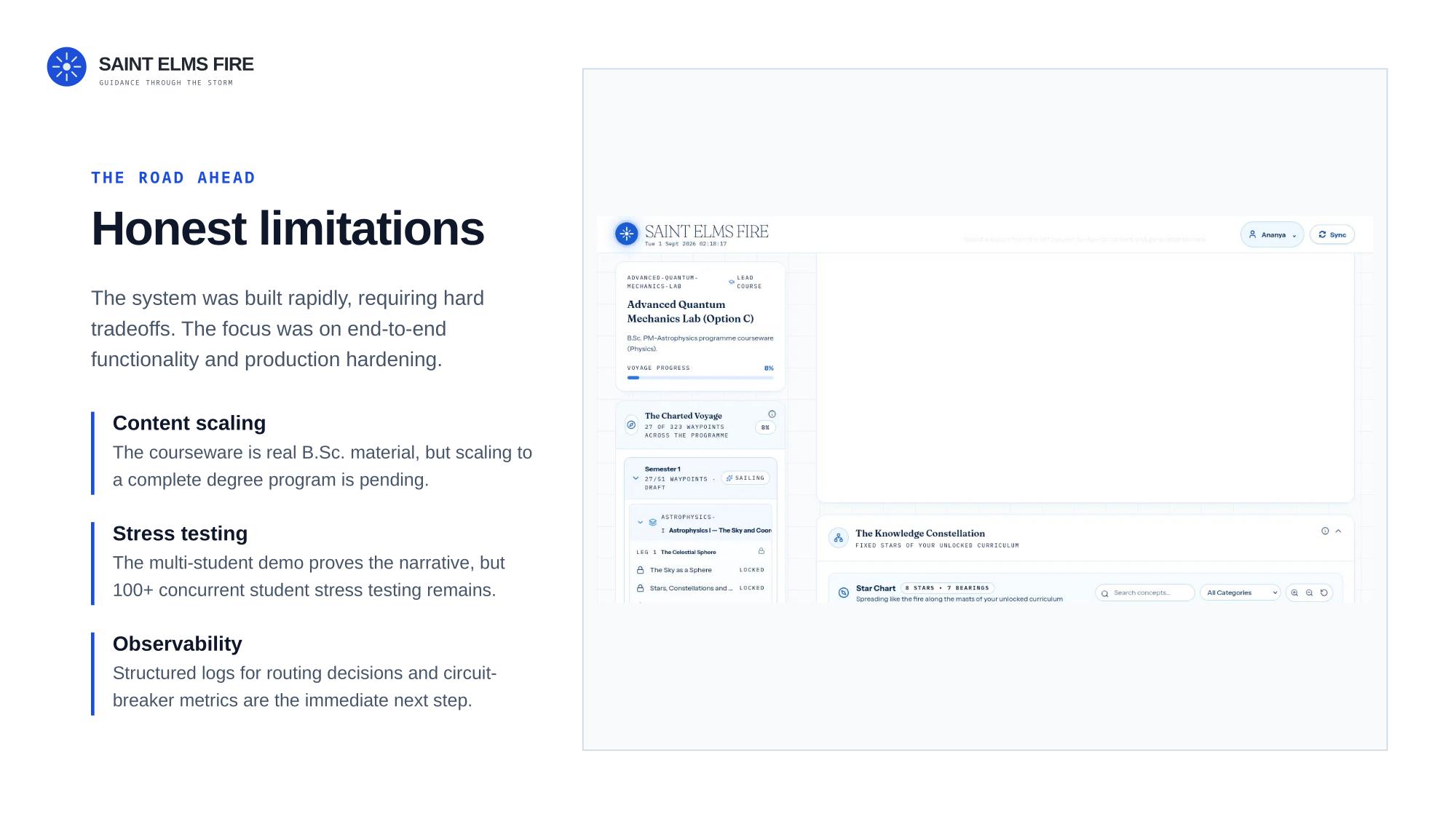
Time pressure. This entire project was built in about a week. That meant making hard tradeoffs: the Socratic Beacon is implemented but not yet as sophisticated as the full vision; the courseware is real B.Sc. material but not yet a complete degree program; the multi-student demo is a narrative proof point, not a large-scale stress test.
Accomplishments that I'm proud of
End-to-end functionality. The system works. RAG-grounded chat, Socratic tutoring, constellation visualization, and artifact generation all run end-to-end on Google Cloud. This isn't a mockup — it's a working system.
Production-grade hardening. Despite the time pressure, I didn't cut corners on resilience. The circuit breaker, idempotent retries, and structured error classification are all implemented and tested. These are the kinds of patterns you'd expect in a real product, not a hackathon demo.
The second-brain metaphor made real. The constellation isn't just a visualization gimmick — it's a real Firestore graph that tracks peer-sharing relationships and grows with the student. Seeing Ananya's 36 stars vs Chetna's 236 stars side-by-side is the clearest proof point I have that the system scales with the learner.
What I learned
RAG is only as good as your retrieval tuning. A similarity threshold that works for a 2-lesson test corpus will fail catastrophically at 200+ lessons. You need scale-aware tests from day one, not as an afterthought.
Circuit breakers need generation awareness. A naive circuit breaker that doesn't track which "generation" of requests it's protecting can make wrong decisions when concurrent requests are in flight. Tagging admissions by generation is essential.
Idempotency is non-negotiable. Any system that retries AI calls must be idempotent at the data layer. Validating message IDs and using deterministic document IDs is the only way to prevent corruption.
Demo narratives matter. The Chetna-vs-Ananya contrast is the strongest visual proof point in the demo. It's not enough to build the system — you have to make the value legible in 30 seconds.
Google Cloud is production-ready. Cloud Run, Firestore, GCS, Secret Manager, and Vertex AI all worked smoothly. The deployment experience was straightforward, and the services integrate cleanly.
What's next for Saint Elms Fire
More sophisticated Socratic reasoning. The current implementation challenges misconceptions, but the full vision is a proactive teaching agent that watches for patterns of error across multiple sessions and intervenes strategically.
Full degree program content. The current courseware is real B.Sc. material, but it's not yet a complete degree. Scaling to hundreds more lessons across multiple majors is the next content milestone.
Multi-student stress testing. The demo shows two students. The system supports many, but it hasn't been stress-tested at scale (e.g., 100+ concurrent students with overlapping constellations).
Richer artifact types. Beyond notes and podcasts: generated quizzes, diagrams, interactive simulations. The multi-format flow is designed to be extensible.
Better observability. Structured logs for routing decisions, circuit-breaker metrics, and retrieval diagnostics are on the Phase 10 roadmap. This is about making the system debuggable in production.
Open-sourcing the second-brain graph. The constellation data model could be useful beyond education — any domain where you want to visualize knowledge growth (onboarding, training, research) could benefit.
Built With
- ai-agents
- bun
- circuit-breaker
- docker
- ed-tech
- embeddings
- firestore
- gemini
- genkit
- google-cloud
- google-cloud-run
- idempotency
- knowledge-graph
- multimodal-ai
- next.js
- node.js
- rag
- react
- secret-manager
- serverless
- tailwind-css
- typescript
- vector-search
- vercel
- vertex-ai

Log in or sign up for Devpost to join the conversation.