-
-

-
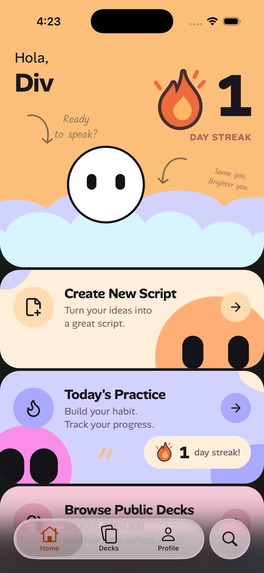
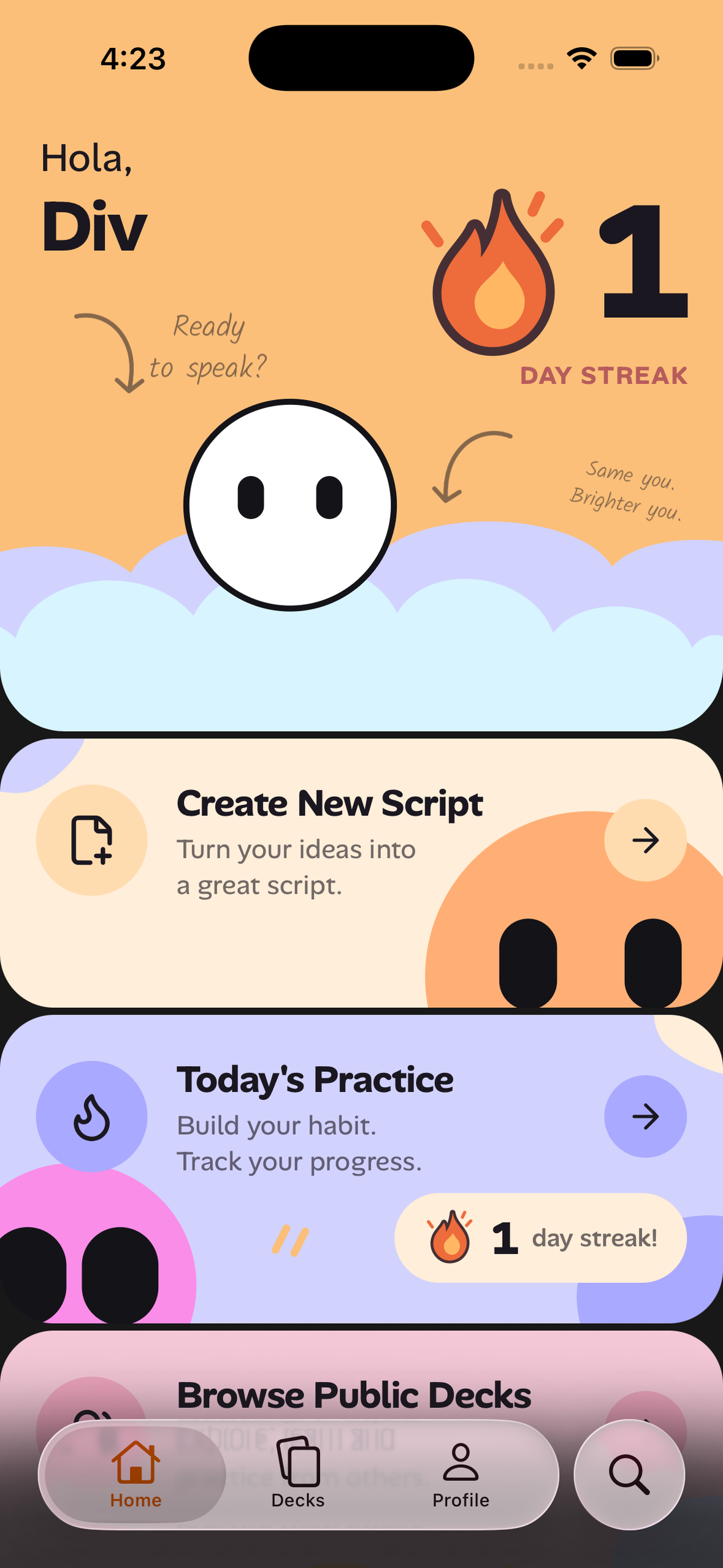
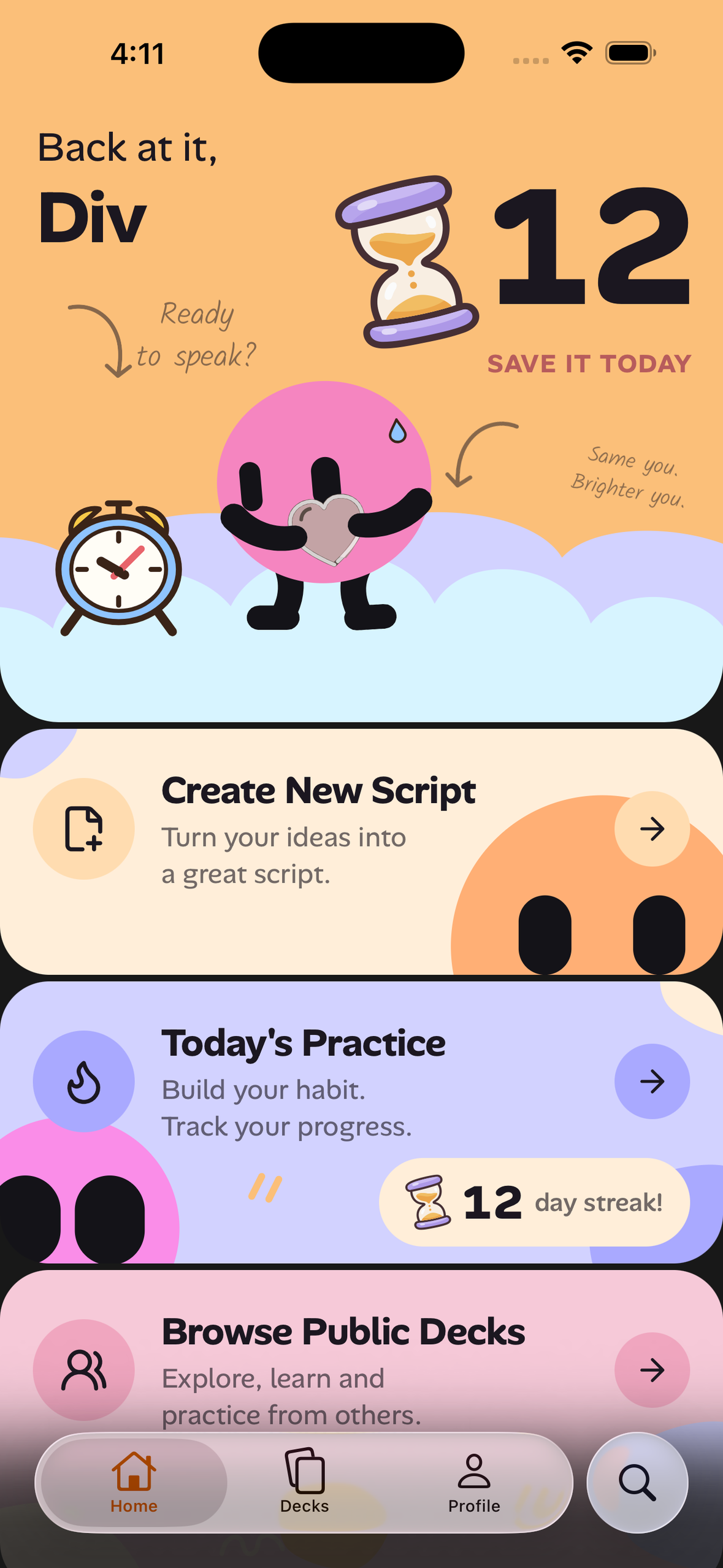
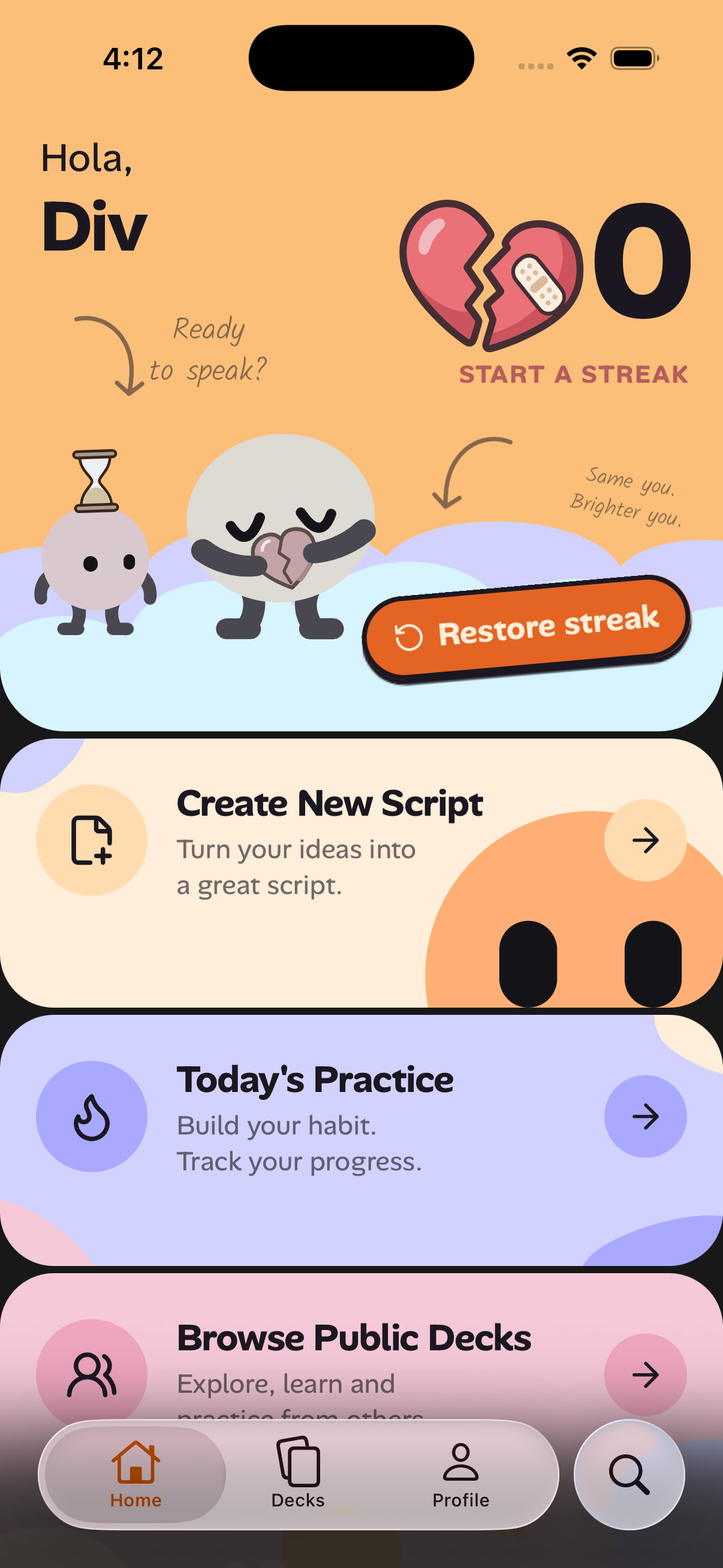
Home Screen - Streak live
-
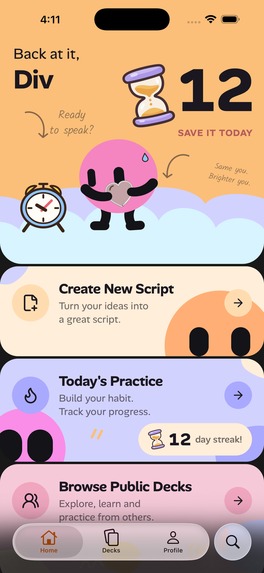
Home Screen - Streak about to break
-
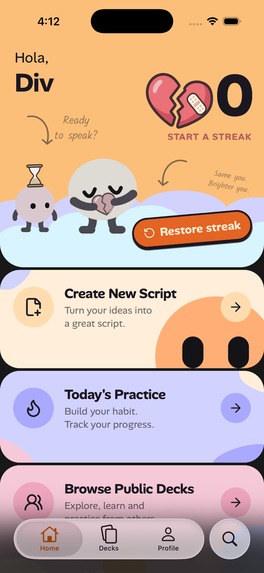
Home Screen - Streak Broken
-
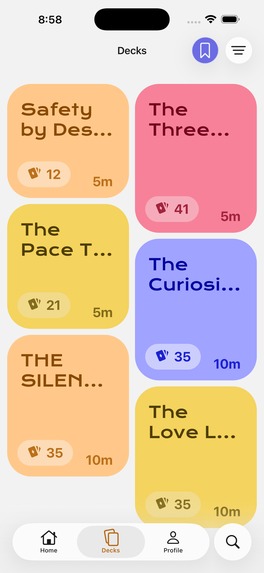
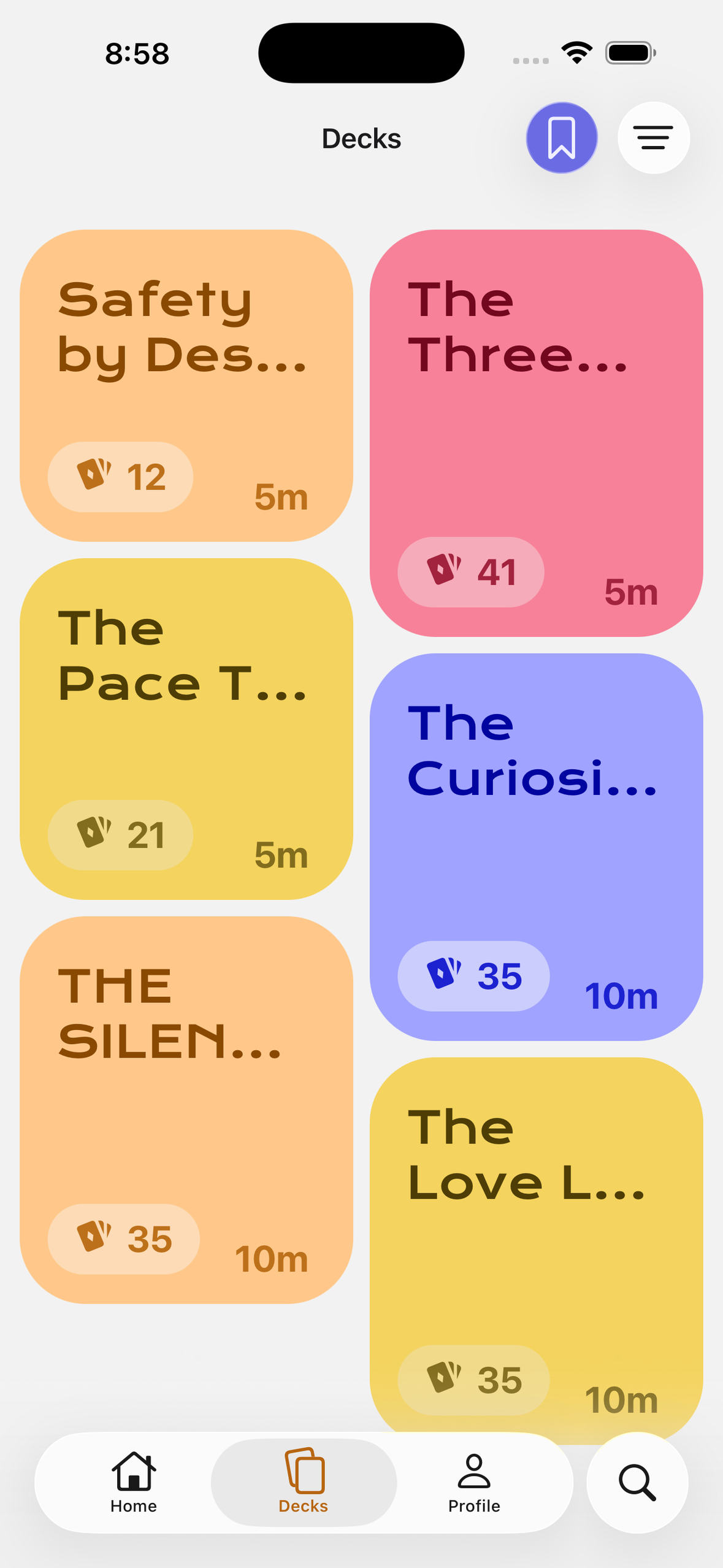
All Decks
-
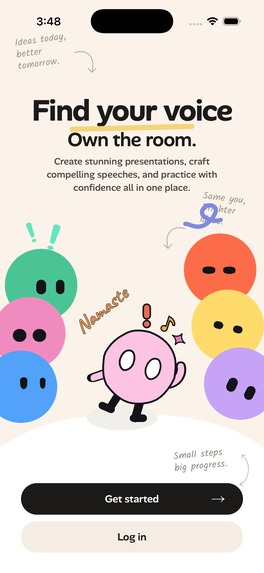
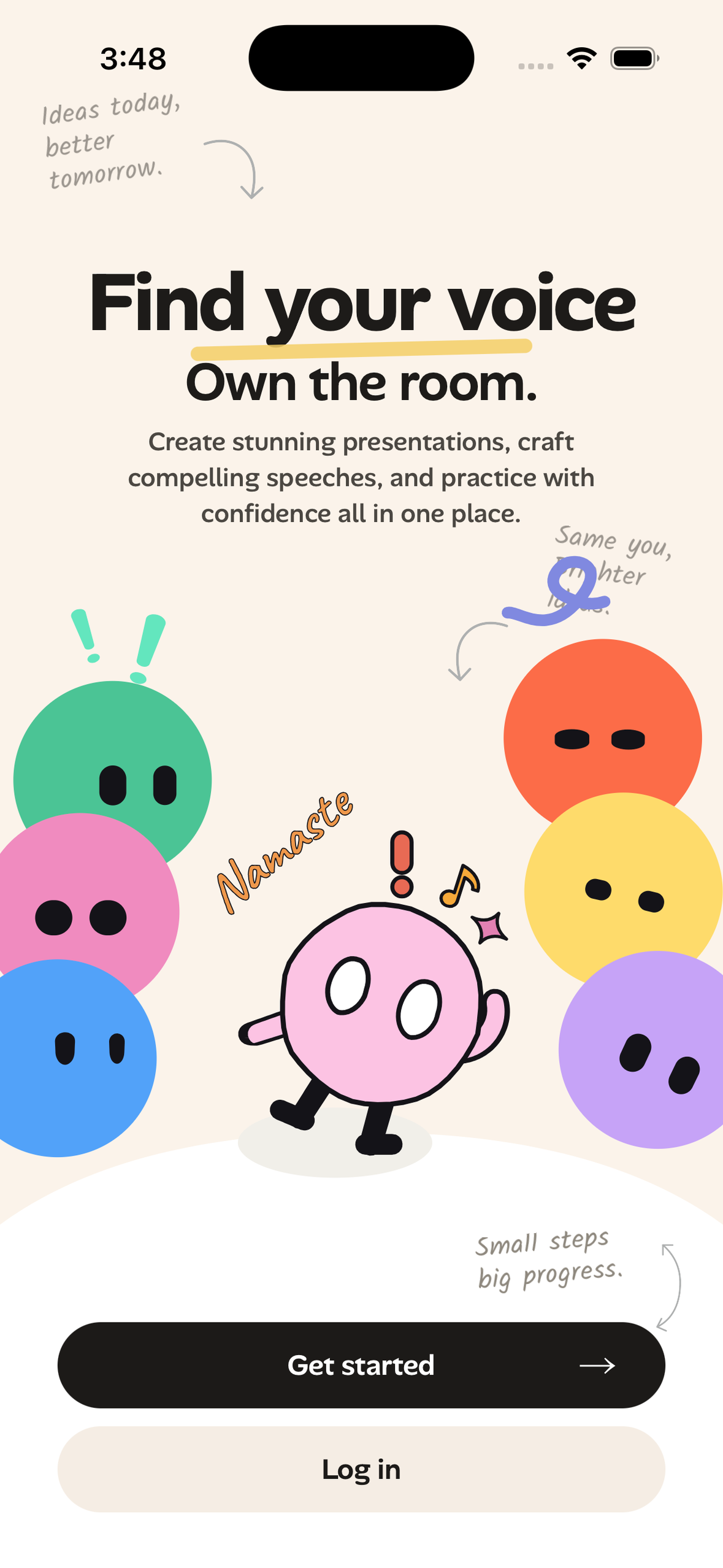
Get Started (first screen on app launch)
-
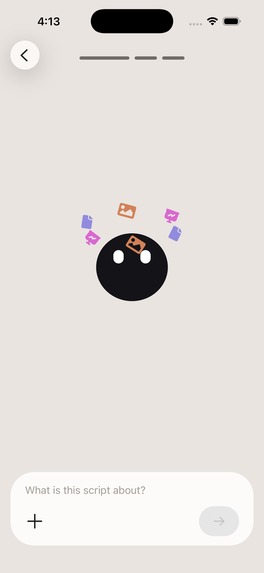
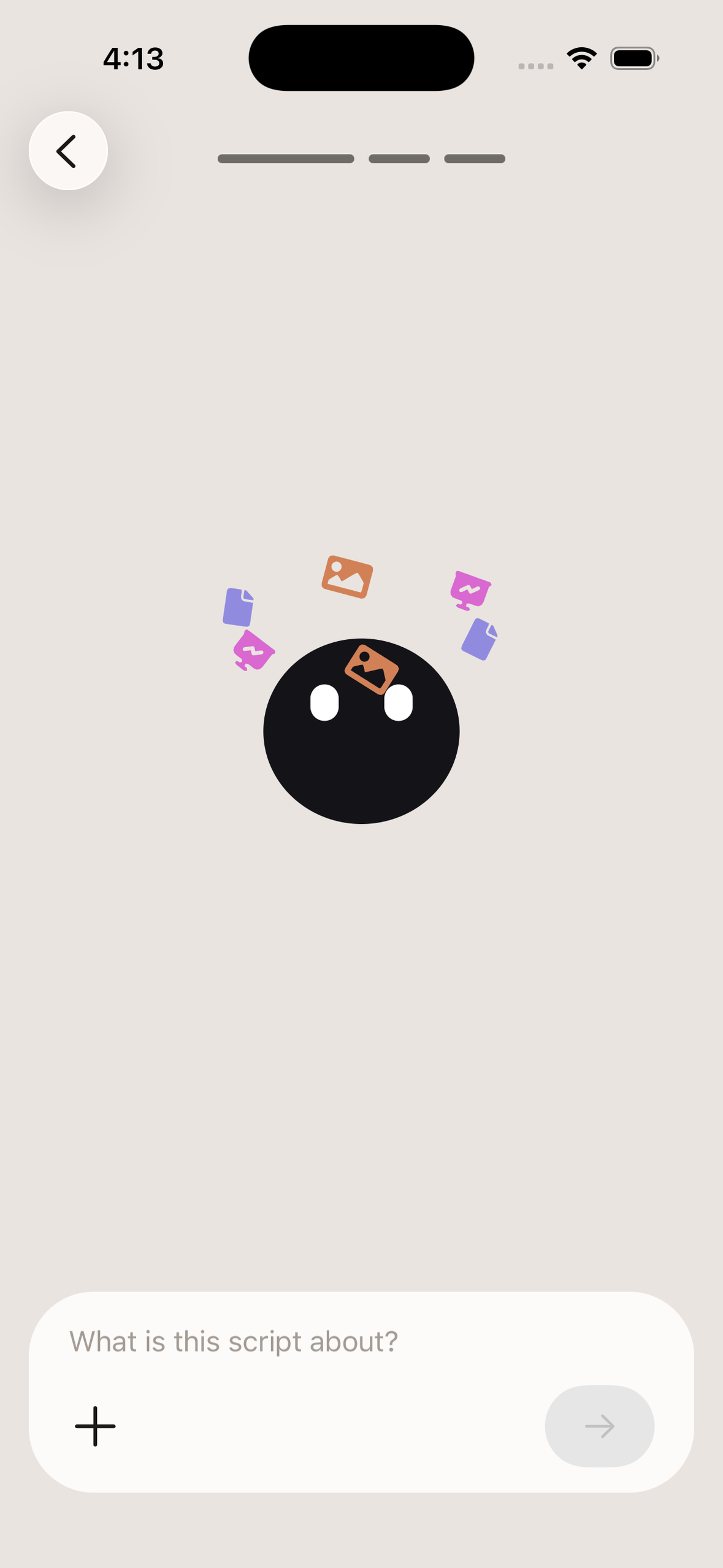
New script: description
-
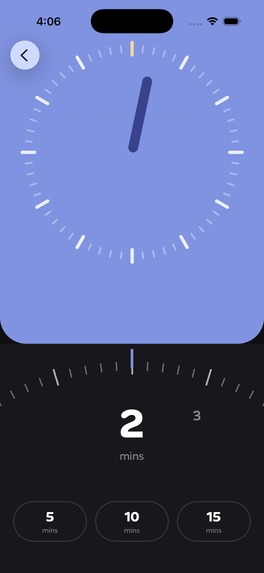
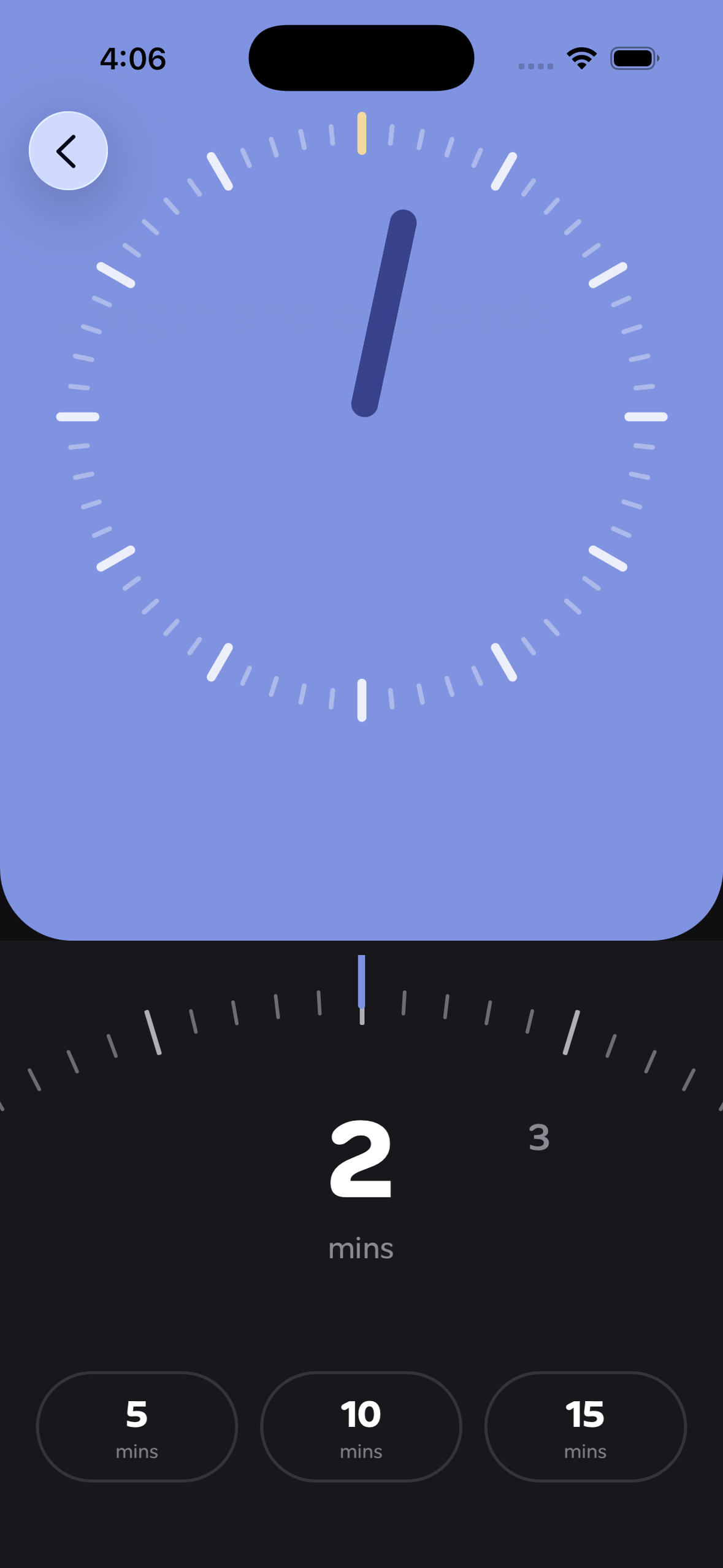
New Script: Duration
-
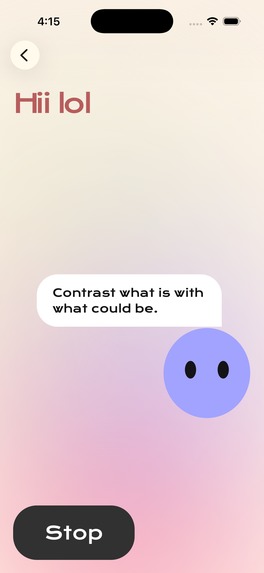
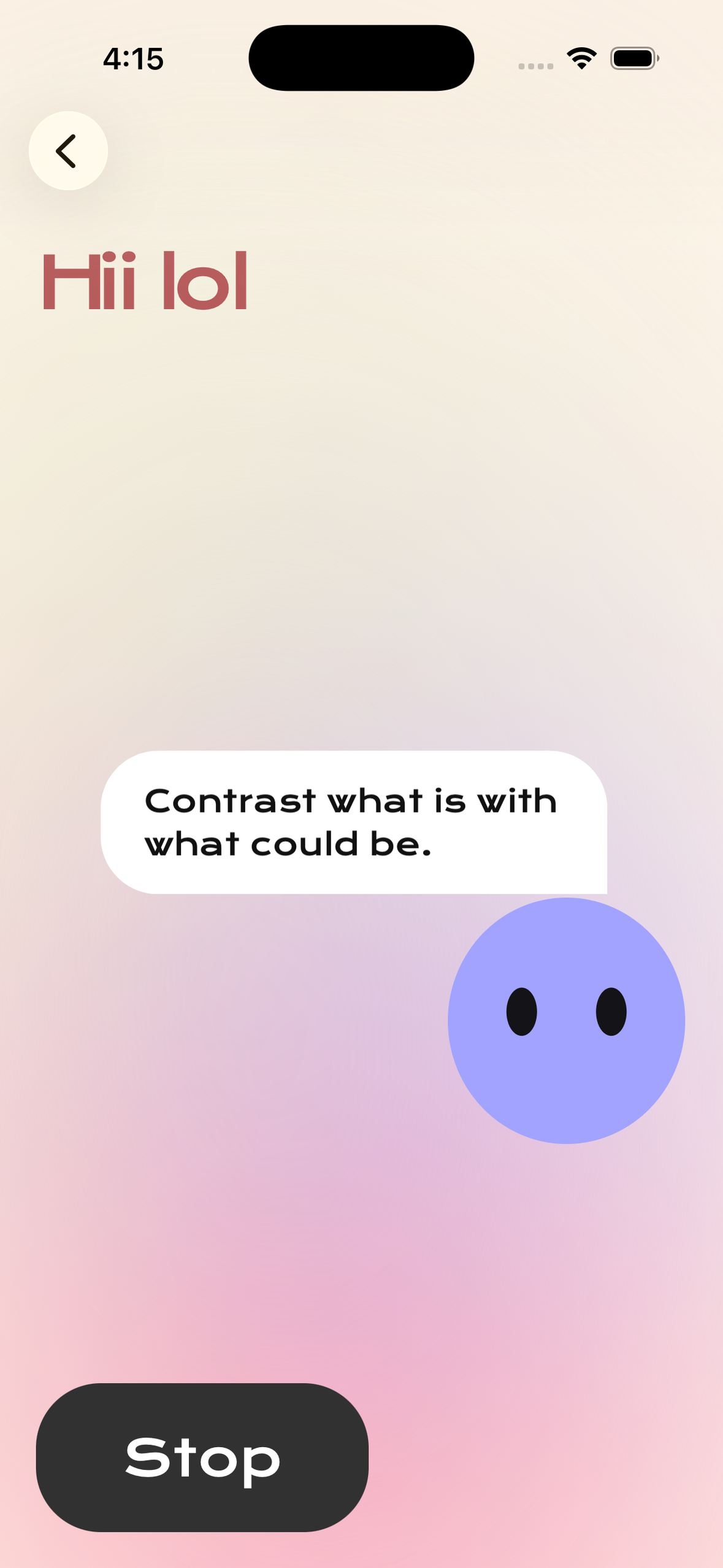
New Script: Generating
-
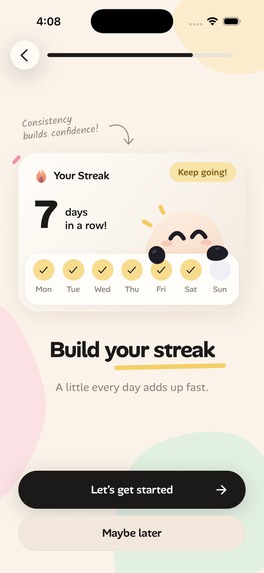
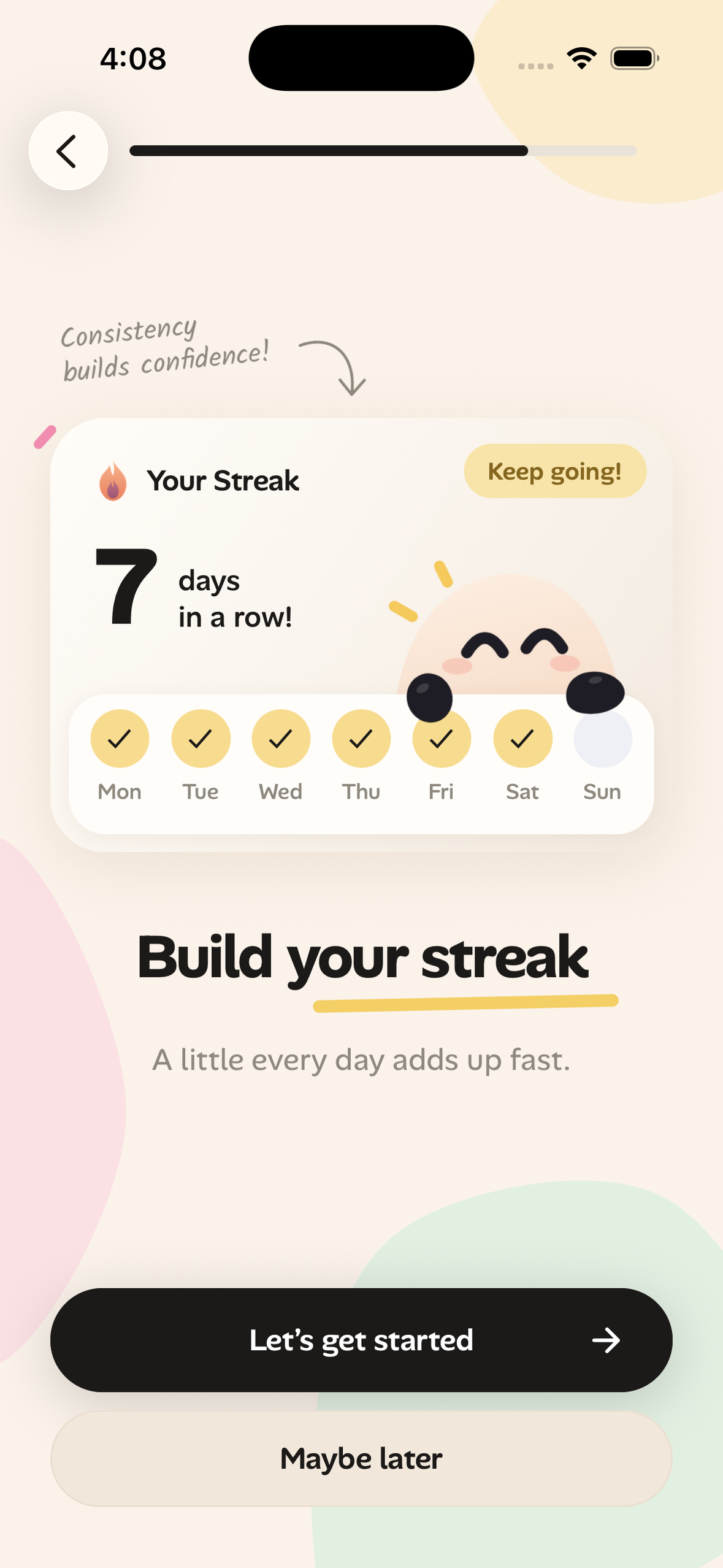
Onboarding: Daily Streak
-
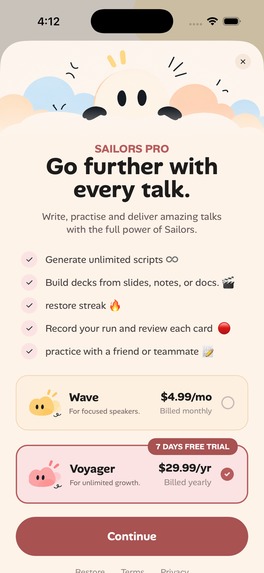
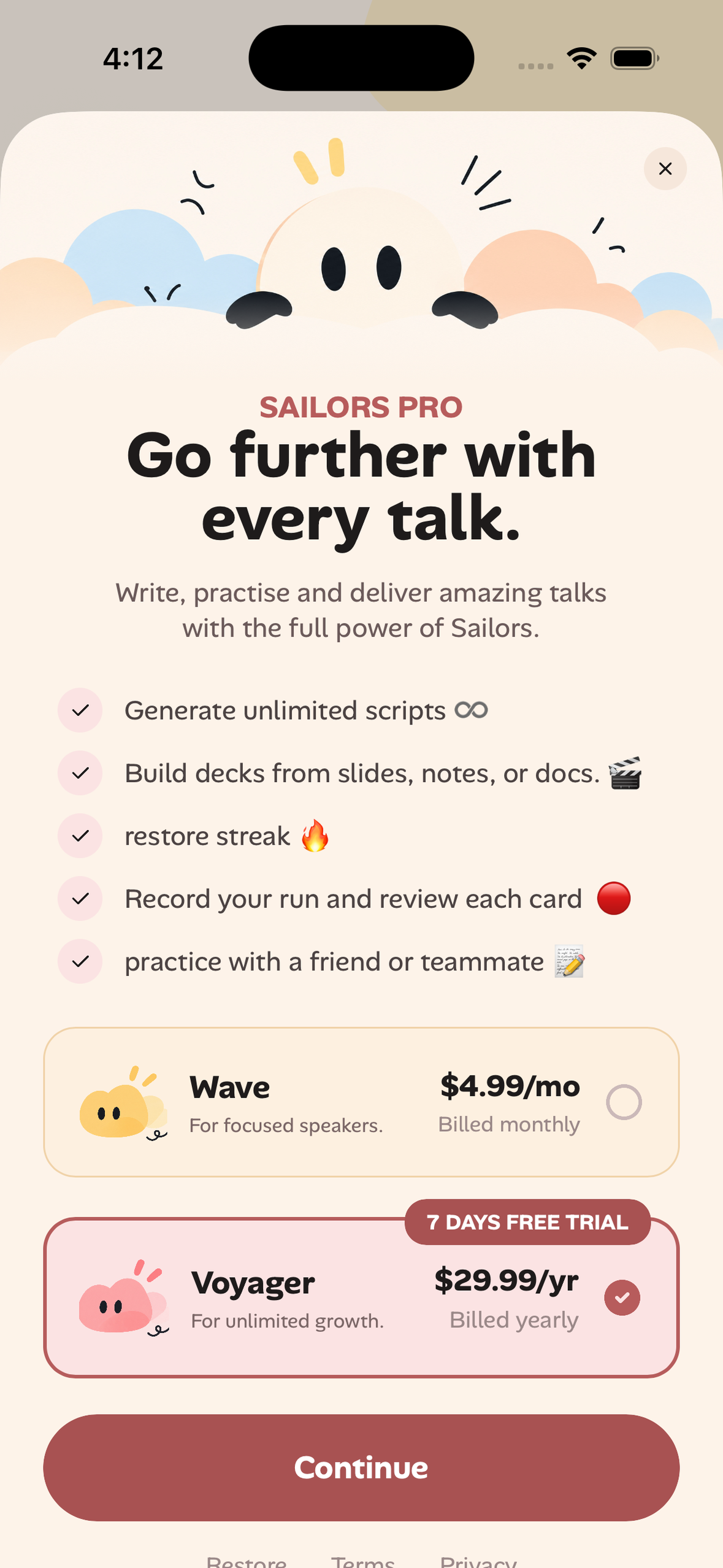
Paywall Screen
-
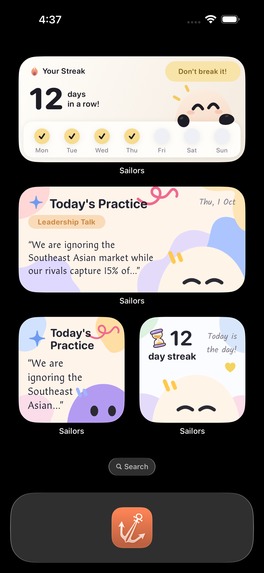
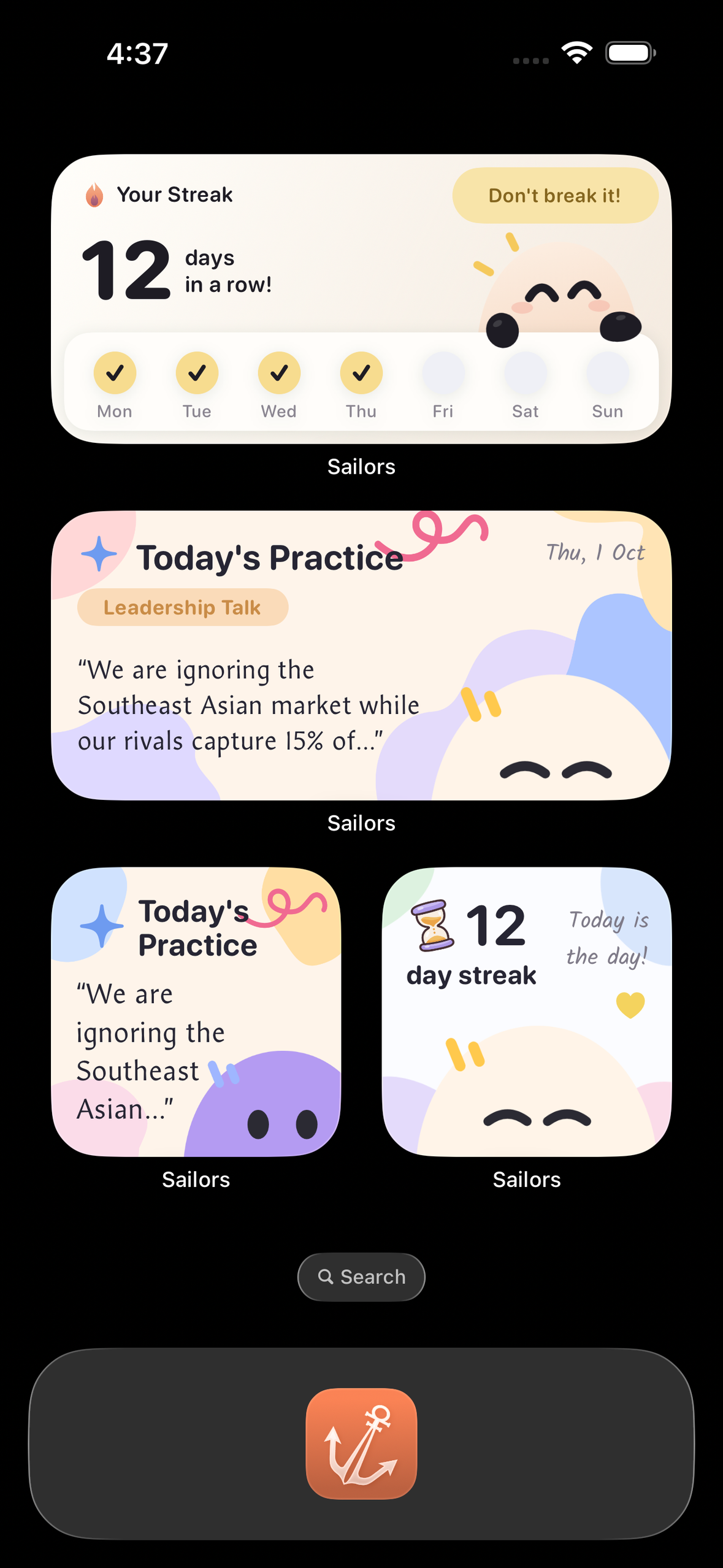
Widgets
-
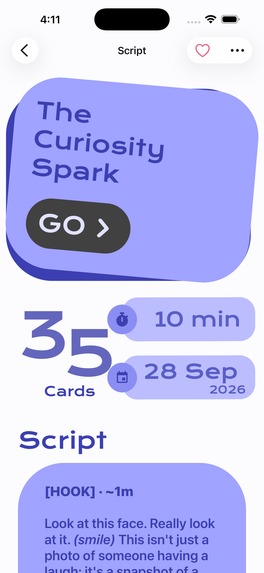
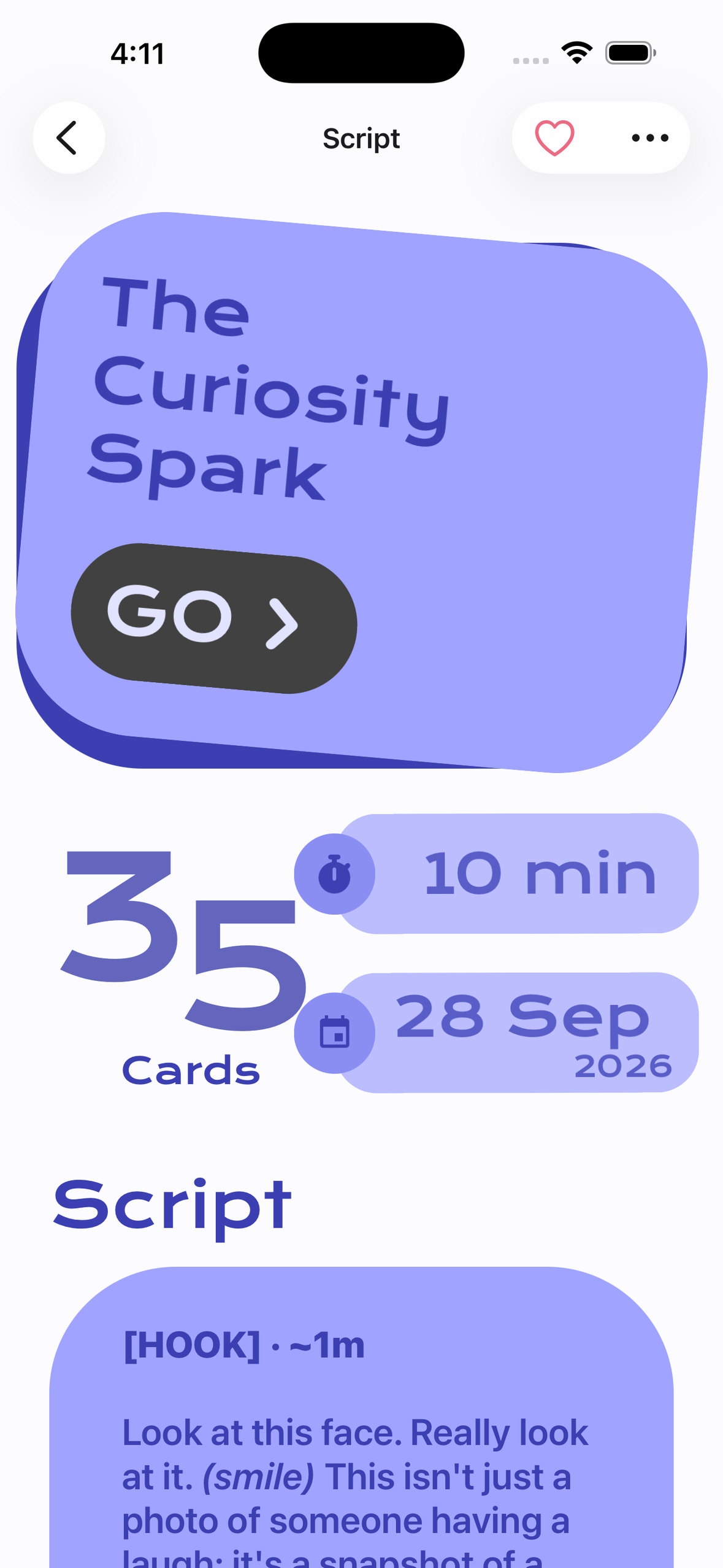
Deck Detail Screen
-
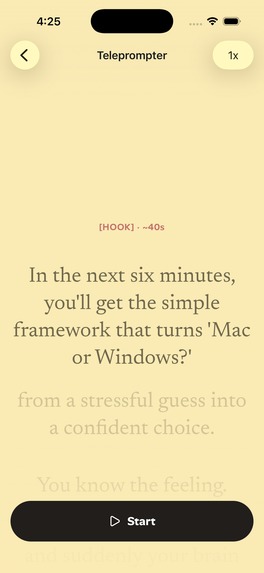
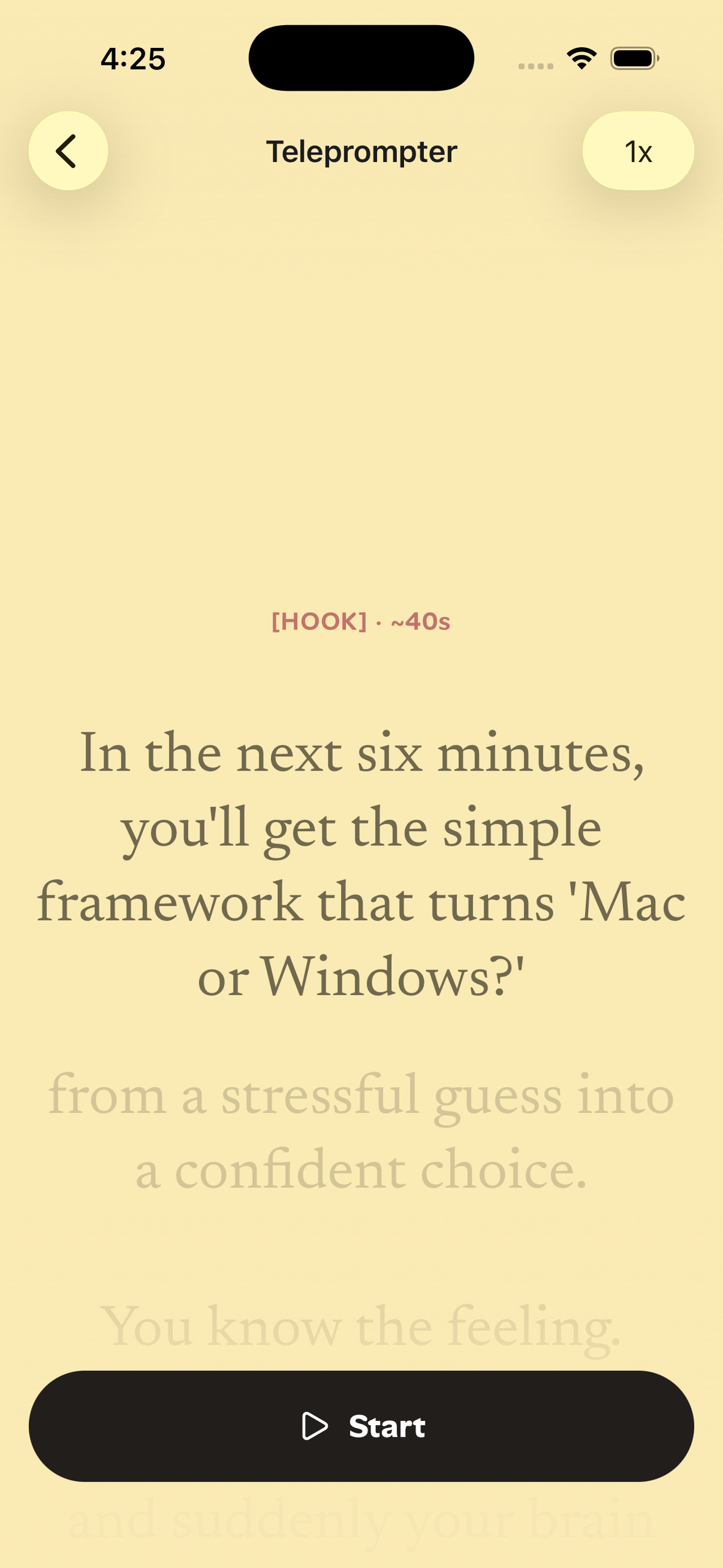
Teleprompter
-
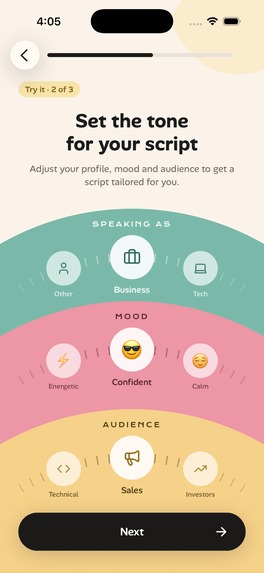
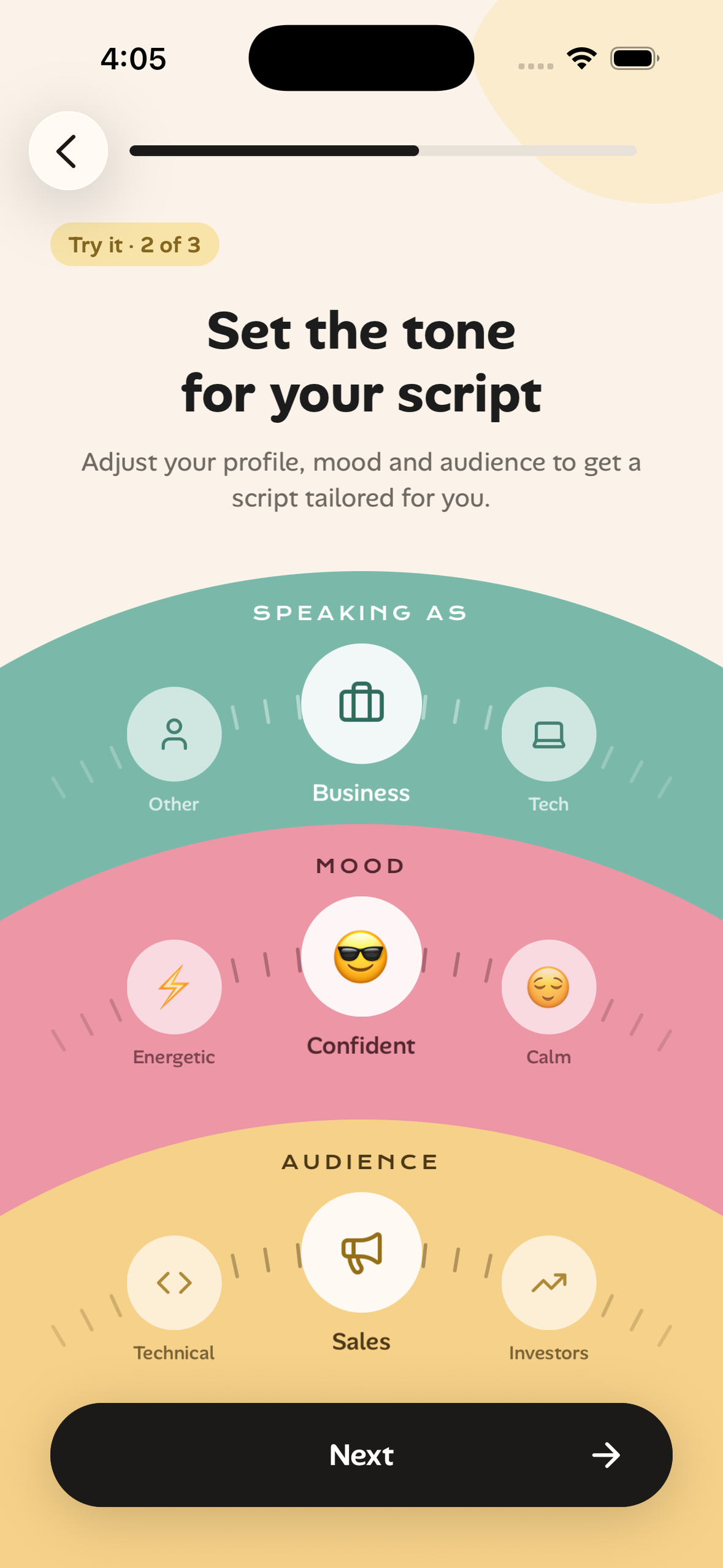
Setting the mood, audience and speaker

What inspired us
Almost every career has a moment that turns on five minutes of talking: a pitch, a demo, a standup that suddenly matters, a wedding toast. Most people prepare for those five minutes the same way. They write something the night before, read it twice, and hope.
When we looked at the tools people use, each one solved a third of the problem:
- A chatbot will write you a script, then leave you alone with it.
- A teleprompter will scroll text at you, but it doesn't care whether you've ever said the words out loud.
- A course teaches theory on a Tuesday that you can't recall on the Friday you need it.
Nobody owned the loop. Writing, rehearsing and delivering a talk are one job, and getting better at public speaking comes from doing that loop again and again. So we built Sailors: one iPhone app that takes you from "I have to talk about this on Thursday" to standing up and doing it, with the daily reps in between that make every talk after it easier.
What it does
The MVP is two steps, plus a daily habit that builds the skill underneath them.
- Generate a presentation script. Describe the talk in a sentence, attach the brief or
the PDF you were handed, and set the length, audience and mood. Sailors writes a
structured script (beats like
[HOOK]and[CORE MESSAGE], stressed phrases, written-in pauses). You tell it your profession and speaking experience once, and every script is pitched at you. - Practise it on colour-coded, haptic cards. The script becomes a deck, one idea per card with its keywords and a delivery style. Each card also carries how hard the line should land, and you get that two ways at once. You see it: the card's colour runs from calm mint to peak coral, more vivid the harder it hits. You feel it: five impact tiers, each with its own haptic, played as the card arrives. Colour and touch give your memory two more hooks than the words alone, so you remember the rhythm of the talk, not just its sentences. Then record yourself against the deck and play it back.
Around that core:
- Learn the patterns with daily practice. Most speaking isn't a prepared talk. It's a question in a meeting, an interview answer, "so, what do you do?", and there's no script for those. What helps is a pattern you can pour any content into. So every day Sailors gives you one two-minute talk built on a named public-speaking framework from a library of 22 (PREP, STAR, SCQA, AIDA, the Golden Circle, Feynman and more). First you see the framework's steps and when to use it, then you read a short talk that applies it to a real topic out loud, line by line, then you get one delivery tip.
Why it helps:
- Patterns, not pep talks. "Be more confident" can't be practised. "Answer first, then one reason, one example, and the point again" (PREP) can, and after a few reps it's how you answer without thinking.
- One shape, many rooms. Each framework returns every 22 days in a different situation it suits (an interview one time, a conference Q&A the next), so you learn when to reach for a pattern, not just what it is.
- Small enough to keep doing. Two minutes fits a coffee queue. Streaks live on the home screen, in an iOS widget, and in reminders timed to the minute your streak would break, with one streak restore a month.
- It feeds the core. Once you know the shapes, you spot them in the scripts Sailors writes, and when a Q&A pulls you off-script, you have a structure ready.
- Deliver with the teleprompter. Autoscroll from 0.25× to 3×. Hold the middle to pause, hold an edge to run at double speed, and drag back to re-read. A stopwatch sits on the button so you know if you're running long.
- Learn from others in Discover. Publish a deck and anyone can read the script, practise the cards and save it. Discover is free, with no plan needed.
How we built it
Sailors is a Turborepo monorepo with two apps.
- The iPhone app (
apps/mobile) is Expo SDK 57 and React Native 0.86 in TypeScript, using Expo Router. It feels native because it is native where it counts: SwiftUI components through@expo/ui, a WidgetKit home-screen widget, system materials, and real native navigation and toolbars. Motion runs on Reanimated, drawing on Skia, and haptics on Software Mansion's Pulsar. - The API (
apps/backend) is FastAPI on Python 3.14 with SQLAlchemy and Alembic over Postgres (Supabase). Script and card generation run as Celery jobs on Redis, so no request ever waits on a model. Recordings and attachments go to S3. - Models go through OpenRouter in production. Ollama is the default for development, so the whole pipeline runs on a laptop with no API key. Anthropic, OpenAI, Gemini and Groq plug in behind the same adapter.
- Identity is Clerk. Subscriptions, the paywall and the customer centre are RevenueCat. Errors go to Sentry.
- The mascot, who reacts to what you're doing, is animated in Blooby and shipped as dotLottie files with their own state machines.
Challenges we ran into
Long AI jobs on a phone. Generating a script takes long enough that people leave the screen, lock the phone, or tap back by accident. Early on, backing out killed the job and threw away a script the user had been waiting for. We rebuilt generation as a server-side resource. Leaving a screen no longer cancels anything, and coming back re-attaches to the running job. Pressing Generate again with an unchanged brief resolves to the generation that already exists instead of paying for an identical one. A deck is only written once all its cards exist, so an empty deck never flashes into your grid.
Making cards you can remember by. The first version of the card colours bucketed each deck by rank, so exactly a fifth of every deck came out as a scarlet "climax" card, even a deck of uniformly calm lines. That was harmless when colour was only decoration. Once the same number decided how hard the phone vibrates in your hand, it was actively misleading. We switched to absolute thresholds on the generator's impact score (and told the model to save scores above 0.8 for genuine peaks), so a quiet deck now looks and feels quiet. We also rebuilt the palette in OKLCH, where equal steps look equally different, so a stronger line is always a visibly more vivid card. Five tiers, five colours, five distinct haptics, all from one number:
$$ \text{tier}(i) = \left|{\, \theta \in {0.2,\ 0.4,\ 0.6,\ 0.8} : i \ge \theta \,}\right| $$
Waiting that doesn't feel like waiting. Even with jobs in the background, a screen that waits on a network round trip before showing anything feels broken. We moved every job kickoff behind the screen that reports on it, so tapping Create shows the loading state on the same frame. While you wait, the mascot slides in with a public-speaking tip that stays the same for that generation.
Mascots at 60fps. Our first mascot renderer gave every animation its own Metal view and drew a fresh image on the main thread every frame. On a screen with seven mascots, that cost us the frame rate. We moved them to Skia's Skottie, advanced frame by frame on the UI thread. They stop drawing entirely when their screen is out of view, and we wrote our own small interpreter for the dotLottie state machines. Some animations aren't played at all but scrubbed by gestures. The pull-to-refresh mascot, for example, follows the pull distance $d$ on a quintic curve, so it barely moves at first and rushes to the end:
$$ p = \left(\frac{\min(d,\ 80)}{80}\right)^{5} $$
Offline-first, including the launch. Backstage wifi is a myth. Scripts, decks and cards live in on-device SQLite, and streaks and preferences live in MMKV. Every screen renders from disk on the first frame and refreshes from the network after. The app even starts from disk when it can't reach its auth provider, which meant auditing every place that assumed a network answer would come.
Making a streak mean something. A streak you can undo at any time was never a streak. Getting restore right took several rewrites. It is offered only on the day the streak breaks, the window closes 24 hours later, and reminders are scheduled against the exact minute the streak dies, then rescheduled or cancelled as you practise.
What we learned
- Structure is the skill that transfers. Our first daily content was generic tips ("here is a tip about structure"), and it read as filler because there was nothing in it to apply. Rebuilding it around named frameworks, each with exact steps, the situations it fits and a worked example, made every rep something you can use the same afternoon.
- Memory likes more than one sense. Pairing each card's colour with a matching haptic turned rehearsal from rereading into something you can feel, and it forced us to make the impact score honest, because a vibration that lies is worse than none.
- Perceived speed is a product feature. The biggest wins came from showing the right screen immediately, not from making the backend faster.
- Motion has a budget. Every animation competes with scrolling for the same frame. We learned to measure first, then move work off the main thread or stop it when nobody's looking.
- Native beats "native-looking". Using SwiftUI controls and system materials directly took less code than imitating them, and they behave the way iPhone users expect.
- Paywalls are product design. With RevenueCat running plans, prices and the paywall, we could change our minds about pricing without shipping an app update. We chose no free tier and no credits: one plan opens everything, and Discover stays free for everyone.
What's next
- Delivery feedback on your recordings: pace, filler words and clarity.
- Android, once there are good equivalents for the native pieces the iOS app leans on.
Built With
- amazon-web-services
- celery
- clerk
- expo-router
- expo.io
- fastapi
- lottie
- ollama
- openrouter
- postgresql
- pulsar-haptics
- python
- react-native
- reanimated
- redis
- revenuecat
- sentry
- sqlalchemy
- sqlite
- swiftui
- typescript
- widgetkit


Log in or sign up for Devpost to join the conversation.