-
-
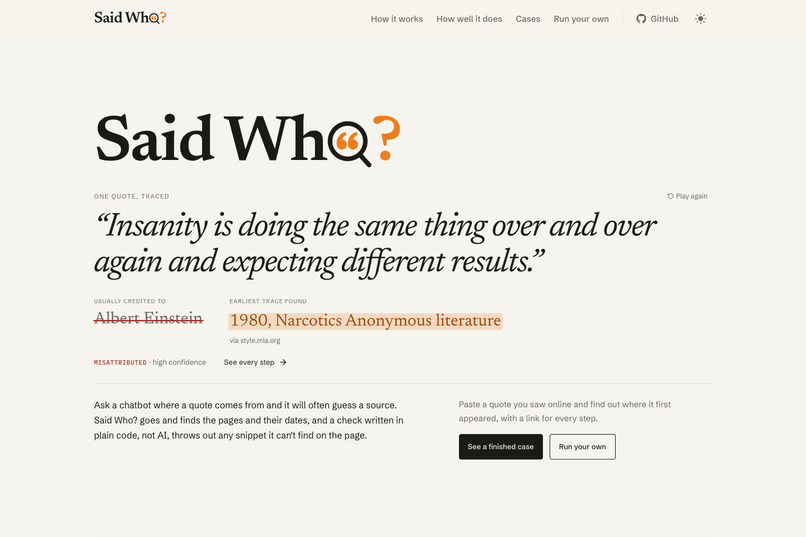
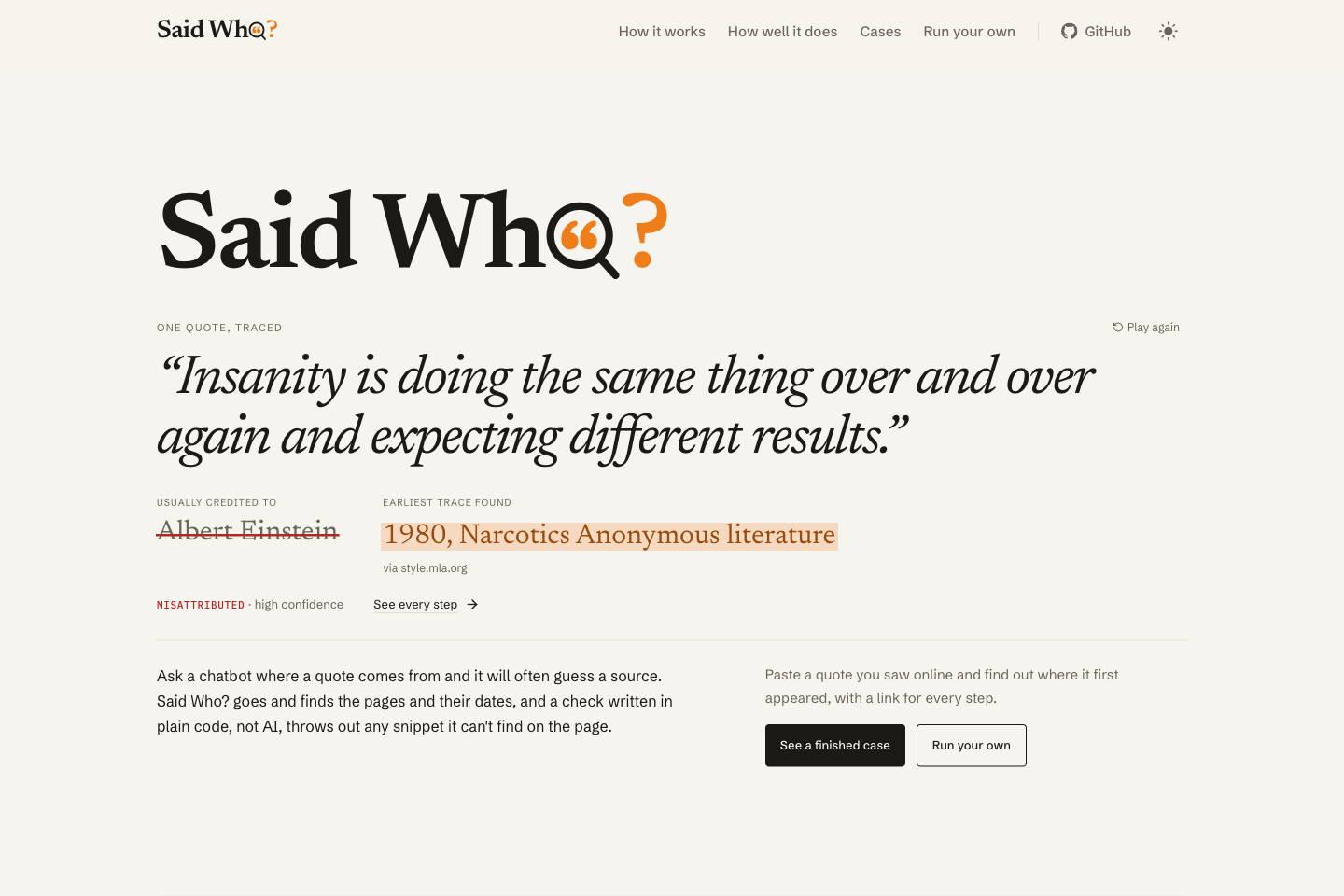
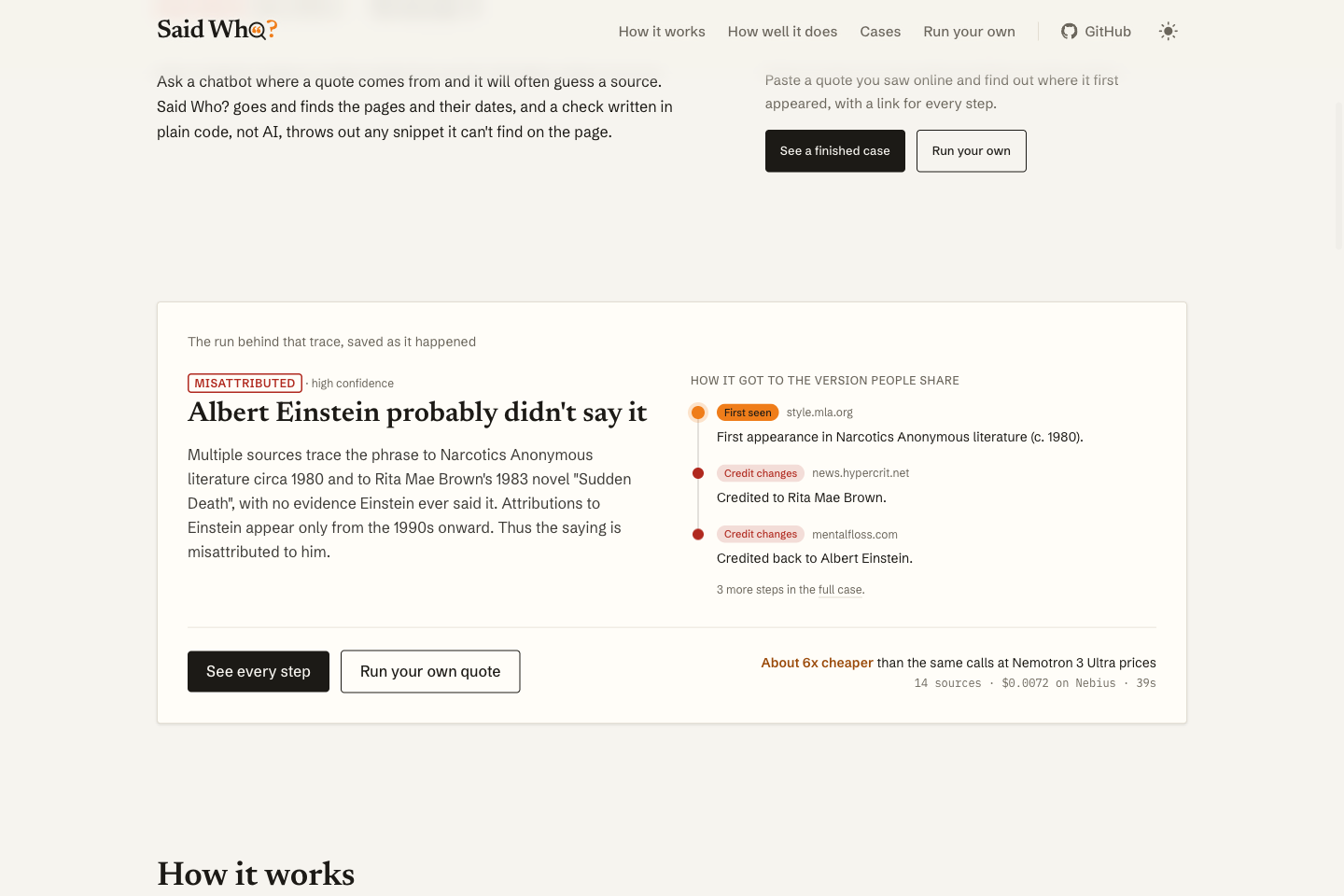
The home page: Einstein's name struck out, and the earliest trace Said Who? found, 1980 Narcotics Anonymous literature.
-
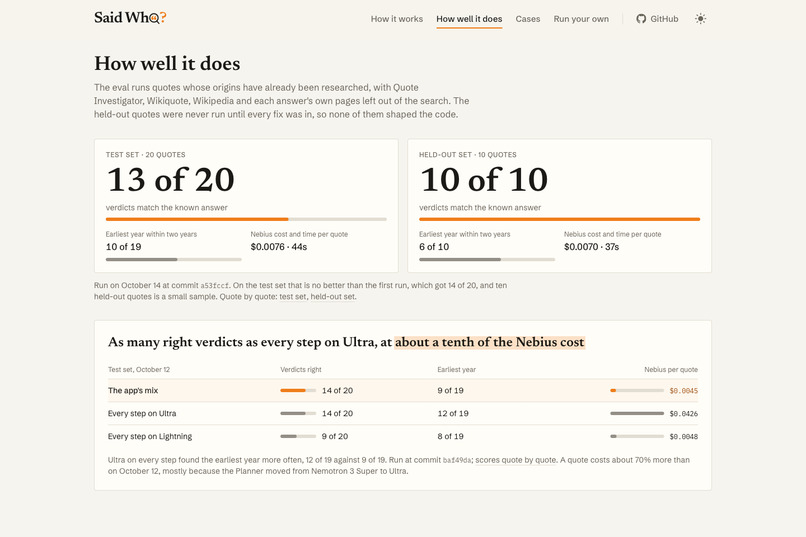
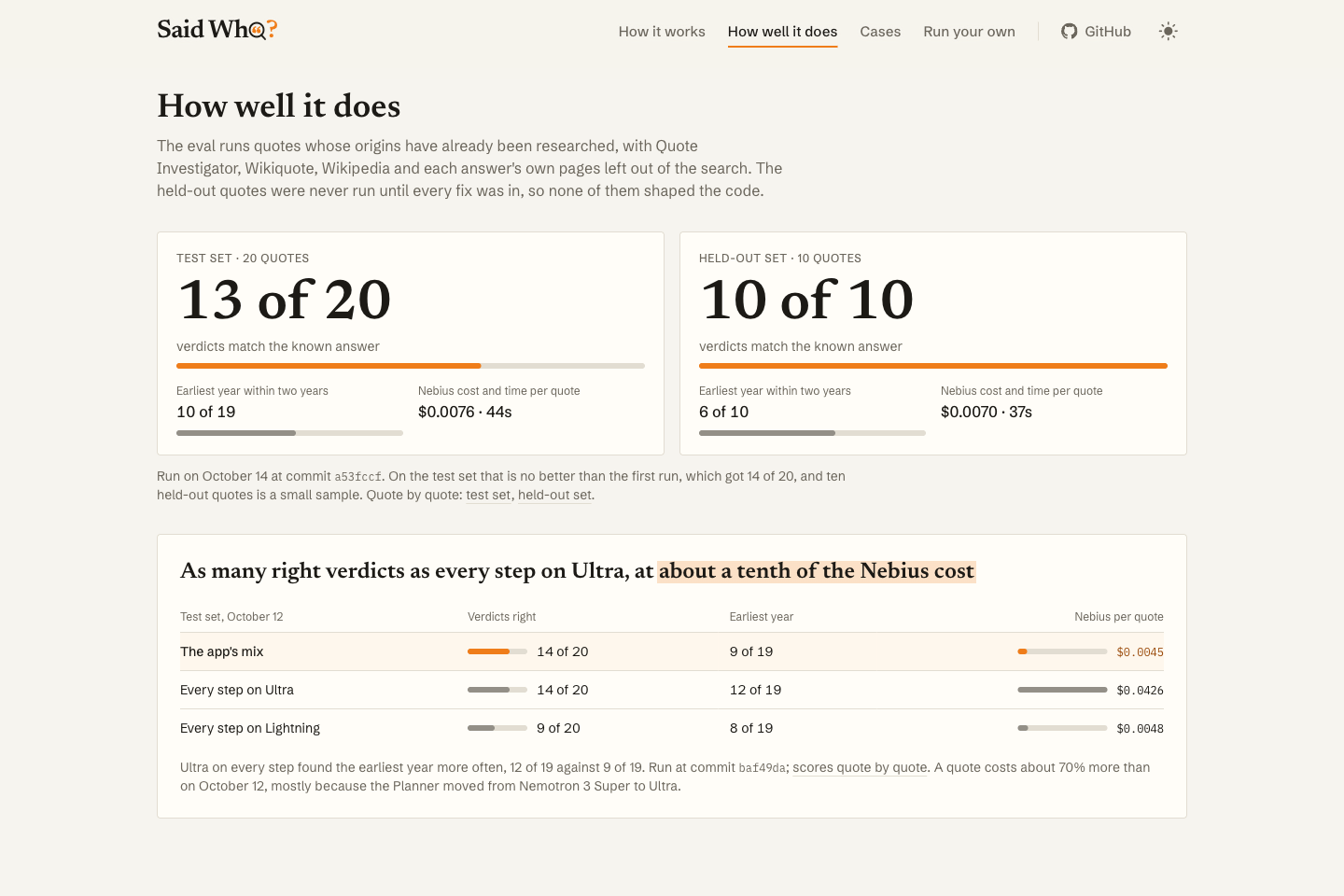
How well it does: as many right verdicts as every step on Ultra, at about a tenth of the Nebius cost.
-
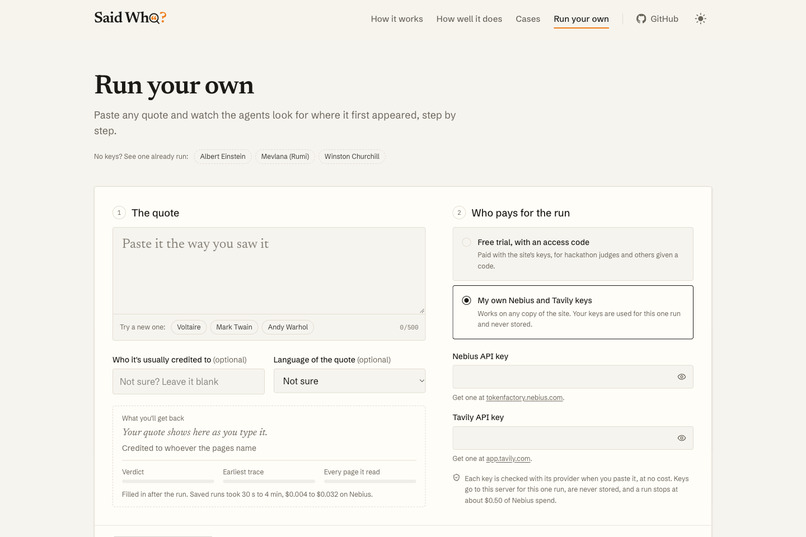
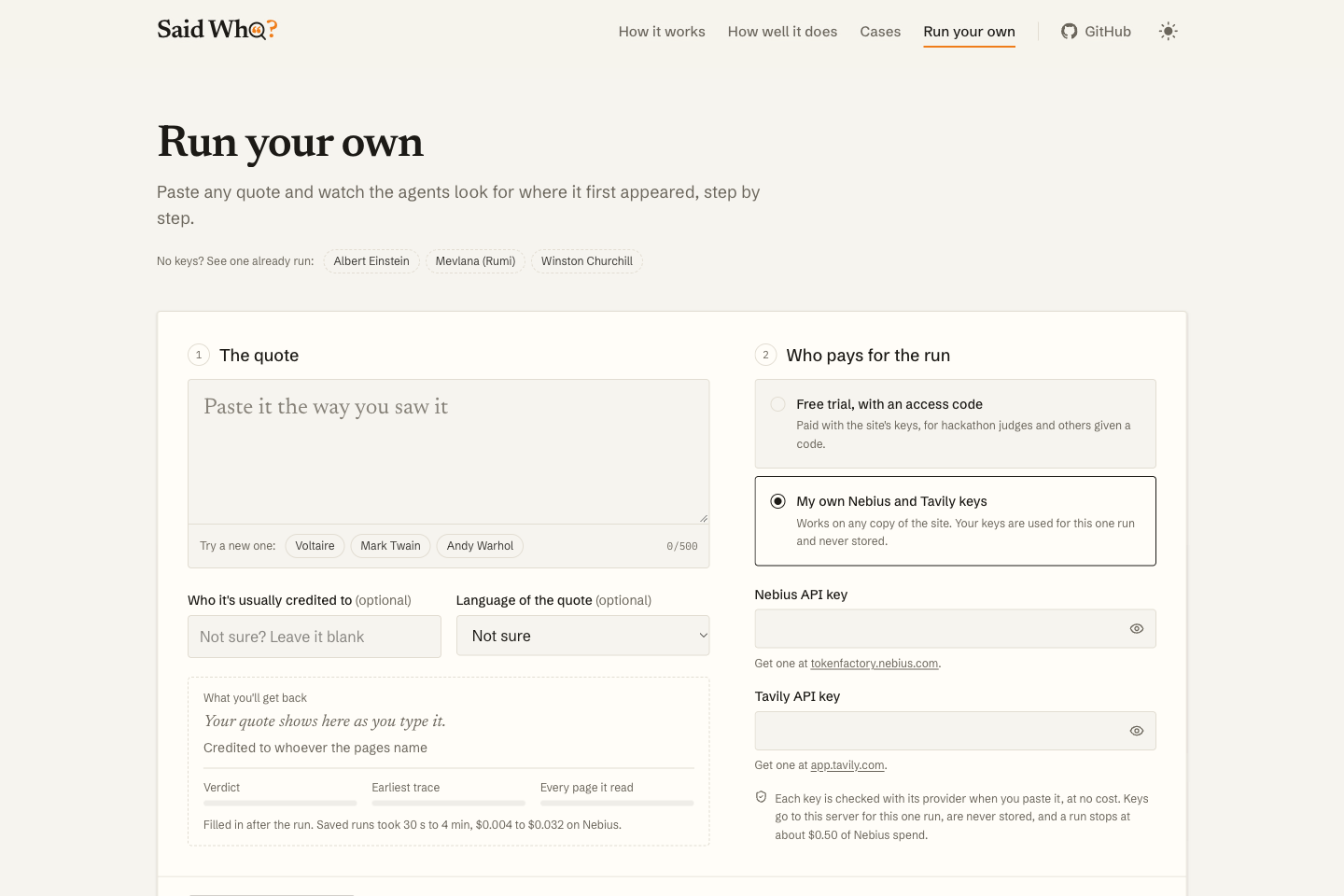
The run page: paste a quote and use the free trial or your own Nebius and Tavily keys.
-
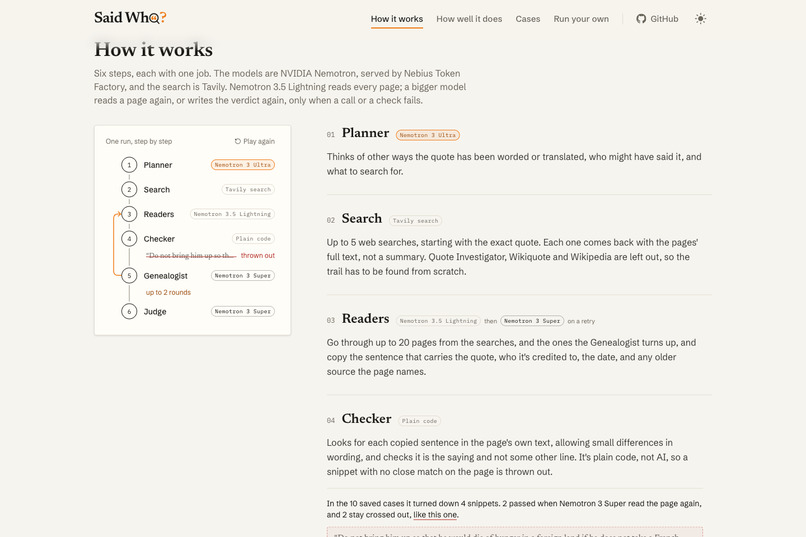
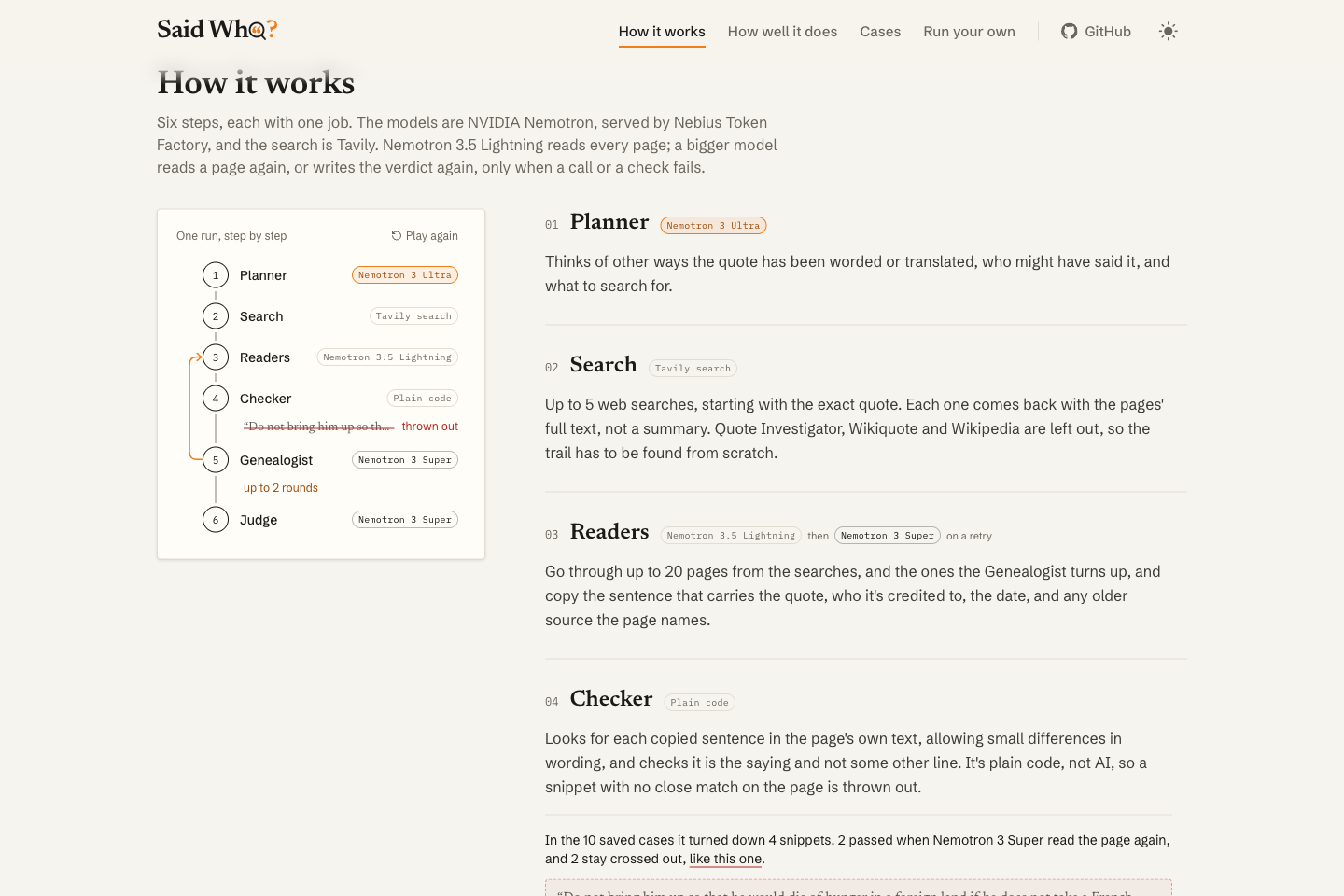
How it works: six steps, each with the Nemotron model or plain code that runs it.
-
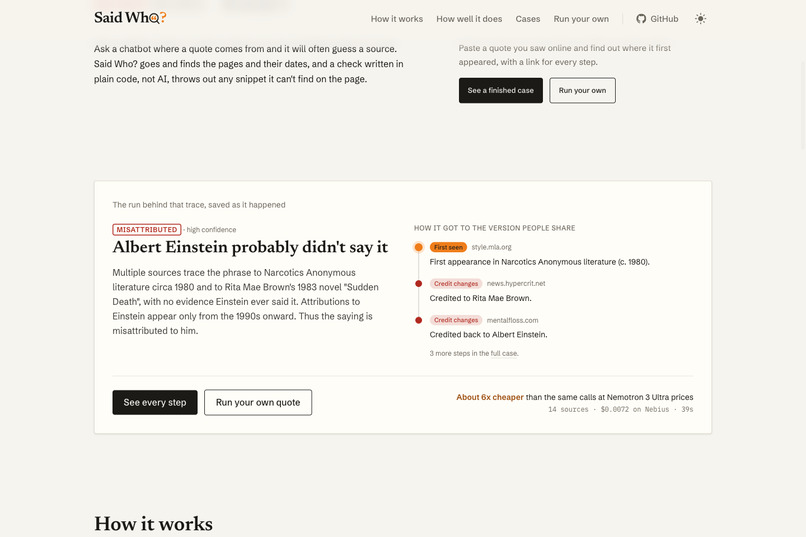
The saved run behind the home page trace, with how the quote got to the version people share.
-
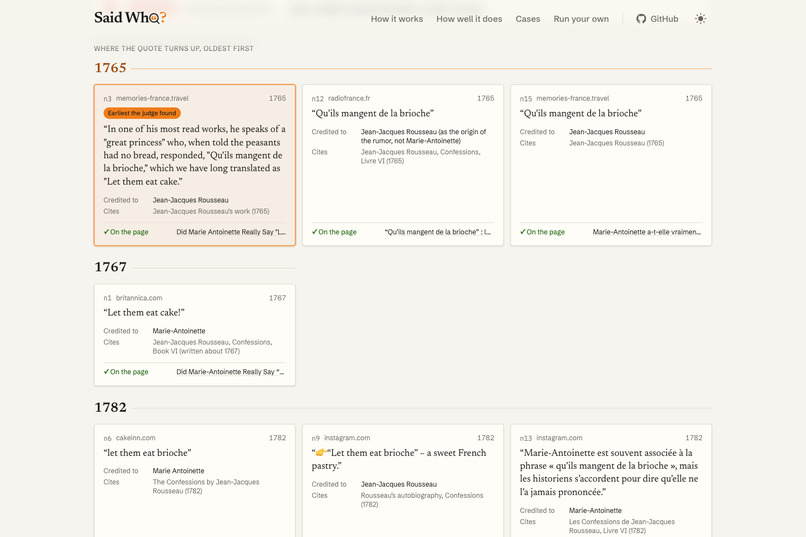
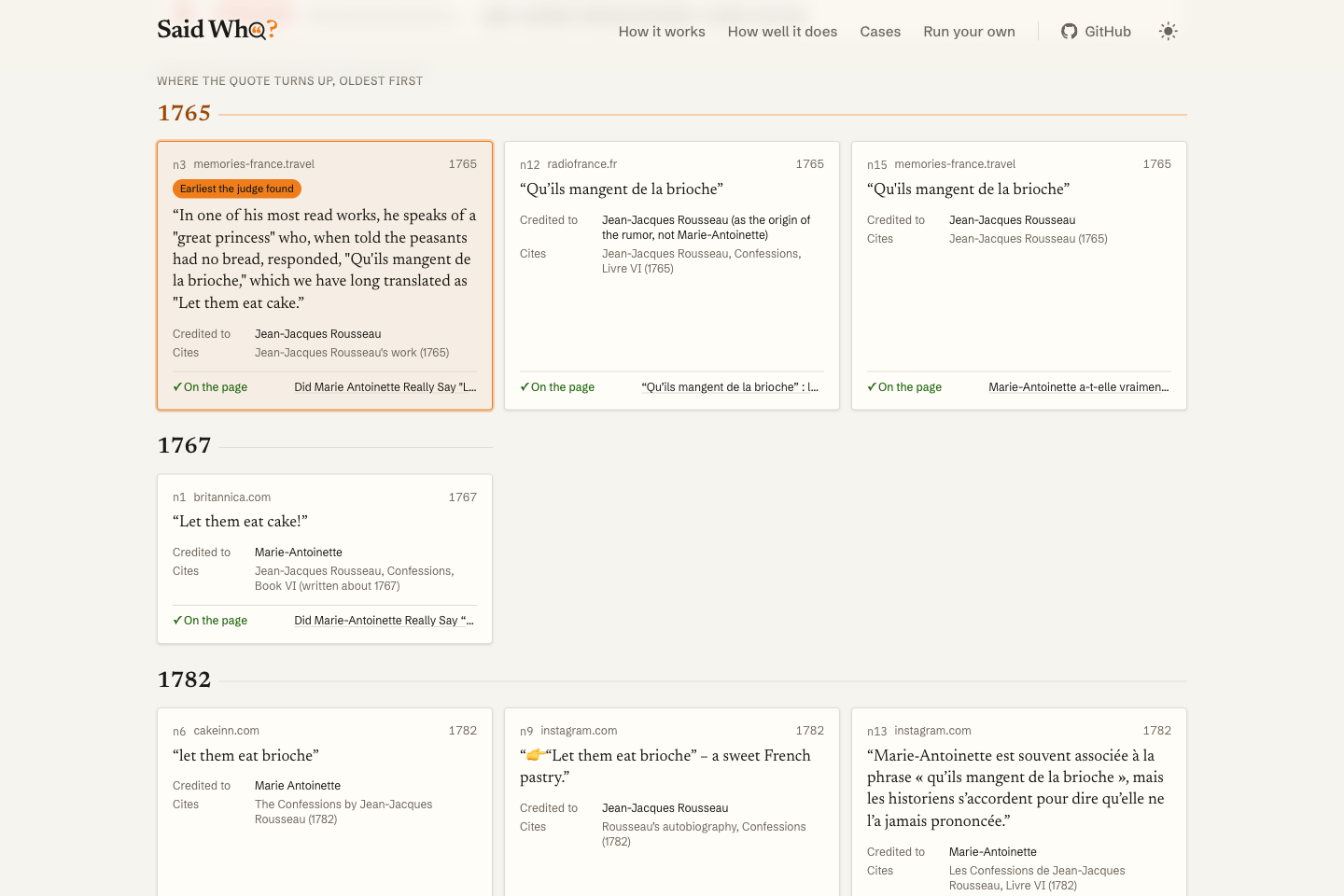
Every page that carries the quote, in columns by year, oldest first.
-
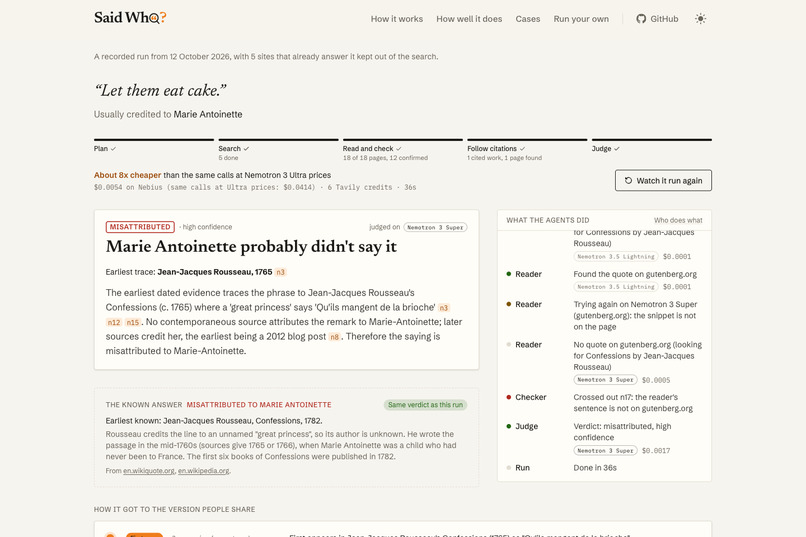
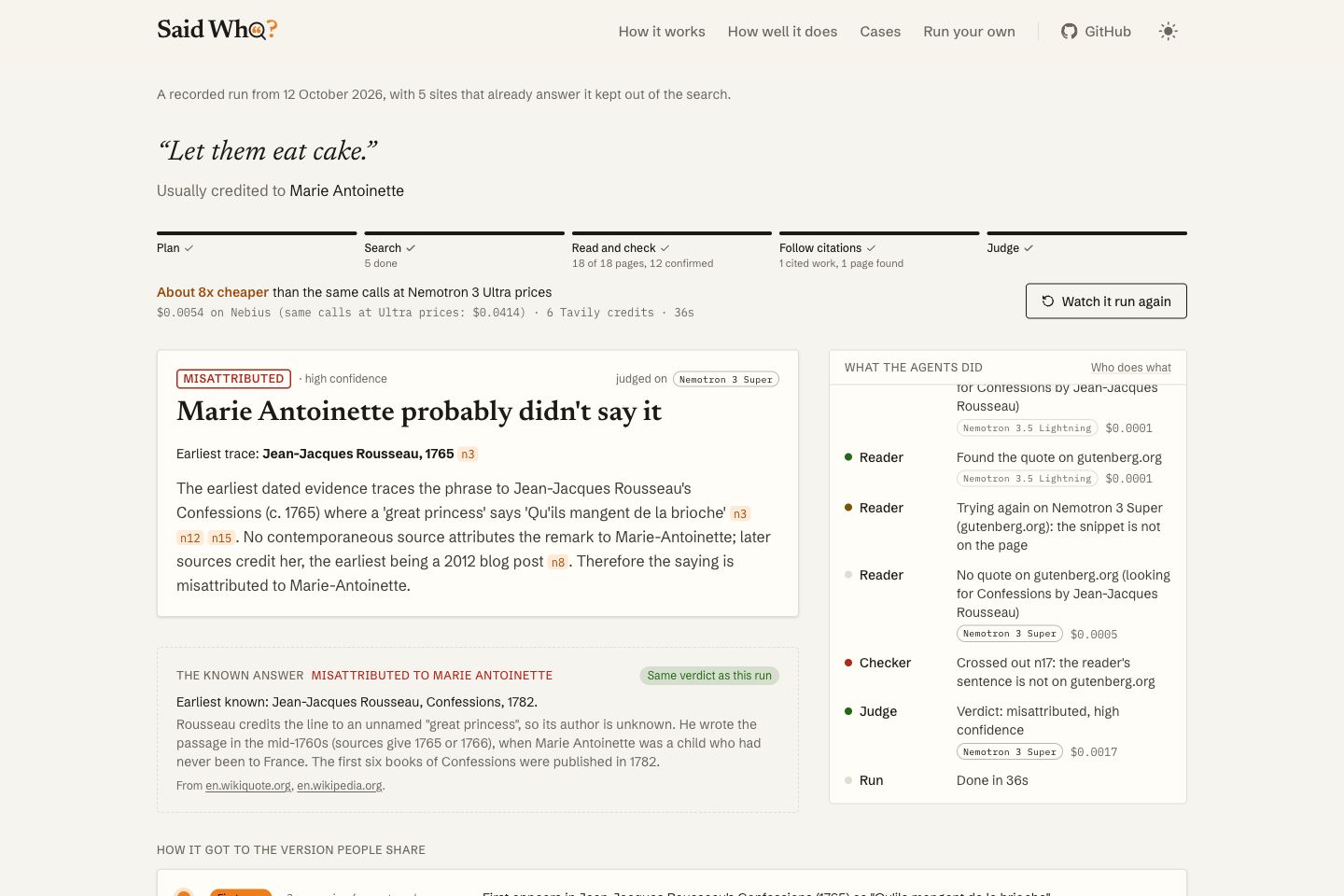
"Let them eat cake": traced to Rousseau's Confessions, with every agent step on the right.
-
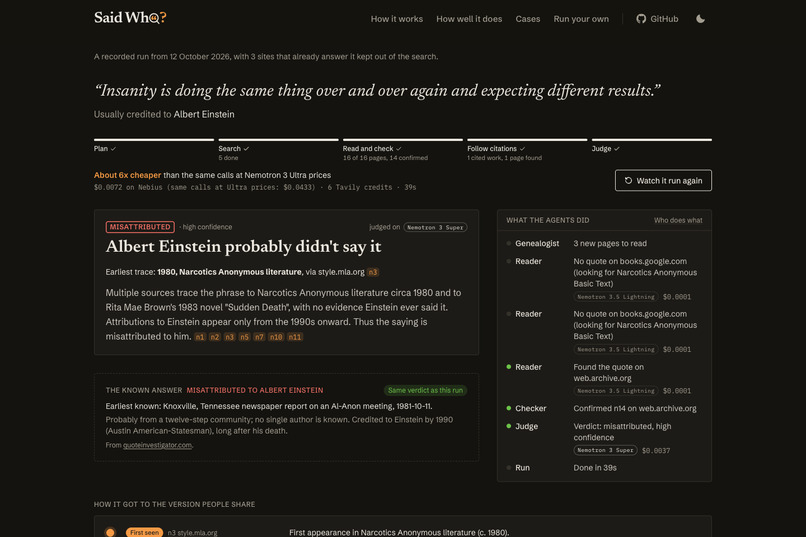
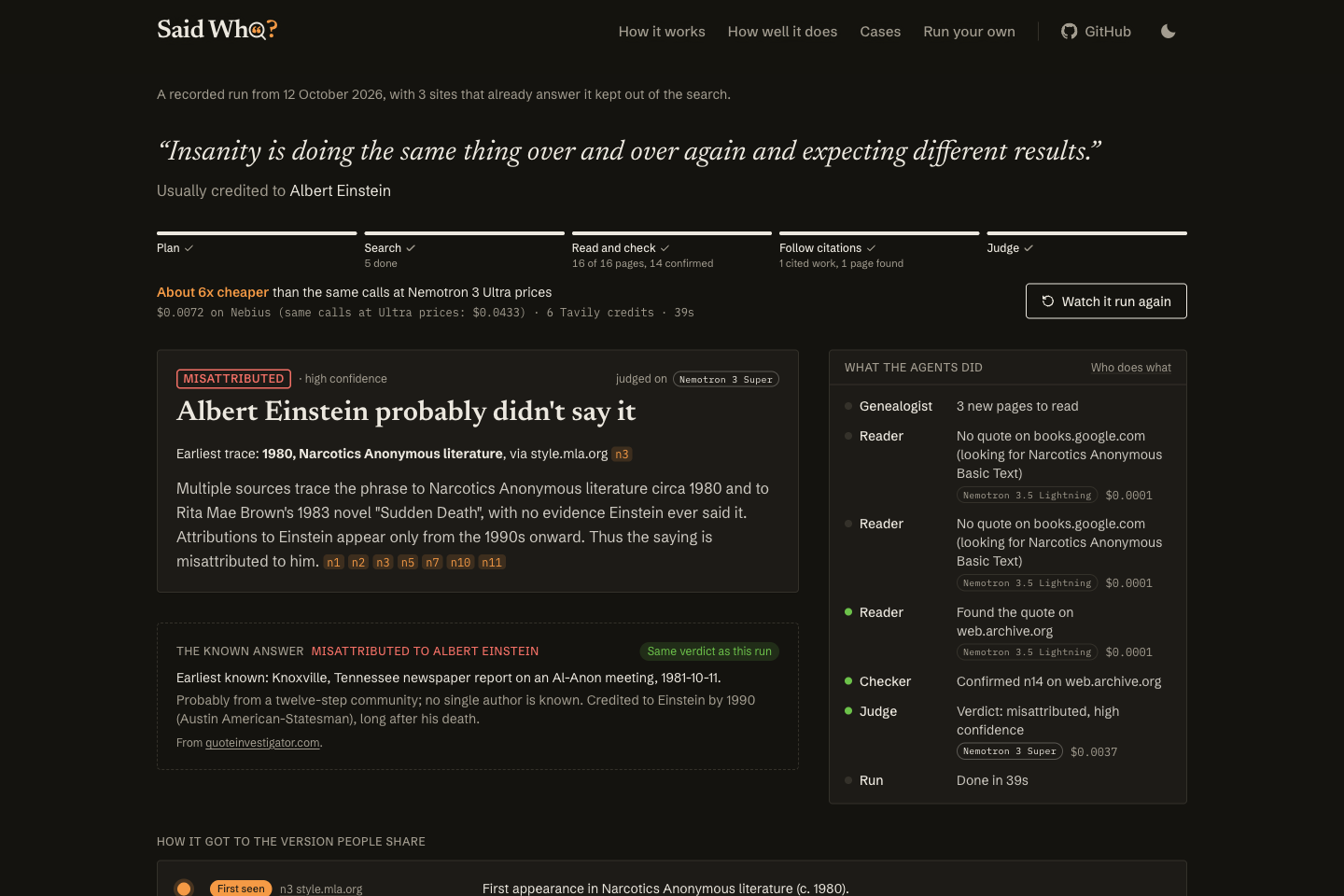
A finished case in the dark theme: the verdict, what each agent did and the known answer next to it.
Inspiration
Quotes travel. Every time one gets shared it can lose a word, pick up a new one, or end up with a more famous name attached. A few years later everyone "knows" who said it, and nobody can point to where.
Take "Insanity is doing the same thing over and over again and expecting different results." It's usually credited to Albert Einstein, but there's no evidence he ever said it. The earliest match Quote Investigator found is a 1981 newspaper report on an Al-Anon meeting in Knoxville, Tennessee. Researchers like that do this work by hand, one quote at a time. On the home page, Said Who?'s own run traces it to Narcotics Anonymous literature from about 1980.
Ask a chatbot where a quote comes from and you'll get a confident answer, and sometimes a source that doesn't exist. I wanted something anyone could use before they share or print a quote: a tool that searches, reads the pages it finds, checks that the quote is really on them, and only then says what it found, with a link for every step.
Who it's for
Anyone about to share a quote, and the people who have to get credits right: writers and journalists quoting someone, teachers putting a line on a slide, editors and fact-checkers asked "did X really say this?".
What it does
- You paste a quote, and the name it's usually credited to if you know it.
- Each step of the search shows up as it happens, with the Nemotron model doing it.
- Each page that carries the quote gets a card with the sentence copied from it, in columns by year, oldest on the left. If the sentence isn't really on the page, the card is crossed out.
- At the end you get a verdict: whether the usual credit holds up (misattributed, correct, contested, or no known source), the earliest source found, and how sure it is. The verdict cites the cards it rests on, and each citation links to its card.
- Above the timeline, a lineage shows how the quote got to the version people share: where it first appears, then each page where its wording, language or credited name changed.
- Each run that gets as far as planning is saved with a public link, and its page shows what it cost on Nebius next to what the same calls would have cost at Nemotron 3 Ultra's prices.
Ten finished cases can be replayed step by step without any keys. A new run uses your own Nebius and Tavily keys, or a free trial access code. Keys are used for that one run and never stored.
Sometimes the honest answer is "people disagree" or "nothing old enough turned up". Said Who? says that rather than make something up.
How I built it
Each quote goes through six steps, each with one job: Planner, Search, Readers, Checker, Genealogist and Judge. Search and page text come from Tavily. The Genealogist looks up the older works that confirmed pages cite, in digital libraries like archive.org, Wikisource and Project Gutenberg, and sends what it finds back through the Readers and the Checker. The app is Next.js on Vercel, and Supabase keeps the run log, the visitor limits and the trial's daily budget.
How Said Who? uses Nemotron on Nebius Token Factory
Every model call goes to Nebius Token Factory, and every one is an NVIDIA Nemotron model. A run uses three of them, each on the step it suits:
| Step | Model | Why this one |
|---|---|---|
| Planner: other wordings, likely authors, what to search | Nemotron 3 Ultra, thinking on | Usually one call a run, and it decides what gets searched |
| Readers: copy the sentence that carries the quote from each page | Nemotron 3.5 Lightning, thinking off | Up to 20 pages from the searches, five at a time, plus the library pages the Genealogist finds, so it has to be cheap and fast |
| A page read again after its reading failed the check | Nemotron 3 Super, thinking off | Only when a check on Lightning's reading fails |
| Genealogist: which older works the pages cite are worth looking up | Nemotron 3 Super, thinking off | A short pick from a list |
| Judge: the verdict and how the quote travelled | Nemotron 3 Super, thinking on | Weighs only the pages the Checker confirmed |
| A second verdict when the first fails a check | Nemotron 3 Ultra | Ultra takes over at most once a run. A verdict that only ran out of room is tried again on Super with thinking off instead |
The Checker between the Readers and the Judge is plain code, not a model. It looks for each copied sentence in the page's own text, allowing only small differences such as punctuation, accents or one word in ten, so a model can't talk a sentence onto a page that doesn't have it. Code also checks every page the Judge cites, and a verdict that cites a page the Checker didn't confirm is never shown as the answer.
What the split buys. In the third full eval (the 20-quote test set, October 14), Lightning made 287 of the eval's 368 model calls, about four in five, and cost $0.029 of the $0.153 total, under a fifth. A page read took a median of 1.1 seconds. Super read 20 pages again because a check on Lightning's reading failed: the sentence wasn't on the page (8), wasn't the saying (5), or a field was too long to be a quote (7). A quote cost $0.0076 on Nebius and took 44 seconds on average.
The first full eval (October 12) ran the same 20 quotes three ways:
| The app's mix | Every step on Ultra | Every step on Lightning | |
|---|---|---|---|
| Verdict matches the known answer | 14 of 20 | 14 of 20 | 9 of 20 |
| Earliest year within two years of the known one | 9 of 19 | 12 of 19 | 8 of 19 |
| Verdicts flagged for page ids the app couldn't match | 0 | 0 | 7 |
| Nebius cost per quote | $0.0045 | $0.0426 | $0.0048 |
| Time per quote | 51 s | 36 s | 69 s |
The app's mix got as many verdicts right as Ultra on every step, at about a tenth of the cost. Ultra found the earliest date more often, and that gap is still open. Lightning on every step wasn't cheaper, it was slower, and 7 of its 20 verdicts were flagged because they wrote page ids the app couldn't match, like "[n8]" for "n8", though the pages they meant were confirmed.
Since then the Planner has moved from Super to Ultra. In the first runs, Super's plan came back unusable 7 times in 34, with stray markup in its searches or nothing to search, and none of Ultra's 34 plans did. It's usually one call a run, for about $0.003 more.
Where Token Factory sped up the work.
- One API for every model size. Token Factory speaks the OpenAI API, so the app uses the official
openaiNode SDK with only the base URL changed, and one function makes every model call. Moving a step to another model means changing one model ID. The eval's "every step on Ultra" and "every step on Lightning" setups are the same code with a different list of models. - Three choices held from day one. On October 6, all four Nemotron models I tried (3.5 Lightning, 3 Nano, 3 Super and 3 Ultra) passed strict
json_schemaoutput, tool calling and theenable_thinkingswitch, and answered short prompts in 0.2 to 1 second. So every step returns JSON checked against a schema, thinking is on for planning and judging, and it's off for reading. - Fast enough to sit inside the loop. I had planned around the 29 seconds Super took in Nebius's own agent cost benchmark. On my calls it planned in 3 to 8 seconds and judged in 5 to 10 in the first runs, so a mid-size model with thinking on could judge inside a run someone watches. In the third eval its verdicts took a median of 11 seconds, and Ultra's plans under 4.
- Cheap enough to measure instead of guess. Each call reports its token counts, so every run page shows what the run cost on Nebius and what the same calls would have cost at Ultra's prices. The three-way eval of 20 quotes cost about $1.04 in Nebius tokens. To test changes to the Judge, a script judges the saved evidence of earlier runs again, three times each, without searching again. On two earlier runs, that showed right dates going from 70 to 100 of 192.
What I learned about the models.
- A reader can tidy a quote. Lightning once copied a sentence in its famous wording instead of the page's. The Checker caught it, which is why no copied sentence counts until code finds it on the page. A page like that is now read again on Super.
- A bigger judge doesn't fix thin evidence. On "Gel, gel, ne olursan ol", Super's verdict was "contested" with low confidence, which is right. Ultra, judging the same pages again, changed it to "no known source", still with low confidence. Ultra now steps in only when a verdict fails a check, not when it's unsure.
More of what I found, with numbers, is in FEEDBACK.md.
The hour-long eval can also run as a Nebius Serverless AI Job (eval/job.sh, steps in eval/README.md), but I haven't run that path end to end yet. Every number here comes from runs on my own machine.
How well it works, and where it fails
The eval runs 20 quotes whose origins have already been researched, with Quote Investigator, Wikiquote, Wikipedia and each answer's own pages left out of the search, so the trail has to be found from scratch. Six of the twenty really were said by the person they're credited to, so a tool that calls every famous quote fake would fail them. After the last fixes, ten more quotes that played no part in the fixes were run once:
| Test set | Held-out set | |
|---|---|---|
| Verdict matches the known answer | 13 of 20 | 10 of 10 |
| Earliest year within two years of the known one | 10 of 19 | 6 of 10 |
| Nebius cost per quote | $0.0076 | $0.0070 |
| Time per quote | 44 s | 37 s |
Ten quotes is a small sample. Where it still goes wrong:
- An older idea is taken for the saying. For "Be the change you wish to see in the world", the Judge found Gandhi's 1913 line "If we could change ourselves, the tendencies in the world would also change". It's a related idea in other words, not an earlier printing of the saying.
- The Judge can be too strict. For Edison's "Genius is one percent inspiration", it had a 1903 credit to Edison from his own lifetime and still said there was no known source.
- Disputes get missed. For "Gel, gel, ne olursan ol" and Warhol's "fifteen minutes of fame", the known answer is "contested". The Judge called the first unsourced and the second right.
Every miss is listed in the README, and every score quote by quote in eval/results.md.
Challenges I ran into
- Models tidy quotes. A reader asked to copy a sentence will sometimes "fix" it into the famous wording. That's why the Checker is plain code and nothing counts until code finds it, or a very close match, on the page.
- Telling the saying from a related idea. The hardest cases weren't finding old pages but deciding whether an old sentence is the saying at all. A verdict that calls the credit wrong because of a page worded unlike the saying is now written once more, shown that sentence and asked.
- Dates that aren't publication dates. Pages are full of years: a lifespan, the year someone supposedly said it, the year a book was written rather than printed. The Checker keeps a page's own date only in its title, near its top or next to the sentence, and an older source's date only next to the sentence, in the title or where the page names that source. A date that names two years, like a lifespan, or a year from another calendar isn't kept.
- Measuring through sampling noise. With thinking on, the Planner and Judge sample at a temperature of 0.6, and between two full runs four quotes flipped to right and five to wrong. One run per quote can't tell a fix from chance, so changes are measured by judging the saved evidence of earlier runs several times.
- A free trial on my own keys. Judges and visitors without keys run on mine, so each trial run reserves its worst case against a daily budget shared through the database before it starts, access codes carry a set number of runs, and each visitor has hourly limits. Keys are never stored or logged.
- Vercel's 300-second limit. A run stops starting new work after 180 seconds, and every Nebius and Tavily call has its own time limit, so a run always finishes with what it has.
Accomplishments that I'm proud of
- No verdict is shown that cites a page the Checker didn't confirm.
- The app's mix of models matched Ultra on every step for right verdicts at about a tenth of the cost, and a quote costs under a cent in Nebius tokens.
- All ten held-out quotes got the right verdict.
- The failure cases are published next to the scores, and every run that gets as far as planning, good or bad, gets a public page.
- Accessibility was part of the work: visible focus rings, run progress announced to screen readers, links and buttons at least 24 px tall on phones, and no motion when the system asks for reduced motion.
What I learned
- Checking beats trusting. The most useful part of the system is the plain code that refuses evidence it can't find.
- The honest answer is often "contested" or "no known source", and a good tool has to be able to say so.
- Small models are good readers and weak judges, and the largest model on every step costs ten times as much. Putting each model on the step it suits got the largest model's right verdicts for a tenth of the price.
What's next
- Close the gap on earliest dates, where every step on Ultra did better (12 of 19 against 9 of 19).
- Read more of the old books themselves. Through search, Google Books gives only a book's "about" page, with no text from inside it.
- Run the eval on Nebius Serverless AI Jobs, with the runner that's already in the repo.
- The site in more languages.
Built With
- nebius-token-factory
- nemotron-3-super
- nemotron-3-ultra
- nemotron-3.5-lightning
- next.js
- nvidia-nemotron
- react
- supabase
- tailwindcss
- tavily
- typescript
- vercel
- zod
