-
-
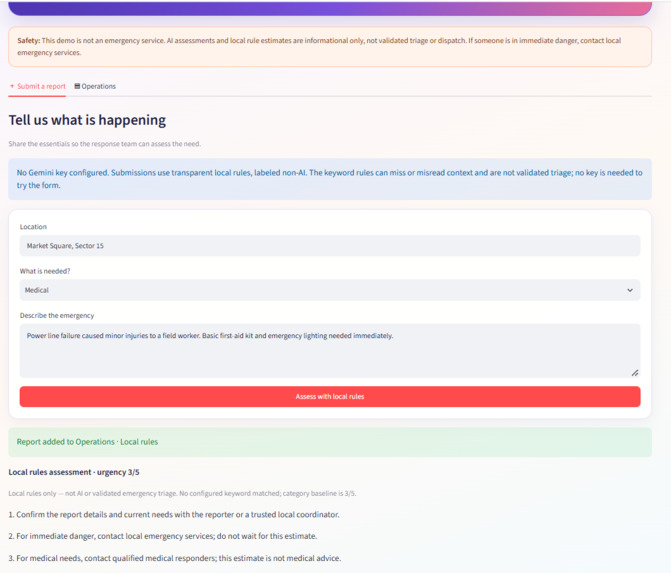
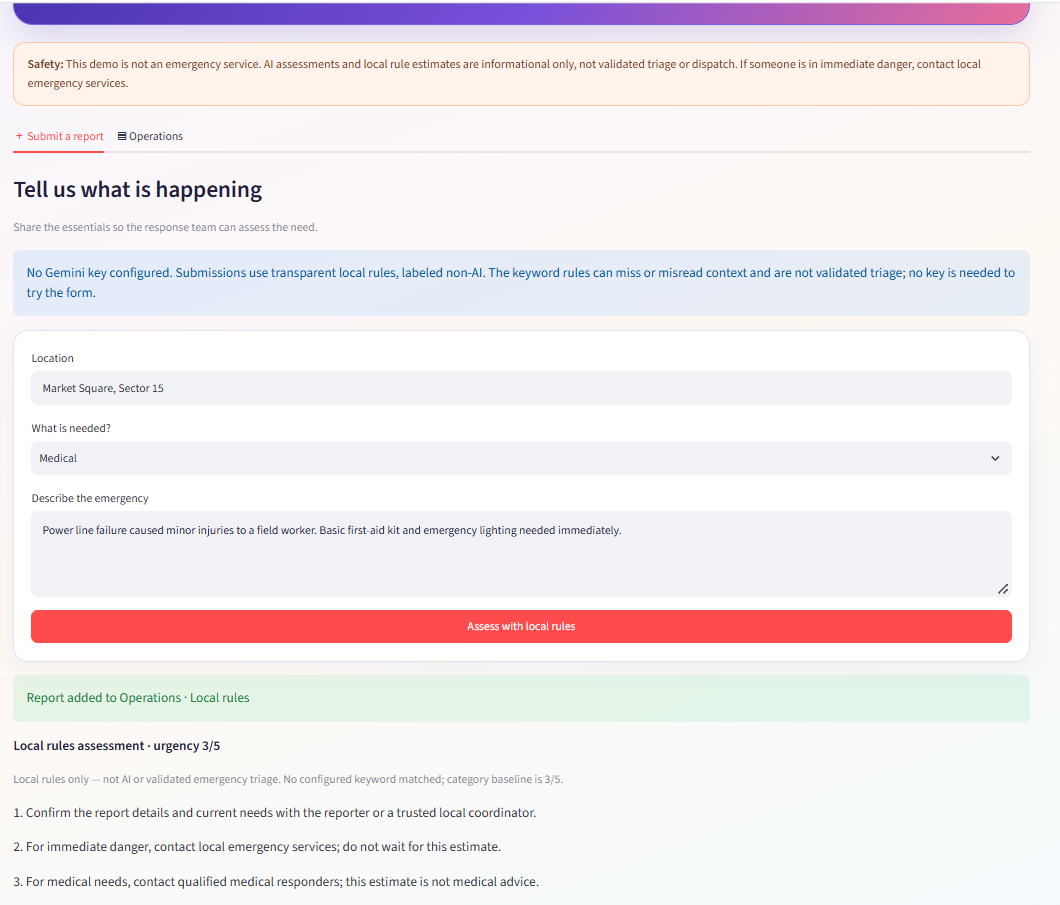
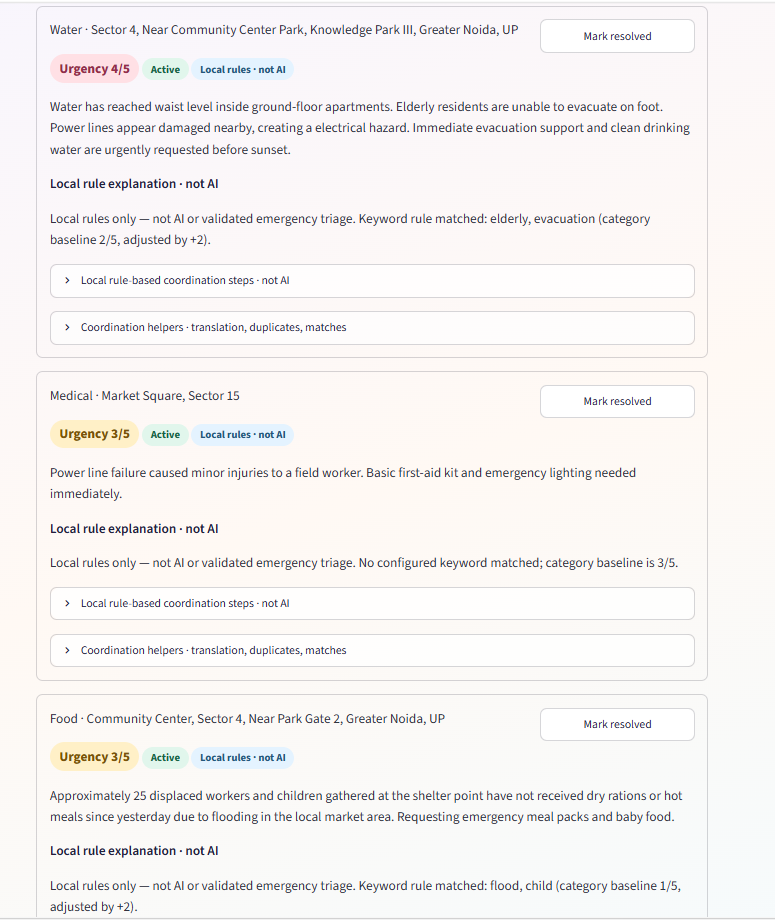
(Triage Output): Real-time local rule-based urgency evaluation and safety guidance generated upon submission.
-
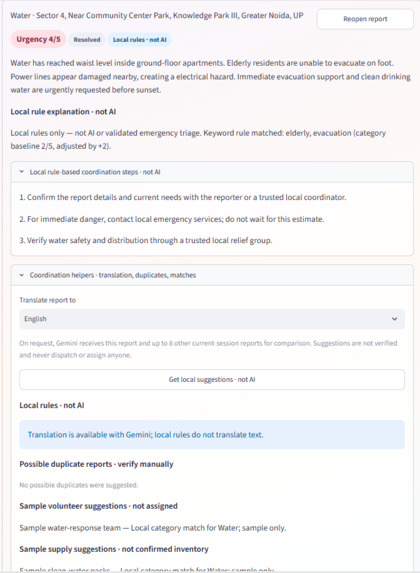
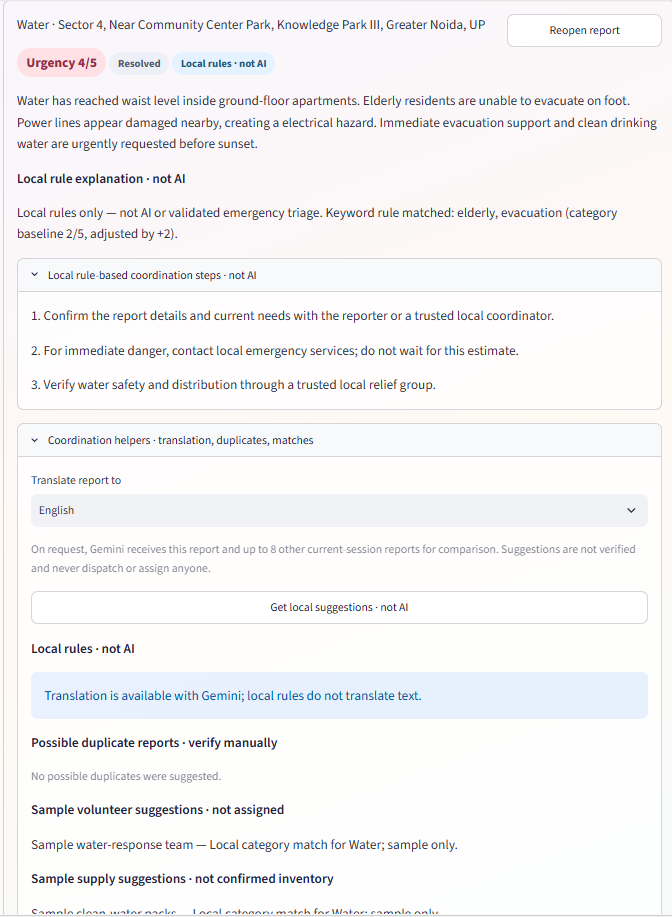
(Status Resolution): Incident resolution tracking showing status updates and report re-opening capabilities for relief coordinators.
-
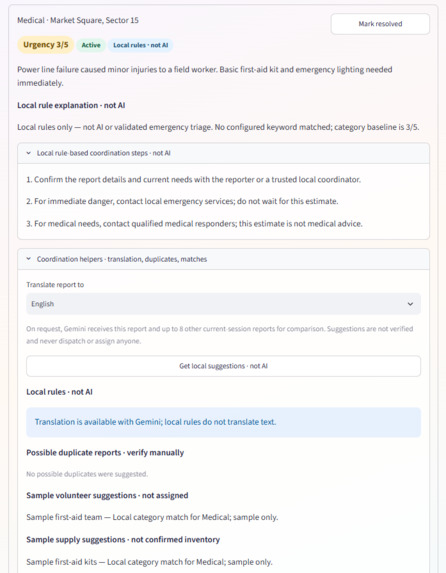
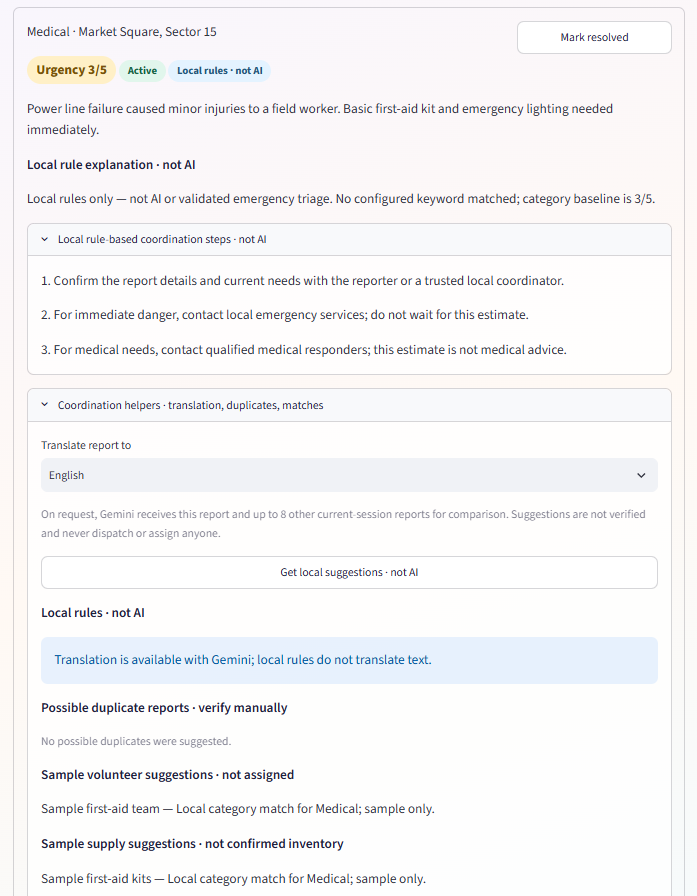
(Coordination Helpers): Field coordination panel displaying action steps, translation options, duplicate checks, and resource suggestions.
-
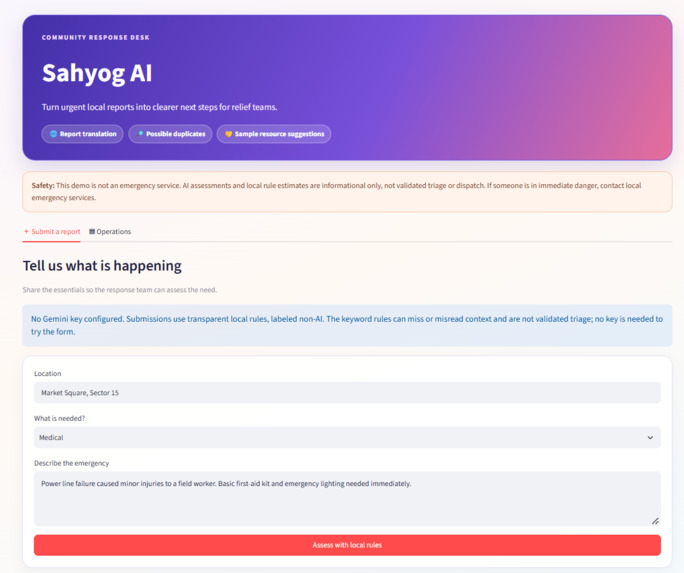
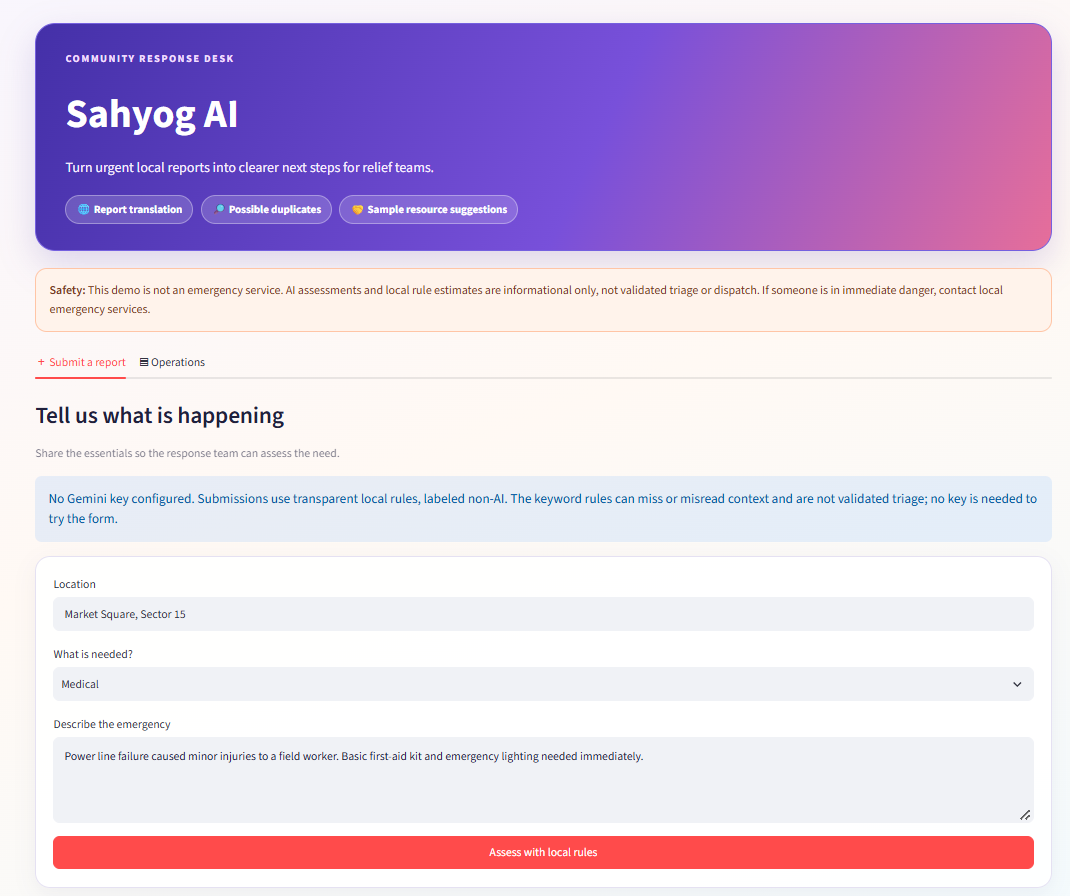
(Form): Emergency report intake form with location, category selection, and transparent fallback notifications.
-
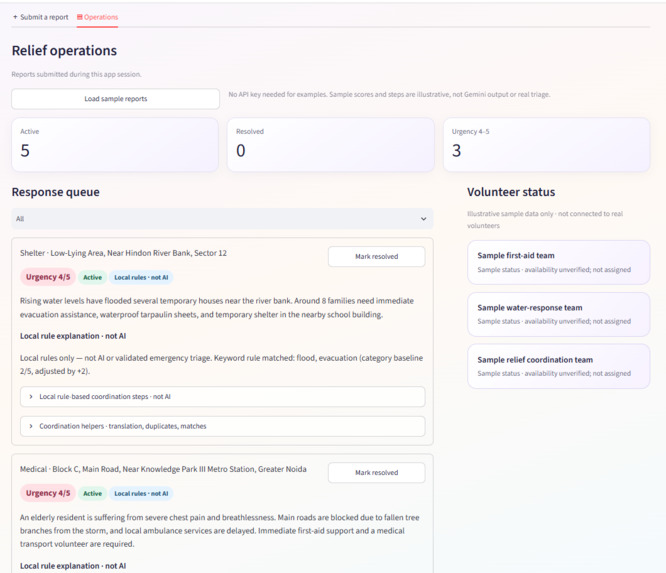
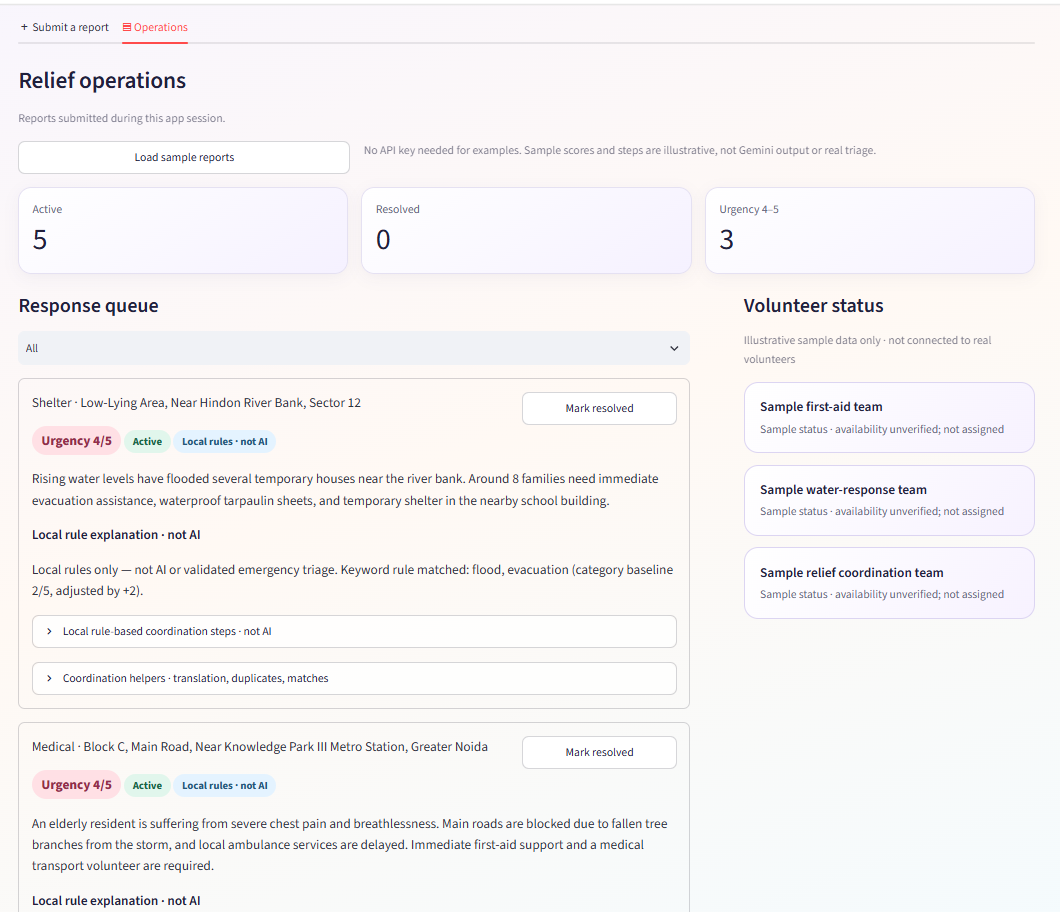
(Dashboard): Relief Operations dashboard featuring live incident counts, high-urgency filters, and volunteer status tracks.
-
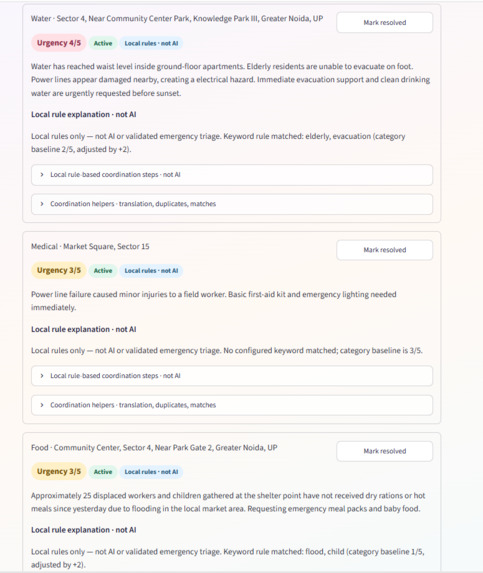
Response Queue prioritizes multi-category reports by urgency. Coordination Helpers add action steps, translation, and resource matching.
Inspiration During sudden urban emergencies, natural disasters, or critical supply shortages, community response coordination often breaks down because urgent requests get scattered across fragmented social media feeds, chat groups, and unorganized channels. We were inspired to build Sahyog AI to bridge this exact gap—providing an intelligent, centralized triage and coordination dashboard that connects citizens reporting ground-level crises directly with local response networks, coordinators, and volunteers.
What it does Sahyog AI is an intelligent emergency relief coordination platform designed for rapid crisis response. It features:
Emergency Incident Reporting: An intuitive interface enabling citizens to log urgent needs (such as Medical Support, Clean Drinking Water, Temporary Shelter, and Food Distribution) alongside location details.
Dual-Engine Urgency Triage: Leverages Google Gemini AI when a valid API key is configured to assess severity and summarize reports, while automatically falling back to a robust keyword rule engine (Local rules · not AI) when offline or unconfigured.
Coordination & Dispatch Helpers: Includes instant report translation via Gemini, session-based duplicate detection to prevent redundant dispatch, and a volunteer/supply matcher.
Operations Command Dashboard: Provides real-time filtering (All, Active, Resolved) and status toggling for field coordinators.
How we built it Sahyog AI was engineered following a structured development lifecycle:
Frontend & Backend UI: Built using Streamlit for rapid, interactive dashboard prototyping in Python.
AI & Fallback Integration: Integrated via the Google GenAI SDK with deterministic fallback rule handling for high availability.
Architecture & Planning: Built adhering strictly to structured workflows using the Devpost Learn Skill Pack (scope.md, prd.md, and spec.md).
Plaintext Sahyog-ai/ ├── scope.md # Project scope & goals definition ├── prd.md # Product Requirements Document ├── spec.md # Technical Architecture & Specifications ├── app.py # Main Streamlit Application UI & Logic └── README.md # Comprehensive Project Documentation Challenges we ran into Handling Missing API Keys & Offline States: In crisis scenarios, API connectivity or rate limits can fail. Ensuring the app didn't crash without a GEMINI_API_KEY required building a robust keyword-based fallback system that clearly notifies users.
Version Control & Git Sync: Managing collaborative planning artifacts alongside code while aligning local repositories with GitHub remote origins presented typical merge hurdles, which we resolved cleanly using structured git workflows.
Accomplishments that we're proud of Resiliency-First Design: Successfully building a seamless dual-engine architecture where the system instantly and transparently switches between Gemini AI and local rule-based fallback without breaking user workflow.
End-to-End Delivery: Moving from initial architectural scoping (scope.md, prd.md, spec.md) to a fully deployed GitHub repository (Swagata21-ai/Sahyog-ai) and functional Streamlit MVP under hackathon constraints.
What we learned Resiliency is Paramount for Critical Tools: Building for real-world emergency scenarios means anticipating API downtime and network limitations, making local-first fallback layers non-negotiable.
Structured Specification Driven Development: Utilizing professional planning documents before writing code kept the feature set focused and accelerated clean execution.
What's next for Sahyog AI GIS Map Integration: Integrating interactive mapping libraries (like Folium or Streamlit-Folium) to visualize incident clusters geographically in real time.
SMS & WhatsApp Gateway: Expanding ingestion channels beyond the web app to allow citizens to text emergency reports via SMS or WhatsApp APIs.
Role-Based Access Control (RBAC): Introducing secure authentication for field volunteers, medical personnel, and central dispatch commanders.
Built With
- ai
- artificial-intelligence
- community-help
- crisis-management
- dashboard
- devpost-skill-pack
- disaster-management
- emergency-response
- fallback-engine
- gemini-api
- git
- github
- google-genai
- machine-learning
- multilingual
- natural-language-processing
- open-source
- python
- resiliency
- social-good
- streamlit
- triage

Log in or sign up for Devpost to join the conversation.