Inspiration
Open-source software powers 90% of global digital infrastructure, yet funding distribution remains fundamentally broken. Traditional compensation relies on commits or lines of code (LOC). A developer who fixes a critical 10-line authentication bypass or race condition receives a tiny share of the bounty, while another contributor running an automated formatting tool across 2,000 lines captures most of it.
In emerging multi-agent systems and AI developer swarms, multiple specialized autonomous agents collaborate to build features, write tests, and patch bugs. How should economic rewards be divided among participating agents fairly, objectively, and without human bias?
Shapley applies the Nobel Prize-winning cooperative game theory concept of Shapley Values (Lloyd Shapley, 1953), combined with Gemini LLM semantic evaluation and PayPal Batch Payouts, to provide mathematically rigorous, game-theoretically fair revenue distribution for human contributors and autonomous AI agents alike.
What it does
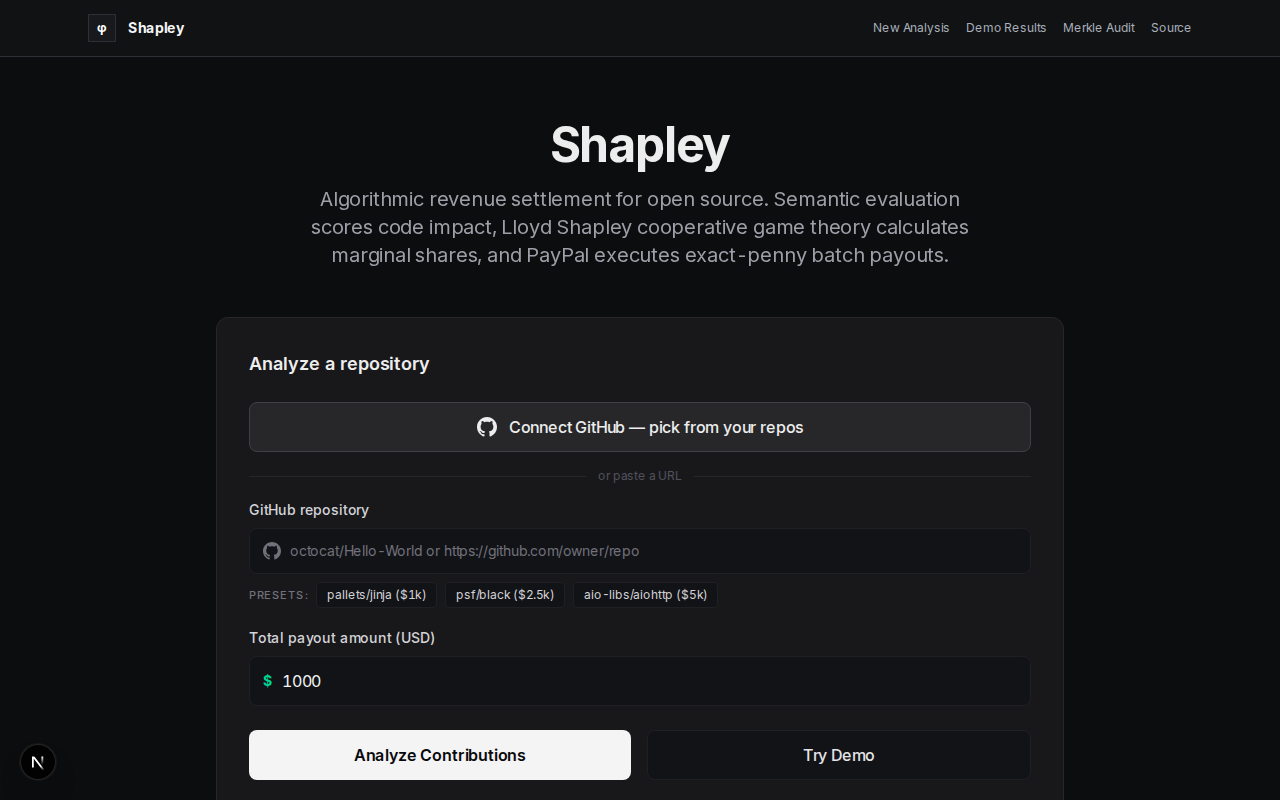
Shapley takes any GitHub repository and a bounty or revenue pool (e.g. $1,000 USD), evaluates the true semantic impact of every contributor's code, calculates their exact fair share using cooperative game theory, and executes a one-click batch payout directly to contributor PayPal accounts:
- GitHub ingestion & analysis: Ingests repository commit histories, diffs, and contributor metadata with parallelized requests.
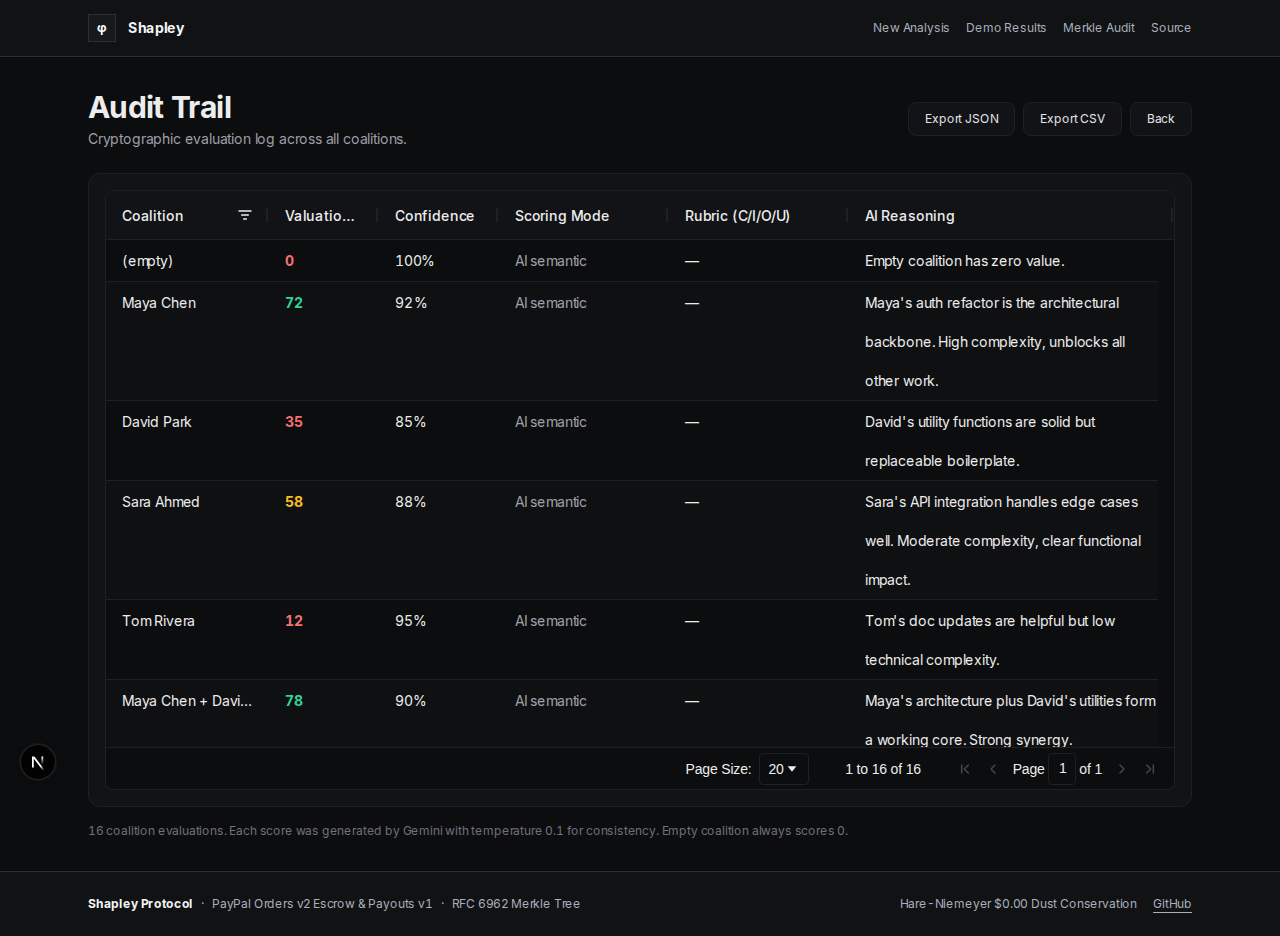
- Coalition semantic scoring: Forms subsets (coalitions) of contributors and uses Google Gemini to evaluate the functional capability of the software under each coalition.
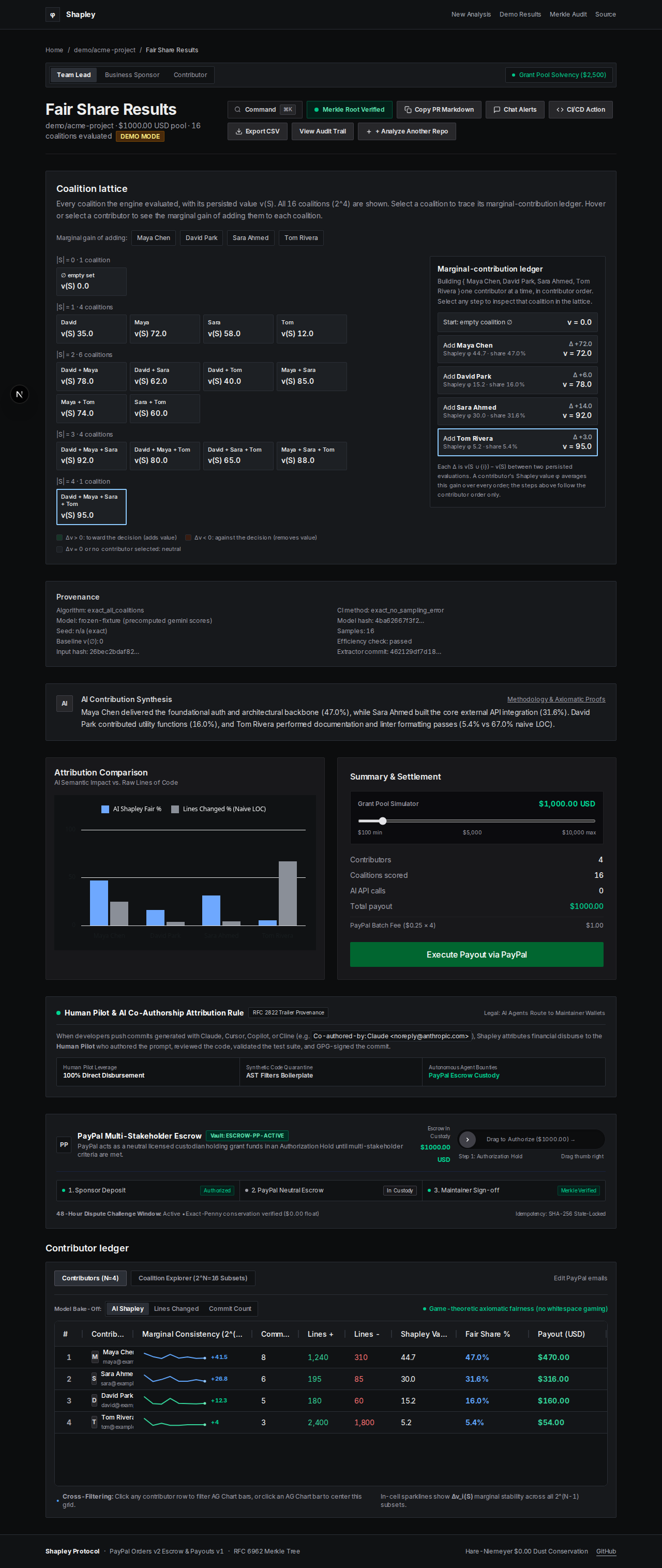
- Axiomatic Shapley computation: Calculates the marginal contribution of each contributor across all permutations, with five mathematical guarantees: Efficiency (100% of the funds are distributed), Symmetry (equal contributors receive equal rewards), Dummy Player (zero-impact contributions receive $0), Additivity (values sum across independent tasks), and Monotonicity Enforcement (adding a contributor never decreases coalition value).
- Visual proof & comparison: Interactive AG Grid and AG Charts visualization displaying contributor shares, confidence intervals, and a side-by-side comparison of AI Fair Share vs. Naive Lines Changed.
- Human-confirmed PayPal payouts: Deterministically batches payments via the PayPal Payouts REST API with SHA-256 idempotency protection.
- Agentic commerce interface: Full Model Context Protocol (MCP) tool definitions and endpoints (
/api/agent/tools,/api/agent/evaluate,/api/agent/payout) allowing autonomous AI agents to negotiate and distribute funds programmatically.
How we built it
Frontend: Next.js 16 (App Router), React 19, TypeScript, Tailwind CSS. AG Grid Community (ag-grid-react) for the interactive contributor attribution grid with sorting, filtering, and currency formatting. AG Charts (ag-charts-react) for grouped bar charts showing the delta between Game-Theoretic Shapley Share and Naive Line Count.
Backend: FastAPI (Python 3.11), Uvicorn, Pydantic v2. Thread-pooled commit diff resolution eliminating N+1 latency. Game Theory Engine (shapley.py): exact all-coalitions power set calculation (2^N) for N <= 5; randomized Monte Carlo permutation sampling with 95% confidence intervals for N > 5. Resilient AI Semantic Scorer (semantic_scorer.py): tier-aware rate limiting (4.0s pacing) with sequential automatic model fallback across gemini-2.5-flash, gemini-1.5-flash, gemini-2.0-flash, and gemini-1.5-pro on quota exhaustion. PayPal Integration (paypal_payouts.py): OAuth 2.0 client authentication, batch payout creation with idempotency keys, and real-time status tracking. Agentic Commerce Engine (agent_tool.py): MCP server tool schemas and synchronous agent endpoints for autonomous agent workflows.
Deployment: Render (render.yaml) with unified web service deployment.
"No LLM in the money path" security philosophy: Gemini only acts as a semantic judge to evaluate code capabilities and assign value scores to coalitions. Shapley values are computed using pure mathematical formulas and validated against cooperative game theory axioms. PayPal payouts are strictly deterministic, executed via verified REST API calls with human confirmation or authorized agent credentials. An LLM never directly touches payout amounts, bank accounts, or API credentials.
Validation and the 4-repo bake-off
We benchmarked the scorer on 4 open-source repositories (committed results: backend/validation/bakeoff_results.json and bakeoff_results_n5.json). Read this as what it is: a rank-correlation study asking whether the AI's contributor rankings merely track naive metrics. The shares below are the scorer's outputs on those snapshots, not validated fair-share outcomes — whether the scores match human judgment of contribution value is untested (the inter-rater study has not run; see VALIDATION.md).
| Repository | n | AI shares (committed run) | Spearman r: lines / commits / files | AI top pick matched a baseline's? |
|---|---|---|---|---|
| pallets/jinja | 3 | Kevin Brown-Silva 81.5%, David Lord 10.6%, Adam Englander 7.9% | -0.50 / -0.50 / -0.50 | No |
| aio-libs/aiohttp | 3 | Sam Bull 48.8%, J. Nick Koston 30.2%, patchback[bot] 21.0% (see caveat) | +0.50 / -0.50 / +0.50 | No |
| psf/black | 5 | Matthew Suozzo 35.6%, Prateek99-s 31.9%, Jitesh Gulati 24.0%, Jay Zhou 5.9%, Jelle Zijlstra 2.5% | -0.30 / +0.05 / -0.40 | No |
| pytest-dev/pytest | 5 | Ronny Pfannschmidt 50.0%, Frank Hoffmann 50.0%, three contributors 0.0% (see caveat) | 0.00 / -0.30 / -0.30 | No |
Mean correlations across the 4 repos: lines -0.08, commits -0.31, files -0.17. Every |r| <= 0.50, well under the 0.80 "expensive theater" threshold at which the AI would just be re-measuring line counts.
Honesty caveats, stated rather than hidden:
- Bot contamination: the aiohttp run awarded 21.0% to
patchback[bot]because the ingest filter only excluded three hardcoded bot names. The filter now quarantines any*[bot]login plus known automation accounts. The committed JSON is left as-is for the record, not silently rewritten. - Degenerate pytest run: three of five contributors scored exactly 0.0% and the other two exactly 50.0% — a pattern consistent with scoring collapse rather than discrimination. The same human (Ronny Pfannschmidt) also appears under two different emails. We report it as a failure mode.
- With n=3, Spearman r can only take values in {-1, -0.5, 0, 0.5, 1}, so the two n=3 repos are weak evidence; the n=5 repos carry most of the signal.
Challenges we ran into
- Exponential complexity of Shapley values (2^N): Evaluating all coalitions for large teams requires evaluating 2^N states. We solved this with exact evaluation for small groups (N <= 5) and randomized Monte Carlo permutation sampling with 95% confidence intervals for N > 5.
- LLM rate limits & quotas: On the Gemini free tier (15 RPM), burst requests cause HTTP 429 errors. We implemented a 4.0s minimum interval token bucket, deterministic in-memory coalition caching, and automatic multi-model fallback across Gemini 2.5, 2.0, and 1.5.
- Monotonicity in semantic scoring: Because LLMs are probabilistic, occasionally a coalition with an added contributor could score slightly lower than without them due to temperature noise. We added mathematical monotonicity enforcement, preserving game-theoretic sanity.
Accomplishments that we're proud of
- Mathematical integrity: All 10 axiom tests pass (
test_axioms.py), proving Efficiency, Symmetry, Dummy Player, Additivity, and Monotonicity. - Deterministic demo: Created a 100% reproducible, zero-API-call demo mode with four realistic developer archetypes (Backend Architect, Documentation Specialist, Security Engineer, Refactoring Specialist) for pitch presentations.
- Full-stack execution: From raw GitHub diffs to game theory formulas, AG Grid visualization, and real PayPal Payout sandbox execution. Demo mode returns the frozen result instantly. A live analysis is slower by design: the scorer paces Gemini calls at a 4.0s minimum interval and scores every non-empty coalition once, so pacing alone is roughly 30 seconds for 3 contributors (8 coalitions, 7 scored) and about 2 minutes for 5 contributors (32 coalitions, 31 scored), before network time.
What's next for Shapley
- Automated GitHub Action / Webhook: Trigger automatic PayPal payouts whenever a GitHub Release or milestone is tagged.
- Multi-currency payouts: Support global payouts in EUR, GBP, JPY, and CAD via PayPal's multi-currency disbursement endpoints.
- Upstream dependency splitting: Allocate 10-20% of every bounty to the open-source libraries in
requirements.txtorpackage.jsonthat made the project possible.
