-
-
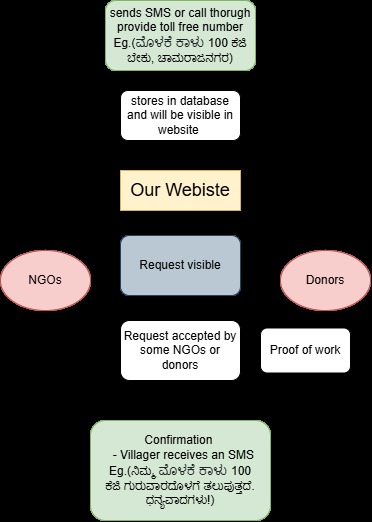
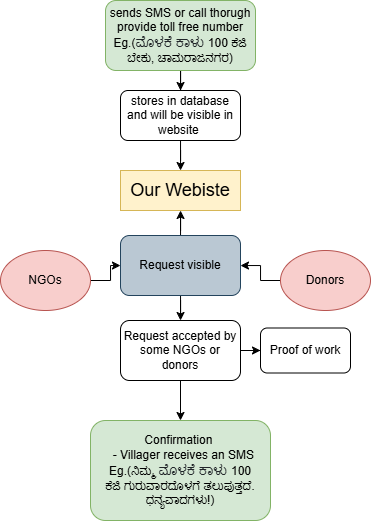
Flowchart of our workflow
Inspiration
The alarming data from NFHS-5 deeply moved us. Nearly two-thirds of Indian children under five suffer from anemia (67%), while 35.5% are stunted, 19.3% are wasted, and 32.1% are underweight—a crisis that continues despite various interventions ruck us even more was the heartbreaking contrast: 40% of food in India is wasted every year, yet millions of children go to bed hungry. This harsh reality inspired us to create "A Bridge of Hope: Linking Communities to Food and Care." Many government programs and NGOs provide food and nutritional support, but people in slums and tribal areas often struggle to access these resources due to lack of awareness, complex application processes, transportation barriers, and even social stigma. Our platform bridges this gap—ensuring that essential food supplies, nutrition programs, and donations actually reach those who need them. By connecting donors, NGOs, and government aid with underserved communities, we make sure that every child gets not just food, but the right nutrition to grow, thrive, and break free from the cycle of malnutrition.
What it does
Tribal or slum people call the provided toll-free number where the call recording begins and captures all their needs. The recorded request is then submitted to the website, where it is first checked for any false requests before being listed for NGOs and donors to view.
NGOs or donors who are willing to help can accept the request, and in the subsequent step, they are allowed to upload proof of their support. Once the proof is uploaded, SMS notifications are sent to the tribal or slum people who originally made the request.
We are open to collaborating and partnering with NGOs in the future to streamline our process. Our page also features a donation section that allows users to donate. Unlike other donation pages, we display the donor's name, the donation date, the amount donated, and the specific cause for which the funds are used, building trust between us and the donors.
If an NGO is located far away and encounters transportation issues while supplying the needs, we support them by coordinating with other NGOs or donors. We strive to form a bridge of hope, ensuring that ‘No child goes hungry’.
How we built it
We built our platform using a modern, scalable tech stack. On the backend, we chose Node.js paired with Express.js to manage our server-side operations, and MongoDB as our database to efficiently track donations and manage data. To boost transparency, we even considered integrating blockchain technology so that every donation could be verified in real time. Although, given that this is an MVP and we had some time constraints, the blockchain aspect remains an exciting idea for our future roadmap. On the frontend, we created a clean and intuitive user interface using HTML5, CSS, and JavaScript. This combination of technologies lets us connect surplus food with those who need it while keeping the whole process transparent and efficient
Challenges we ran into
Real-world issues emerged. We noticed that our toll-free number sometimes received false or prank requests, meaning we had to manually follow up with calls to confirm that each request was genuine. Additionally, language barriers posed a challenge in our diverse country, so we recognized early on that multi-language support would be crucial to ensure that everyone, especially those in tribal and slum areas, can easily access our services. Despite these hurdles, our team's collaborative spirit has helped us build a platform that bridges the gap between surplus food and those in need, and we're eager to keep refining our approach.
Accomplishments that we're proud of
We're proud our platform is ensuring no child goes hungry by connecting surplus food with communities in need. This stable food environment not only nourishes children but also helps reduce the pressure for families to migrate in search of resources, ultimately strengthening local communities.
What we learned
Throughout this project, we truly understood the value of teamwork and open communication. Every team member’s unique skills played a vital role in helping us tackle technical issues as well as practical challenges like false requests and language barriers. We learned that being adaptable and persistent—always open to new ideas and ready to change our approach when needed—can make all the difference.
What's next for SahayyaSetu-A bridge of hope
After the hackathon, we're excited to take SahayyaSetu – A Bridge of Hope into the real world. We’re not just here for a competition; our vision is to truly make a difference. We want to ensure that surplus food reaches communities that need it most, helping to nourish children and ease the hardships that force families to migrate in search of better resources. We plan to collaborate with local NGOs, government organizations, and community leaders to refine our platform based on real-life experiences. This journey will not only touch lives but also help us learn and grow as a team, driving us closer to a future where every child is fed and every community thrives.


Log in or sign up for Devpost to join the conversation.