-
-
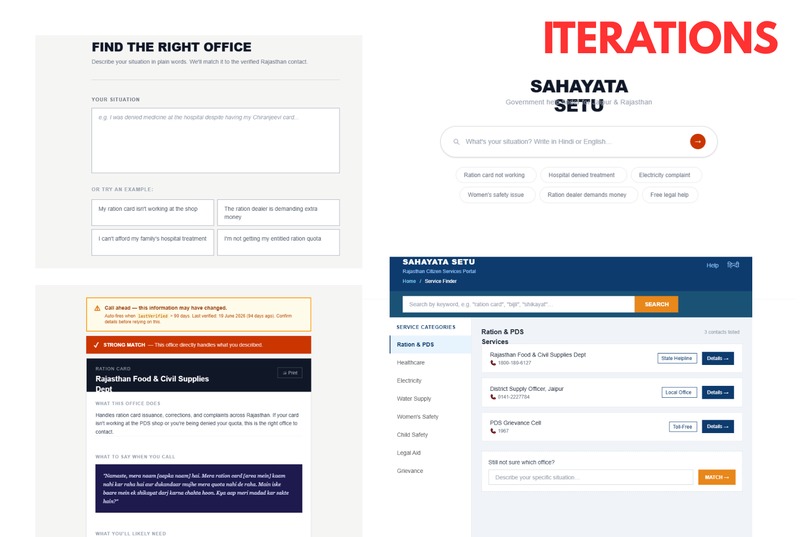
Different Iterations of the site
Inspiration
In Jaipur, there is an entire profession built on a single fact: government information is too confusing for ordinary people to navigate alone.
They are called touts. They sit outside government offices and charge families ₹500 to ₹2000 to answer three questions: which scheme applies to you, which office to visit, and which documents to bring. The families pay because the alternative is spending entire days visiting the wrong counters, being turned away, and starting over.
40+ government welfare schemes exist across Rajasthan covering food, housing, healthcare, employment, education, elder care, disability support, and legal aid which are administered by seven different agencies with overlapping jurisdictions and eligibility criteria written in bureaucratic language that is simply too complex for a common family to comprehend.
We built Sahayata Setu because we watched this happen to people we know. They qualified for the help, but could not actually complete the processes to receive it.
What It Does
Sahayata Setu is a free-text AI matching and live navigation tool that helps Jaipur families discover government support programs they are entitled to, with no prior knowledge of the system required.
The user simply describes their situation in their own words — in Hindi or English — in a single text field.
"My Swami Vivekananda Scholarship results are pending beyond the due results day, and my college applications are closing soon. What should I do?."
That description is processed by an AI backend that evaluates it against a manually verified database of 40 real Rajasthan government schemes. The AI returns up to 4 ranked matches, each containing:
- A plain-language sentence explaining why this program fits this specific problem.
- A personalised script — exactly what to say when visiting or calling the office, tailored to the user's specific situation and the scheme they are asking about
- The exact office address with GPS-accurate Google Maps directions.
- Operating hours and tappable phone number.
- A document checklist with interactive checkboxes.
Live Web Results: Alongside the verified program matches, Sahayata Setu fetches 3-4 live web results related to the user's situation — current news, recent updates, and relevant context from across the web. Each live result comes with its source link and an explicit disclaimer:
"These results are pulled from the web in real time and have not been verified by Sahayata Setu. Please check each link before taking any action."
This gives users current, real-world context while being completely transparent that live web results require human verification before acting on them. The results page also generates a printable summary card the user can bring to the office. The word "qualify" does not appear anywhere in the product.
How We Built It
| Layer | Technology |
|---|---|
| Frontend | React + Tailwind CSS |
| Backend | Node.js + Express.js |
| AI Model | Llama 3.1 8B Instant via Groq API |
| Live Search | Serper API |
| Program Data | 40 manually verified Rajasthan government schemes |
| Maps | Google Places API for real GPS coordinates |
| Hosting | Replit |
The frontend is designed light-mode first with bold typography and a single free-text intake field that removes all friction between the user and their results.
The backend handles all AI and search calls server-side so no API keys are ever exposed on the frontend. The server receives the user's description, runs two parallel operations — AI matching against the program database and a Serper live web search — and returns both sets of results simultaneously to the frontend.
The AI generates personalised office scripts for each match based on the user's specific situation, so they know exactly what to say whether they are calling ahead or walking in. These reference the user's actual circumstances and the specific scheme they are enquiring about rather than being simple templates.
The program database was built entirely through manual research across six official Rajasthan government portals. GPS coordinates for all 40 offices were verified through Google Places so map links open to the actual counter.
Challenges We Ran Into
Building the database was harder than building the application.
Government websites in Rajasthan are fragmented across agencies, frequently outdated, and sometimes contradictory. Eligibility criteria that appear on one portal are absent from another. We spent significant time cross-referencing sources and making judgment calls on undocumented criteria.
The second major challenge was routing and state management. Getting the AI response and Serper results to flow correctly from intake through to the results page without data loss required rebuilding the React state architecture twice. The root cause was that the original Groq model had been decommissioned, causing silent 400 errors that looked like frontend routing failures.
Accomplishments That We're Proud Of
Every program is real, verified, and GPS-accurate A family in Jaipur could use Sahayata Setu today and walk into the right office with the right documents and the right words.
Personalised office scripts No other welfare navigation tool tells you exactly what to say when you get there. This is the feature that converts information into action , which is the whole point.
Two-layer information architecture. Verified static knowledge from the program database combined with live web context from Serper, with honest transparency about which is which. Users get depth and currency simultaneously.
*Responsible AI * The word "qualify" is banned at model level and UI level. Confidence scoring communicates uncertainty honestly. Live results carry explicit verification disclaimers.
What We Learned
The data is the product, meanwhile the AI is the interface.
A matching algorithm is only as good as the knowledge base it operates on. Building a genuinely useful knowledge base about Jaipur's welfare system required domain knowledge that no public dataset provides and no general-purpose AI can replicate.
We also learned that the most important design decision in a high-stakes tool is what the AI is not allowed to do. Every constraint we built such as no "qualify," no unverified claims, explicit confidence levels, human verification prompts on live results, made the product more trustworthy and more useful simultaneously.
What's Next for Sahayata Setu
Immediate roadmap:
- Hindi voice input using the Web Speech API so users can describe their situation by speaking rather than typing which is critical for low-literacy users and elderly dependants.
- WhatsApp integration via Twilio so the entire flow works as a WhatsApp conversation, removing the browser entirely and reaching users where they already are. -Automated scheme verification a scheduled backend job that pings official Rajasthan government portals weekly and flags changed schemes for human review, replacing the current manual process
- Caseworker callback requests so users who need more help can connect to a partner NGO with their matched programs and situation description pre-attached
Medium-term vision:
City-by-city expansion starting with Jodhpur, Udaipur, and Kota before moving to Delhi, Mumbai, and Bengaluru. Same model, same architecture, new verified local databases.
Long-term vision:
Becoming the navigation layer that sits on top of broken bureaucracy in India and eventually every emerging market where the same tout economy exists..
The tout economy dies when information becomes free. That is what we are building.
Built With
- express.js
- google-places
- groq
- llama-3.1-8b-instant
- node.js
- react
- replit
- serper-api
- tailwind-css
- vite

Log in or sign up for Devpost to join the conversation.