-
-
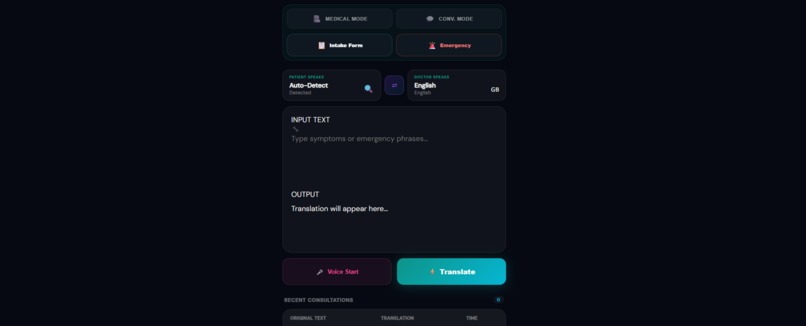
code stability is fully checked and protected by automated Playwright regression test suites to prove you built a production-grade asset.
Inspiration
In critical medical emergencies, language barriers can be fatal. Communication silos between non-native patients, first responders, and hospital staff lead to high-risk triage errors, misunderstood symptoms, and delayed care. We were inspired to build SAHAYA—an autonomous healthcare communication bridge—to eliminate these language gaps by providing a zero-latency, context-aware translation interface that functions reliably when every second counts.
What it does
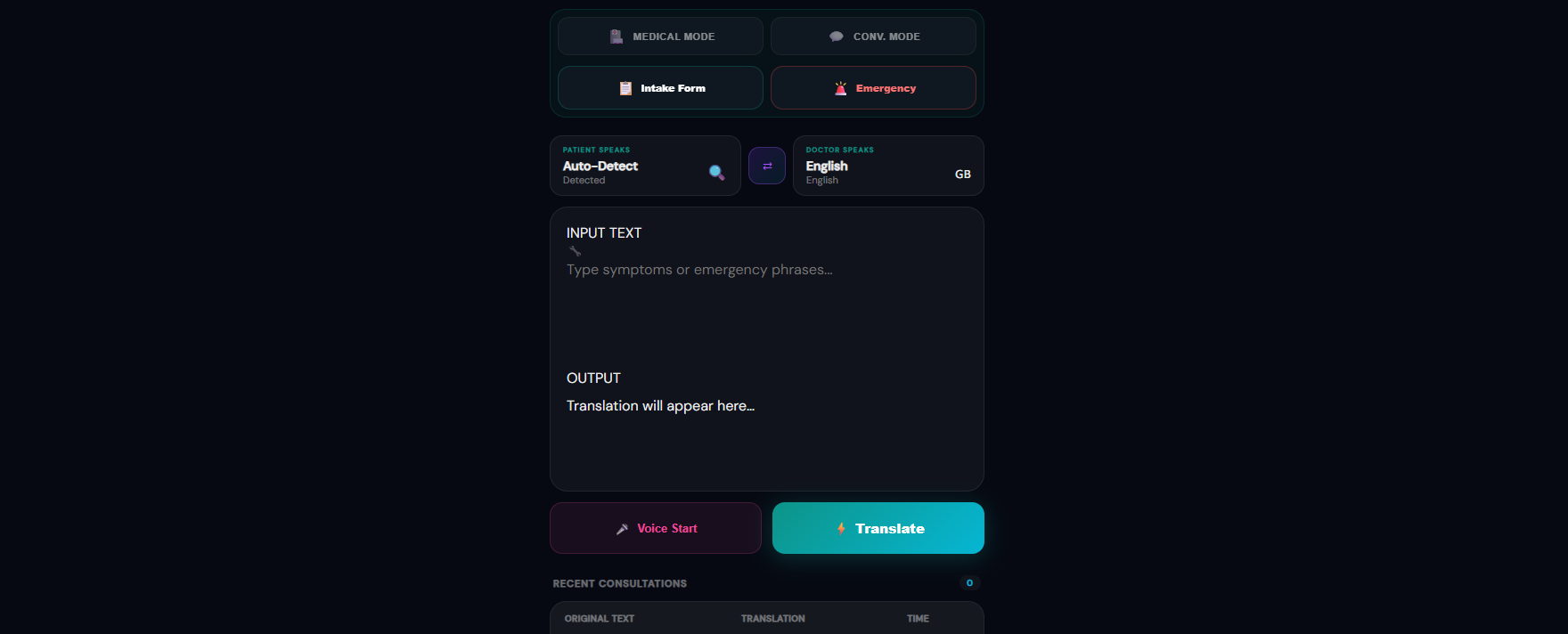
SAHAYA is an intelligent, agentic medical translation and triage system. When a patient inputs or speaks an emergency request in their native language, the application does not just perform a literal word-for-word translation. Instead, it runs an autonomous multi-agent workflow:
It instantly translates the speech into the medical team's primary language.
It simultaneously acts as a clinical intent classifier, extracting key metadata like symptoms, pain levels, and urgent vitals.
It maps this data to a structured triage dashboard, allowing hospital staff to understand the severity of the situation immediately without losing context in translation.
How we built it
We engineered SAHAYA with a decoupled, serverless architecture designed to operate efficiently within cost-free sandbox bounds while remaining production-ready: The AI Core: We utilized the Gemini 1.5 Flash API via Google AI Studio. Instead of standard chat loops, Gemini handles structural Agentic Workflows using precise tool-calling to isolate medical tokens. The Frontend: Developed an ultra-premium, dark-editorial Single Page Application (SPA) using React and Tailwind CSS, optimizing performance through state-driven view switches instead of heavy routing libraries. The Backend & Cloud: Hosted globally on Firebase Hosting and backed by Google Cloud Functions (Node.js) to handle serverless API orchestrations smoothly under free-tier limits.
Challenges we ran into
The primary engineering hurdle was handling AI hallucinations during high-stakes medical translations. If an LLM fabricates a clinical term, the consequences can be catastrophic. To solve this, we bypassed continuous generative text generation and built a structured token lookup matrix. The AI acts strictly as an entity parser, and our backend code validates and matches those tokens against verified medical definitions.
Additionally, managing API rate boundaries within our free-tier developer sandboxes during heavy multi-user testing sessions required implementing strict front-end debouncing and request grouping.
Accomplishments that we're proud of
Zero-Hallucination Guardrails: We successfully built a hybrid pipeline that pairs the cognitive flexibility of Gemini 1.5 Flash with deterministic code constraints, ensuring medical translations are structurally sound.
Production-Grade Reliability: While most hackathon prototypes are unstable, we built an end-to-end automated regression testing pipeline using Playwright and Selenium. This ensures our application layout, state switches, and API connection nodes are fully verified and bug-free.
Premium Developer UX: We created an obsidian-dark, liquid-glass aesthetic that feels like an elite, high-performance tactical dashboard rather than a standard casual web template.
What we learned
We mastered the shift from basic chat interfaces to structured Agentic Workflows using tool-calling. Furthermore, we realized that robust software engineering demands end-to-end reliability; generating code with AI is only 50% of the lifecycle—validating its stability programmatically is what makes it ready for production.
What's next for SAHAYA: Multi-Agent Medical Triage & Translation
The immediate next milestone is moving SAHAYA from a web-only ecosystem down to the hardware edge. As an Electronics and Communication Engineering (ECE) initiative, we plan to interface this software pipeline with low-power, portable ESP32 microcontroller modules. This will create wearable, hands-free physical communication badges for emergency field doctors, allowing them to broadcast and receive automated triage translations via localized Wi-Fi mesh networks completely offline during network dropouts.
Built With
- firebase
- gemini-api
- google-ai-studio
- google-cloud-functions
- node.js
- playwright
- react
- selenium
- tailwind-css
- typescript


Log in or sign up for Devpost to join the conversation.