-
-
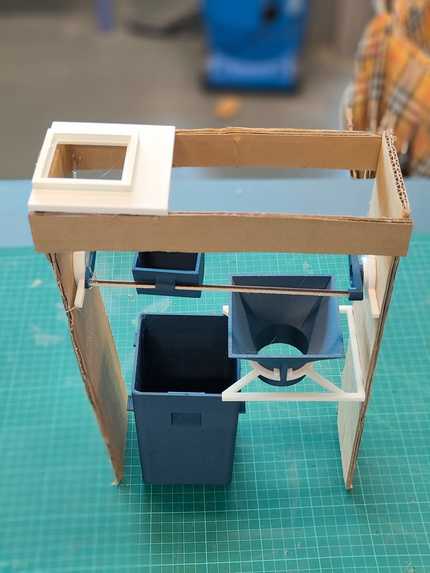
BioBin Structure Prototype
Inspiration
During a visit to a foreign workers’ dormitory, I was struck by the overwhelming amount of food waste and its impact on shared spaces, with scraps often ending up on the floor and in sinks. Speaking with the dorm owner, I learned that compost machines could help but will be often damaged when non-compostable items are mistakenly added. This inspired me to design a compost system with a waste classification feature to ensure proper usage. The compost could enrich the dorm’s gardens, where workers grow fruits and vegetables to save money and find joy, creating a solution that improves both sustainability and their living environment.
What it does
The dormitory environment often suffers from poor waste management, leading to dirty and unhygienic conditions due to negligence. Implementing industrial compost bins is not feasible in this context, as they are costly and prone to damage when non-compostable waste, such as metal, is improperly disposed of in them. Our solution,BioBin, leverages deep learning and compact IoT technology to address this challenge. The system automatically separates non-compostable waste, ensuring the composting machine's longevity. When non-compostable materials are detected, the waste is redirected to a general waste bin. Only compostable waste is processed, optimizing the system for efficient and sustainable waste management.
How we built it
We trained our deep learning software using Teachable Machine and exported it as python code using TensorFlow library, to use it in our system. We connected a smartphone with an IP based camera streaming app (Droid Cam) to ESP32 via local Wifi network to stream the video to the python model, using a web socket. The video is then analyzed by the model; the output further drives the servo motors from ESP32 using Arduino to continue the separation process of the mechanism.
Challenges we ran into
Hardware Integration: Getting the ESP32S3-EYE to communicate seamlessly with the cameras and servo motors was a real test of patience. We spent countless hours troubleshooting connections and ensuring everything worked in harmony. We even burnt one of the ESP32 boards in the process, which was a tough setback. Real-time Processing: Achieving real-time image processing with the limited resources of the ESP32S3-EYE was really hard to do. We had to optimize our code and make tough decisions to balance speed and accuracy. Error Handling: Developing robust error handling was crucial. We encountered numerous misclassifications and hardware malfunctions. One persistent issue was the AI detecting other trash as metal, which led to frequent misclassifications and required us to refine our model extensively.
What we learned
Through this project, we gained invaluable experience in integrating hardware and software to solve real-world problems. We deepened our understanding of the ESP32 microcontroller, particularly its capabilities in edge computing and image processing, which proved critical in designing an efficient, cost-effective solution. We also explored the transformative potential of deep learning in waste management, learning how to train and deploy models that adapt to complex, real-world scenarios. This process taught us the importance of dataset quality, model optimization, and balancing performance with hardware constraints, especially in resource-limited environments. This project showed us how interdisciplinary thinking—combining IoT, AI, and environmental sustainability—can drive impactful, innovative solutions for pressing societal challenges.
What's next for Sahara
We remain deeply committed to driving sustainable change, making it a part of everyday life for everyone. Together, we can create a better future, one small step at a time!

Log in or sign up for Devpost to join the conversation.