-
-
Logo
-
Local Host
-
Version 1
Inspiration
Every year, over 600 million Indians are affected by climate disasters — floods in Assam, heatwaves in Rajasthan, cyclones along the coasts. Yet when disaster strikes, the systems meant to help people fall apart at the exact same moment: weather monitoring is siloed from healthcare, healthcare is disconnected from relief coordination, and survivors are left navigating three different systems while terrified and alone. We were inspired by a simple but devastating truth: people don't die only from the disaster itself — they die from not knowing what to do in the first 30 minutes. A flood survivor drinking contaminated water because nobody told them about leptospirosis. A heatstroke victim whose family didn't recognize the signs until it was too late. SAHARA was born from the question: what if one AI agent could connect all three systems — detection, triage, and relief — in under 15 seconds?
What it does
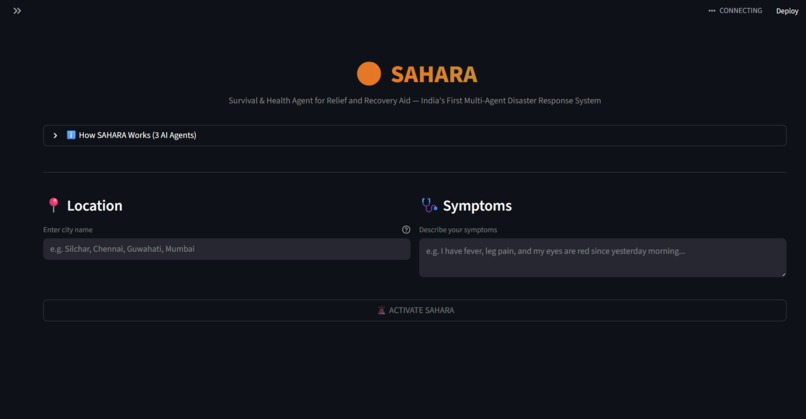
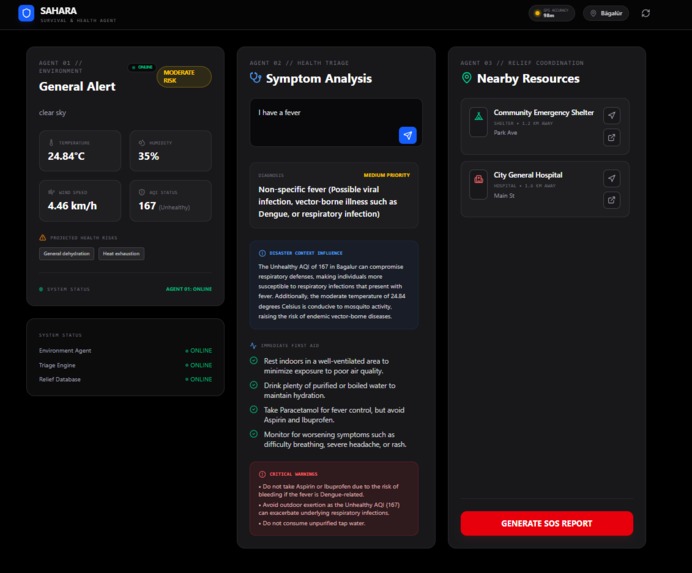
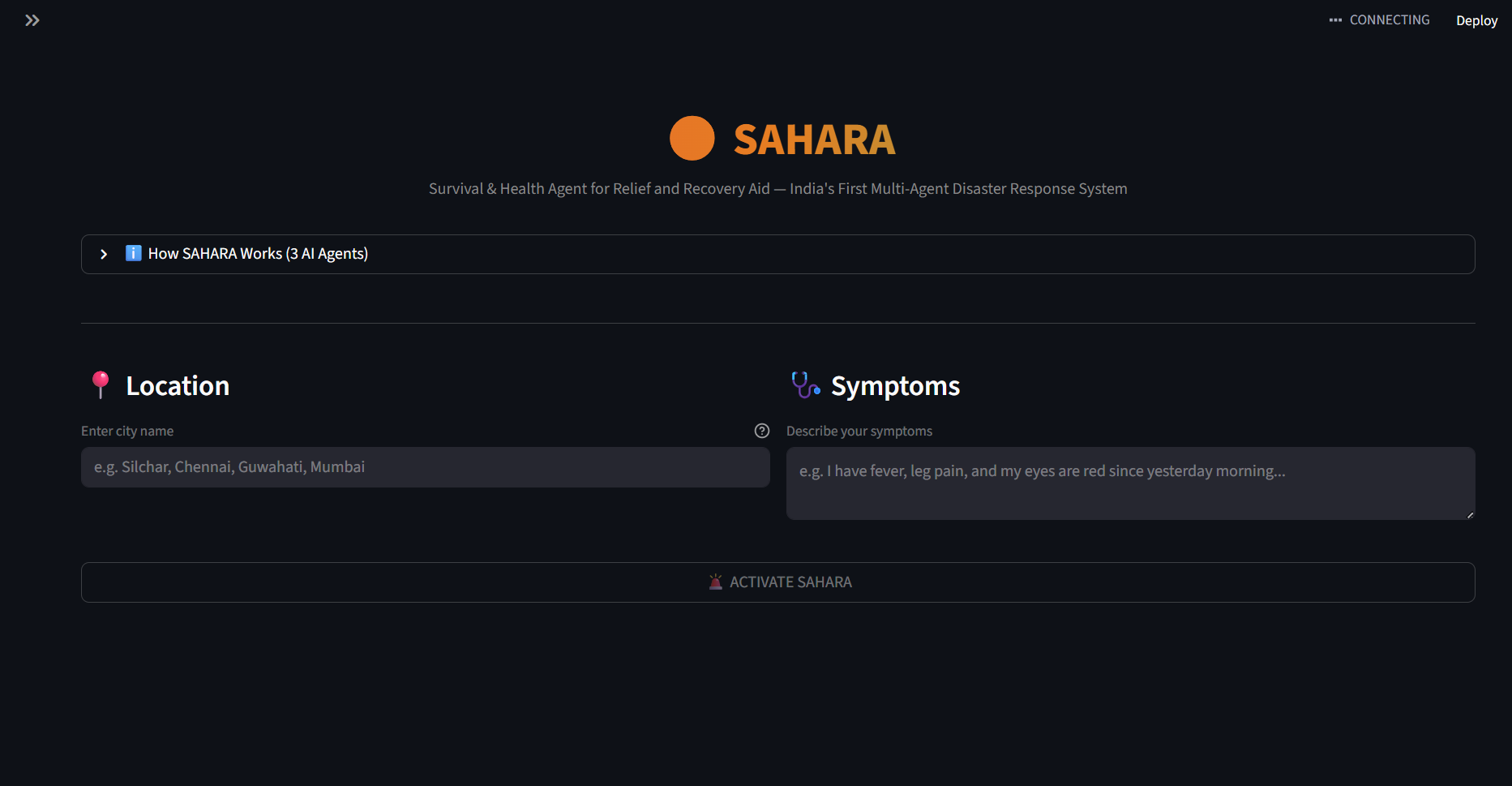
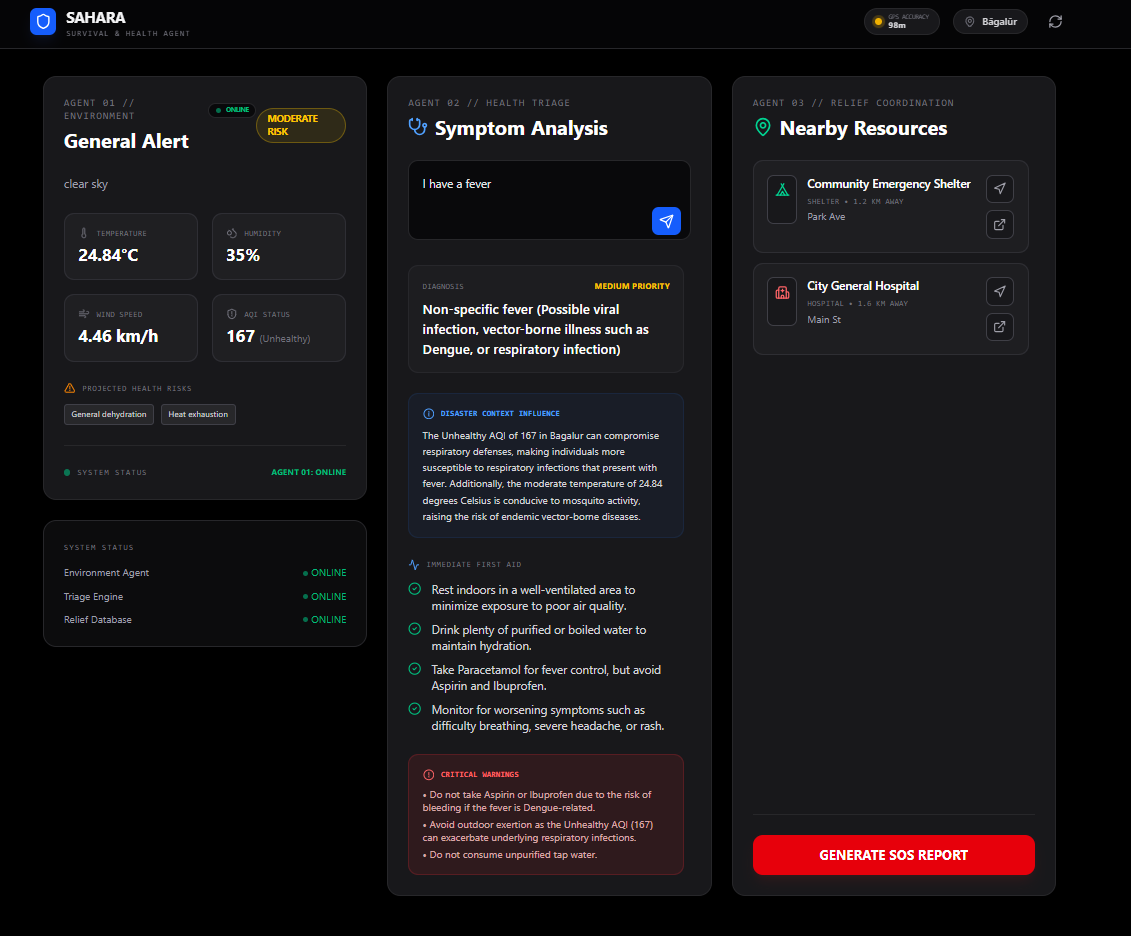
SAHARA is a multi-agent AI disaster response system that activates the moment a disaster hits. A survivor simply enters their city and describes their symptoms — SAHARA does the rest through three coordinated agents: Agent 1 — Environment Scanner monitors live weather data and air quality to detect the disaster type (flood, heatwave, fire, storm), calculates a real-time severity score from 0–10, and maps the disaster to its known health risks. Agent 2 — Health Triage Agent takes the survivor's symptoms and cross-references them with the specific disaster context. Instead of generic advice, a flood survivor reporting fever and leg pain gets leptospirosis-specific guidance — because SAHARA knows what disaster just happened. It outputs urgency level, immediate first aid steps, and red-flag symptoms requiring emergency care. Agent 3 — Relief Coordinator finds the nearest hospitals and pharmacies using OpenStreetMap, generates tailored evacuation advice for the disaster type, and produces a plain-text SOS report the survivor can forward via WhatsApp or SMS to family or rescue teams. The entire pipeline — from city input to SOS report — runs in approximately 15 seconds.
How we built it
SAHARA is built entirely in Python with a Streamlit frontend, designed to be lightweight and deployable on any machine.
Agent 1 uses the OpenWeatherMap API for live weather and the AQICN API for real-time air quality. A custom rule engine maps weather conditions (rainfall, temperature, wind speed, weather codes) to disaster types and severity scores. Agent 2 uses the Anthropic Claude API for intelligent, context-aware triage when available, with a full rule-based fallback system built on a disaster-symptom knowledge base — meaning it works even without an API key. Agent 3 uses the OpenStreetMap Overpass API (completely free, no key required) to find nearby hospitals, pharmacies, and shelters via live geospatial queries. A curated evacuation advice engine provides disaster-specific safety guidance. The three agents are orchestrated by a central pipeline in app.py, with each agent passing a structured data package to the next, mimicking a real multi-agent architecture.
Challenges we ran into
The biggest challenge was making Agent 2 genuinely useful without just giving generic medical advice. Early versions would say "drink water and rest" regardless of context — useless for a flood survivor. We solved this by building a disaster-symptom cross-reference system where the health advice is always anchored to the specific disaster type, its known disease vectors, and the environmental conditions Agent 1 detected. A second challenge was reliability — real disasters mean poor internet connectivity. We addressed this by building complete fallback logic into Agents 2 and 3 so SAHARA degrades gracefully, always providing useful output even when external APIs fail. Finally, integrating three live APIs (OpenWeather, AQICN, Overpass) with different response structures, error modes, and rate limits in a single coherent pipeline required careful error handling at every step.
Accomplishments that we're proud of
Built a fully functional 3-agent pipeline as a solo developer in under 24 hours The health triage is genuinely disaster-specific — not a generic symptom checker SAHARA works end-to-end with zero paid APIs (all free tiers or open data) The SOS report is immediately shareable via WhatsApp/SMS — designed for real-world use, not just a demo Complete graceful degradation — the system provides useful output even when individual APIs are unavailable
What we learned
Building SAHARA taught us that multi-agent architecture is most powerful when agents share context, not just results. The reason Agent 2 gives better advice than any standalone symptom checker is because it receives Agent 1's full environmental report — the disaster type, severity, and known health risks. Each agent makes the next one smarter. We also learned that real-world impact requires planning for failure. A disaster response tool that crashes when the internet is slow is worse than useless. Designing fallback logic wasn't an afterthought — it was a core feature.
What's next for SAHARA
Voice input — so survivors with limited literacy can speak their symptoms in Hindi, Tamil, Bengali, or other regional languages Offline mode — a compressed version that works on low-end Android phones without internet, pre-loaded with regional disaster risk data Government API integration — connecting with NDRF (National Disaster Response Force) and IMD (India Meteorological Department) official data feeds Predictive alerts — using historical disaster patterns to warn communities 24–48 hours before a disaster strikes, not just respond after Mesh network communication — allowing SAHARA nodes to relay SOS messages even when cellular networks are down, inspired by disaster communication research


Log in or sign up for Devpost to join the conversation.