Inspiration
Most households quietly depend on one person's undocumented memory. School pickup times, pet routines, an elder's evening check-in, a bill reminder, who can open the door for a trusted neighbour — none of it is written down. When that one person is suddenly unavailable, even for 72 hours, good intentions are not enough. We built Sahaaya (a word meaning "help/support") so a temporary absence never turns household knowledge into a crisis.
What it does
Sahaaya is a Family Continuity Planner. For a bounded, fictional P0 demo — the primary household organizer is unavailable for 72 hours — it:
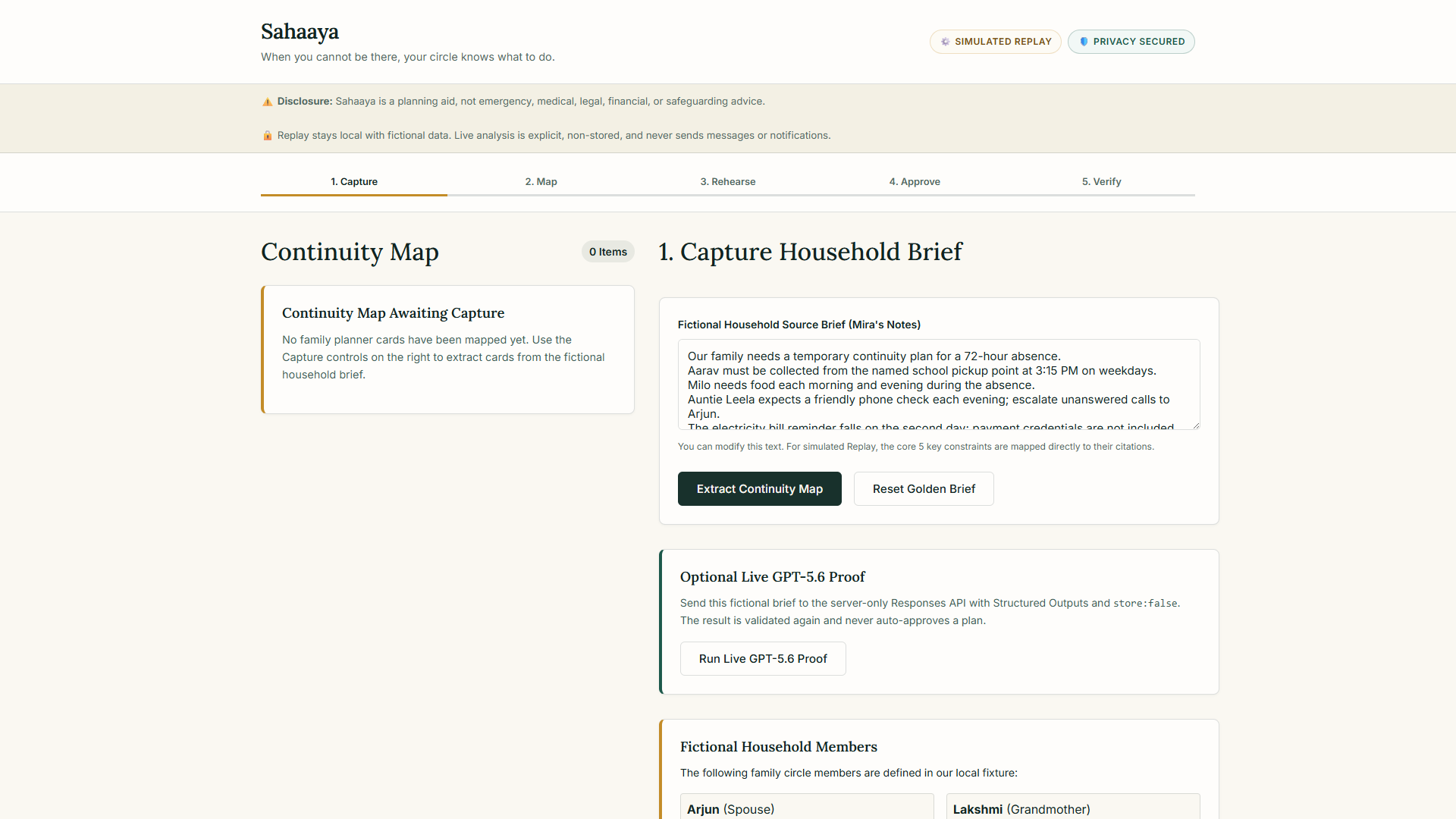
- Captures a short household brief and extracts five everyday responsibilities, each attached to a cited source fact.
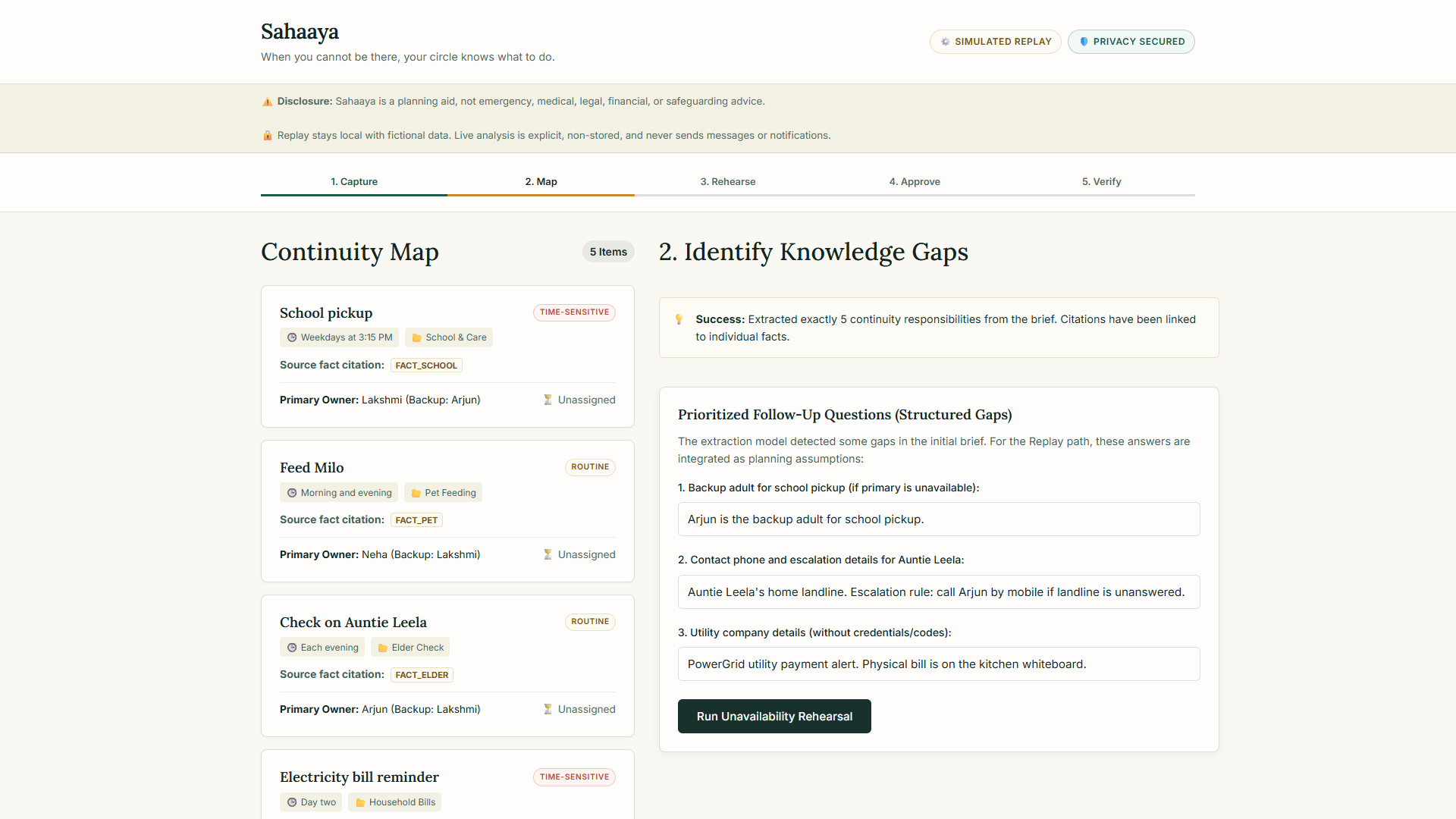
- Maps dependencies and surfaces grounded gaps: questions the family still needs to answer (a missing access code, unpaid credentials, an unconfirmed backup).
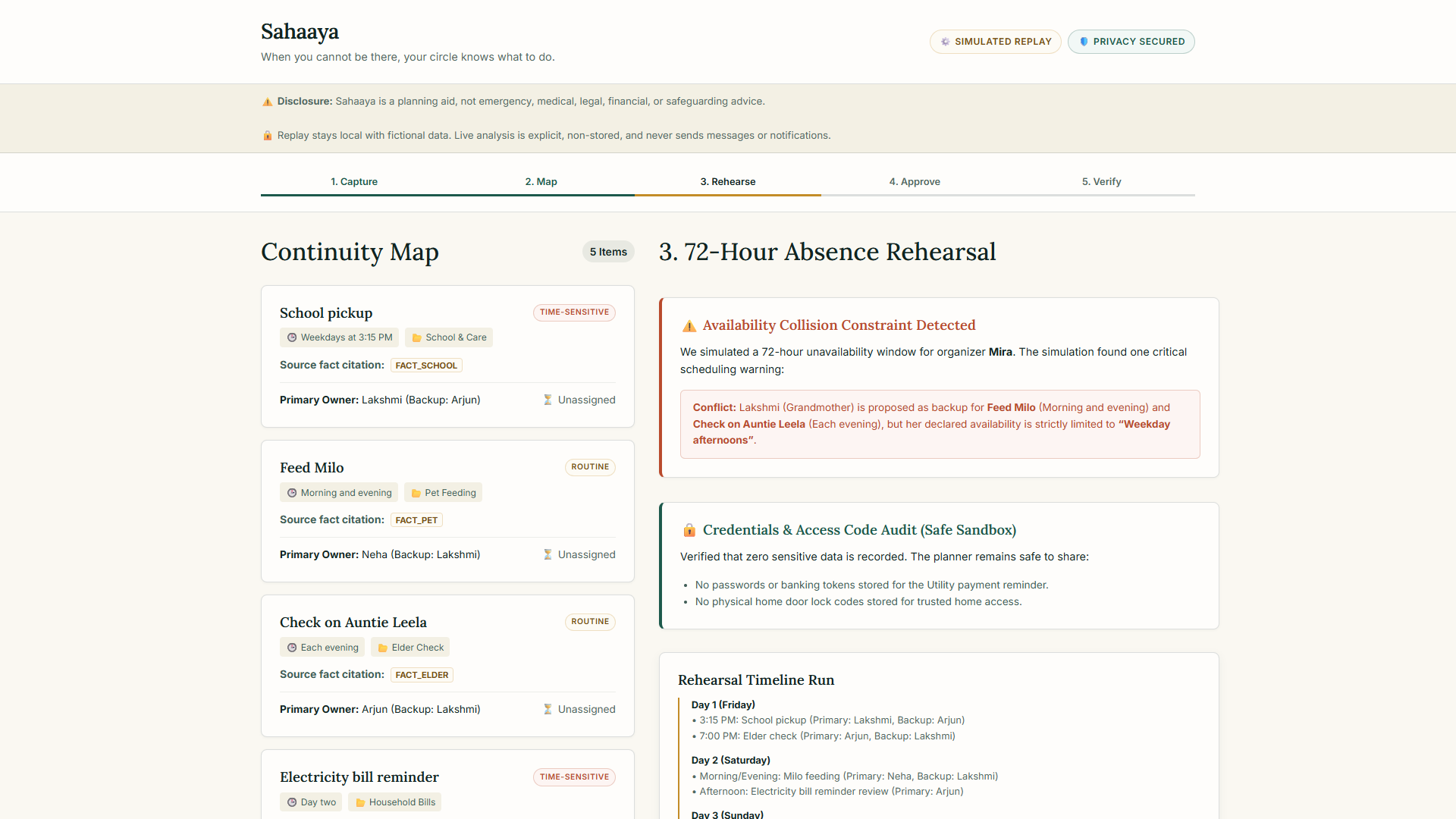
- Rehearses the handoff by proposing trusted-circle assignments matched to each member's availability.
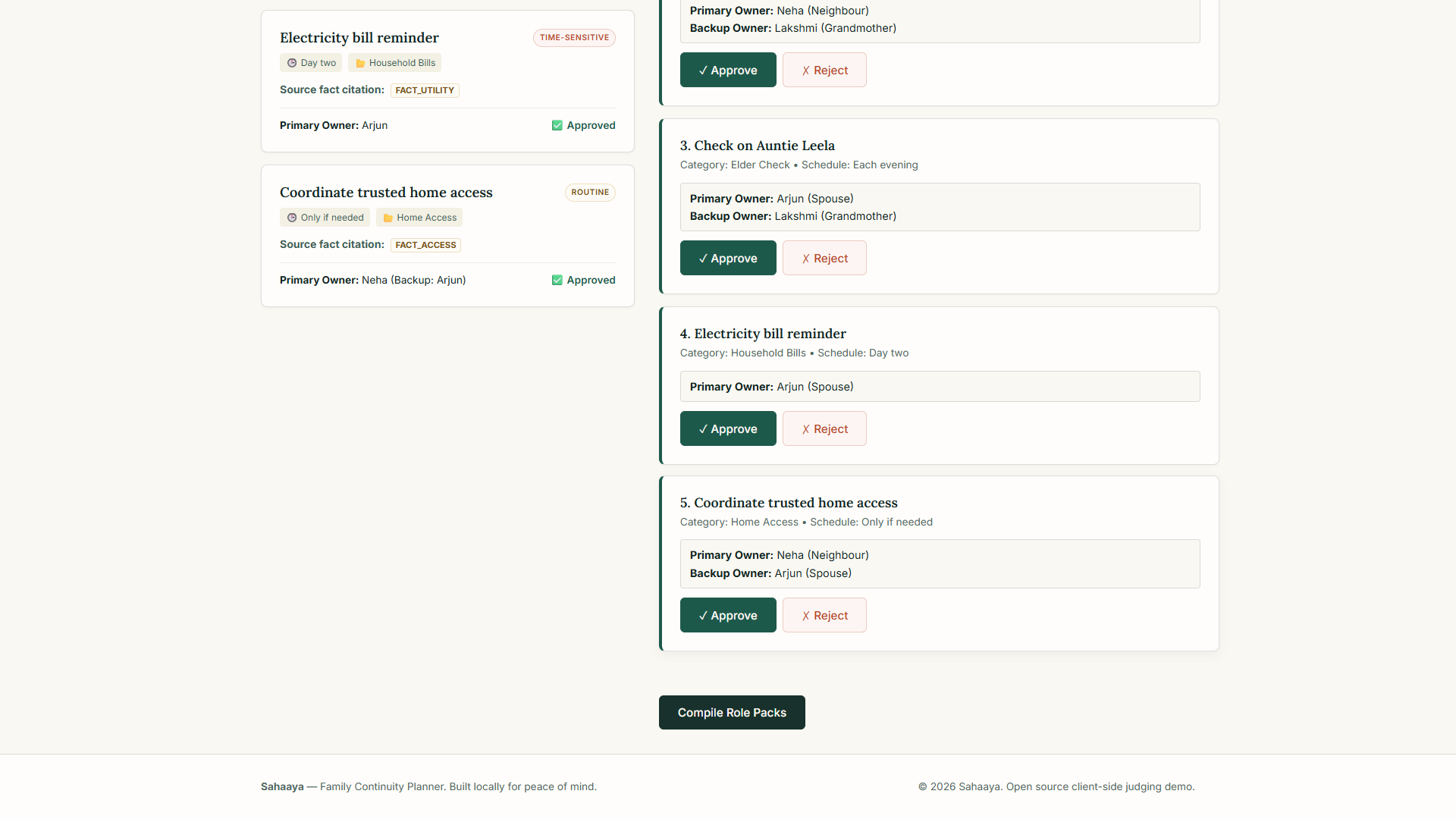
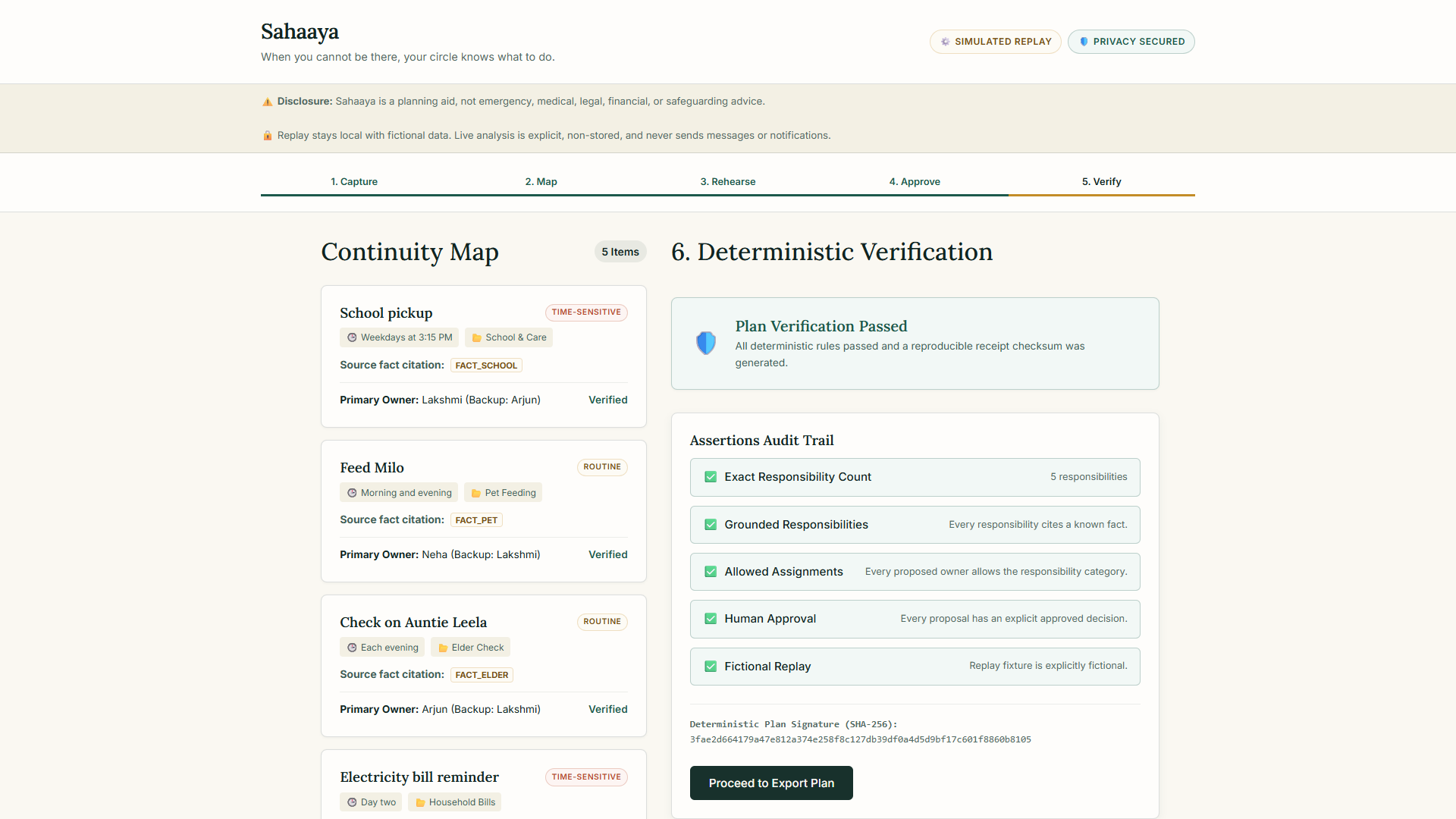
- Requires approval: every responsibility stays pending until a person explicitly approves it, and compilation is blocked until all five decisions are made.
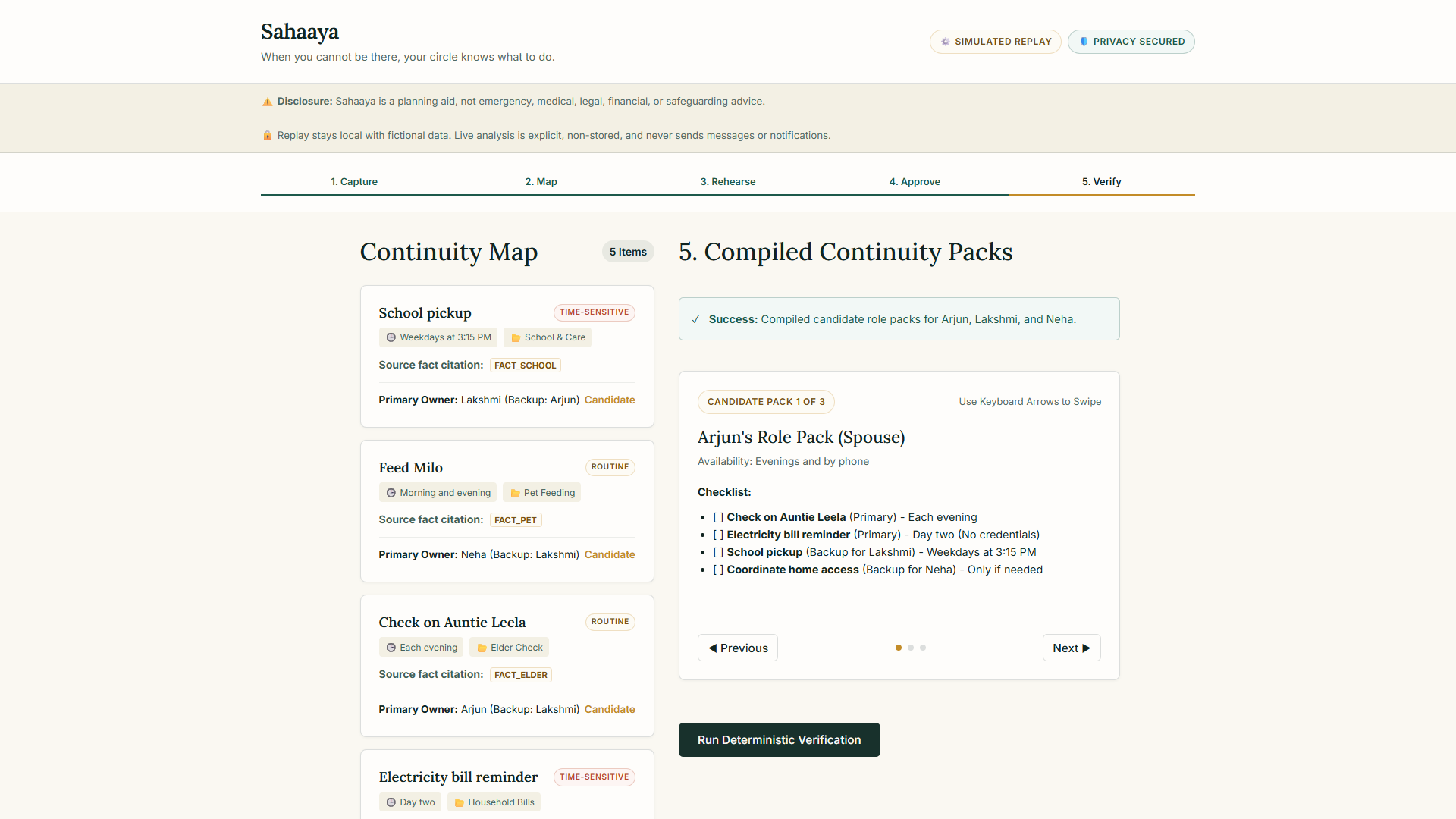
- Verifies deterministically: exact responsibility count, known evidence citations, allowed assignees, explicit approvals, and the fictional replay boundary — sealed with a SHA-256 receipt that makes the demonstrated plan reproducible.
How we built it
The entire application was developed with Codex driving GPT-5.6 end to end — blueprint, architecture, domain code, UI, tests, deployment, and this submission's media.
- GPT-5.6 (Responses API, Structured Outputs,
store:false) proposes grounded structured analysis of the household brief on a server-only route, with application-side grounding checks on every field. - Deterministic TypeScript (Next.js, strict contracts) validates, gates, compiles, and verifies. The model proposes; the code and the human decide.
- A Replay mode with a fictional fixture makes the public demo credential-free and reproducible, while a Live GPT-5.6 proof path shows the real model call (
stored:false, five responsibilities, five proposals, four grounded gaps). - Quality gates: lint, typecheck, seven unit/golden-path assertions, Playwright golden paths for Live and Replay, zero axe violations in the final state, and a clean production build.
Challenges we ran into
- Grounding: keeping every model-proposed fact traceable to a cited line of the source brief, and rejecting anything ungrounded.
- Consent and control: designing an approval gate that genuinely blocks — candidate packs and verified packs are separate artifacts, and nothing is "verified" until humans approve all five assignments.
- Conflict detection: availability-aware assignment proposals that surface conflicts instead of hiding them.
- Privacy boundaries: a household product touches sensitive life details, so P0 forbids persistence and high-risk secret categories entirely.
Accomplishments that we're proud of
- A human-approved, deterministically verified continuity pack with a reproducible SHA-256 receipt.
- A public, credential-free demo that is honest about what is simulated and what is live.
- Accessibility: 360px-wide layouts with no horizontal overflow and zero final-state axe violations.
What we learned
The most valuable AI output in a family-safety context is a proposal, not an action. Pairing GPT-5.6's structured reasoning with deterministic verification and explicit human approval produced something a family could actually trust.
What's next for Sahaaya
Opt-in encrypted household workspaces, preview-first calendar and reminder integrations after explicit consent, and multilingual briefs for multigenerational households.
Safety and privacy
Sahaaya does not store passwords, access codes, account numbers, identity documents, or medical records. It does not contact people, change calendars, dispatch emergency help, or provide medical, legal, financial, or safeguarding advice. All demo data is fictional and visibly labelled; no external messages or real-world actions are ever sent.
Built With
- codex
- gpt-5.6
- next.js
- playwright
- react
- typescript
- vercel
- vitest

Log in or sign up for Devpost to join the conversation.