PAUL Open
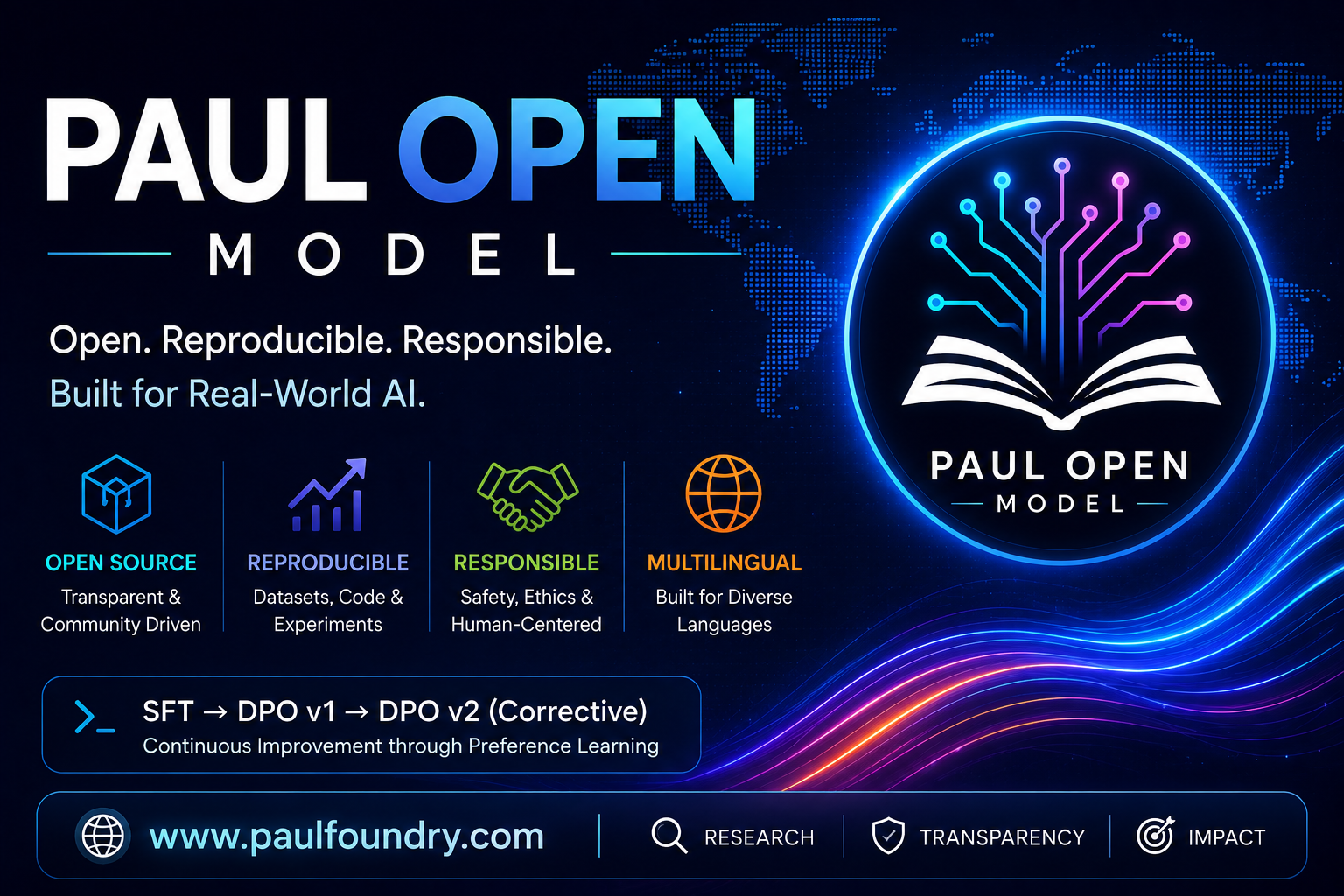
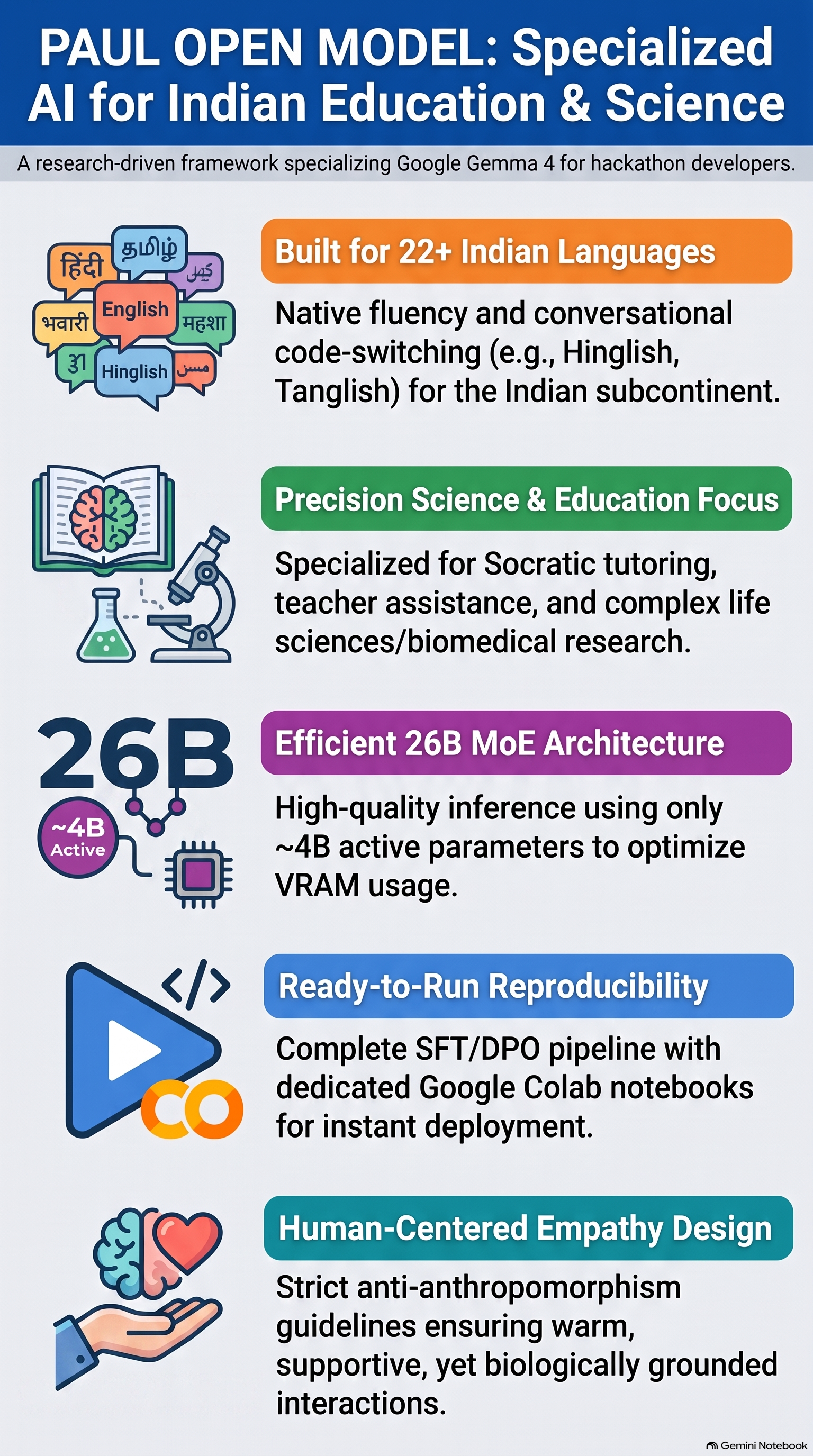
PAUL Open is Paul Foundry's public, open-source research initiative for building and evaluating reproducible AI systems for multilingual knowledge work, science education, tutoring, teacher assistance, human-centered interaction, and scientific research.
Website · Current research status · E4B experiment journey · Contributing
[!IMPORTANT] Current research state — 10 September 2026
- Base model:
google/gemma-4-E4B-it.- The historical SFT adapter remains the reference checkpoint.
- DPO V2 Corrective is a technically valid research checkpoint with mixed behavioral effects. It has not been established as superior to SFT.
- The existing 50-case SFT-vs-DPO V2 comparison is useful diagnostically but is contaminated for DPO V2 and must not be used as clean held-out superiority evidence.
- Human-evaluation infrastructure has completed genuine sandbox collection and verifier checks. Final H2 recovery/closure acceptance is still being completed after a live Google Forms runtime incompatibility was isolated and patched in the repository.
- Immutable Step 2 research freeze:
research-freeze/step2-dpo-v2-20260909atac899e879f930f25b2081550bd8c5dd5c983df35.
The detailed, evidence-oriented status is maintained in docs/PROJECT_STATUS.md.
Repository is the research source of truth
The public GitHub repository is authoritative for PAUL Open research claims, experiment definitions, datasets that are intended to be public, evaluation protocols, manifests, and reproducibility documentation.
open.paulfoundry.com is the public presentation and participation layer. It may render research status, documentation, and human-evaluation entry points, but it must not independently redefine experimental facts. If the website and repository disagree, the versioned repository evidence takes precedence.
For machine-readable website integration, see:
For coding agents and IDEs, start with AGENTS.md.
Research question
PAUL Open is not a leaderboard-optimization project. The working question is:
For the intended user and task, does post-training produce responses that are actually more useful, correct, clear, natural, and appropriately calibrated while preserving existing strengths?
A higher aggregate score alone is not sufficient evidence that a checkpoint is better.
The project separates four evidence layers:
- Technical validity — did training execute exactly as intended?
- Automated regression signal — what observable indicators changed?
- Behavioral quality — are responses actually better under task-specific review?
- Model superiority — does improvement hold under clean evaluation, preservation checks, robustness testing, and blinded human preference?
The current DPO V2 result passes the first layer. The fourth has not been established.
Current E4B experiment
The current research line follows:
Gemma 4 E4B → PAUL SFT reference → DPO V1 diagnosis → DPO V2 Corrective → clean evaluation + blinded human review
DPO V2 Corrective
The final DPO V2 production run is reproducible and technically validated:
- experiment:
paul_e4b_dpo_v2_corrective - corrective dataset:
data/train/dpo_v2_corrective.jsonl - records: 14
- training: DPO sigmoid loss,
beta=0.1, 4 epochs - topology: 2 × Tesla T4; policy on GPU 0, frozen external reference on GPU 1
- quantization: 4-bit NF4 base models
- final completion gate: PASS
- intended trainable tensors changed: 516 / 516
- train loss:
0.687744140625 - train runtime:
238.58 s
The technically valid run does not imply behavioral superiority. The current evidence shows both improvements and meaningful regressions, including multilingual/script fidelity and factual-risk cases.
Read the full evidence chain:
Evaluation integrity
PAUL Open treats evaluation contamination as a research failure, not a documentation detail.
The canonical 50-case baseline was later found to overlap with DPO V2 source material at exact, content, template, or concept level. Therefore the current 50-case SFT-vs-DPO V2 comparison is explicitly labeled:
Diagnostic / contaminated for DPO V2 — not a clean held-out superiority evaluation.
Future training datasets must be checked against the full frozen evaluation registry before acceptance. Human review is also being added as a first-class evidence layer rather than using heuristic benchmark numbers as the final judge.
Human evaluation
PAUL Open uses blinded pairwise comparison: reviewers see a prompt and Response A / Response B without model identity, checkpoint identity, score hints, or hidden winner labels.
The research instrument and durability path are versioned in this repository. Google Forms is currently used as a collection surface, with normalized storage and an independent checksum-backed backup ledger.
The public website can provide a more approachable entry point, but the following rules remain fixed:
- reviewer links must be respondent-facing
/viewformURLs only; - editor/admin links and response spreadsheets must never be exposed;
- model/checkpoint identity must stay blinded;
- optional comments remain optional;
- the website must not create a second, divergent research protocol;
- when no reviewed evaluation packet is open, the website should show the evaluation as closed/preparing rather than exposing a sandbox instrument.
See docs/WEBSITE_INTEGRATION.md and docs/HUMAN_EVALUATION_PROTOCOL.md.
Target capabilities
PAUL Open currently explores:
- Indian and multilingual language understanding and generation
- translation, native-script fidelity, transliteration, and code-switching
- science education and rigorous conceptual explanation
- Socratic tutoring and misconception-guided learning
- student and teacher assistance
- human-centered interaction without false anthropomorphic claims
- scientific research assistance
- life-science and biomedical reasoning
- general reasoning and instruction following
- multimodal scientific understanding
Capability and dataset research notes:
Reproducing the research
The project uses versioned source, datasets, configs, manifests, and remote GPU execution. Kaggle is the current production GPU environment for the E4B DPO V2 workflow.
Useful entry points:
notebooks/paul_open_model_training_kaggle.ipynbscripts/dpo_v2_e4b_train.pyconfigs/training/dpo_v2_e4b_corrective.yamldocs/TRAINING_GUIDE.md
Local setup
git clone https://github.com/foundrypaul-cloud/paul-open.git
cd paul-open

uv sync
cp .env.example .env
uv run pytest
Never commit tokens, private adapters, checkpoints, private Kaggle outputs, or credentials.
Project map
paul-open/
├── AGENTS.md                  # Agent/IDE operating context and source-of-truth rules
├── public/                    # Machine-readable public status for website consumers
├── configs/                   # Model, training, data, and evaluation configuration
├── data/                      # Public research datasets and schemas
├── docs/                      # Research protocols, experiment history, and methodology
├── notebooks/                 # Reproducibility notebooks
├── scripts/                   # Training, evaluation, export, and verification entry points
├── src/paul_open_model/       # Core Python research library
├── tests/                     # Test suite
└── artifacts/                 # Versioned manifests and public research artifacts
Contributing
PAUL Open welcomes technically rigorous contributions. Research-facing changes have stricter requirements than ordinary application code: provenance, contamination boundaries, experimental claims, and reproducibility must remain explicit.
Please read CONTRIBUTING.md before opening a pull request. The repository also provides issue and pull-request templates, a code of conduct, and a security policy.
Research identity and provenance
PAUL Open is an independent research initiative of Paul Foundry Technologies Private Limited.
The current model research is derived from Google's Gemma 4 model family. PAUL Open is not an official Google model and is not affiliated with, endorsed by, or developed in collaboration with Google or Google DeepMind.
Website: https://open.paulfoundry.com/
Repository: https://github.com/foundrypaul-cloud/paul-open
License boundary
The repository source-code layer is distributed under the Apache License 2.0; see LICENSE.
Gemma 4 is released by Google under Apache 2.0. Third-party datasets, libraries, benchmarks, and other materials retain their own licenses and attribution requirements. Public release suitability is evaluated separately from whether a dataset can be downloaded or used experimentally.
See NOTICE.md, DATASET_REGISTRY.md, and the applicable upstream terms before redistributing derived artifacts.
Citation
See CITATION.cff. A simple project citation is:
Paul Foundry Technologies Private Limited.
"PAUL Open."
Paul Foundry Research Wing, 2026.
https://github.com/foundrypaul-cloud/paul-open


Log in or sign up for Devpost to join the conversation.