-
-
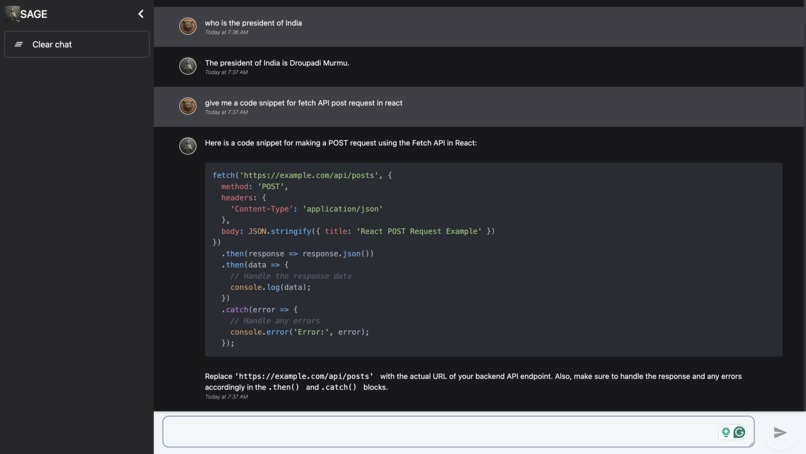
Home Page
-
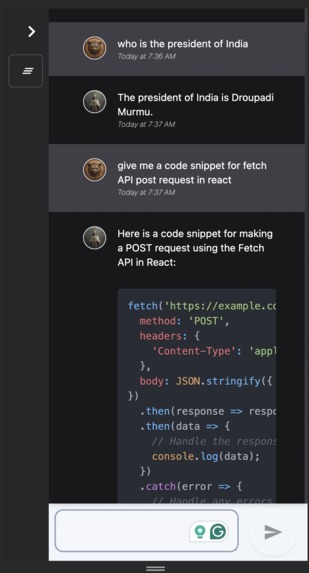
Responsive Design


In today's fast-paced world, individuals often struggle to find accurate and relevant answers to their queries amidst the abundance of information available online. Traditional methods involve scouring through multiple websites, which can be time-consuming and overwhelming. To address this challenge, I have developed a solution called SAGE (Search Augmented Generation Engine) - using RAG: Retrieval Augmented Generation.
SAGE harnesses the power of Retrieval-Augmented Generation (RAG), a cutting-edge natural language processing (NLP) model architecture. By integrating information retrieval from the web with generative capabilities, SAGE delivers responses that are not only accurate but also grounded in relevant context.
One of the primary objectives of SAGE is to streamline the information-seeking process for users across various domains. For instance, an international student seeking updates on OPT or EAD filing procedures can rely on SAGE to fetch and present the latest information from relevant sources in a coherent manner.
Key features of SAGE include:
- Generating code snippets in a readable format.
- Providing accurate responses to user queries, surpassing the limitations of traditional search engines.
- Crafting email responses tailored to specific topics.
- And much more.
Basically, anything that ChatGPT does but more.
Here are a few examples on how this is better than ChatGPT:
- When asked who the president of India is, ChatGPT answered Ram Nath Kovind, which is actually the former president but SAGE gave the current president's name
- You can ask SAGE about the Union budget that was released last week and it will get you the information but GPT fails since the training data is limited to 2022 (last update)
- When asked about the current Director of School of Computing at UGA, SAGE gave the correct response and GPT did not.

Log in or sign up for Devpost to join the conversation.