-
-
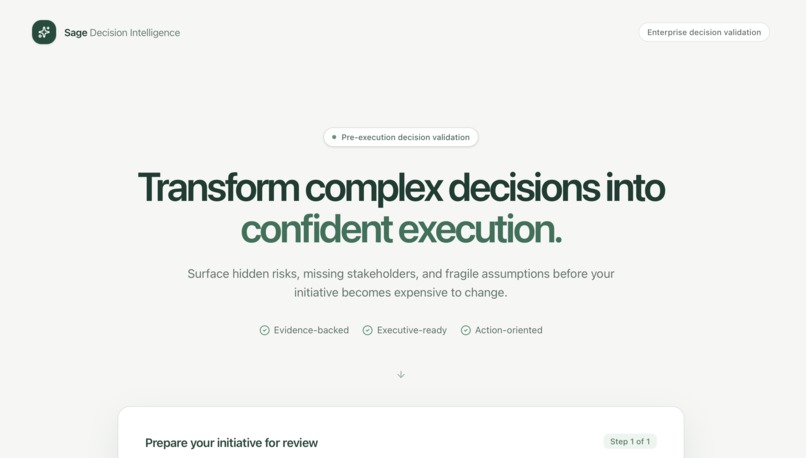
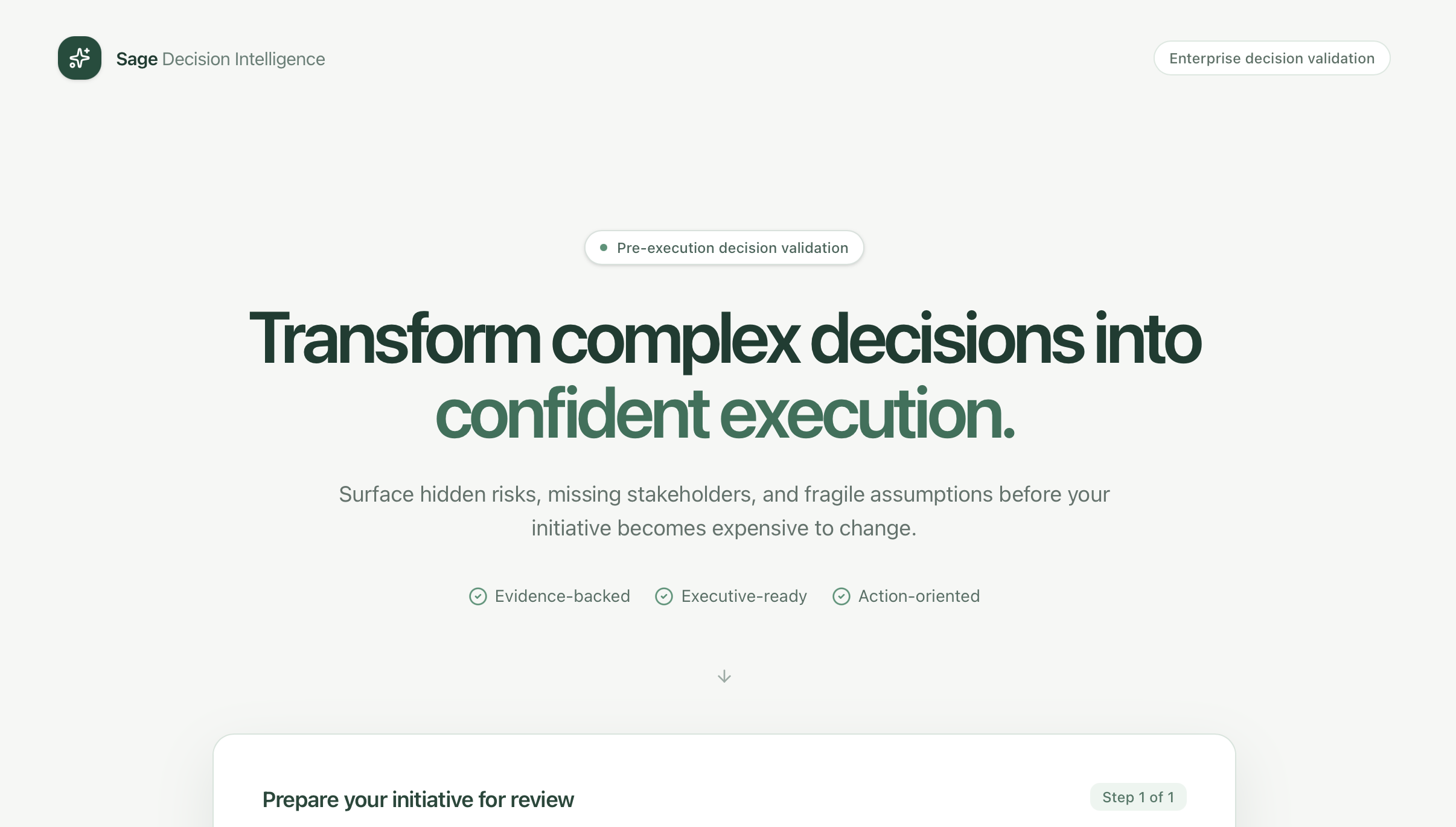
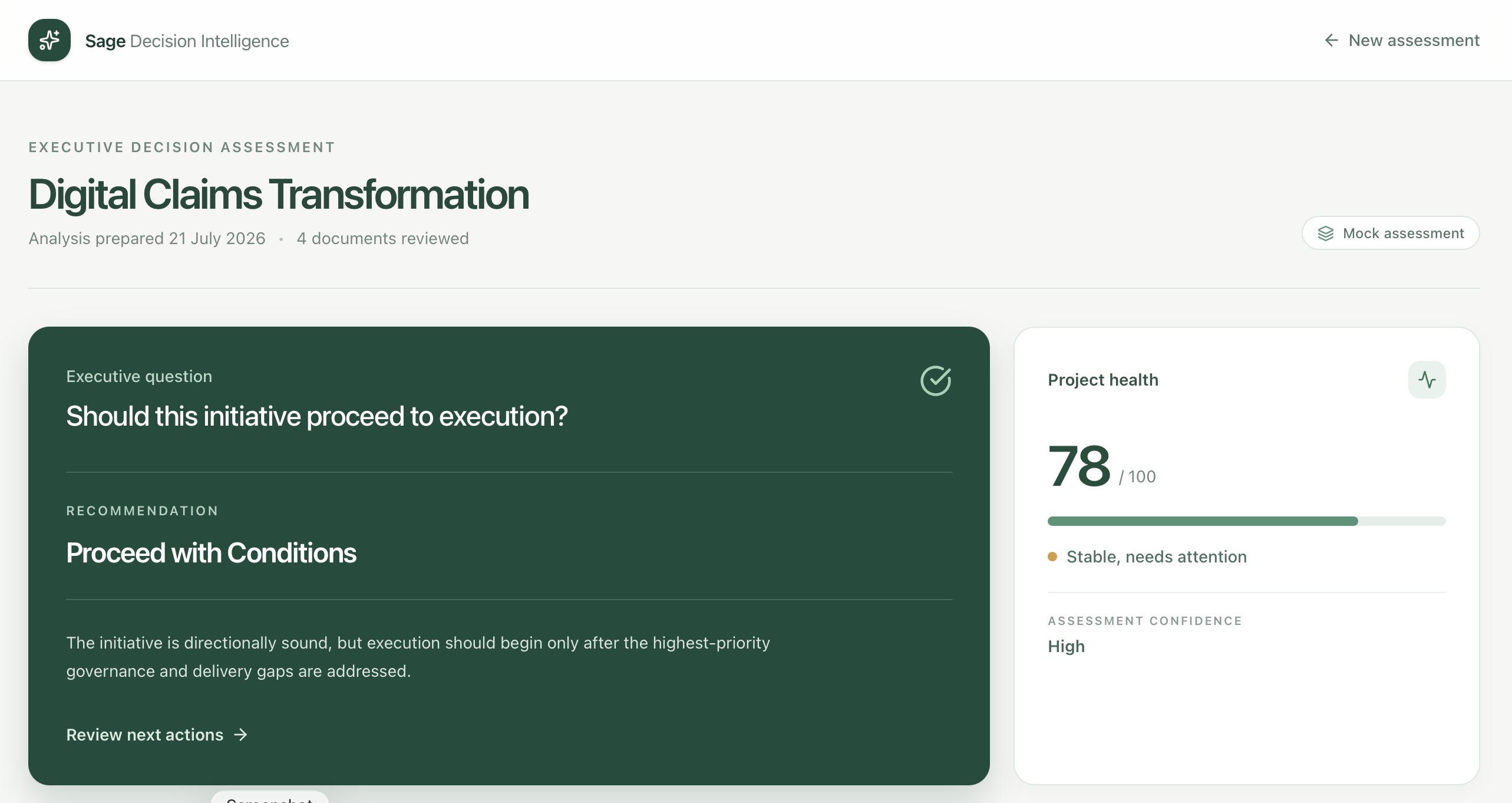
01 Main Header Page
-
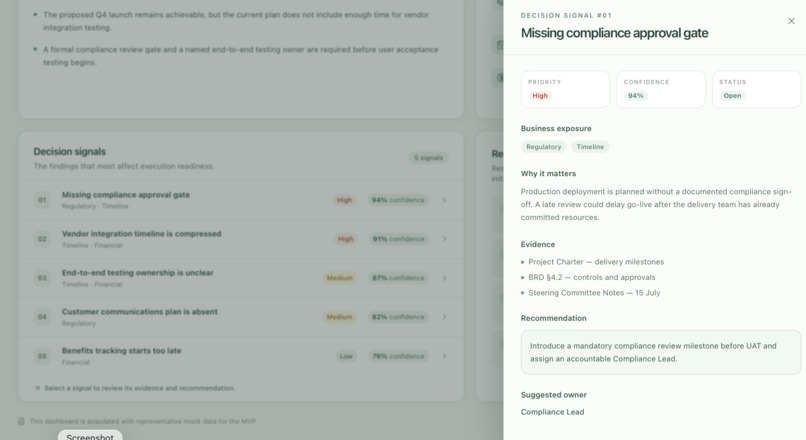
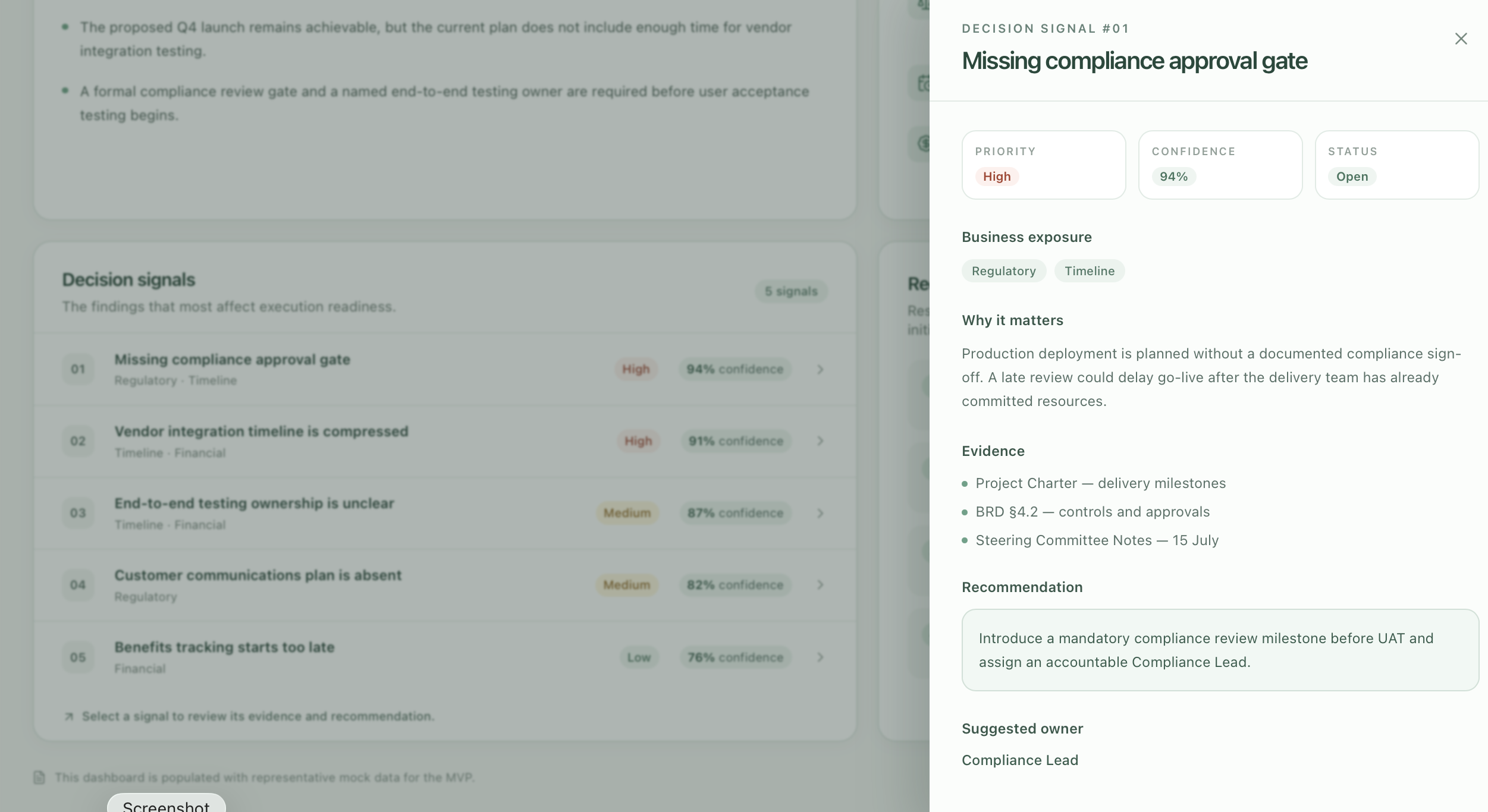
06 Side Drawer on Evidences, Recommendations
-
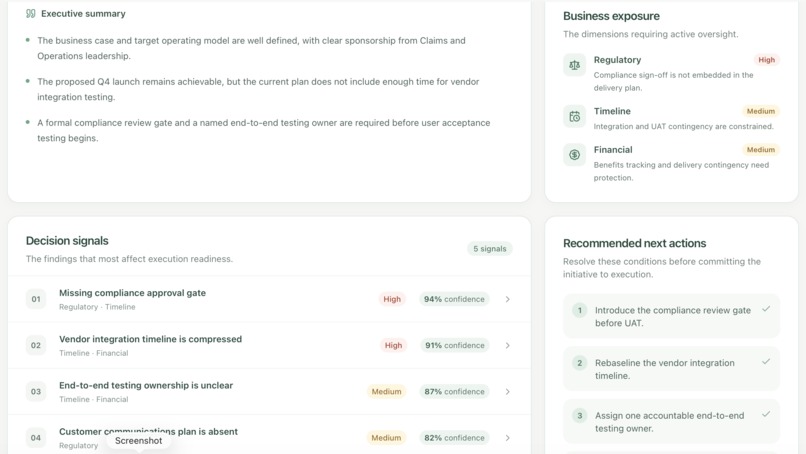
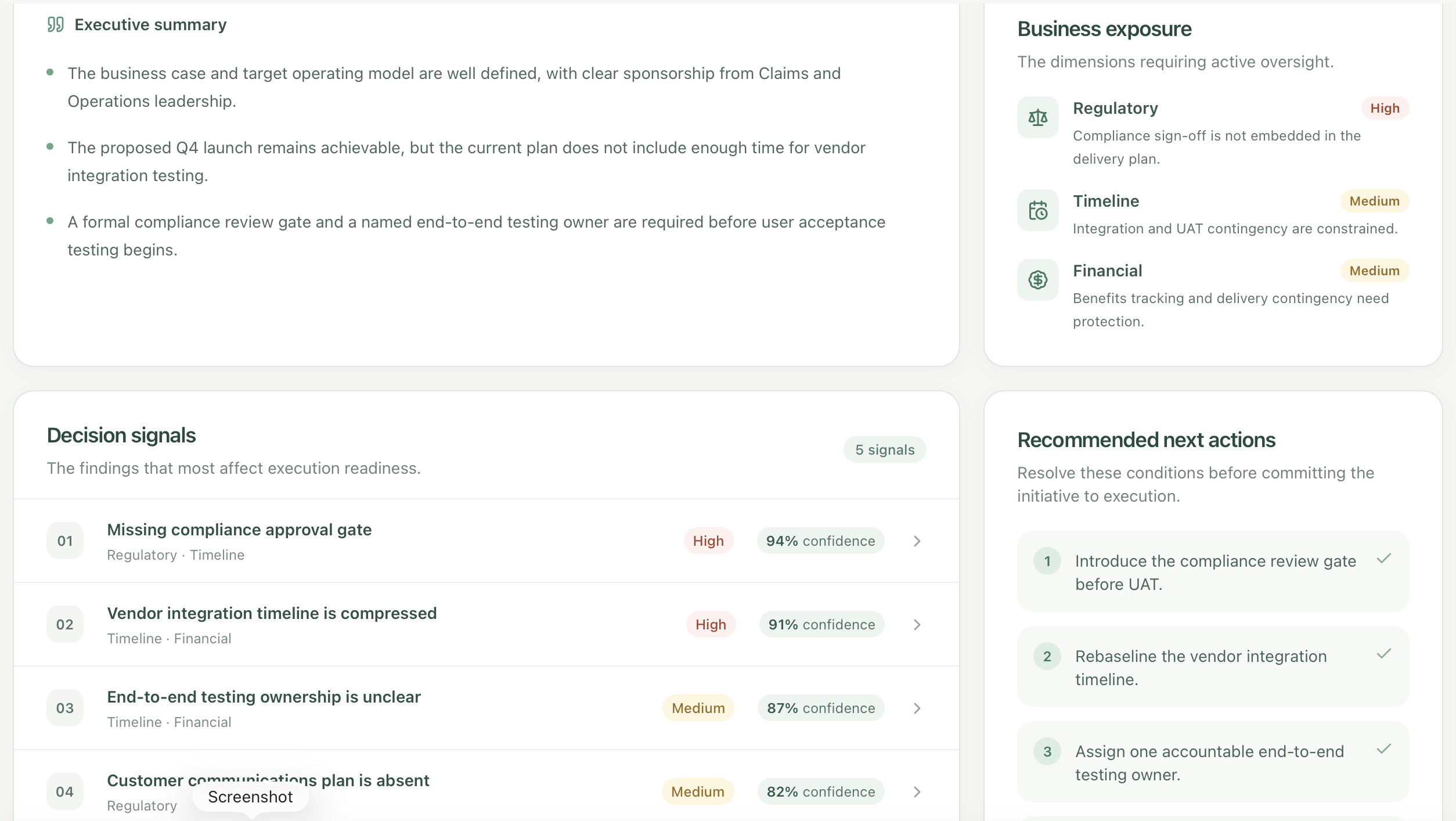
05 Complete Analysis
-
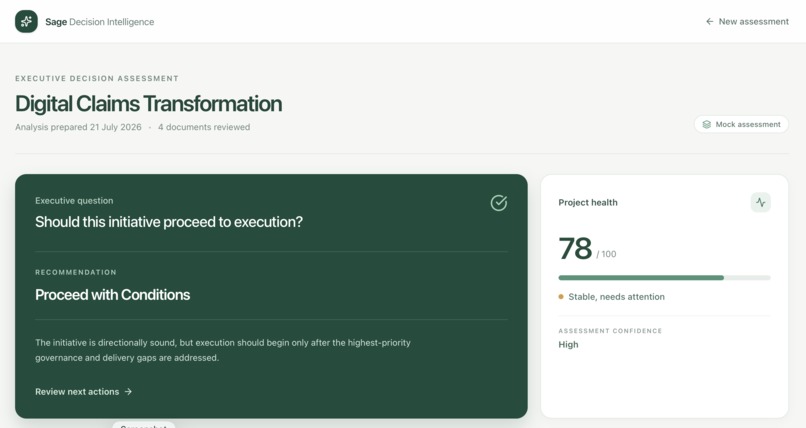
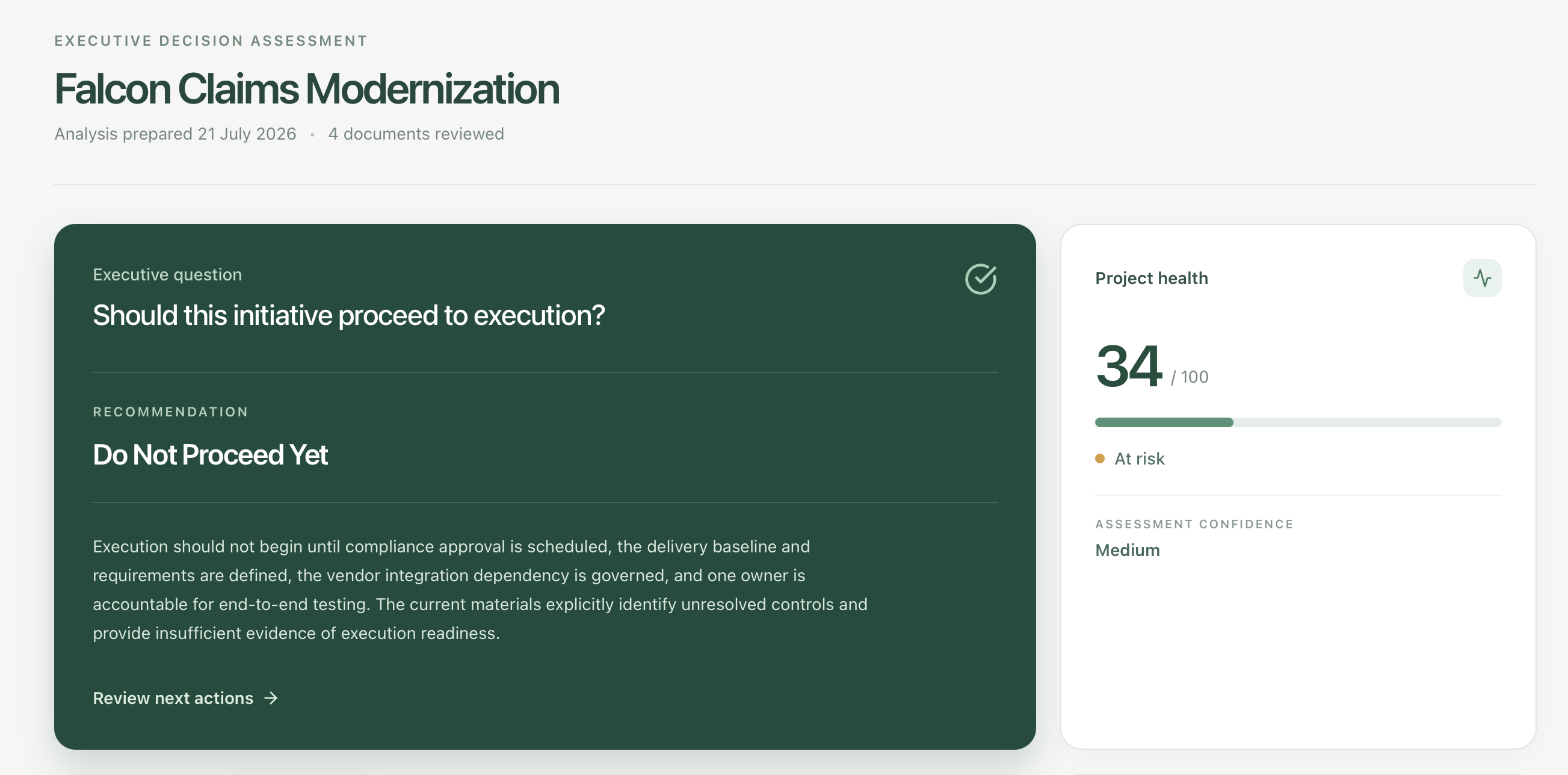
04 Recommendation main page
-
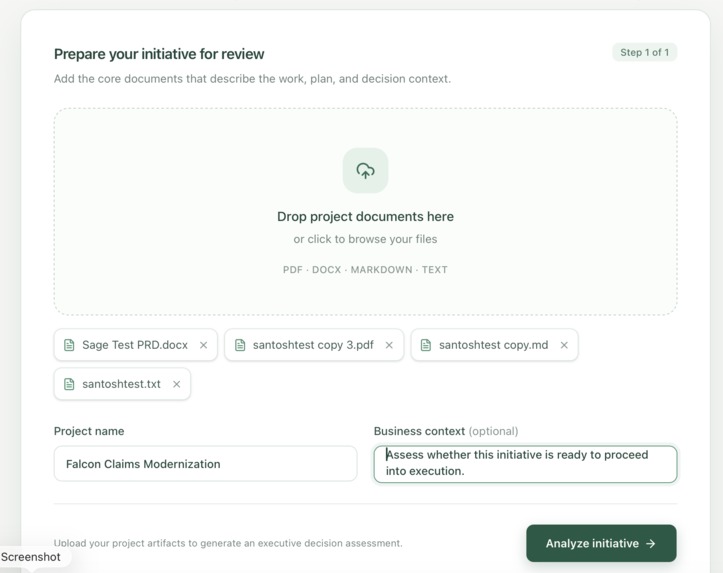
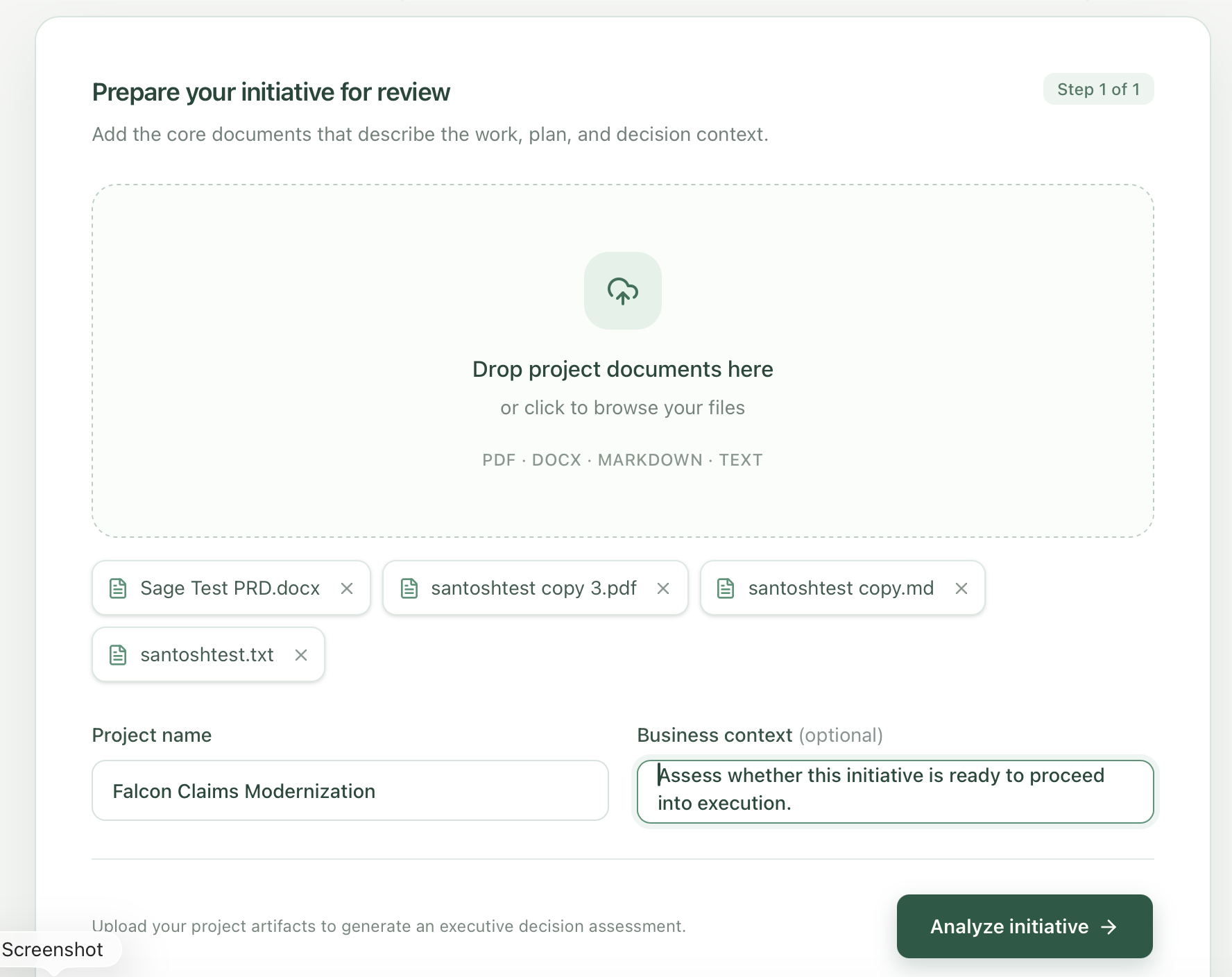
02 Files / Artefacts upload section
-
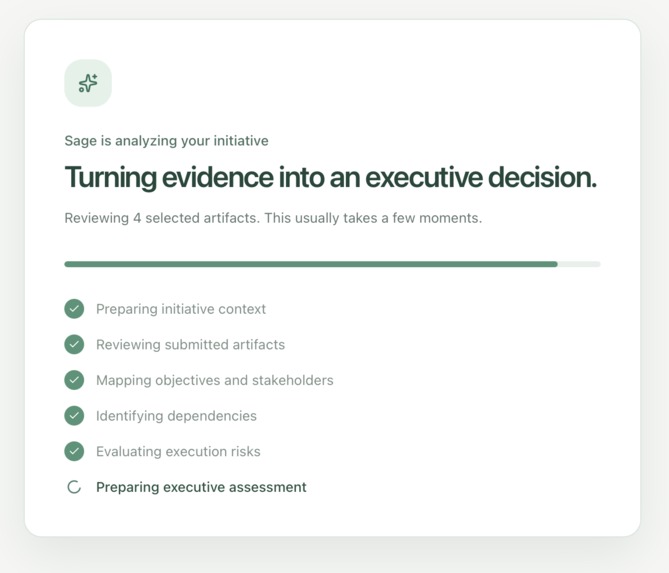
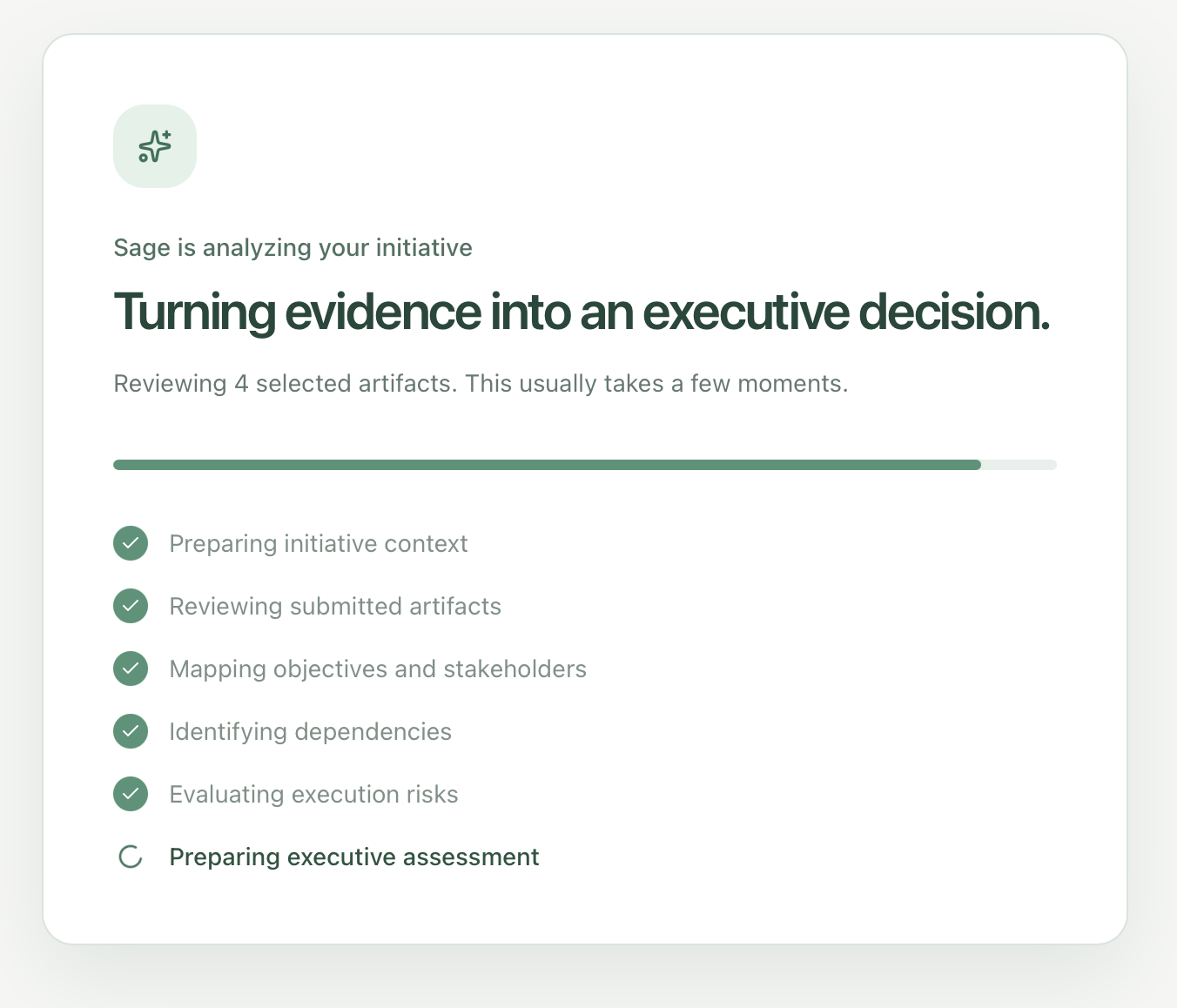
03 Files processing and AI analysis in action
-
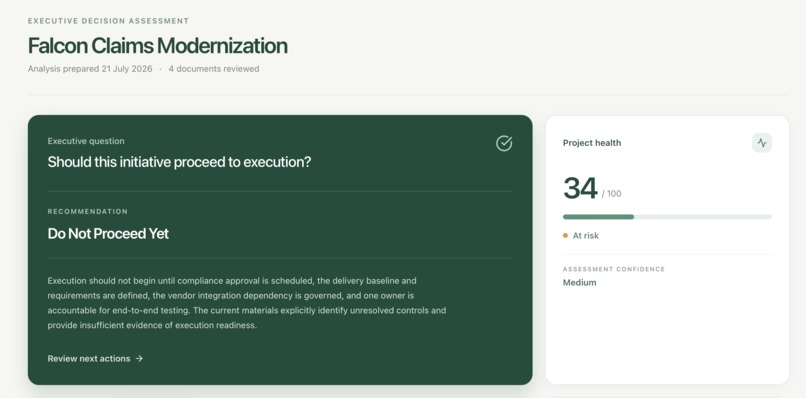
04.1 Recommendation main page1
Inspiration
High-stakes enterprise initiatives are often approved using fragmented information spread across project charters, requirements documents, meeting notes, delivery plans, and governance records.
Executives are then asked a deceptively simple question:
Should this initiative proceed to execution?
The problem is that hidden dependencies, missing owners, regulatory gaps, weak assumptions, and delivery risks are often discovered only after significant money and time have already been committed.
We built Sage Decision Intelligence to provide leaders with an intelligent second opinion before execution begins.
What it does
Sage Decision Intelligence transforms project documents into an executive-ready decision assessment.
Users upload initiative artifacts and provide brief business context. The application then uses GPT-5.6 to produce:
- An overall recommendation:
- Proceed
- Proceed with Conditions
- Do Not Proceed Yet
- A Project Health Score
- An assessment confidence level
- A concise executive summary
- Prioritized Decision Signals
- Regulatory, timeline, and financial exposure
- Evidence supporting each finding
- Recommended next actions and suggested owners
Each Decision Signal can be opened in a detailed side panel showing why it matters, the supporting evidence, and the recommended mitigation.
The product is intentionally not a chatbot. It is a focused, dashboard-first decision experience designed for enterprise executives, transformation leaders, program directors, product leaders, and PMOs.
How we built it
We designed the product around one clear workflow:
Upload documents → Analyze evidence → Review executive recommendation → Investigate Decision Signals → Take action
The application was built with:
- Next.js and React
- TypeScript
- Tailwind CSS
- shadcn/ui
- OpenAI Responses API
- GPT-5.6
- Strict Structured Outputs using JSON Schema
- OpenAI Node SDK
- react-dropzone
- Mammoth for DOCX extraction
- PDF text extraction
- Session-based state for the hackathon MVP
The AI layer uses a single server-side analysis workflow rather than a complex multi-agent system.
Submitted materials are treated as untrusted reference data. The prompt explicitly prevents instructions embedded inside uploaded documents from overriding the system behavior.
GPT-5.6 returns a strictly validated AnalysisResult, allowing the same typed contract to power both the API and the executive dashboard.
Challenges we faced
Producing reliable executive outputs
A generic model response was not sufficient. The output needed to be concise, evidence-backed, prioritized, and immediately usable by senior decision-makers.
We solved this using a strict JSON Schema, runtime validation, explicit evidence rules, and a carefully scoped enterprise transformation prompt.
Avoiding fabricated or repetitive findings
An early schema required a fixed number of Decision Signals. With sparse documents, this encouraged repeated findings.
We changed the contract to allow zero to five evidence-supported signals and required overlapping observations to be consolidated into one distinct finding.
Preserving trust
Enterprise documents may contain sensitive information or even prompt-injection attempts. We kept all model calls server-side, disabled response storage for the analysis call, avoided logging document contents, and explicitly treated uploaded content as untrusted evidence rather than instructions.
Designing for executives rather than AI enthusiasts
It was tempting to create a conversational interface. Instead, we focused on the decision executives actually need to make and surfaced the recommendation, health score, exposure, evidence, and next actions in a calm, dashboard-first experience.
Accomplishments that we are proud of
- Built a polished enterprise decision dashboard rather than a generic chatbot
- Integrated GPT-5.6 through the OpenAI Responses API
- Implemented strict Structured Outputs and runtime validation
- Created evidence-backed Decision Signals with confidence scores
- Added distinct zero-signal and low-evidence behavior
- Built a detailed signal investigation drawer
- Added real document extraction for common enterprise file formats
- Created an end-to-end workflow from uploaded artifacts to live executive assessment
- Designed a product experience that feels credible for enterprise use while remaining achievable as a hackathon MVP
What we learned
The most important lesson was that reliable AI products require more than a strong model.
The quality of the final experience depended on:
- A tightly defined product decision
- A shared data contract between AI and UI
- Evidence and provenance requirements
- Protection against prompt injection
- Thoughtful handling of insufficient information
- Clear separation between model reasoning and executive communication
We also learned that fewer, distinct, well-supported findings are more valuable than a long list of generic risks.
What's next
The hackathon MVP focuses on validating a single initiative before execution.
Future versions could add:
- Persistent assessment history
- Collaboration and executive review workflows
- Comparison between document versions
- Decision Signal lifecycle tracking
- Jira, Slack, and Microsoft Teams integrations
- Portfolio-level initiative intelligence
- Organization-specific decision principles
- Governance templates for regulated industries
- Executive memo and PDF report generation
- Enterprise authentication, audit controls, and data-retention policies
Our long-term vision is to help enterprises move from fragmented project information to confident, evidence-backed execution decisions.
Built With
- api
- codex
- css
- enterprise
- gpt-5.6
- json
- lucide
- mammoth
- next.js
- node.js
- openai
- outputs
- parsing
- react
- react-dropzone
- responses
- schema
- shadcn/ui
- structured
- tailwind
- typescript
- vercel


Log in or sign up for Devpost to join the conversation.