# About the Project

## The problem

Most AI systems are optimized to produce an answer quickly. In high-stakes professional work, that is not enough.

Consultants and decision-makers must determine:

- which sources are reliable;
- which claims are actually supported;
- where documents contradict one another;
- what information is still missing;
- which scenarios remain feasible;
- what should be investigated next;
- and when the available evidence is too weak to support a decision.

A fluent answer can still be dangerous if it hides uncertainty or manufactures confidence.

Sage was created around a different principle:

> Evidence should come before conclusions, and the system must be able to refuse unjustified certainty.

Sage is not intended to replace consultants. It is designed to multiply the analytical capacity of a competent consultant while leaving interpretation, challenge and decision authority with the human expert.

## What we built

The project submitted for Build Week is the **Sage Governed Resolution Loop**.

It combines Codex, a case-specific adapter and the Sage governed runtime:

```text
Unfamiliar dossier
→ Codex analyzes the case
→ Codex creates a case-specific engagement adapter
→ targeted tests and governance gates
→ Sage executes the governed analysis
→ contradictions, evidence gaps and scenarios
→ consultant-ready work products
→ human review and decision
The adapter is deliberately specific to one engagement. It can define:
- the decision frame;
- domain vocabulary;
- relevant variables and constraints;
- evidence requirements;
- contradiction patterns;
- scenarios to explore;
- ranking criteria;
- decision gates;
- questions that should be escalated.
It cannot override Sage's evidence policies, manufacture facts or commit a decision.
This allows the loop to recover the depth of bespoke case analysis without contaminating unrelated engagements.
How Sage works
Sage ingests a dossier and creates governed, traceable analytical state rather than immediately generating a recommendation.
The runtime produces and connects:
- source custody and provenance;
- source-quality assessments;
- claims and observations;
- contradictions;
- evidence gaps;
- decision gates;
- a canonical decision graph;
- a case world-model surface;
- bounded scenarios and simulations;
- ranked but conditional options;
- consultant-facing reports;
- machine-readable audit artifacts.
Every important conclusion must remain connected to evidence, uncertainty and decision authority.
If the required information is unavailable, Sage does not silently fill the gap. It records the missing evidence and can block commitment.
The governing boundary is explicit:
Sage may prepare, compare and challenge decisions.
Sage does not commit the decision.
The verified demonstration
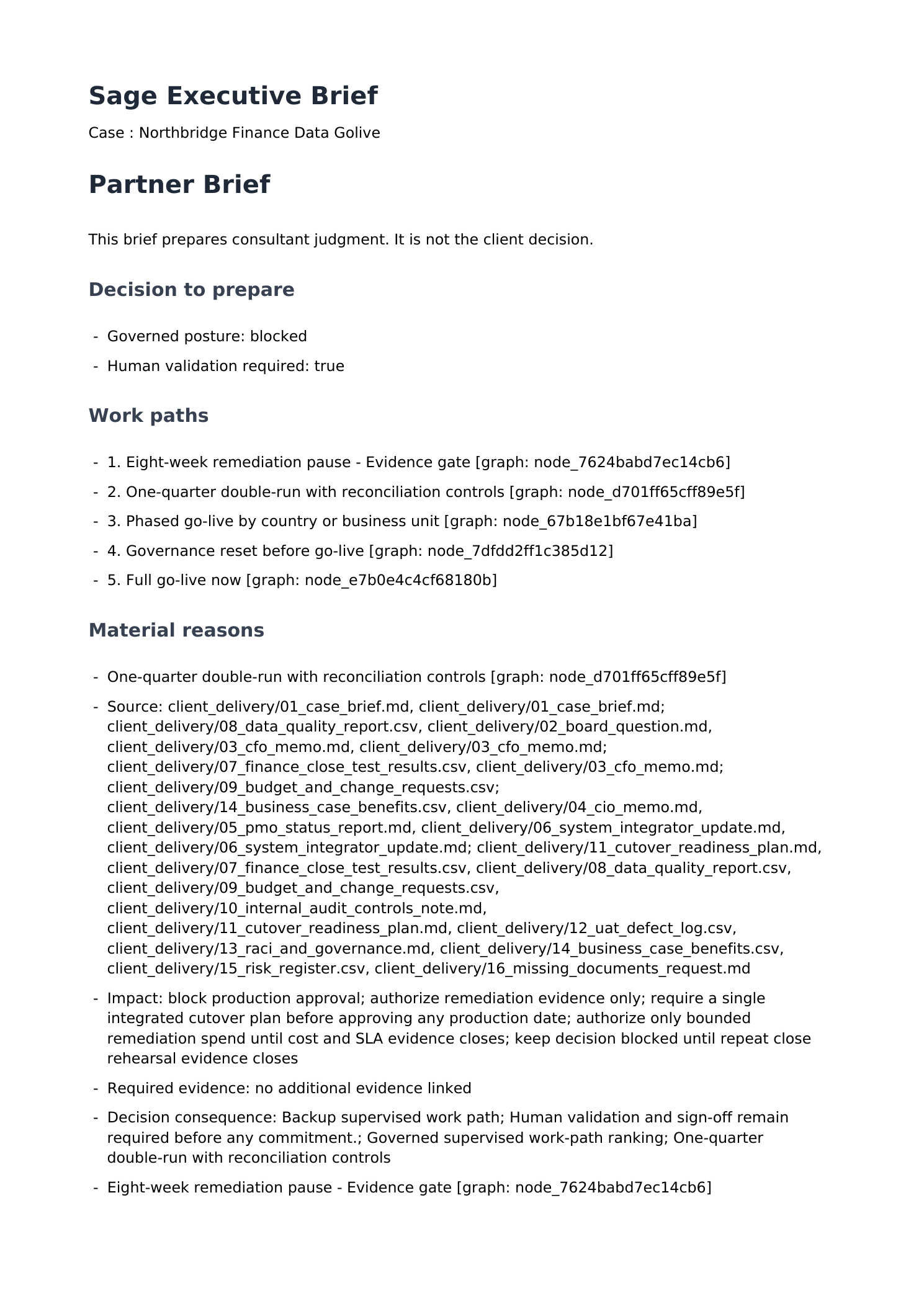
The Build Week demonstration uses Northbridge Finance + Data Go-Live, an entirely synthetic enterprise-transformation case.
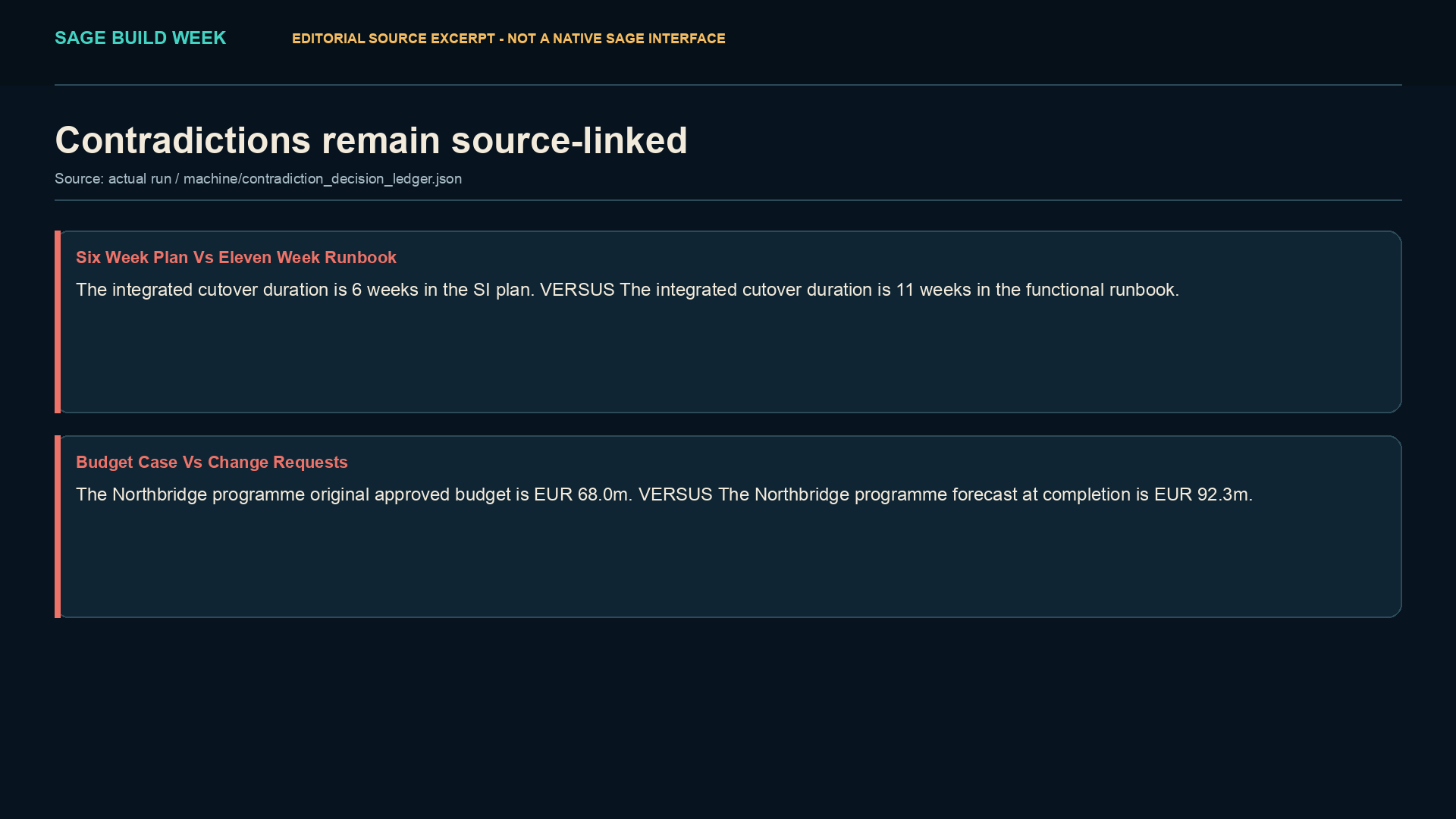
The dossier contains conflicting migration metrics, an unresolved financial-close dry run, inconsistent planning assumptions, budget uncertainty and incomplete operational evidence.
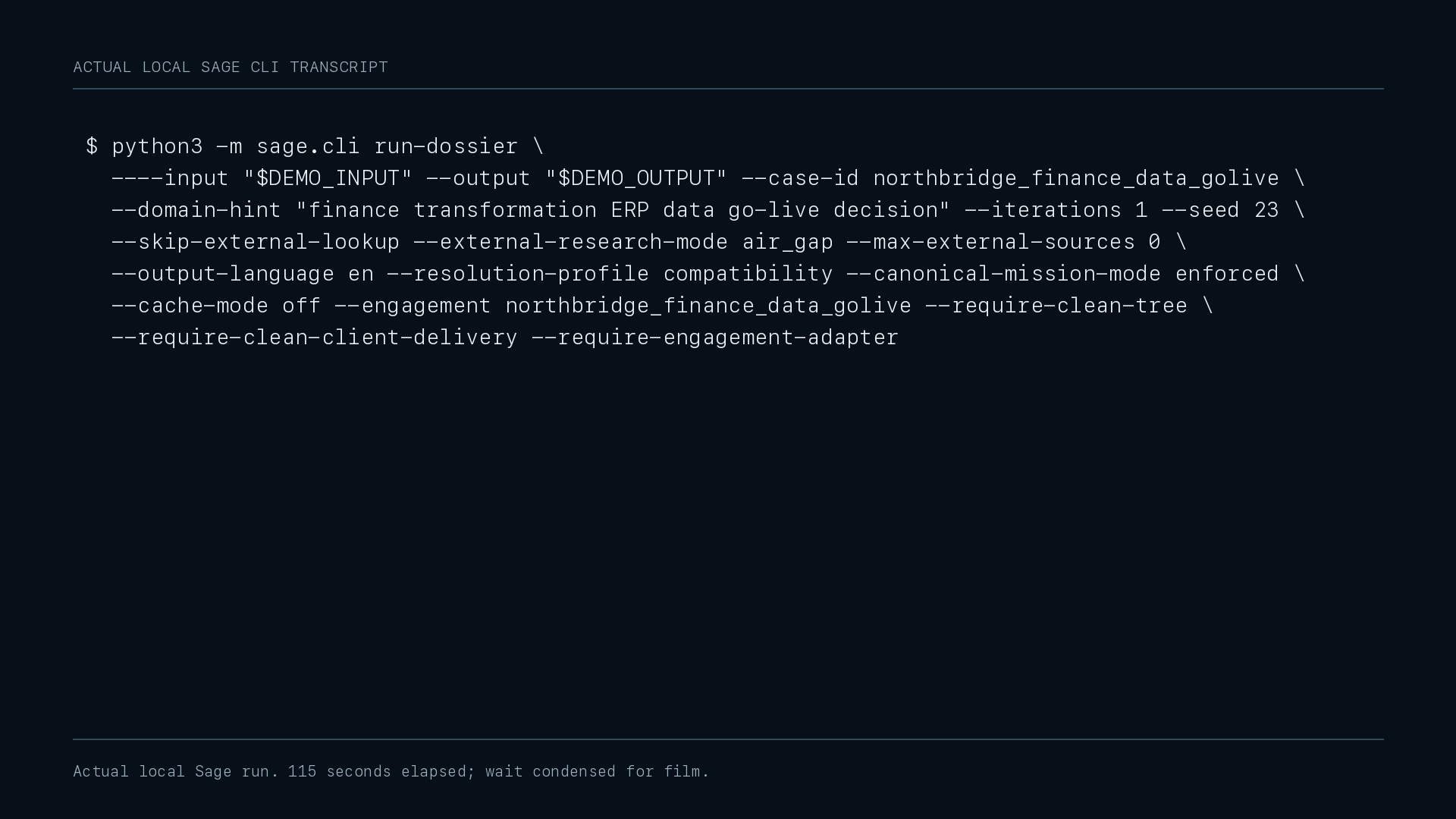
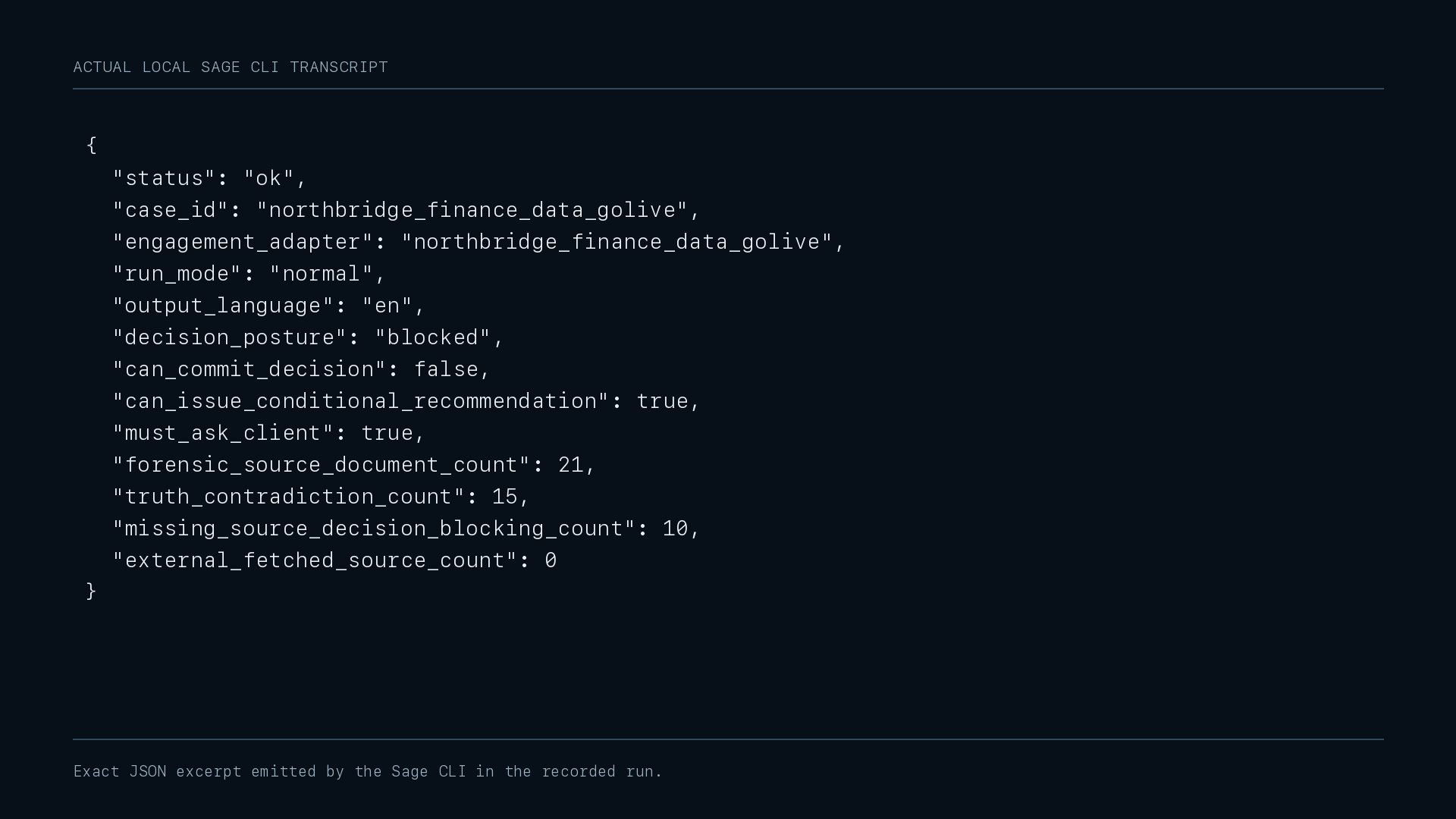
The demonstrated run:
- used a validated Northbridge engagement adapter;
- executed in air-gap mode without external lookup;
- constructed a canonical decision graph;
- identified governed contradiction rows;
- ranked conditional go-live strategies;
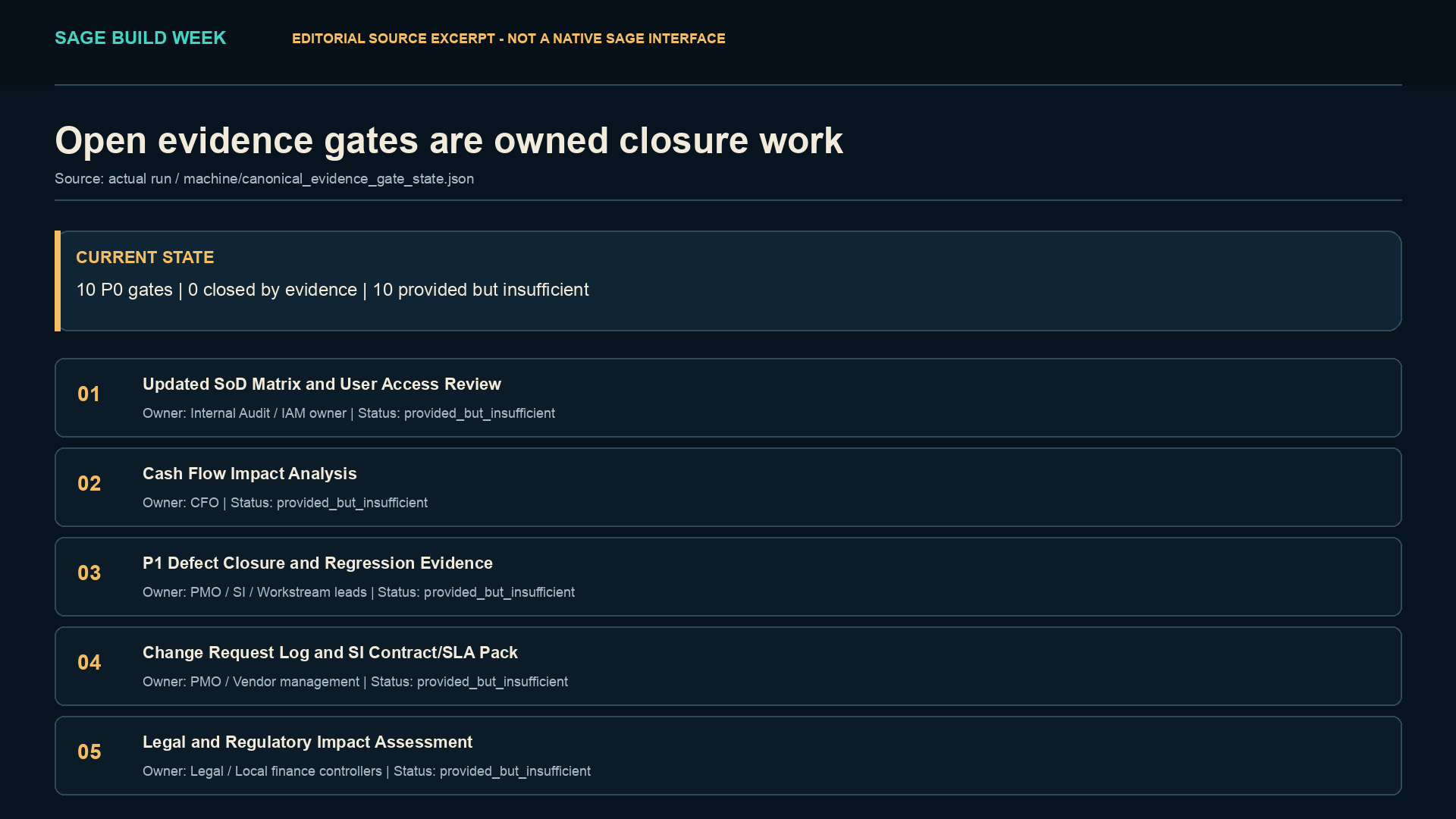
- exposed ten priority evidence gates;
- produced consultant and machine-readable artifacts;
- refused to commit the final decision.
The preferred path was not presented as an unconditional recommendation. It remained dependent on unresolved evidence gates and human approval.
The numerical Case World Model also refused to claim a calculable projection because the adapter did not declare a sufficient numerical model contract. This is intentional: absence of a valid model is reported as a limitation rather than hidden behind invented precision.
What was built during Build Week
Sage's foundational governed runtime existed before Build Week. We are explicitly disclosing that prior work.
During the official Build Week period, Codex and GPT-5.6 were used to meaningfully extend Sage into a more complete, case-specific resolution system.
The Build Week work included major additions and hardening across:
- real-format governed dossier ingestion;
- isolated engagement adapters;
- adapter validation and provenance;
- external adapter-vault lifecycle;
- multi-cycle case operations;
- canonical mission lifecycle;
- canonical decision graph projections;
- evidence-bound simulation contracts;
- consultant deliberation surfaces;
- Governed Case World Model;
- governed deliberation;
- mission-data custody contracts;
- evidence and performance measurement;
- permission-brokered artifact execution;
- execution-workbench contracts;
- real-artifact regression gates;
- consultant-ready delivery and decision-integrity controls.
The submission does not claim that all of Sage was created during Build Week. The work is presented as a substantial, verifiable extension of an existing system, with dated Git history and explicit prior-work disclosure.
How we used Codex and GPT-5.6
Codex was not used only for autocomplete or isolated code generation. It operated as an engineering and case-modeling partner.
Codex and GPT-5.6 were used to:
- audit a large existing Python repository;
- identify architectural boundaries and regression risks;
- analyze synthetic enterprise dossiers;
- construct case-specific engagement adapters;
- design typed contracts and governance gates;
- implement cross-cutting runtime capabilities;
- create targeted and artifact-level tests;
- diagnose failures across complete dossier runs;
- reduce architectural debt;
- verify that case-specific logic did not leak into the neutral runtime;
- inspect the final consultant artifacts rather than relying only on unit tests.
The development loop itself became part of the project:
case analysis
→ implementation candidate
→ tests
→ governed execution
→ artifact inspection
→ correction
→ reproducible evidence
Technical approach
Sage is currently a local-first Python system operated through a command-line workflow.
The verified environment uses:
- Python 3.11;
- deterministic seeds and explicit run contracts;
- structured JSON state;
- Markdown and PDF consultant artifacts;
- pytest-based targeted and regression testing;
- content hashes and custody manifests;
- case-specific adapters isolated from the neutral core;
- explicit network and execution policies;
- human approval boundaries.
The local-first architecture is intentional. Enterprise dossiers may contain sensitive information, so the system should not require unrestricted network access or silent data egress.
The main challenges
Preserving case-specific depth
Earlier versions demonstrated that highly specific adapters could produce strong analysis. The challenge was retaining that depth without turning the core into a collection of hardcoded cases.
The solution was to separate:
neutral governance mechanisms
from
engagement-specific analytical models
Preventing cross-case contamination
A recommendation useful for one banking, aviation or technology case can be dangerously wrong in another.
We introduced stronger adapter isolation, provenance contracts and artifact-level regression tests to detect case-specific language or assumptions appearing in unrelated reports.
Testing the real output
Function-level tests can pass while a final report is still incomplete or contaminated.
We learned to run complete synthetic dossiers and inspect the actual Markdown, JSON and PDF artifacts produced by the official workflow.
Remaining useful without overclaiming
A system that refuses unsupported conclusions can become too cautious to help.
The challenge was to produce conditional options, scenarios, evidence requests and operational next steps while preserving uncertainty and human decision authority.
Demonstrating a system without a polished product UI
Sage is currently an operational system rather than a finished SaaS product.
For the demonstration, we chose not to fabricate a product interface. The video combines real test results, a real persistent run and clearly labelled editorial views generated from the artifacts of that same run.
What we learned
The most important lesson was that stronger reasoning does not come only from using a stronger model.
Reliable professional reasoning also requires:
- explicit contracts;
- source provenance;
- typed uncertainty;
- case isolation;
- adversarial testing;
- artifact-level validation;
- deterministic execution;
- and a clear human authority boundary.
We also learned that specialization and generalization should not be confused.
The neutral runtime should generalize governance. The engagement adapter should specialize the analysis. Trying to force every case through one generic analytical template removes precisely the depth that makes the system useful.
Finally, we learned that refusing to calculate, rank or conclude can itself be a valuable output when the available evidence does not justify doing so.
What comes next
The next stage is to strengthen the complete mission loop:
understand
→ model
→ simulate
→ deliberate
→ construct
→ test
→ supervise
→ measure outcomes
Planned directions include:
- richer case-model compilation;
- governed specialist solver plugins;
- executable work-product candidates;
- stronger test-and-verify loops;
- incremental mission runtime;
- outcome measurement and recalibration;
- independent senior-review campaigns.
The objective remains unchanged: Sage should help experts understand and resolve difficult situations faster and more rigorously, without removing human judgment or manufacturing certainty.
Prior-work disclosure
Sage's foundational runtime, evidence governance and earlier consulting capabilities predate the Build Week submission period.
The submitted Build Week contribution is the substantial extension and industrialization of the governed, case-specific resolution loop described above.
Supporting evidence includes:
- dated Git commits;
- Build Week feature timelines;
- prior-work disclosure;
- targeted tests;
- complete synthetic dossier runs;
- generated artifacts;
- provenance manifests;
- and Codex session evidence. ```


Log in or sign up for Devpost to join the conversation.