-
-
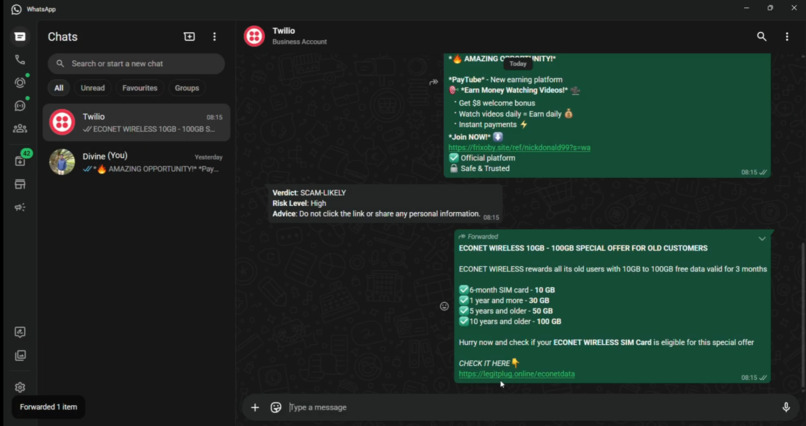
Screenshot
Inspiration
I started writing about online safety in 2021 with a small blog series called Safety Net. Episode 1 was about clickbait, like "free iPhone" surveys and a 60 GB game "compressed" to 30 MB. Episode 2 was about app permissions, like a calculator app asking to make phone calls. Both episodes made the same point: most harm doesn't come from clever hacking. It comes from a moment of hesitation before someone clicks.
Years later, I saw the same thing in my own community in Zimbabwe, except the scams now arrive as WhatsApp forwards. The advice in a blog post is useless at the moment someone is staring at a suspicious message. I wanted to build the thing that helps in that moment.
What it does
Safety Net is a WhatsApp-first scam checker. A user forwards a suspicious message, link, or email, and gets back a plain-language risk assessment. It explains why something looks risky and says how confident it is, so the user stays in control of the decision. Email analysis is supported too, and a web playground lets anyone test tricky and failure cases.
Example of a safer outcome: [e.g. a fake "you've won" message with a lookalike link is flagged as high risk, with the reasons listed, before the user taps it.]
Limitation: It gives decision support, not a guarantee. A novel scam can be rated wrongly, and for that reason the tool reports uncertainty instead of a flat "safe" or "unsafe."
How I built it
- Backend: Python, FastAPI
- AI layer: StepFun 3.5 Free / OpenRouter
- Messaging: WhatsApp via Twilio
- Analysis: content, URL, and metadata signals combined into an explainable score
Challenges
- Confidence vs. correctness. A model can sound sure and be wrong. I designed the output to show uncertainty honestly.
- Explaining risk to non-technical users. The explanation had to be short enough to read on a phone and specific enough to trust.
- I couldn't find a consistently, reliable and free LLM provider with less rate limits.
What I learned
Safety tools earn trust by being honest about what they don't know. The best interface for a safety tool is often a place people already use, like WhatsApp, not a new app.
Credits
Built with Python, FastAPI, Twilio, VirusTotal and Openrouter. AI assistance: in writing a chunk of the code and docs. Background and earlier writing: the Safety Net blog series (divinesaung.hashnode.dev).
What's next
I'm thinking of adding more languages, local-scam datasets or a feedback loop for reporting new scams.
Built With
- fastapi
- openrouter
- python
- twilio
- virustotal
- whois
