-
-
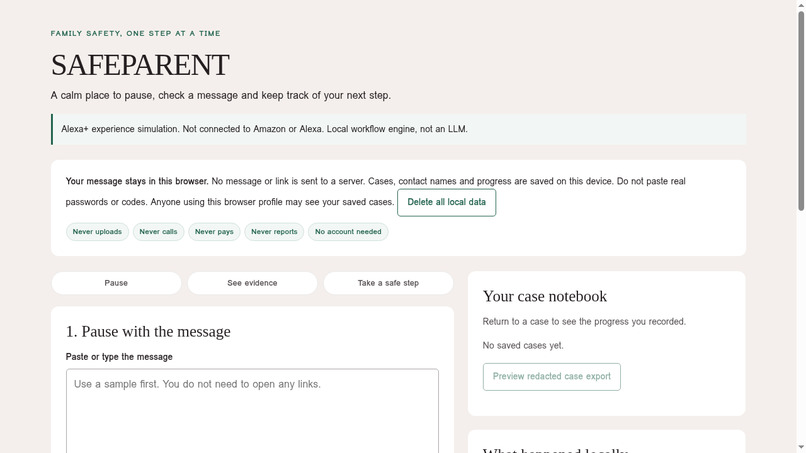
-
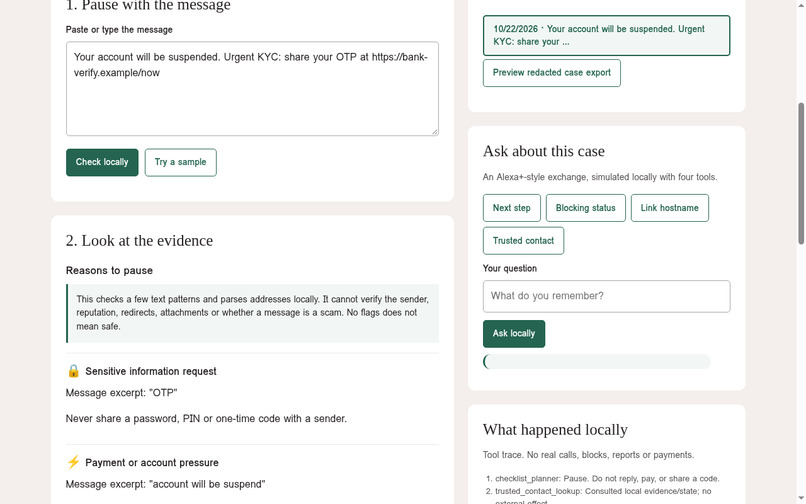
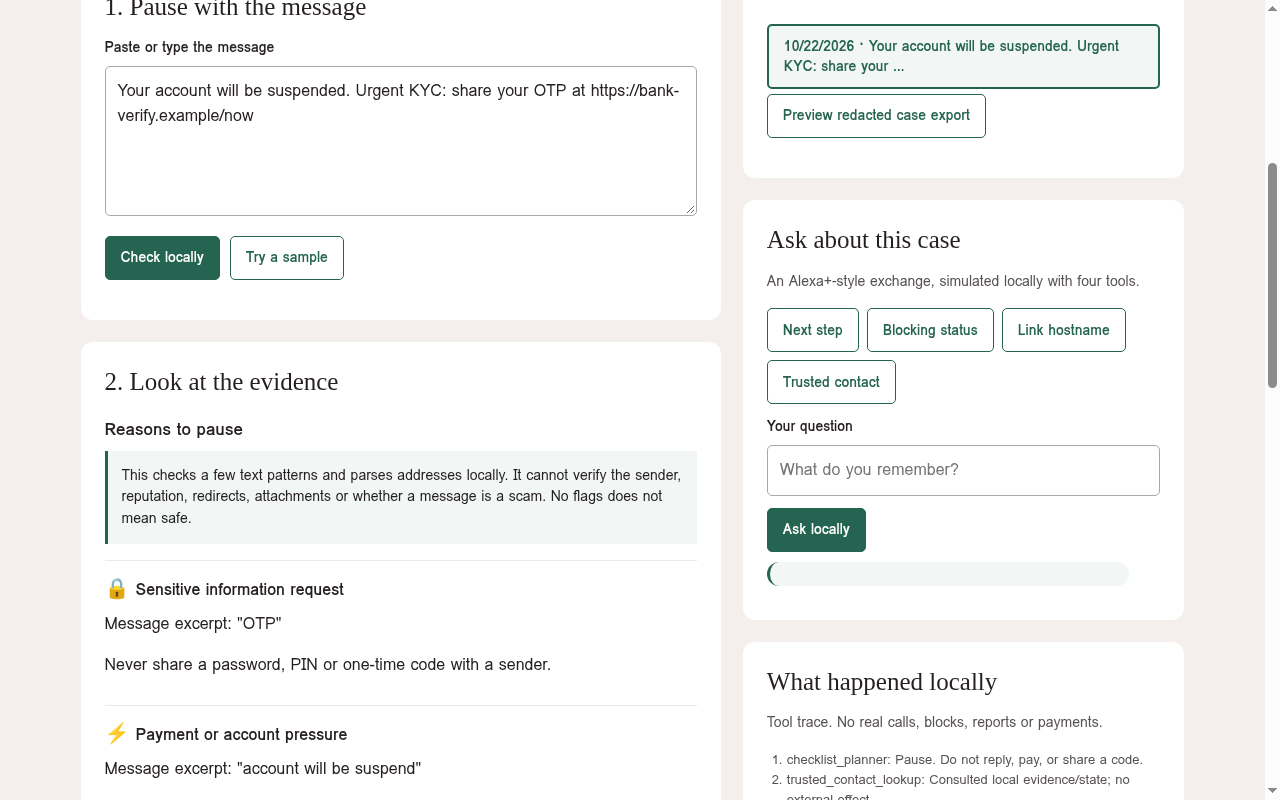
Evidence view: cue excerpts and the parsed hostname (simulation, runs locally)
-
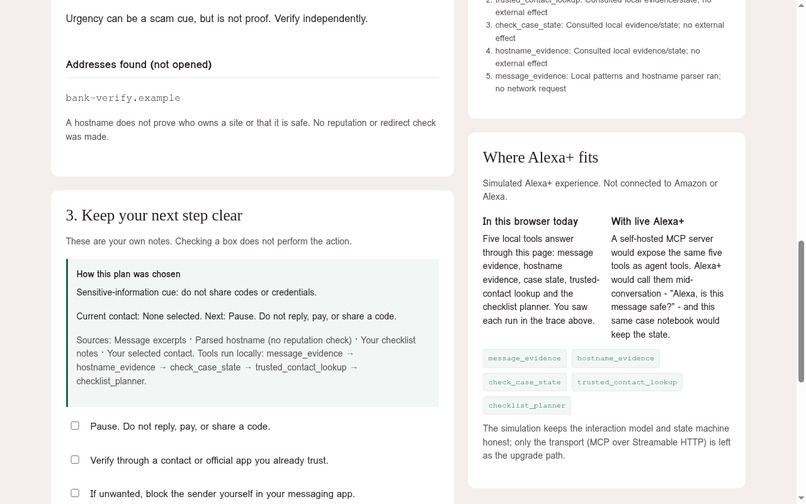
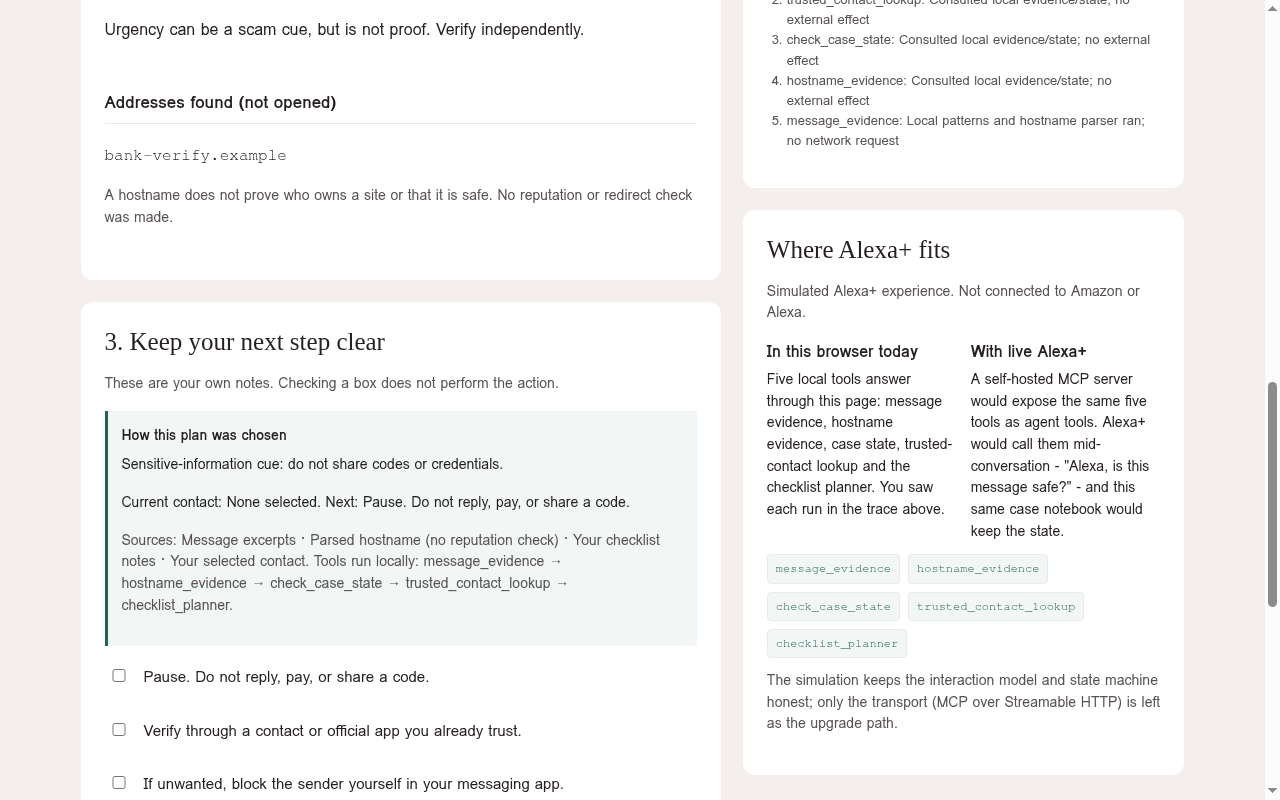
Saved plan with sources, and where Alexa+ would fit (simulated)
-
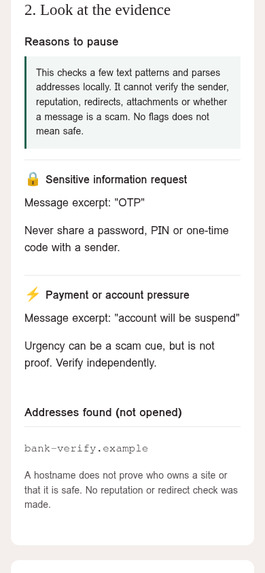
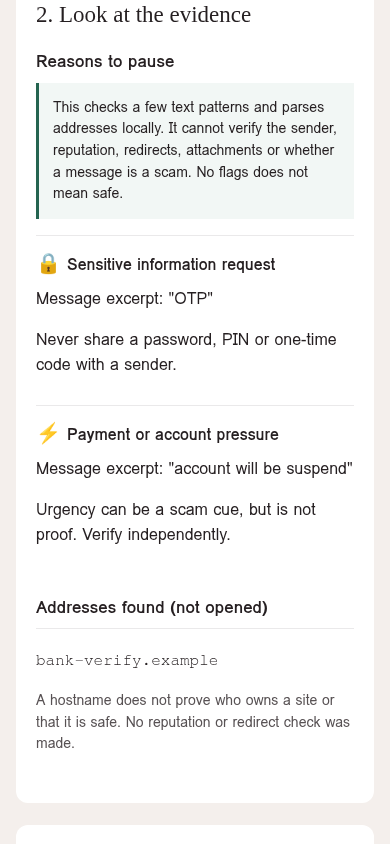
Phone layout of the evidence view
Inspiration
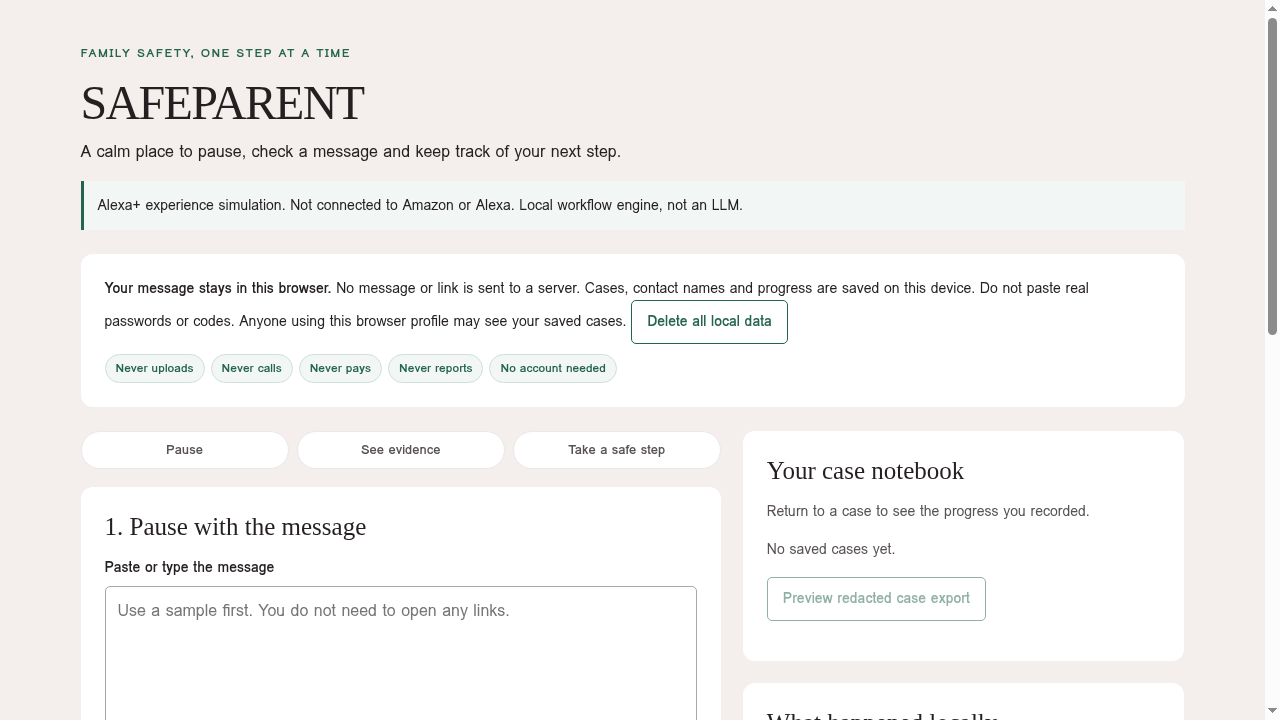
Scam messages are built to panic people who are least prepared to pause: "your account will be suspended, share the OTP now." One-shot scam detectors answer once and forget. A real assistant should do what a calm family member does - slow the moment down, show why the message smells wrong, and remember where you left off when the fear comes back tomorrow.
What it does
SAFEPARENT is a stateful safety assistant for a parent facing a suspicious message:
- Paste the message. Local cue analysis shows each red flag with the exact excerpt and an honest meaning ("Urgency can be a scam cue, but is not proof"). The true hostname is parsed out of any link - including credential-before-host tricks and xn-- encoded lookalikes - and is never opened.
- A three-step plan (pause, verify, block) persists per case across sessions, with a visible "How this plan was chosen" card listing the local tools and sources behind it.
- A trusted-contact flow rehearses an independent callback script without dialing anyone or copying any number from the scam message.
- A case assistant answers questions ("Did I already block this sender?", "What is the link hostname?") from saved local state through four visible tools - and refuses requests to enable external actions like paying, calling or reporting.
- Built to de-escalate, not just detect: when a message shows multiple panic cues, a short breathing beat ("Pause. Breathe in slowly... the message can wait 30 seconds") appears before the evidence; a progress stepper (Pause - See evidence - Take a safe step) keeps the user oriented; the assistant answers in a familiar chat-style exchange; cue cards carry at-a-glance icons; completing all three steps is acknowledged; and always-visible "Never uploads / Never calls / Never pays / Never reports" chips keep the safety promise in view.
- Privacy is the product: common OTP/PIN/password values are masked before anything is saved, exports strip the message, hostname and contact names, damaged storage is recovered without silent overwrites, and per-case or full deletion actually deletes.
How it works
A transparent local workflow engine (no LLM, no network calls, no paid API, no AWS): deterministic cue matching, strict URL hostname parsing, a local case notebook in localStorage, and a five-tool planner (message_evidence, hostname_evidence, check_case_state, trusted_contact_lookup, checklist_planner) whose every run is recorded in a visible tool trace. 27 engine tests plus end-to-end browser and axe accessibility suites (WCAG 2 A/AA + 2.1 AA clean across six app states) run with npm test and the scripts in tests/.
Why this fits Alexa+
The interaction model is the Alexa+ promise applied to a vulnerable moment: an ambient assistant that remembers context and does things, not a one-shot Q&A. SAFEPARENT's state machine (cases, contacts, checklist, tool trace) maps directly onto a self-hosted MCP server: each local tool is an MCP tool waiting to be exposed, and the simulation keeps that upgrade path explicit instead of faking an integration.
This entry uses the Alexa+ track's simulated-experience route: a web app built with an agentic tool, simulation source included in the repo, honest on-screen labels throughout ("Alexa+ experience simulation. Not connected to Amazon or Alexa. Local workflow engine, not an LLM."), and the demo video clearly shows the simulated experience running live from GitHub Pages.
Product feedback (tools, APIs, SDKs used)
We took the simulated-experience route, so we did not call a live Alexa+ API; feedback is on the track materials themselves.
- What worked: the simulation exemption let us build and test the full assistant loop offline within the rules; the MCP spec link gave a concrete target shape for the tool design (our tool trace mirrors MCP-style tool/result pairs).
- What needs work: the Alexa+ track page mixes the MCP server and Agent Skill paths; a single minimal "simulated experience" example repo (even a static page calling one local tool) would anchor what judges expect from this route.
- Onboarding: eligibility, deadline and deliverables were findable; the private-repo collaborator step is easy to miss - worth surfacing at submission time, not only in rules.
- Would we build with it again: yes - the MCP path is the natural v2 for this project.
Built during the hackathon window
Everything. SAFEPARENT was designed and implemented from scratch on 10-16 Oct 2026 for this hackathon. It shares only the problem-space inspiration (scam safety) with an unrelated earlier project; no classifier code, UI or copy was reused.
Friction log entries (for the judging bonus)
- Task: clarify what the Alexa+ simulated route requires in the repo. Expected: one canonical example. Actual: requirements are split across the overview, rules and FAQ text. Severity: medium. Workaround: cross-read all three and keep the simulation source + labels explicit. Suggestion: publish a minimal reference simulation.
- Task: plan private-repo reviewer access. Expected: add collaborators at submission. Actual: page notes invitations expire after 7 days, so early setup silently lapses. Severity: low. Workaround: add reviewers at submission time only. Suggestion: remind on the submission form itself.
- Task: keep a deterministic assistant honest. Expected: users understand "simulation". Actual: early drafts read like a live AI product. Severity: high (trust). Workaround: persistent banner, honest labels on every answer, capability limits beside every result. Suggestion: publish labeling guidelines for simulated entries.
- Task: verify accessibility without a device lab. Expected: quick automated pass. Actual: automated scans miss focus loss after re-renders; found only by scripted keyboard tracing. Severity: medium. Workaround: tab-order and focus-retention tests in tests/review.mjs. Suggestion: recommend focus-management checks in hackathon accessibility guidance.
Feature requests
- A reference "simulated Alexa+ experience" starter (critical for first-time track entrants).
- A submission-time checklist that restates repo sharing + video requirements (important).
- A sandboxed MCP conformance checker for self-hosted servers (nice-to-have).

Log in or sign up for Devpost to join the conversation.