-
-
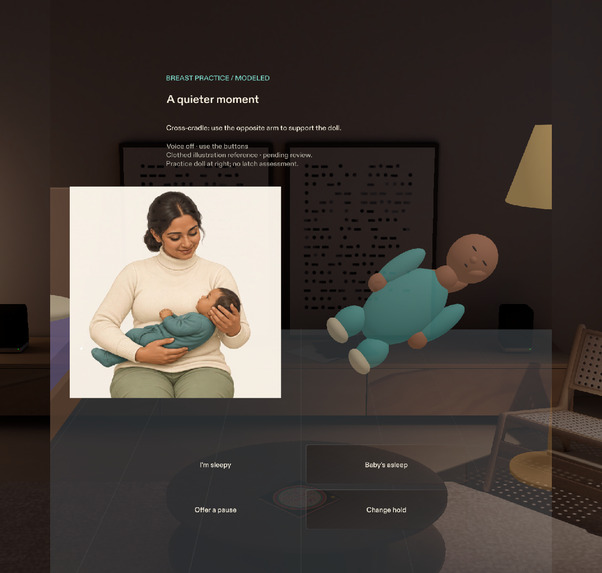
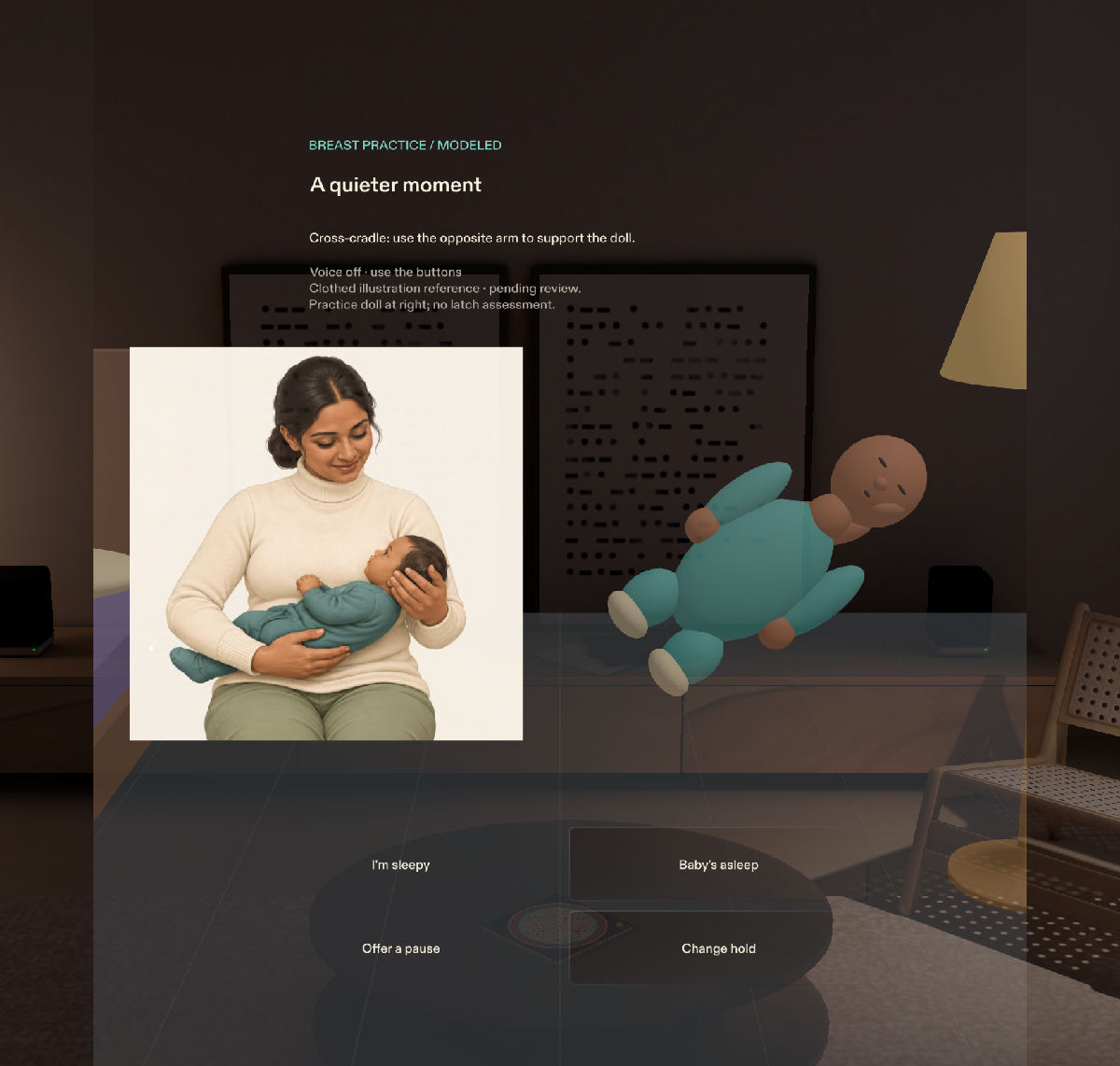
Breast practice: a fully clothed caregiver illustration beside the interactive practice dol
-
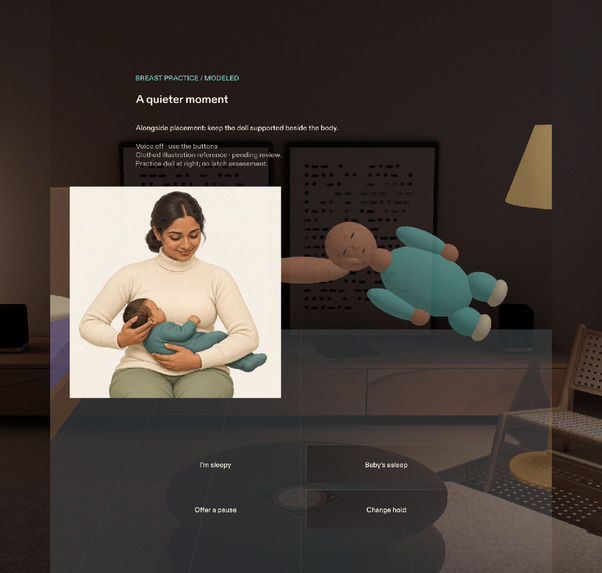
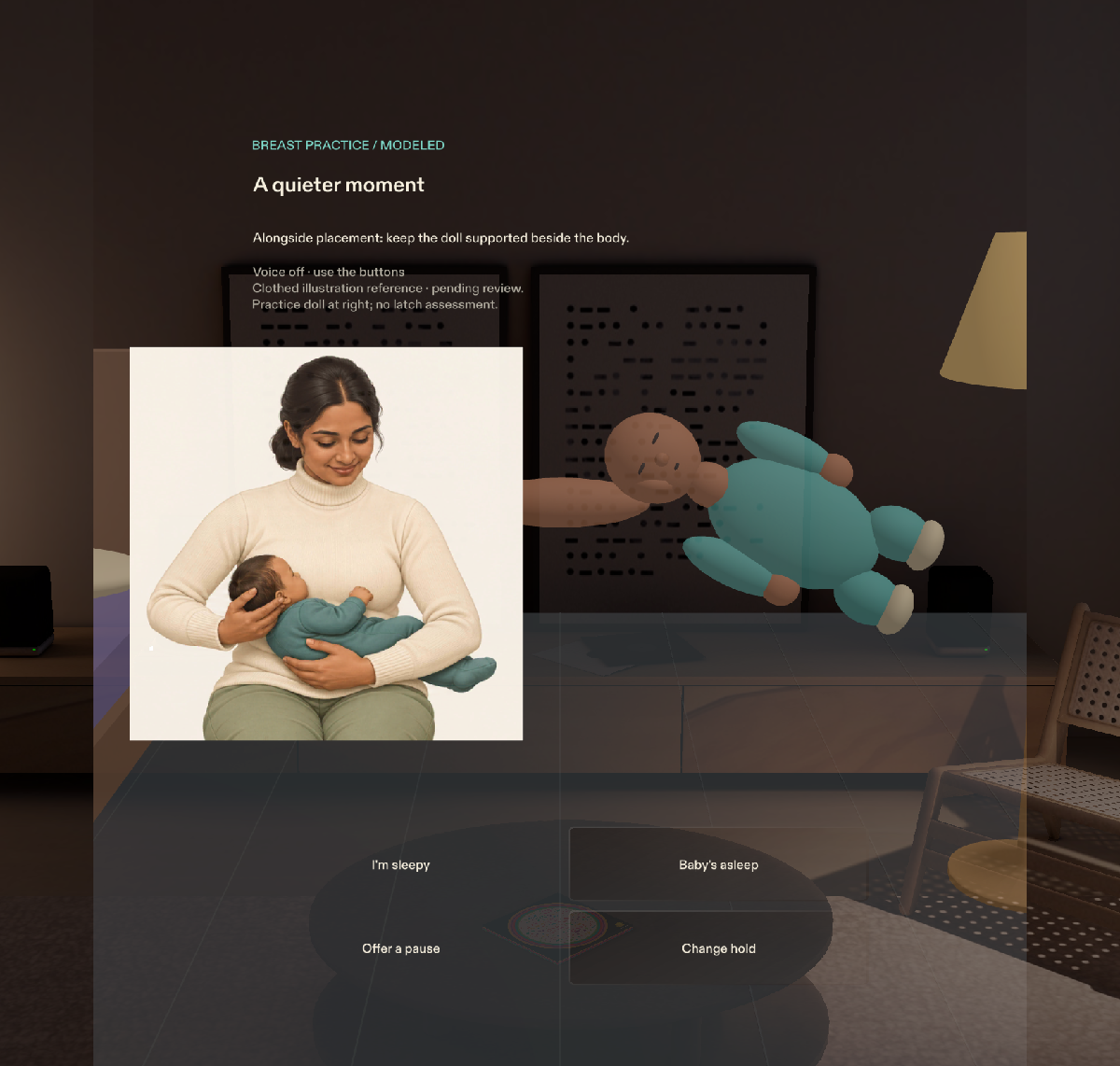
Alongside placement: Change hold selects a matching reference and doll placement
-
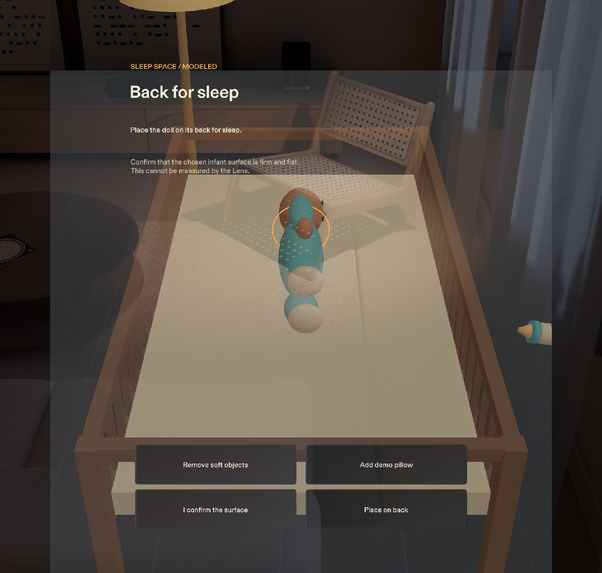
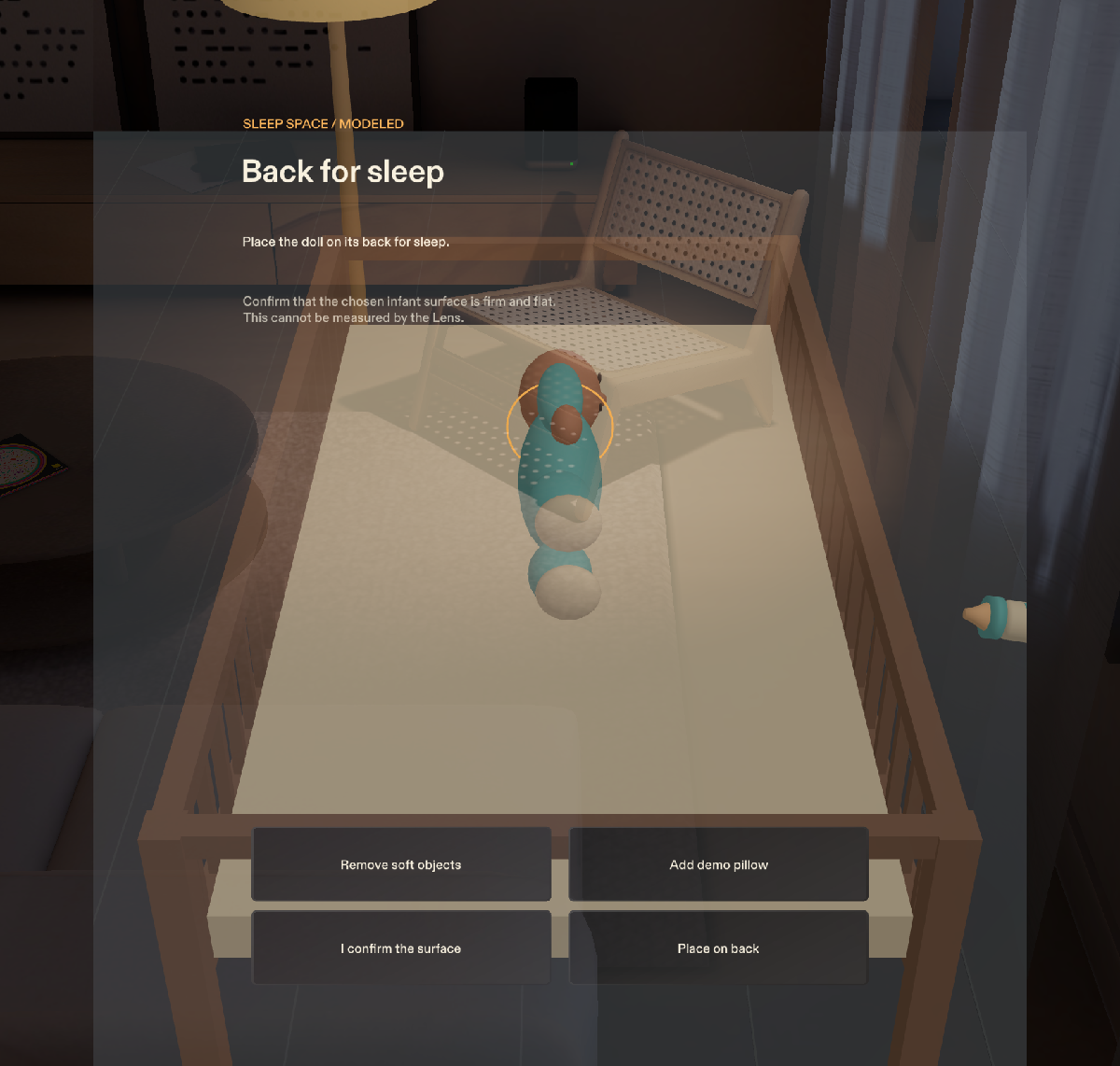
Sleep practice: a side pose prompts a cue to place the doll on its back
-
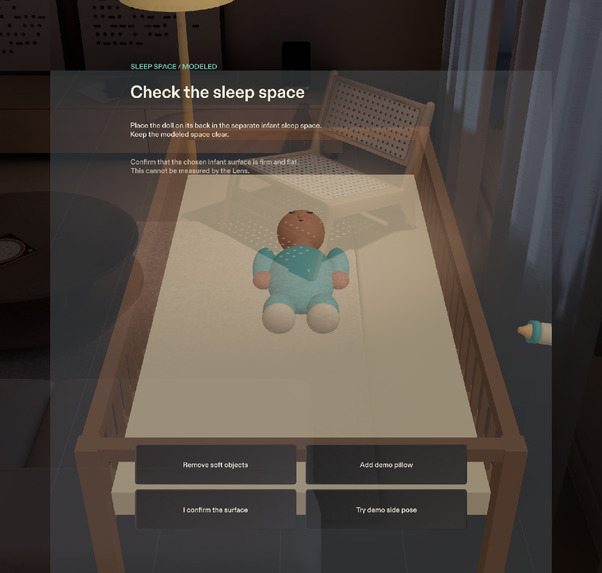
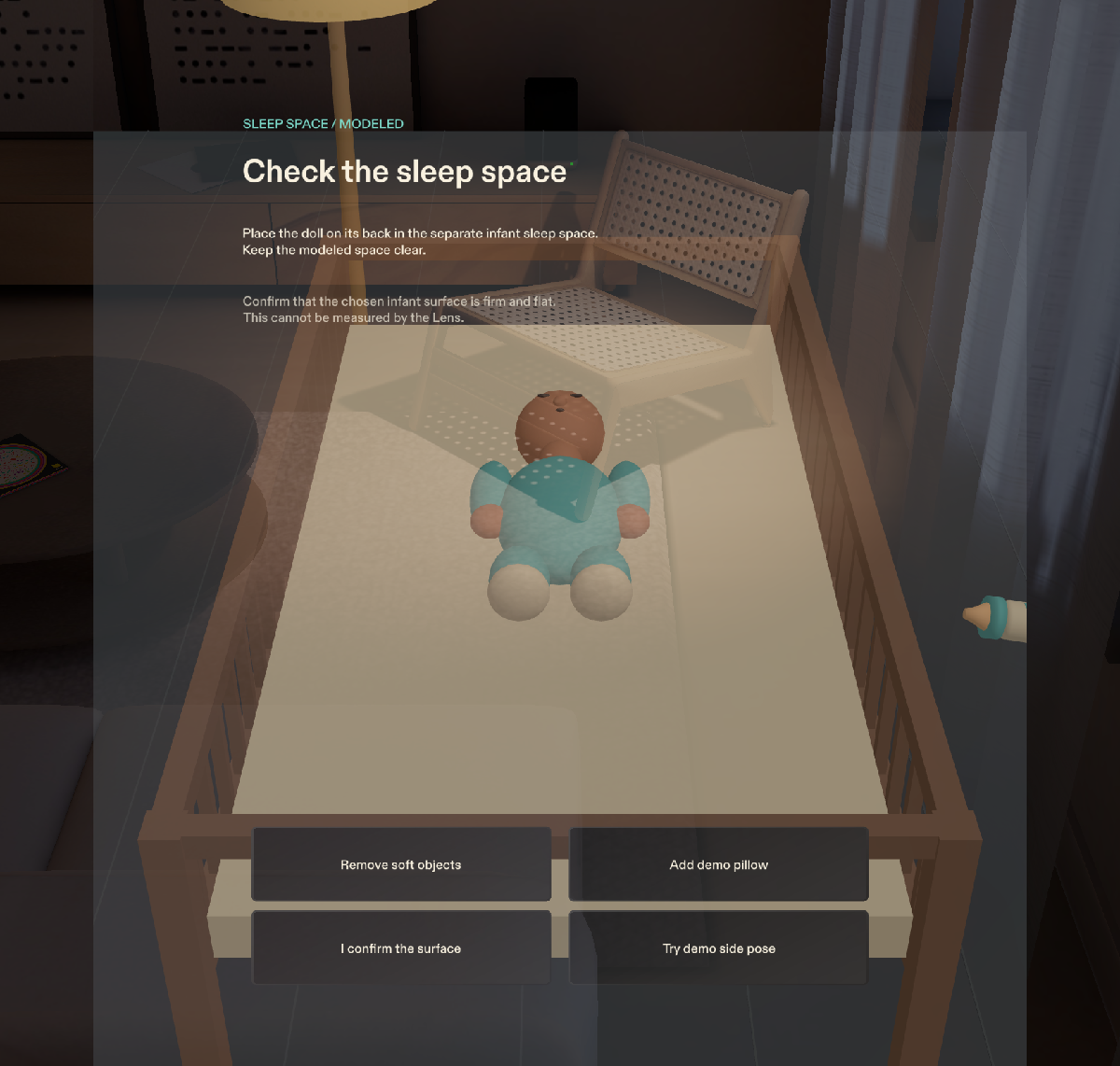
The doll on its back inside the modeled infant sleep space
Inspiration
A new mother, exhausted, feeding her baby in the dark with both hands full. How the baby is supported, and where the baby is placed to sleep afterwards, are small moments that matter, and they are hard to learn from a leaflet.
The wider picture is sobering. WHO and its partners estimated 4.9 million deaths before age five in 2024, including 2.3 million newborn deaths. Leading neonatal causes include complications of premature birth and delivery, which this Lens cannot address (WHO / UN IGME).
But some deaths happen at home. Where injury data are tracked, choking and suffocation are among the leading causes of accidental infant death. In Canada they account for almost 40% of unintentional injuries in infants under one (Canadian Paediatric Society), and in US data for 2022, mechanical suffocation made up nearly 85% of injury deaths in the first year of life (National Safety Council). A CDC registry study of 4,929 sudden unexpected infant deaths in participating US jurisdictions during 2011–2017 found that 72% occurred in unsafe sleep environments (CDC study). That is an association, not proof that bedding caused 72% of deaths.
We asked: could spatial practice make those two moments easier to understand, with one quiet cue at a time instead of dashboards? Safe Night is built to help with feeding-position and sleep-placement risks. It has not been shown to prevent choking, suffocation or infant death.
What it does
Safe Night is a hands-free practice guide for Snap Specs, demonstrated entirely in Lens Studio Preview with a virtual doll and simulated inputs. Its core moment: move the doll away from the supporting-arm model, and after a sustained change a short cue appears right at the baby. Correct the position and the cue clears.
Breast practice. Original illustrations of a caregiver and baby accompany a separate interactive practice doll. The Change hold control selects one of three placement references and moves the doll to the matching placement. Free dragging does not update the illustration. This covers placement and support only, not latch, milk transfer or feeding effectiveness.
Bottle practice. Manipulate the doll and bottle. When a modeled condition stays outside its configured threshold, one cue appears at the affected area and clears after a sustained correction.
Handoff to sleep. Explicit "I'm sleepy" and "Baby's asleep" controls begin the transition toward a separate virtual infant sleep space. A direction label and a quiet spatial chime help locate it when it is out of view. Sleepiness is selected by the user, not detected.
Sleep practice. Try a side pose and correct the doll onto its back, check that the whole doll is inside the modeled infant sleep space, and remove simulated soft objects such as a pillow. Firmness and flatness need a separate user confirmation, because the Lens cannot measure them.
Honest review. The session review separates modeled observations, user confirmations, unknown input and untested conditions. Simulated input loss produces a visible "can't check" state. Unknown never counts as a successful check, and the experience produces no safety score.
Who it's for
The intended audience is new mothers and caregivers learning feeding support and infant sleep placement, and the nurses and educators who teach them. These are intended users; none has yet participated in usability testing.
Why it belongs on glasses
- It leaves your hands free. In real use a caregiver's hands are holding the baby, so guidance can't depend on a phone. In this prototype, pinch interactions stand in for moving the baby, and explicit buttons stand in for voice.
- It draws in the world. The practice task is spatial: a doll, supporting arms, a bottle and a separate infant sleep space. Cues appear at the modeled body, not in a dashboard.
- Direction follows where you look. When the sleep space is out of view, an edge label and a quiet spatial chime point toward it.
Hardware comfort and the suitability of these interactions still need testing.
What's different
- One instruction at a time, selected by a priority arbiter when conditions compete.
- Sustained-change timing and separate clearing thresholds help avoid flickering cues.
- Every check keeps modeled observations, user confirmations, unknown input and untested conditions distinct.
- Editable guidance and simulation parameters make the prototype's assumptions inspectable.
How we built it
We built the Lens through CLAD and the Lens Studio MCP, using TypeScript, Spectacles Interaction Kit and Spectacles UI Kit.
A pure TypeScript engine handles rules, sustained-change timing, hysteresis, prompt priority, state transitions and evidence reporting. The nursery and practice doll use procedural geometry. The caregiver references are original AI-generated illustrations, reviewed for proportions, limb errors and cropping. They are placement illustrations, not clinically validated latch diagrams. A quiet chime was synthesized locally.
Node tests verify the logic. Mutation checks deliberately break important conditions. LEAF scenarios exercise real interactions in Lens Studio Preview.
Process note. We initially built from a user-approved brief because the Devpost Learn skill was unavailable in our setup. We later obtained the official pack and applied its plan-lens template and design guidance in a documented post-build review. The chronology is recorded in devpost/design-brief.md and the build log. We do not claim the official planning interview preceded the initial build.
Challenges we ran into
Connecting the coding agent to Lens Studio was the largest challenge. CLAD could appear installed while the chat exposed no Lens Studio editor tools. Reopening Lens Studio could also leave the chat connected to an outdated local server connection.
We hit a LEAF compatibility error, runtime initialization issues, and clipping visible only in Preview captures. Manipulation tests exposed inconsistent drag behavior, which we corrected and checked against measured released positions. We also rejected illustration variants with anatomy or cutout defects.
Accomplishments that we're proud of
- A complete virtual feeding-to-sleep practice flow, with distinct breast and bottle practice.
- Explicit side-pose correction onto the back, and whole-doll containment checks.
- An unknown-input state that never counts as a successful check.
- One instruction selected at a time.
- 12 passing logic test groups, all 10 deliberate mutations caught, and all 14 Preview regressions passing.
- A clean source handoff tested with its assets restored.
- A 2:55 demo made from actual Preview recordings, with narration and captions.
What we learned
- A successful compile does not prove an AR experience works. Runtime logs, real interactions and visual inspection each caught different problems.
- Check measured positions, not just screenshots. Repeated manipulation tests exposed inconsistent drag behavior, and we verified the fix against the doll's measured released position.
- "Unknown" has to be its own state. Keeping apart what the prototype models, what the user confirms and what remains unknown means missing input never counts as a pass.
- Restraint is design. Sustained-change timing and one instruction at a time made the Lens quieter, which is the point.
What's next for Safe Night
Clinician review of the guidance, illustrations and geometric proxies; supervised caregiver usability studies; and hardware testing for comfort, readability and interaction. Live voice input and perceived spatial audio direction also need validation.
Limits, plainly
- Everything demonstrated runs in Lens Studio Preview with a virtual doll, nursery and simulated inputs. No Specs hardware testing has been completed.
- This is a practice concept, not a monitor or medical device. It does not recognize or monitor a real infant, or detect breathing, sleepiness or swallowing.
- Clinical wording, illustrations and geometric proxies await clinician review. No caregiver usability study has been conducted.
- Voice commands were not verified; the demo uses explicit controls.
- The opening statistics provide context. They are not prototype outcomes or evidence of prevention.
Built With
- clad
- git
- leaf
- lens-studio
- lens-studio-mcp
- node.js
- openai-codex
- specs
- spectacles-interaction-kit
- spectacles-ui-kit
- typescript
