Inspiration
The inspiration for SafeNet stems from the realization that while Twitter's existing filters are effective at removing blatantly offensive content, many potentially harmful tweets still slip through the cracks. This gap in content moderation can lead to negative online experiences, particularly for vulnerable users such as children and teenagers. SafeNet aims to address this issue by providing an additional layer of filtering, transforming aggressive or inappropriate tweets into more family-friendly, polite, and professional content. By doing so, the tool seeks to create a safer social media environment, offering users a more positive experience that can help reduce stress and foster healthier online communication.
What it does
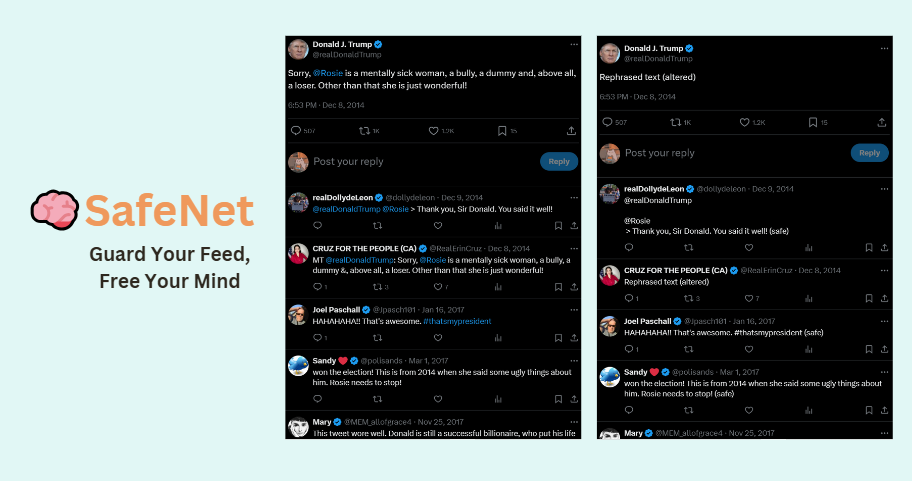
SafeNet offers a real time filtering of tweets in the user X 's feed and posts. The tool helps eliminate any profanity, tone down aggressive remarks and neutralize bias tweets.
How we built it
Front-End:
- JavaScript: Front-end development and tweet text alteration
Back-End:
- Flask: Handling HTTP requests and API development
- GUS-Net NER model: Detecting and classifying aggressive/inappropriate words
- LLaMA model: Rephrasing tweets
Challenges we ran into
- Idea relevancy: We thought twitter filtering is a bit too good so we end up wasting time thinking of other ideas even though little research has been made.
- Team Communication: This is our first hackathon together so it takes time to get the gears up and running
- Time limit: We weren't able to collect and train our own model due to the hackathon 24 hour time constraints
- Technical inexperience: We have little to none front end experience, especially in the UI department
Accomplishments that we're proud of
After locking down on the idea, we dedicated significant time to researching and determining models and impactful outputs to show to the user. Finally creating the extension that connected all the elements together to realize our vision is what we are really proud of.
What we learned
We learn a lot about the hidden corners of social media, the limitation of current filtering technology and the market for them, the up-to-date models to analyze sentiment and word context, and prompt engineering.
What's next for SafeNet
- Improving models: With more time, we could gather more relevant dataset, alter it to our liking and train a better model to classify sentiment and word context.
- Cover more website: Right now the extension on cover twitter, we hope to expand it to other popular social media platform like Reddit or Facebook.
- Visualizing data: Add more features to visualize the data classify and altered to provide clarity to the user
Built With
- gus-net
- javascript
- llama
- python

Log in or sign up for Devpost to join the conversation.