-
-
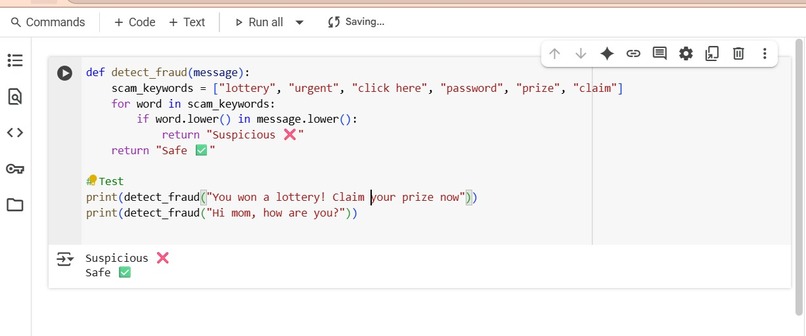
The python code just to show the overview of the project

Inspiration
Millions of elderly and less-educated people are targeted daily by online fraud. Many cannot distinguish between safe and scam messages. I wanted to build a tool that empowers them to stay safe online.
What it does
SafeNet scans text messages (emails, SMS, or chats) and uses algorithms to detect fraud indicators such as suspicious keywords, fake links, and phishing patterns. It classifies messages as Safe ✅ or Suspicious ❌, giving simple warnings for vulnerable users.
How we built it
Python for the core algorithm
Scikit-learn for a lightweight machine learning classifier
NLTK for text preprocessing
Rule-based logic (keyword & URL checks) combined with ML predictions
Prototype tested in a Jupyter/Colab notebook
Challenges we ran into
Limited dataset: scam message datasets are not freely available, so I built a small demo dataset manually.
Balancing simplicity and accuracy: keeping the tool easy to understand while still effective.
Accomplishments that we're proud of
Built a working prototype in a short time.
Designed something meaningful that can genuinely help vulnerable people.
Combined rule-based + ML detection in a lightweight solution.
What we learned
How fraud patterns can be identified through simple text analysis.
Importance of designing for non-technical users — security should be understandable.
The value of combining algorithms with social good.
What's next for SafeNet
Train on a much larger dataset for better accuracy.
Add multi-language support.
Build a browser extension and mobile app for real-time scam detection.
Extend to detect voice scam calls.
Built With
- nltk
- python
- scikit-learn
- streamlit


Log in or sign up for Devpost to join the conversation.