INSPIRATION
Financial scams are no longer just suspicious emails. Scammers manipulate people through AI-generated voices, convincing text messages, fake bank alerts, impersonation, urgency, and social engineering. Seniors and retirees can be especially vulnerable because one successful scam can mean losing years of savings.
The hardest part is that scams are designed to make people act before they think.
I wanted to build something that creates that missing moment of pause.
SafeNest AI is an AI financial safety assistant that helps people answer one simple question before they send money:
Could this be a scam?
Instead of expecting someone to understand complicated security warnings, SafeNest turns a suspicious message, payment request, or conversation into a simple risk assessment with clear red flags and practical verification steps.
My goal is simple: help people slow down, verify, and protect their money before taking action.
WHAT IT DOES
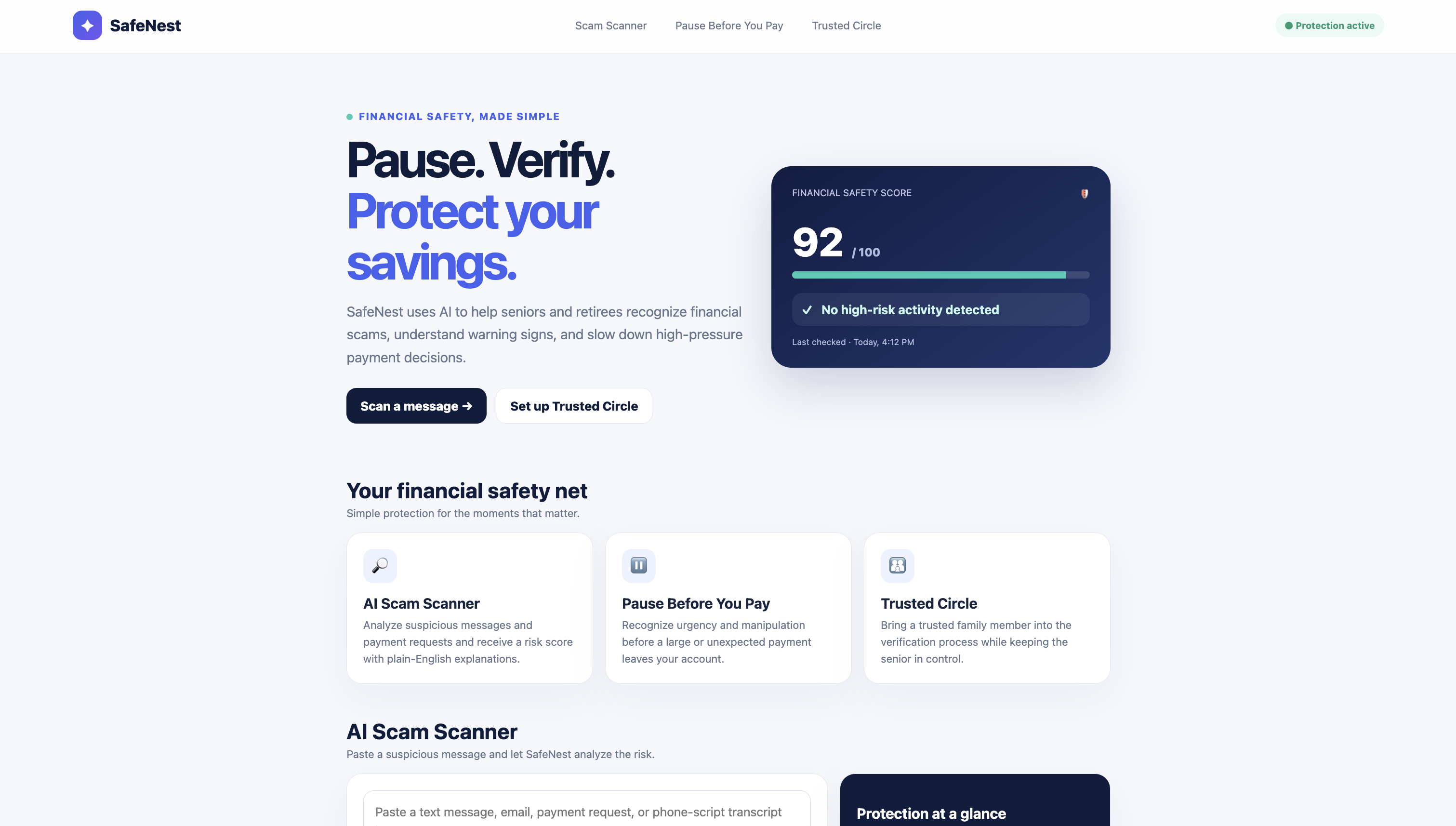
SafeNest AI lets users paste a text message, email, phone-call transcript, or payment request and immediately analyzes it for financial scam and social-engineering risk.
It produces a 0–100 risk score, a LOW, MEDIUM, HIGH, or CRITICAL risk level, an easy-to-understand explanation, detected scam tactics, suspicious financial requests, recommended actions, and verification steps.
Rather than simply saying that something looks suspicious, SafeNest explains why.
It can identify patterns such as:
Urgency: “Send the money within 10 minutes.”
Impersonation: someone pretending to be a bank, government agency, family member, or trusted company.
Payment manipulation: requests for gift cards, wire transfers, cryptocurrency, or unusual accounts.
Fear and threats: claims that an account will be closed, money will be lost, or someone will be arrested.
Credential harvesting: requests for passwords, verification codes, banking information, or other sensitive information.
Emotional manipulation: exploiting fear, trust, family relationships, or financial anxiety.
Most importantly, SafeNest does not tell users to send money or blindly follow instructions. It encourages independent verification before taking financial action.
The goal is not to make financial decisions for people.
The goal is to help them pause long enough to make a safer decision themselves.
HOW I BUILT IT
I built SafeNest as a lightweight AI-powered financial safety layer around a simple web application.
The frontend provides a deliberately simple interface so that someone without technical knowledge can paste suspicious content and understand the result immediately.
Behind the interface, a Node.js and Express backend receives the content and sends it to Google Gemini through the Gemini API.
I designed a specialized system prompt focused specifically on financial scams and social engineering.
The AI returns a structured JSON assessment containing:
Risk score
Risk level
Summary
Red flags
Detected tactics
Requested amount
Recommended action
Verification steps
This structured approach allows the frontend to transform an unstructured message into a consistent visual safety report instead of displaying a wall of AI-generated text.
I also added safety instructions directly into the AI layer.
The system is instructed to never claim certainty from text alone, never tell users to send money, recommend independent verification for unexpected financial requests, and communicate using simple language.
The application uses an API-based architecture so the user interface and AI intelligence layer can evolve independently.
CHALLENGES I RAN INTO
The biggest challenge was not simply getting an AI model to recognize scams.
It was making the output trustworthy enough to be useful when someone's money is at stake.
A generic chatbot can produce a convincing paragraph, but a financial safety tool needs predictable structure, clear reasoning, and actionable recommendations.
I therefore designed the AI response around a fixed schema and structured JSON output, allowing every analysis to be rendered consistently.
Another challenge was balancing false positives and false negatives.
A legitimate urgent bank message can sometimes look similar to a scam, while sophisticated scams can intentionally avoid obvious warning signs.
SafeNest therefore avoids claiming that a message is definitely fraudulent. Instead, it communicates risk, identifies evidence, and provides verification steps.
I also had to make the experience accessible.
Financial security terminology can be intimidating, especially for seniors and non-technical users. Instead of presenting complicated security classifications, SafeNest translates the analysis into simple explanations that clearly describe what the user should be concerned about.
The hardest conceptual problem was this:
How do I build an AI system that protects someone without taking away their agency?
My answer was to make SafeNest a decision-support system, not a decision-maker.
ACCOMPLISHMENTS THAT I'M PROUD OF
I built a complete working AI financial scam detection MVP from the user interface all the way through the AI analysis pipeline.
I am particularly proud of turning an ambiguous question into a structured safety workflow.
Instead of simply asking:
“Is this message a scam?”
SafeNest helps answer:
What is the risk?
Why is it risky?
What tactics are being used?
What should I verify?
What should I do before taking action?
I also designed SafeNest around real-world scam behavior rather than generic text classification.
The system can recognize social-engineering patterns involving urgency, impersonation, fear, payment manipulation, credential requests, and emotional pressure.
Most importantly, I designed the product around a simple principle:
AI should create a pause between manipulation and action.
That pause could prevent someone from losing their savings.
WHAT I LEARNED
I learned that building an AI application for a high-impact problem is very different from simply putting an LLM behind a user interface.
The quality of the product depends on prompt design, structured outputs, safety guardrails, user experience, and communicating uncertainty just as much as the underlying AI model.
I also learned that an AI answer is not necessarily useful just because it is technically correct.
For SafeNest, the result has to be fast enough to use in the moment, simple enough to understand, specific enough to be useful, and cautious enough not to create false confidence.
The bigger lesson was that financial safety is not only an AI problem. It is a human decision-making problem.
The best technology does not replace someone's judgment.
It gives them the information and confidence to use their judgment better.
WHAT'S NEXT FOR SAFENEST AI
SafeNest's current MVP focuses on analyzing text-based scam content. My next step is expanding it into a comprehensive real-time financial safety companion.
Future versions could include:
Real-time voice scam analysis for suspicious phone calls.
Detection of AI-generated voice impersonation.
Browser and email integrations for suspicious messages.
Banking and payment context to identify unusual transaction requests.
Family or caregiver alerts with privacy-preserving controls.
Personalized scam education based on recurring scam patterns.
Multi-language support for seniors who are more comfortable communicating in languages other than English.
A “Verify Before You Pay” workflow that guides users through independent verification.
Continuous evaluation against evolving scam patterns and newly emerging AI-powered fraud techniques.
Longer term, I envision SafeNest becoming a personal financial safety layer that sits between people and increasingly sophisticated social-engineering attacks.
Scammers are using AI to become more convincing.
I want to use AI to make people harder to deceive.


Log in or sign up for Devpost to join the conversation.