-
-
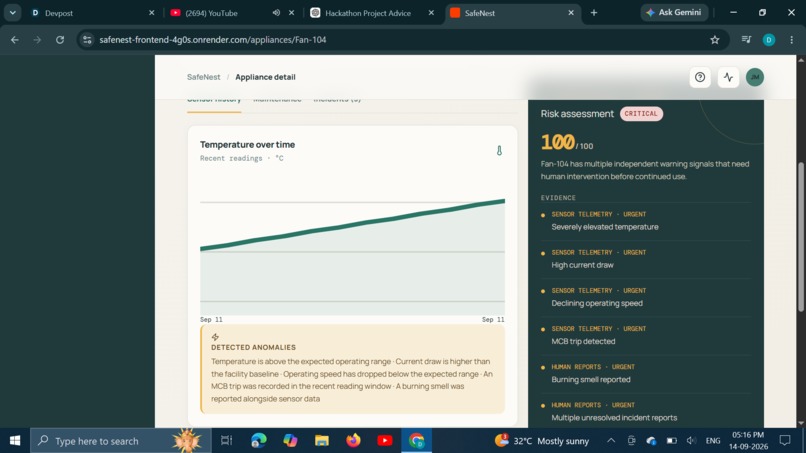
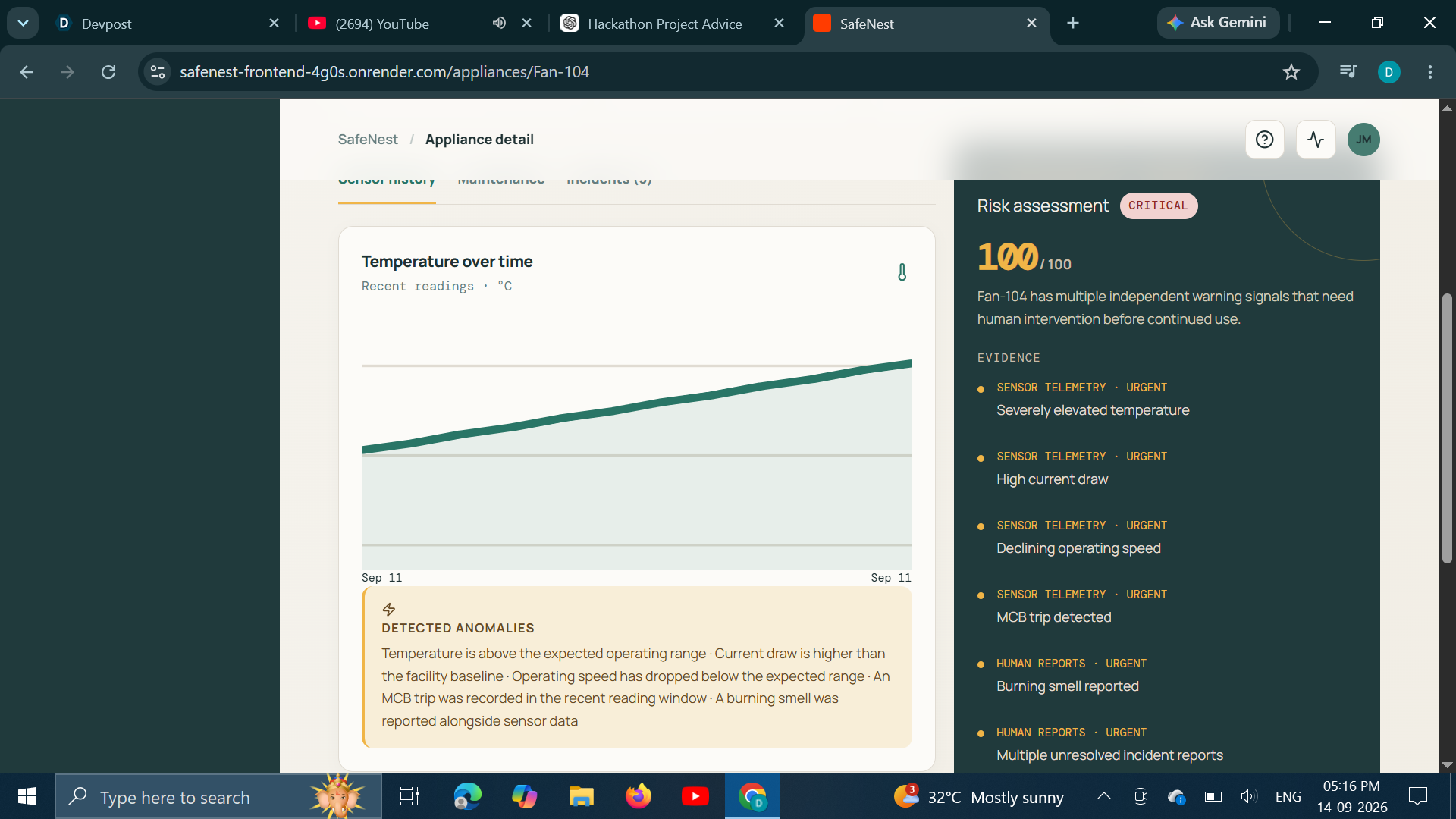
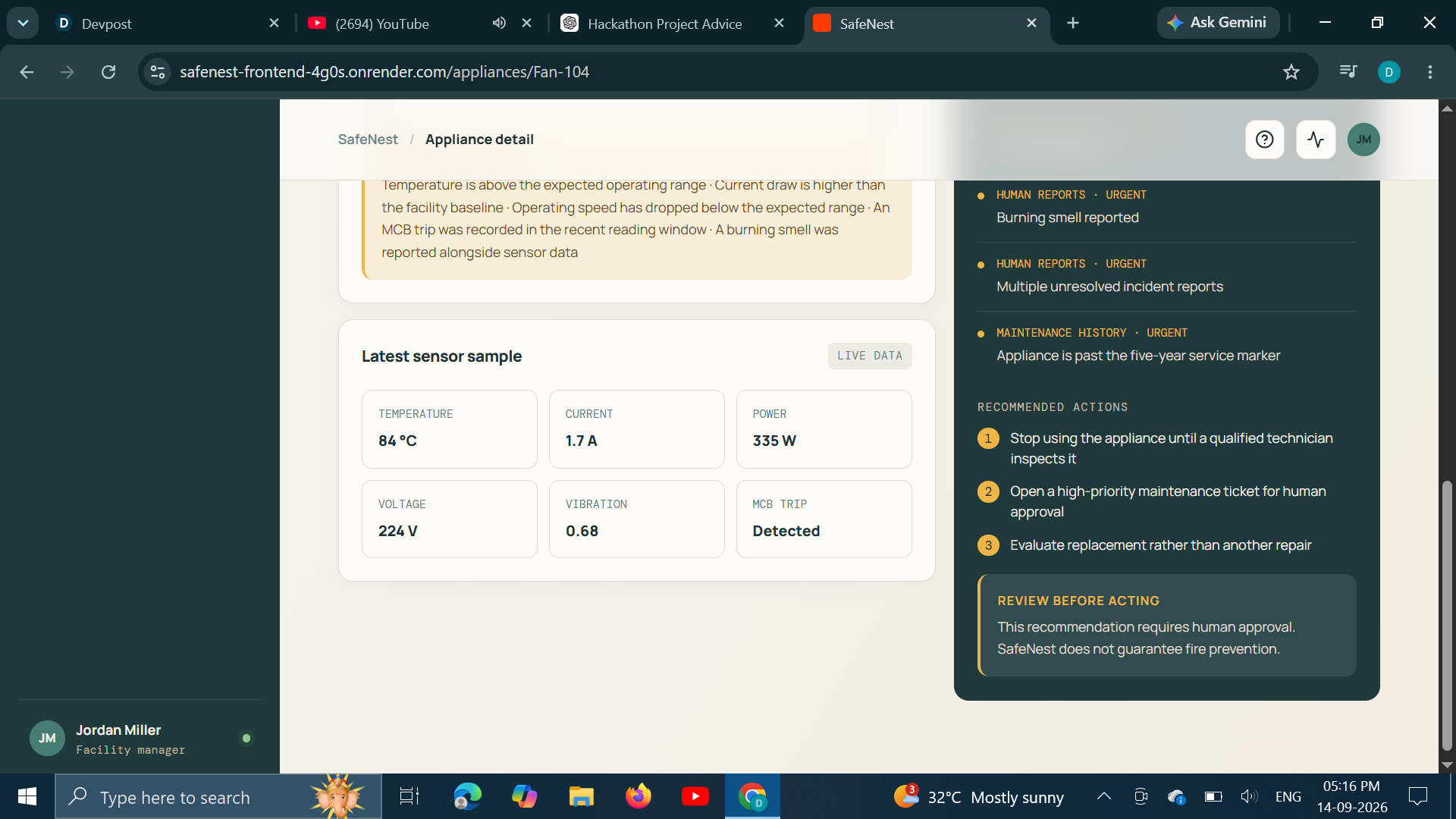
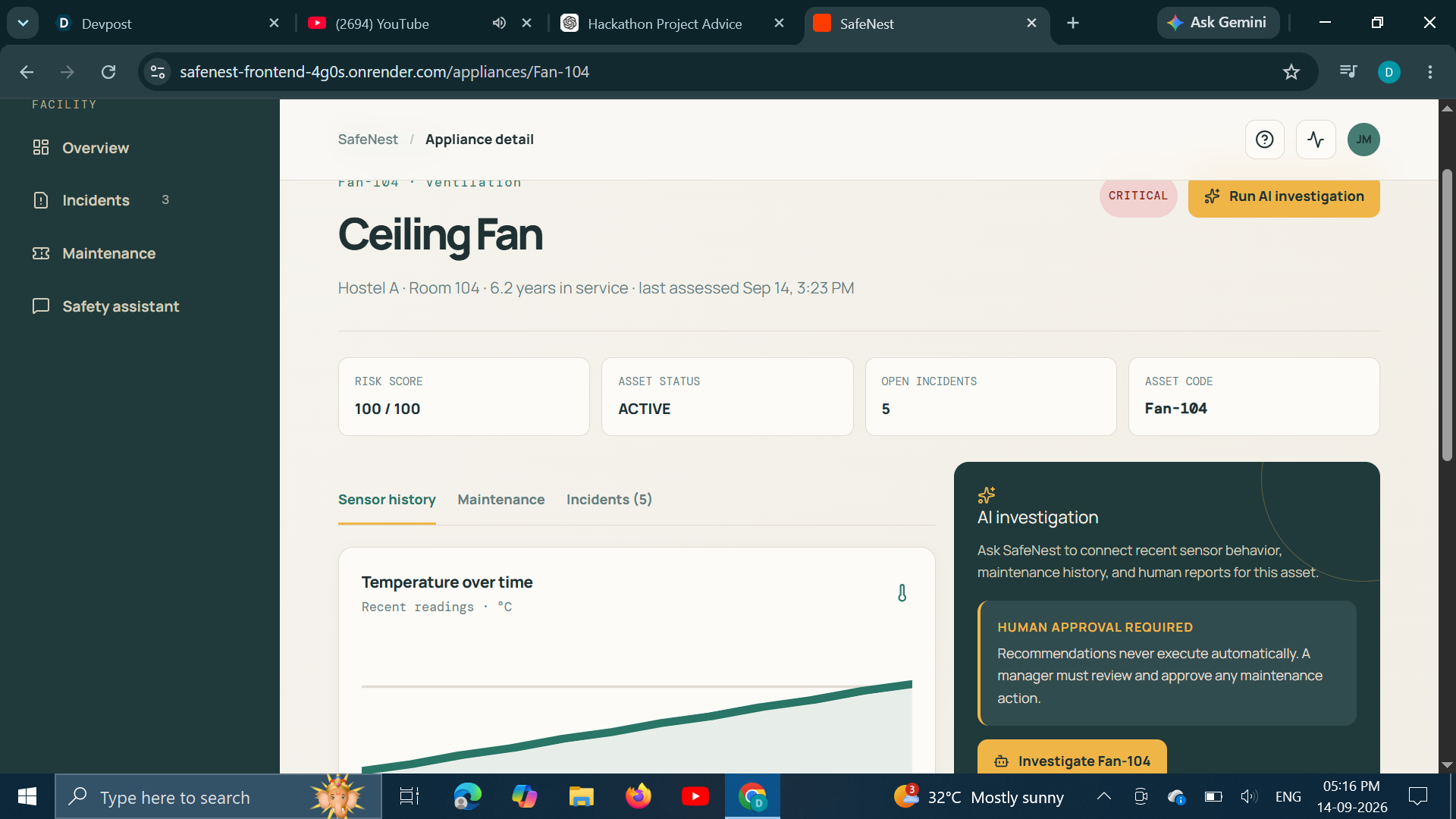
analysis of critical asset
-
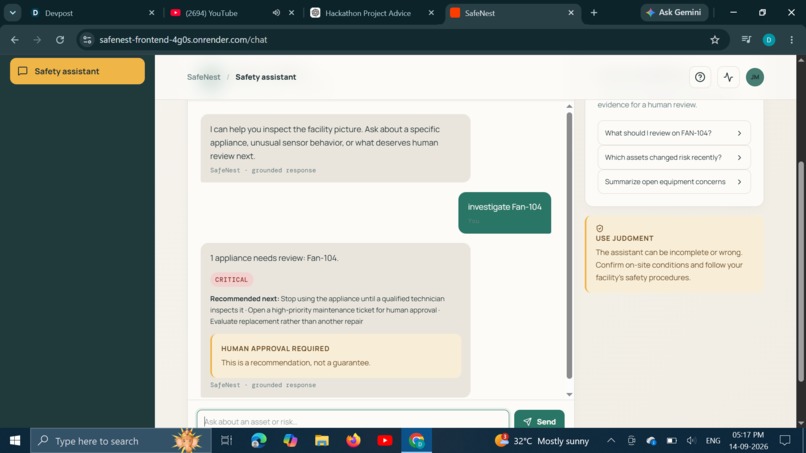
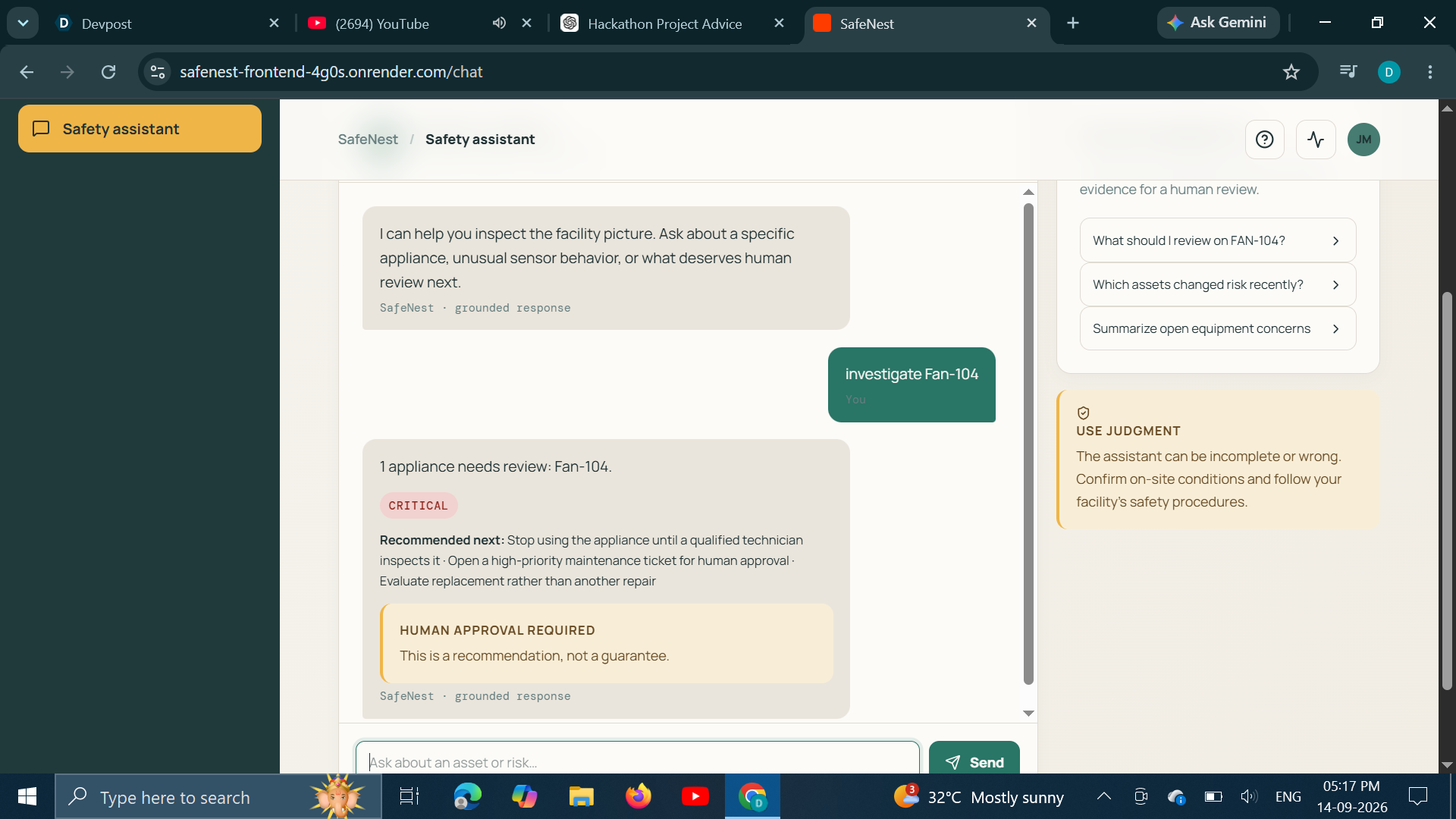
safety assistant
-
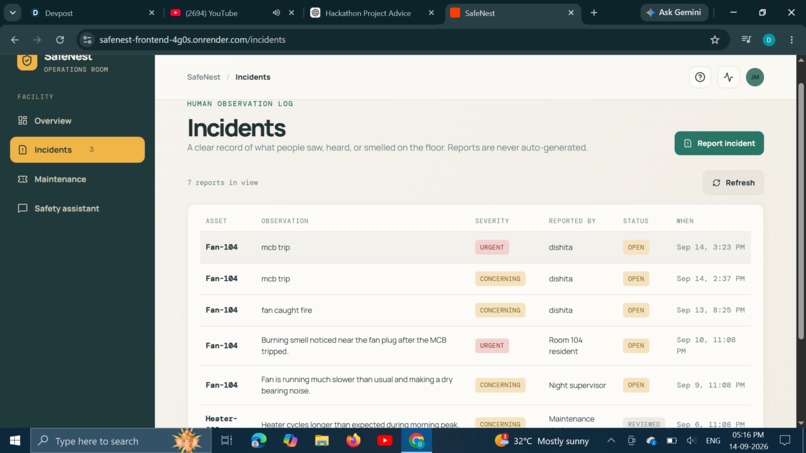
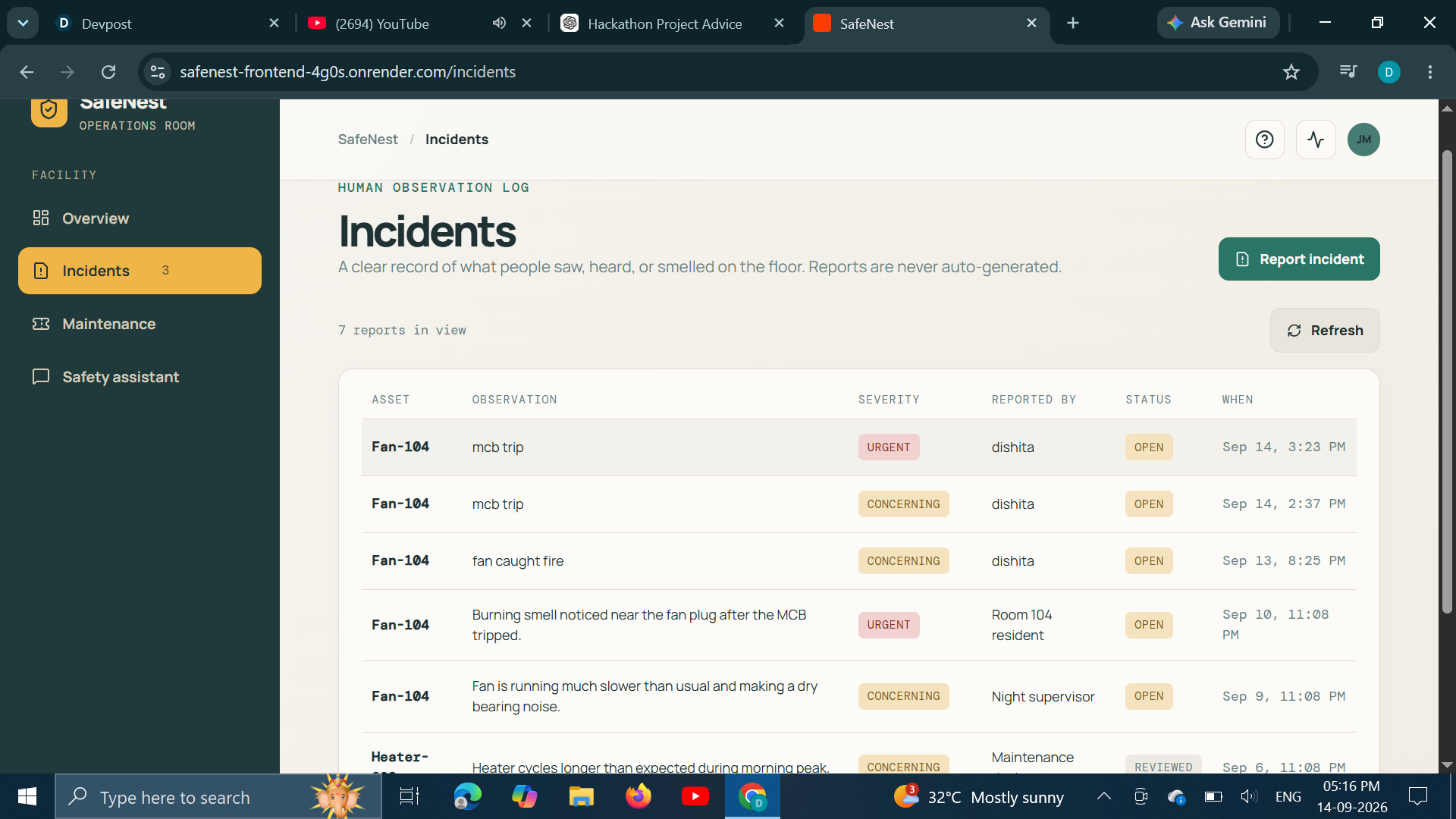
incidents page
-
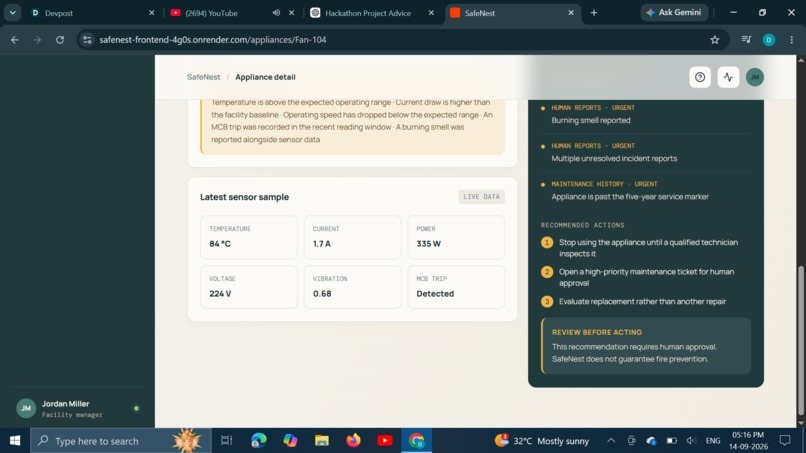
ai investigation of critical asset
-
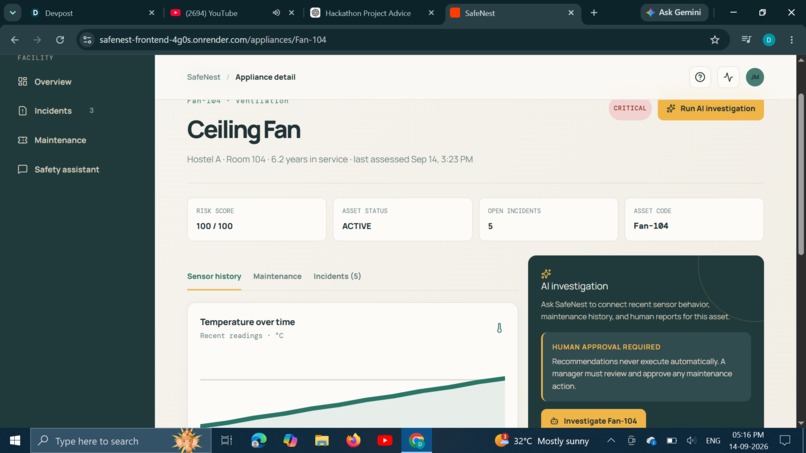
informtion on the critical asset
-
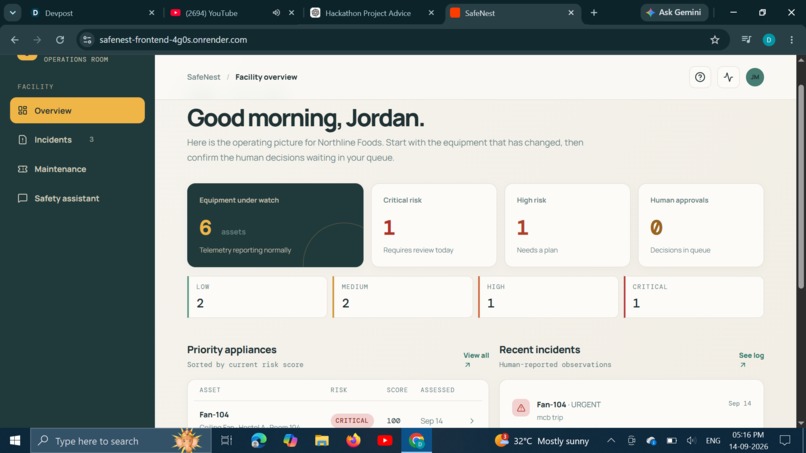
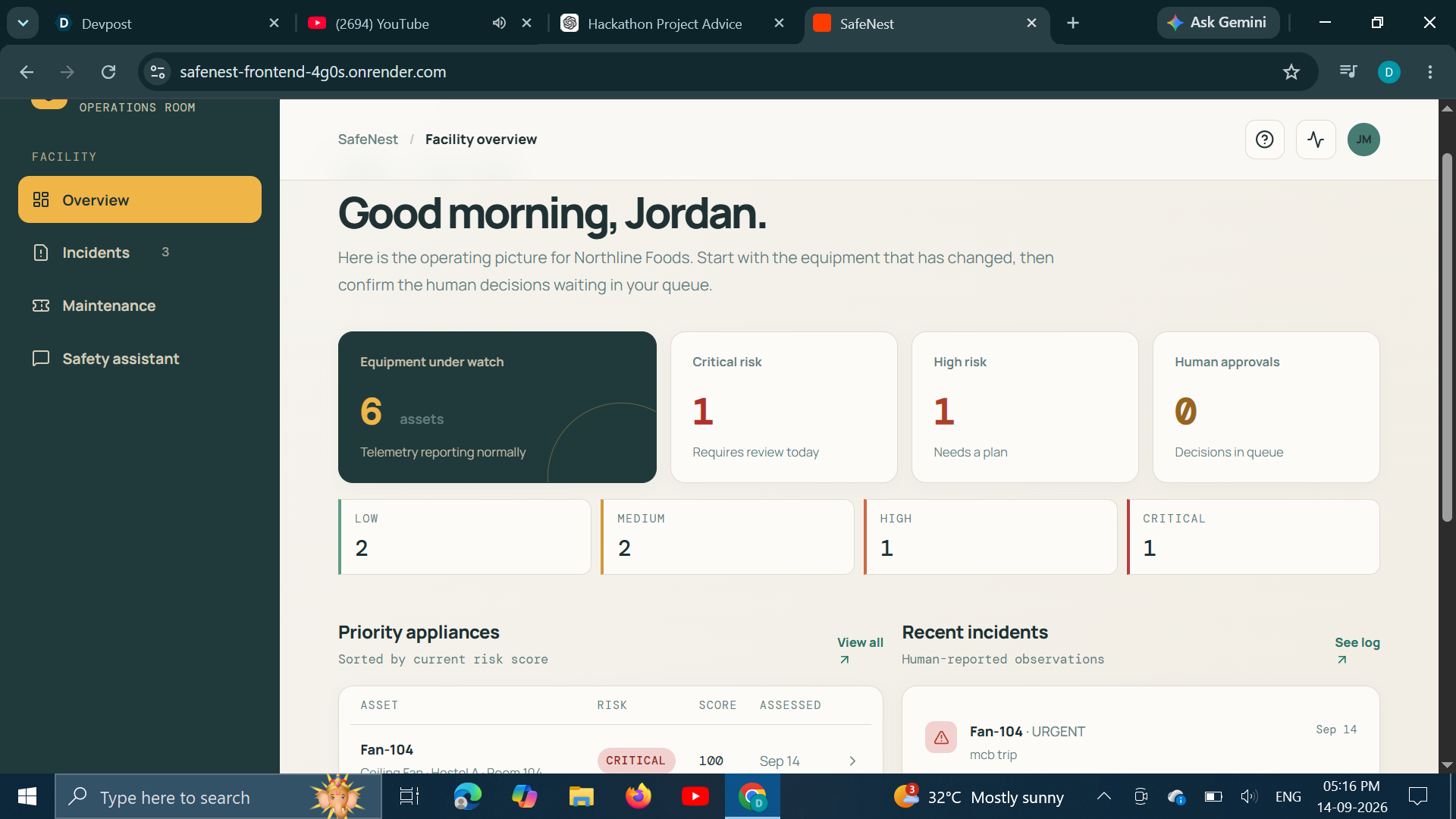
dashboard
-
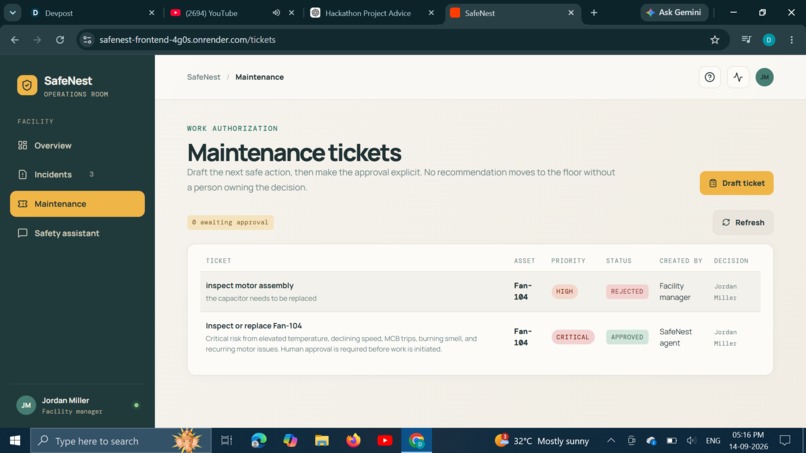
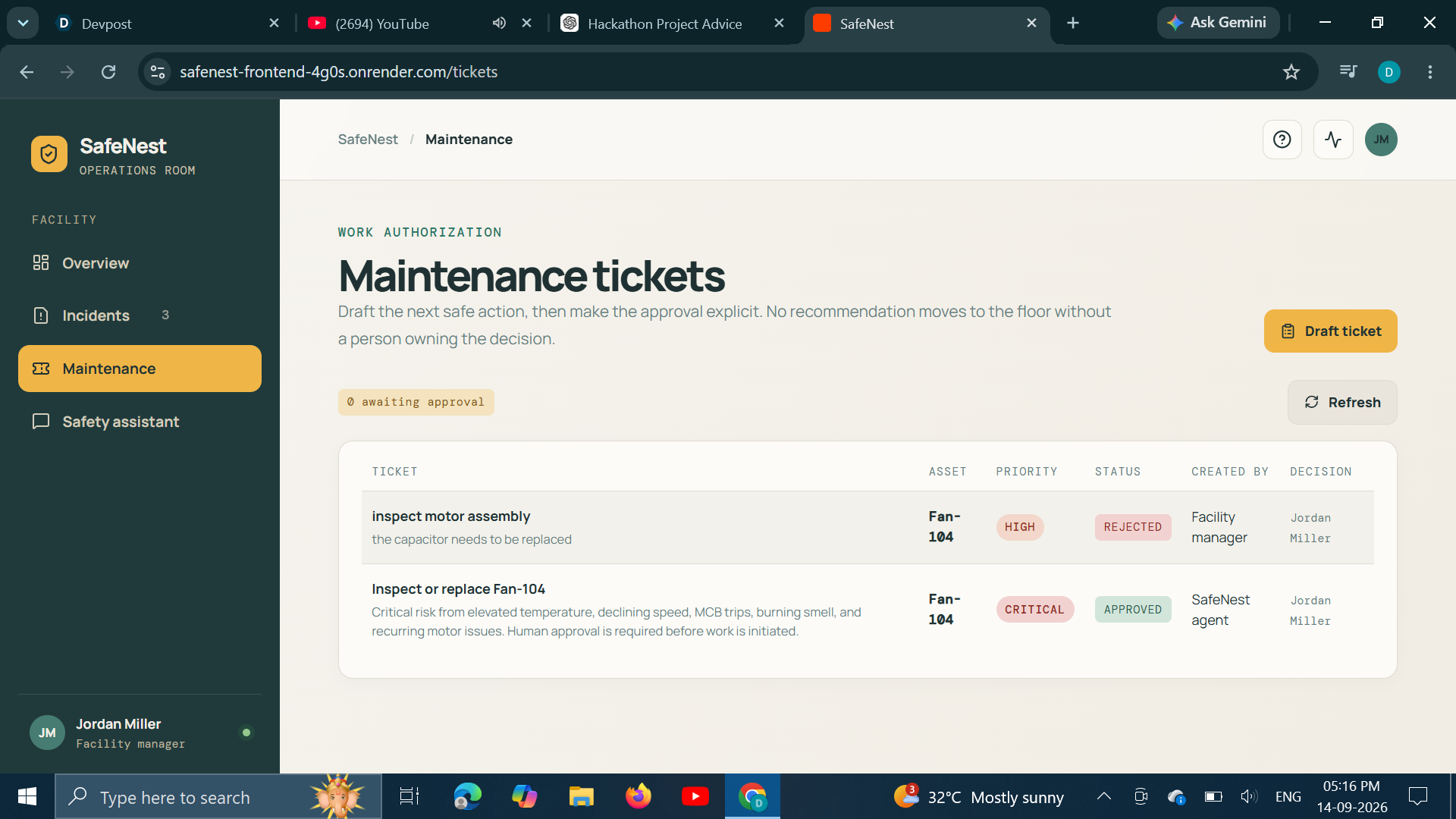
maintenance ticket
Inspiration
The idea for SafeNest came from a real incident in my hostel.
One night, an old ceiling fan in my room had started running unusually slowly. Around 5 AM, the MCB tripped, and by around 7 AM, it was reset and the fan started running again. However, a burning smell was still present.
The warning signs were there, but everyone became occupied with their morning routines, and the situation wasn't treated as an immediate safety concern. About 30 minutes later, the fan caught fire.
What stayed with me was that this wasn't a situation where there were no warning signs. There were several: degraded performance, an electrical trip, and a burning smell. The problem was that these signals existed as separate pieces of information, and no system connected them to highlight the growing risk.
That became the inspiration for SafeNest.
I wanted to explore whether an intelligent system could bring together sensor readings, equipment history, maintenance records, and human incident reports, identify combinations of warning signals that deserve attention, and help facility teams prioritize them before they are overlooked.
SafeNest is built around a simple idea:
The warning signs were there. They just weren't connected.
What it does
SafeNest is an AI-assisted facility safety and preventive maintenance agent that connects equipment data, sensor readings, maintenance history, and human incident reports to identify appliances that require attention.
It follows a Detect → Investigate → Explain → Recommend → Human Approval workflow.
SafeNest calculates equipment risk using deterministic safety rules based on signals such as abnormal temperature, current fluctuations, declining performance, vibration, repeated MCB trips, burning-smell reports, unresolved maintenance issues, and equipment age.
The Safety Assistant then helps facility operators investigate an appliance, understand why it has been prioritized, and determine the recommended next step. For safety-critical situations, SafeNest can recommend actions such as stopping use, requesting qualified inspection, creating a high-priority maintenance ticket, or evaluating replacement — while keeping the final decision with a human.
How we built it
SafeNest was built as a full-stack web application.
Frontend: React, TypeScript, Vite Backend: Node.js + Express Database: PostgreSQL ORM: Drizzle ORM AI: Gemini Deployment: Render Version control: GitHub
The system stores appliances, sensor readings, maintenance records, incident reports, maintenance tickets, and audit events in PostgreSQL.
A key design decision was separating safety-critical reasoning from generative AI. The risk score and risk level are calculated through deterministic rules, while Gemini is used for grounded natural-language investigation and communication. This prevents the language model from independently inventing the core safety assessment.
Challenges we ran into
One of our biggest challenges was making the AI useful without allowing it to become the authority for safety-critical decisions.
We had to design the system so that the AI could investigate and communicate evidence while deterministic rules remained responsible for the actual risk assessment.
We also encountered several deployment and integration challenges, including configuring a PostgreSQL database on Render, handling frontend-to-backend API routing, resolving production build issues in a monorepo environment, and integrating Gemini after an initial model availability issue.
Another challenge was making the system respond meaningfully to natural-language requests while keeping its responses grounded in the actual appliance data rather than generic AI-generated advice.
Accomplishments that we're proud of
We are especially proud that SafeNest evolved from an idea inspired by a real incident into a working, deployed end-to-end system.
The application can:
Monitor multiple appliances and their risk levels Combine different sources of safety information Deterministically calculate risk Investigate high-risk equipment through an AI assistant Incorporate human incident reports Generate maintenance recommendations Create maintenance tickets requiring human approval Clearly communicate the evidence behind a risk assessment
We are also proud of the human-in-the-loop architecture. SafeNest doesn't claim that AI can guarantee safety or prevent every failure. Instead, it is designed to help qualified humans notice important warning signals and make better-informed decisions.
What we learned
Building SafeNest taught us that building an AI application is about much more than connecting an LLM to a frontend.
We learned how important it is to design clear boundaries between deterministic logic and generative AI, especially when the application deals with safety-related decisions.
We also gained practical experience with full-stack development, API design, PostgreSQL databases, ORM-based data modeling, authentication-free operational workflows, deployment, debugging production APIs, and integrating an LLM into an existing application.
Most importantly, we learned that good AI systems should not simply generate answers — they should be grounded in reliable data, transparent about uncertainty, and designed with appropriate human oversight.
What's next for SafeNest
The current version demonstrates the core workflow, but SafeNest could eventually become a much more comprehensive facility safety platform.
Future versions could include:
Real-time IoT sensor integration for continuous equipment monitoring Anomaly detection based on historical equipment behavior Automated trend analysis to identify gradual deterioration Technician dashboards and work-order management Mobile incident reporting Notifications and escalation workflows Equipment replacement and inventory management Historical risk analytics and maintenance forecasting Integration with existing facility-management and building-management systems
The long-term goal is to move from simply showing facility teams that something deserves attention toward helping them build a continuous, evidence-based preventive maintenance workflow — while keeping safety-critical decisions under qualified human control.
Built With
- drizzleorm
- express.js
- gemini
- github
- node.js
- postgresql
- react
- render
- replit
- typescript
- vite


Log in or sign up for Devpost to join the conversation.