Inspiration
Many workplace injuries happen during simple lifting tasks because people unknowingly bend, twist, or lift with poor posture. Professional ergonomic assessments can help, but they are not always available at the exact moment someone needs guidance.
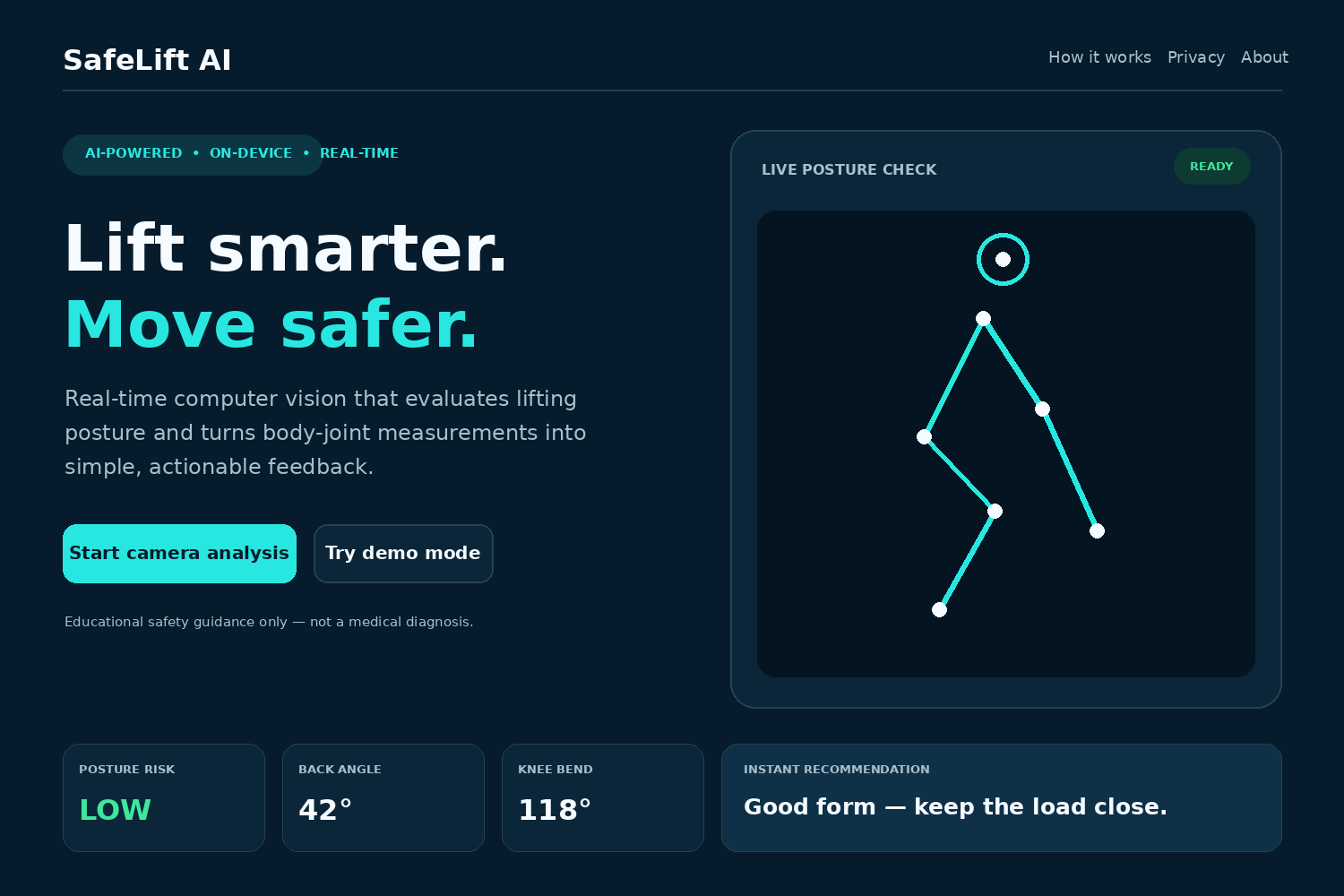
SafeLift AI was created to make basic lifting-safety feedback immediate, accessible, and easy to understand using only a device camera.
What it does
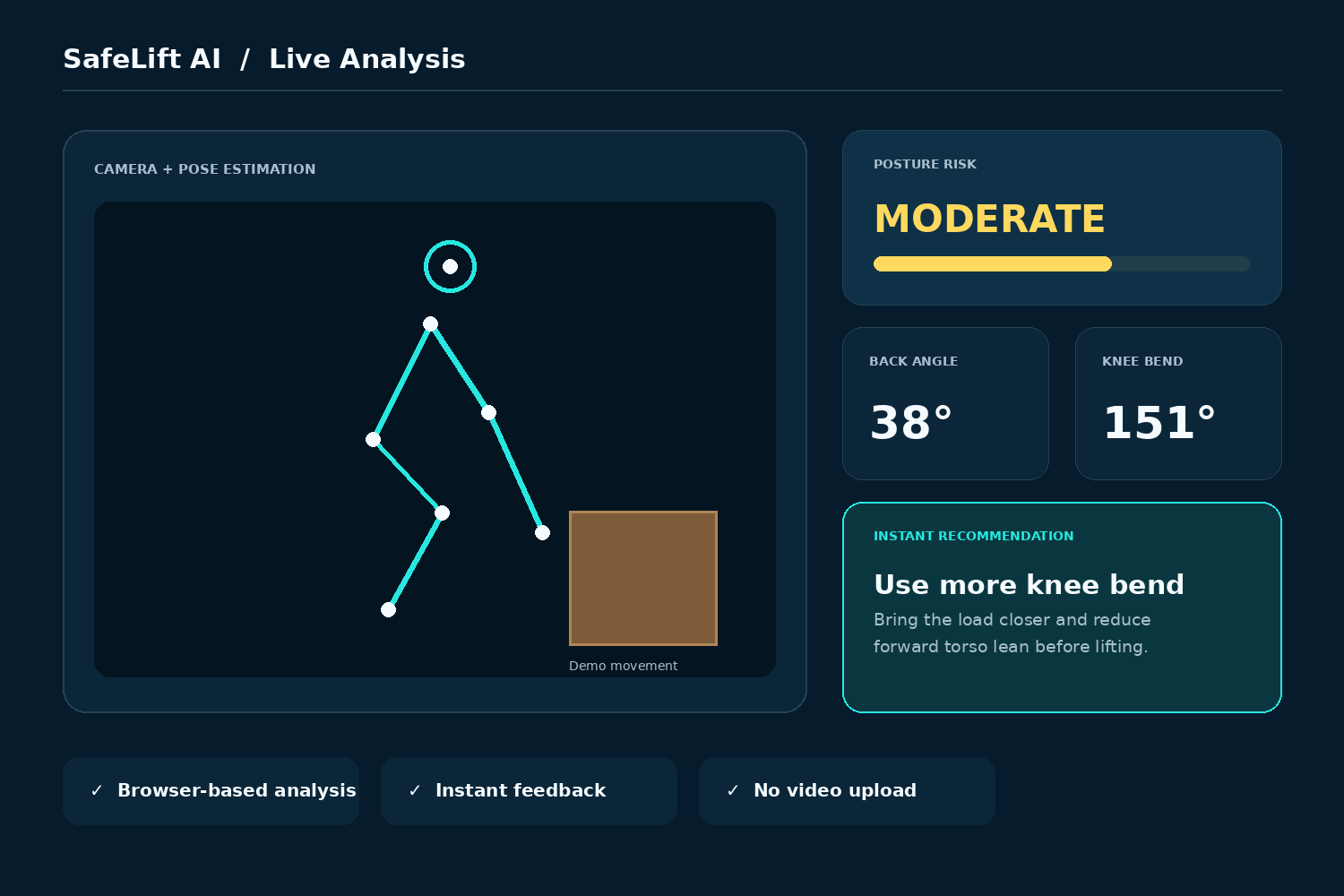
SafeLift AI is a browser-based posture and lifting safety assistant. It uses AI-powered pose detection to identify key body landmarks and evaluate the user's lifting posture in real time.
The system analyzes factors such as back position, knee bending, and body alignment, then provides:
- Real-time posture detection
- Visual body tracking
- Back and knee angle analysis
- Low, Moderate, or High risk feedback
- Instant corrective recommendations
- Privacy-focused on-device processing
Instead of simply telling users that their posture is unsafe, SafeLift AI explains what they can improve, such as bending their knees more or keeping their torso more upright.
How we built it
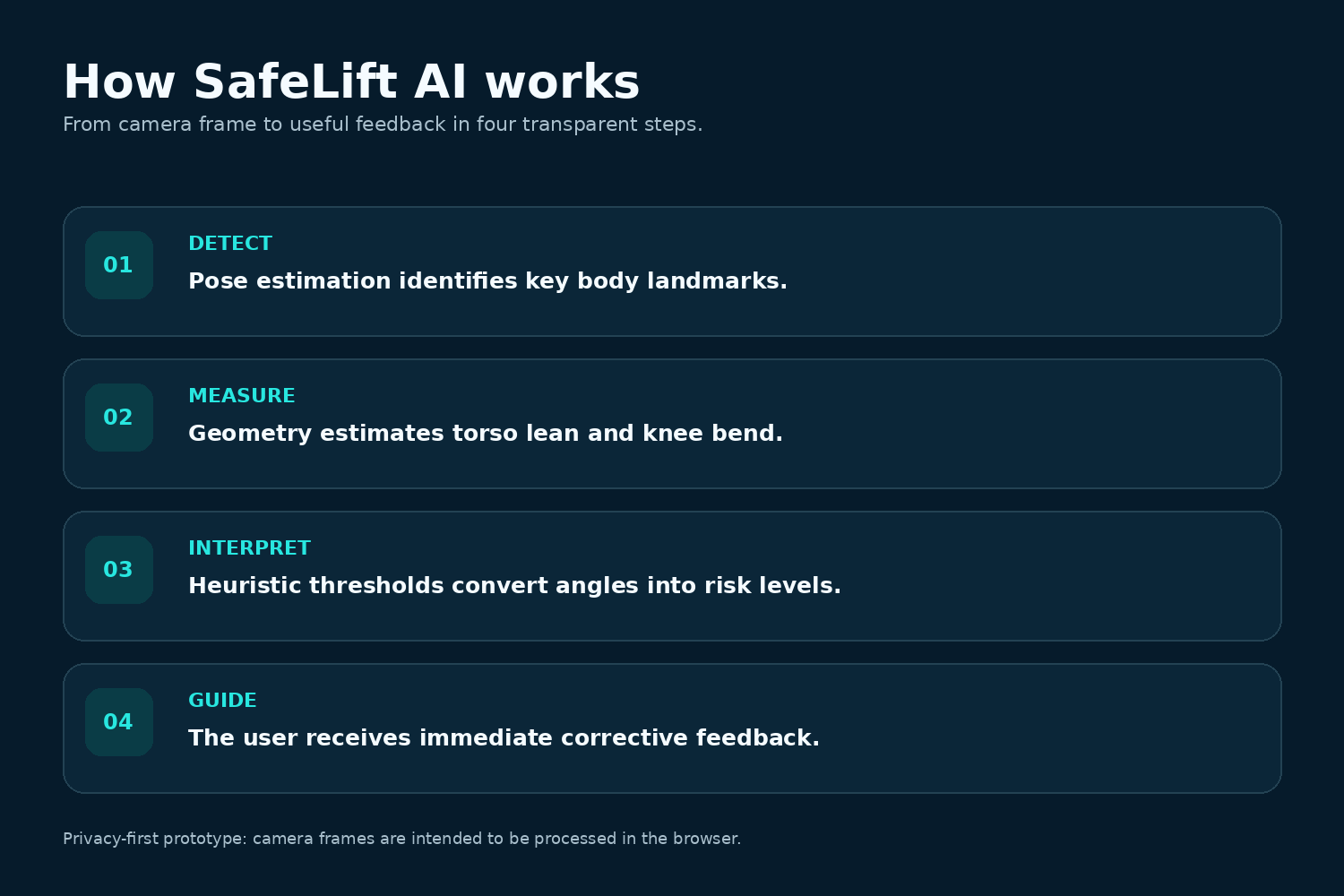
SafeLift AI is designed as a lightweight web application that runs directly in the browser. Computer-vision pose estimation detects body landmarks from the camera feed, while geometric calculations between key joints are used to estimate posture angles.
These measurements are translated into simple safety feedback that users can understand immediately. The interface was intentionally designed to keep the most important information visible at a glance: posture status, risk level, joint angles, and corrective guidance.
A major design goal was privacy. The system is intended to process posture data locally whenever possible rather than requiring users to upload recorded camera footage.
Challenges
One of the main challenges was turning raw body-landmark data into feedback that feels understandable and useful. Human movement is dynamic, so posture cannot be evaluated from a single point alone.
Another challenge was designing an interface that communicates risk quickly without overwhelming the user with technical measurements.
What we learned
Building SafeLift AI showed us how computer vision can turn an ordinary camera into an interactive safety tool. We also learned that useful AI does not always require a complicated experience—the technology becomes more valuable when its output is translated into simple, actionable guidance.
What's next
Future versions could support additional workplace movements, repetitive-task monitoring, personalized ergonomic recommendations, progress tracking, and organization-level safety dashboards.
SafeLift AI could eventually be adapted for warehouses, construction environments, training centers, rehabilitation settings, and workplace safety education.
Our goal is simple: make safer movement easier to understand before poor posture becomes an injury.

Log in or sign up for Devpost to join the conversation.