-
-
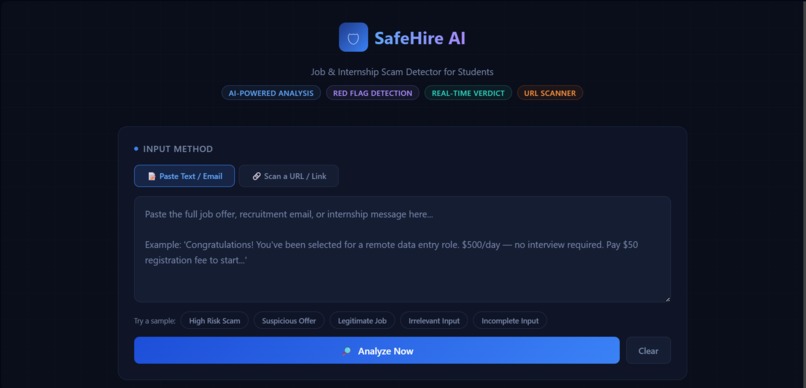
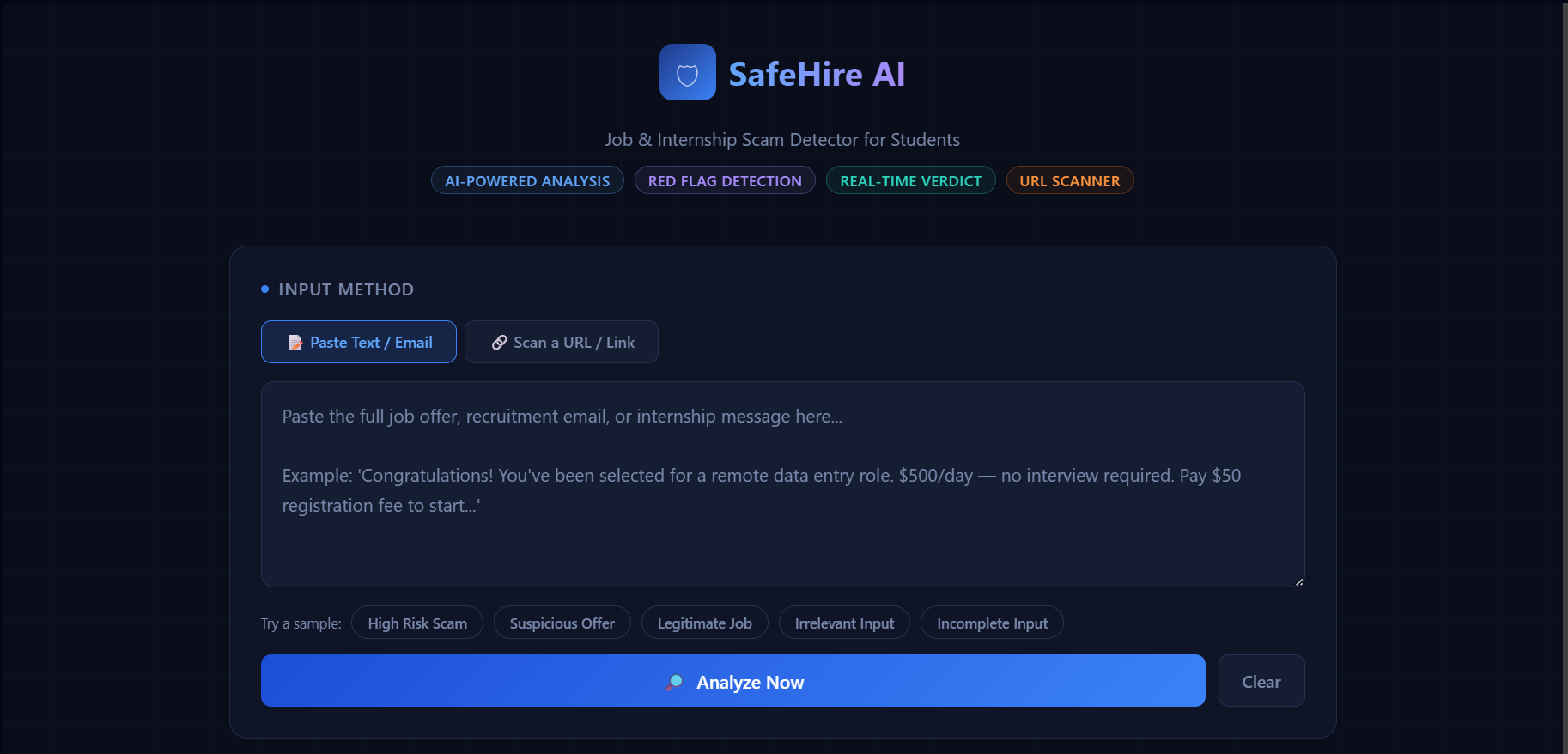
SafeHire AI UI
Inspiration
SafeHire AI was inspired by the growing rise of fake job offers and recruitment scams targeting students, fresh graduates, and early professionals. These scams often use psychological manipulation such as urgency tactics, inflated salaries, no-interview hiring promises, and early requests for sensitive personal or financial information.
The goal was to build a simple, fast, and reliable system that helps users verify job authenticity instantly by pasting a job description or URL. SafeHire AI aims to reduce fraud exposure and improve trust in online hiring.
What it does
SafeHire AI is a browser-based job and internship scam detection system that analyzes job postings and returns a real-time risk verdict.
It allows users to:
- Paste job descriptions or recruitment emails
- Submit job URLs for automated analysis
- Receive an instant scam risk score (0–100)
The system classifies results into:
- Likely Safe
- Suspicious
- High Risk
It detects common scam patterns such as:
- Payment or registration fee requests
- Unrealistic salary promises
- Fake urgency tactics
- No-interview or guaranteed hiring claims
- Suspicious email domains (Gmail/Yahoo instead of company domains)
- Requests for sensitive data (SSN, bank details, ID documents)
It also provides:
- Explainable red-flag breakdown
- Risk category visualization
- Safety recommendations for users
- URL-based job scanning support
- Input validation for irrelevant or incomplete content
How we built it
SafeHire AI is built as a fully frontend, zero-backend system using:
- HTML5
- CSS3
- Vanilla JavaScript
Core components:
- Rule-based detection engine using weighted scoring
- Regex-based pattern recognition system for scam signals
- Input validation layer to filter irrelevant or incomplete inputs
- URL extraction workflow for analyzing job links
- Interactive cybersecurity-style dashboard UI
- Animated scam score visualization system
The detection engine assigns weighted values to different scam indicators and computes a normalized risk score (0–100), which is then mapped into a clear verdict system for users.
Challenges we ran into
- Reducing false positives in legitimate job postings
- Handling incomplete or irrelevant inputs
- Designing reliable URL-based job extraction logic
- Balancing strict detection accuracy with user experience
- Ensuring explainability for non-technical users
Accomplishments that we're proud of
- Built a fully working scam detection system without any backend
- Designed a real-time explainable risk scoring engine
- Created a professional cybersecurity-style dashboard UI
- Implemented strong input validation system
- Built dual-mode input system (text + URL analysis)
- Fully browser-based and instantly deployable
What we learned
- Job scams follow consistent linguistic and behavioral patterns
- Strong input validation is critical for reliable AI systems
- Explainability builds trust in cybersecurity tools
- Rule-based systems can be powerful when carefully engineered
- UX design is essential for adoption in security tools
What's next for SafeHire AI
- Add AI/NLP-based semantic scam detection
- Build a browser extension for instant job verification
- Integrate real-time job scraping from LinkedIn and job boards
- Expand scam dataset for global regional patterns
- Add multi-language support (Urdu, Arabic, French, Hindi)
- Build an API for universities and job platforms
Built With
- animated-data-visualization
- client-side-architecture
- css3
- cybersecurity-ui-design
- html5
- input-validation-system
- javascript
- regex-pattern-matching
- responsive-web-design
- rule-based-ai-engine
- static-frontend-deployment
- url-parsing-logic
- vanilla-js
- weighted-scoring-system

Log in or sign up for Devpost to join the conversation.