About the project
SafeHer Network is a privacy-first digital safety platform designed to support girls and women during and after cyber harassment and emergency situations. Most solutions stop at “reporting,” but SafeHer focuses on the full journey: capturing and preserving evidence, organizing incidents into trackable cases, enabling emergency response, and supporting emotional recovery after an incident.
The goal is simple: women should not have to fight twice — once against the abuser, and again against the system.
What inspired us
We were inspired by how often cyber harassment cases fail not because survivors don’t speak up, but because the process is broken.
Evidence disappears quickly. Messages get unsent. Accounts get deleted. Posts vanish. Even when someone has screenshots, they are often dismissed as edited or incomplete. Reporting is also exhausting: survivors are forced to repeat the same story across multiple platforms, complaint portals, and authorities, often while still in shock or fear.
At the same time, most systems completely ignore what happens after the incident. Emotional impact, anxiety, and trauma are treated as “not part of the problem,” even though they are often the hardest part to live with.
SafeHer Network was built to close these gaps by combining safety, evidence, reporting structure, and recovery support in one place.
What SafeHer Network does
SafeHer Network is designed around four core needs:
- Emergency protection when the user is in danger
- Evidence preservation that remains trustworthy
- A structured case system that reduces reporting friction
- Recovery support after the incident, not just during it
Instead of scattering these across multiple apps and websites, SafeHer keeps them connected through a single dashboard and guided flows.
Core features and what makes them novel
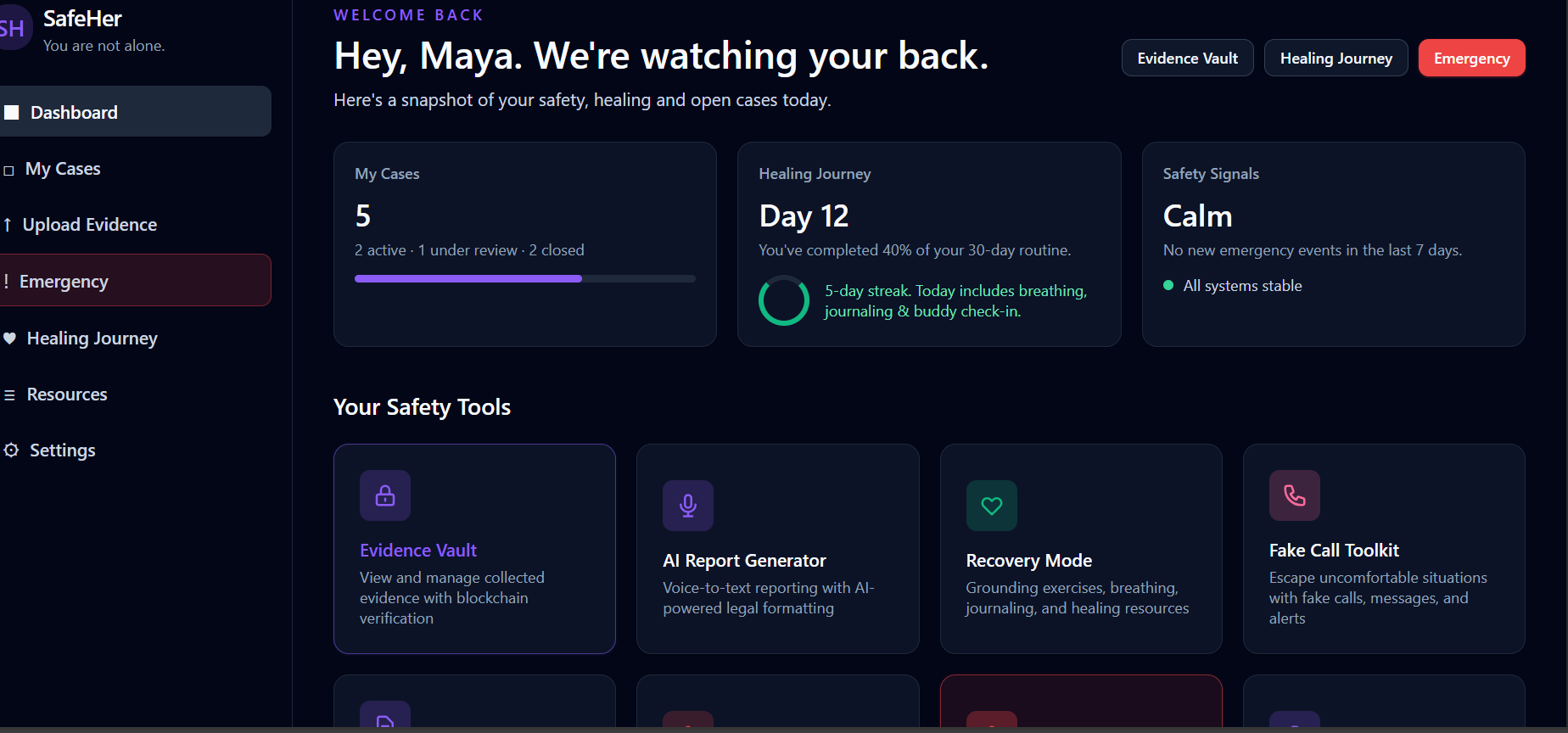
Dashboard
The dashboard acts as the control center. It gives a clear summary of a user’s safety journey without overwhelming them.
It shows:
- Total cases and case status (open, under review, resolved)
- Healing journey progress
- Upcoming events and recent activity
This design is intentional: it helps the user feel organized and in control, even during stressful situations.
My Cases: turning incidents into trackable cases
In real life, survivors are often forced to manage incidents using scattered screenshots, chat backups, and personal notes. SafeHer replaces that with a structured case system.
Each case includes:
- Incident details such as platform, abuse type, severity, and date
- Abuser information such as username and any known identifiers
- Evidence attachments stored inside the vault
- Actions selected by the user
- Status tracking: Open, Under Review, Action Taken, Resolved
This structure reduces confusion, prevents missing details, and makes the process feel manageable.
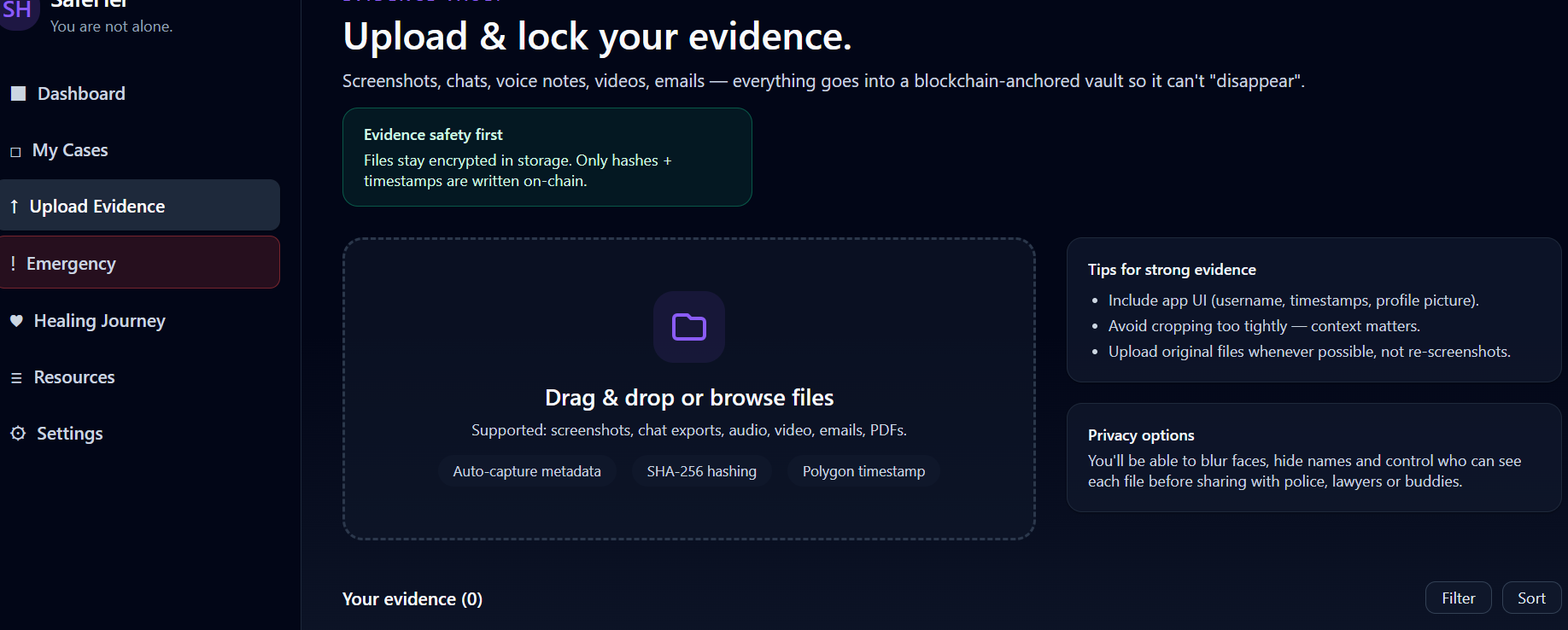
Evidence Vault: preserving proof and integrity
Evidence is the most fragile part of cyber harassment reporting. It can disappear in seconds, and even when it exists, it can be challenged.
SafeHer’s Evidence Vault is built to solve both problems.
When evidence is uploaded, SafeHer generates a cryptographic fingerprint of the file using hashing. This creates a tamper-resistant integrity marker that helps prove the evidence was not modified later.
This is especially important in cases involving threats, stalking, sextortion, doxxing, or non-consensual intimate content. The vault makes evidence easier to preserve, reference, and use in reporting workflows.
We do not claim to instantly delete content across all social media platforms, because real takedowns require platform-level processes and integrations. Instead, SafeHer supports faster action by keeping evidence verifiable and ready for takedown and legal reporting workflows.
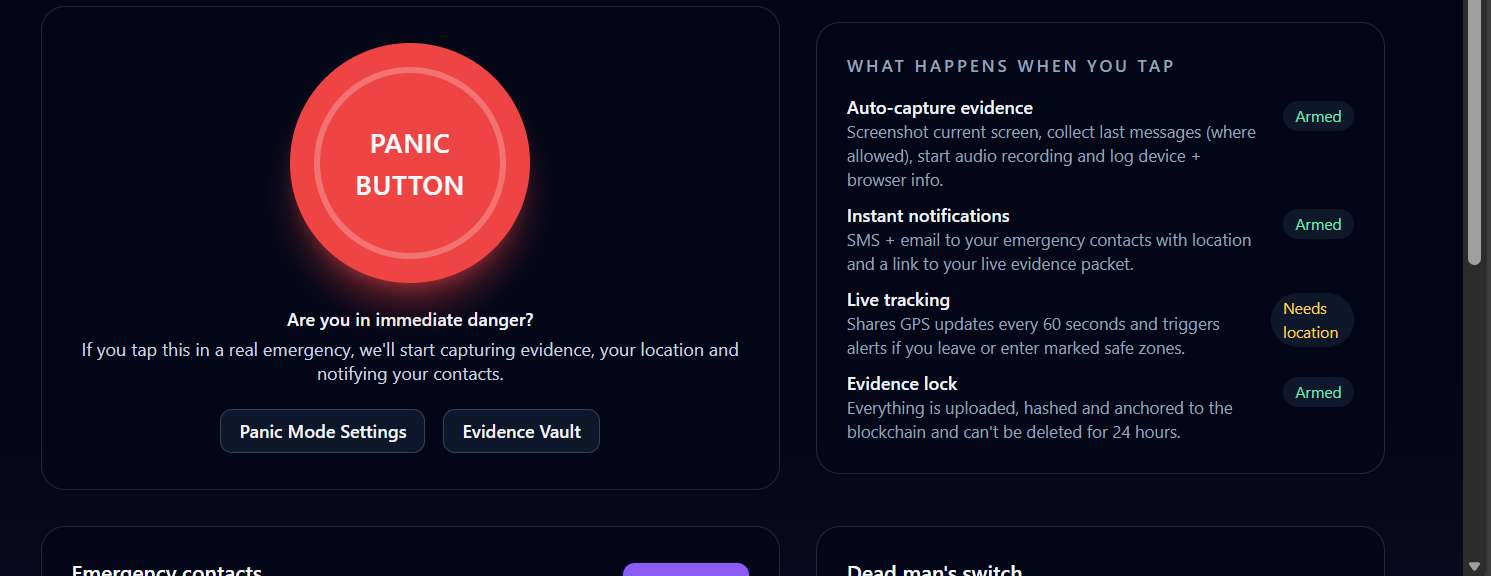
Emergency Mode: protection when the user cannot explain
SafeHer includes an emergency workflow designed for moments when a user cannot type, report, or collect proof manually.
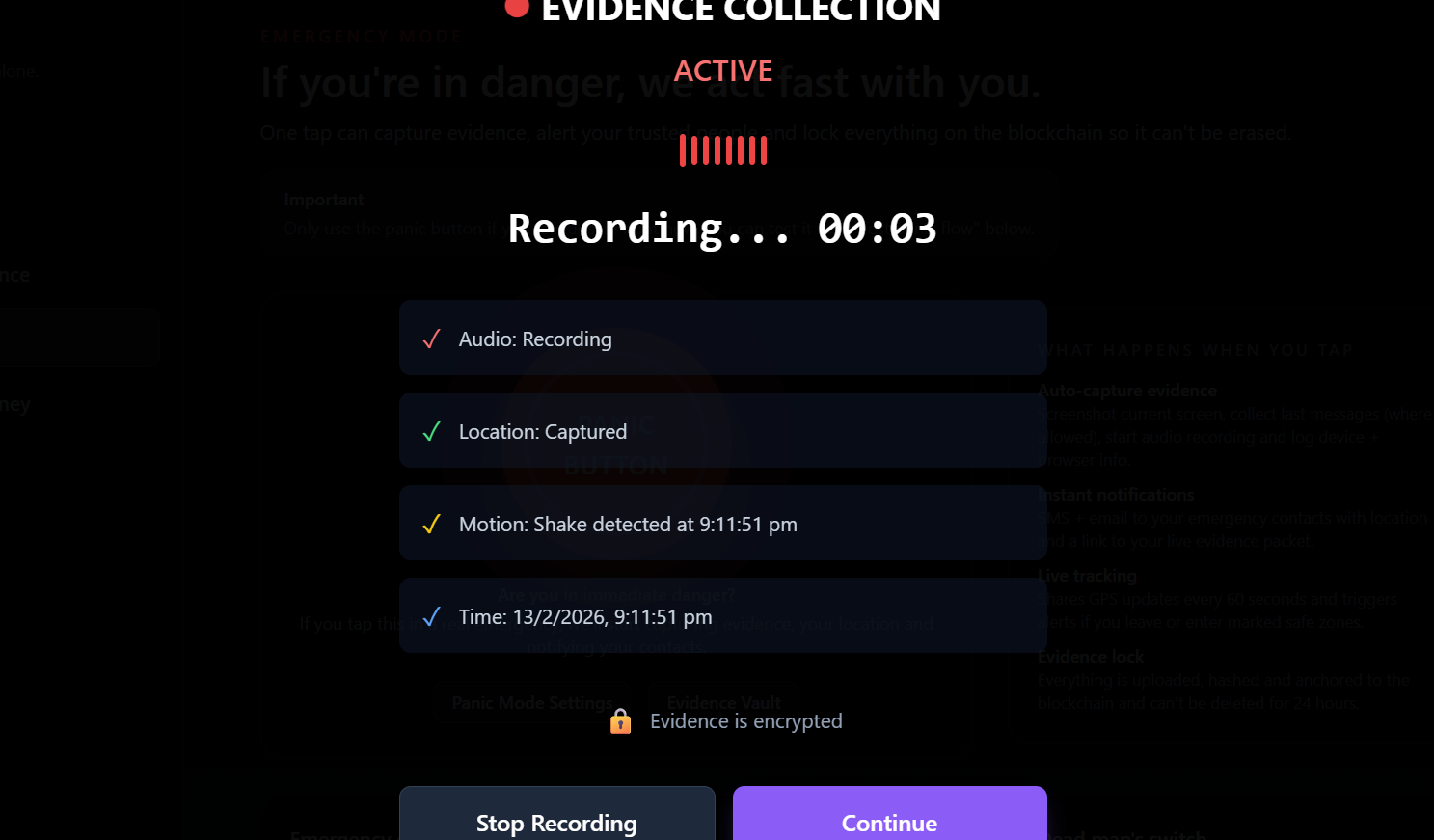
When the panic button is activated:
- Live recording begins automatically
- GPS location is captured with timestamps
- Motion and shake detection is enabled
- Emergency contacts can be notified
- Evidence is stored securely inside the Evidence Vault
The design principle is that the system should protect automatically when the user is most vulnerable.
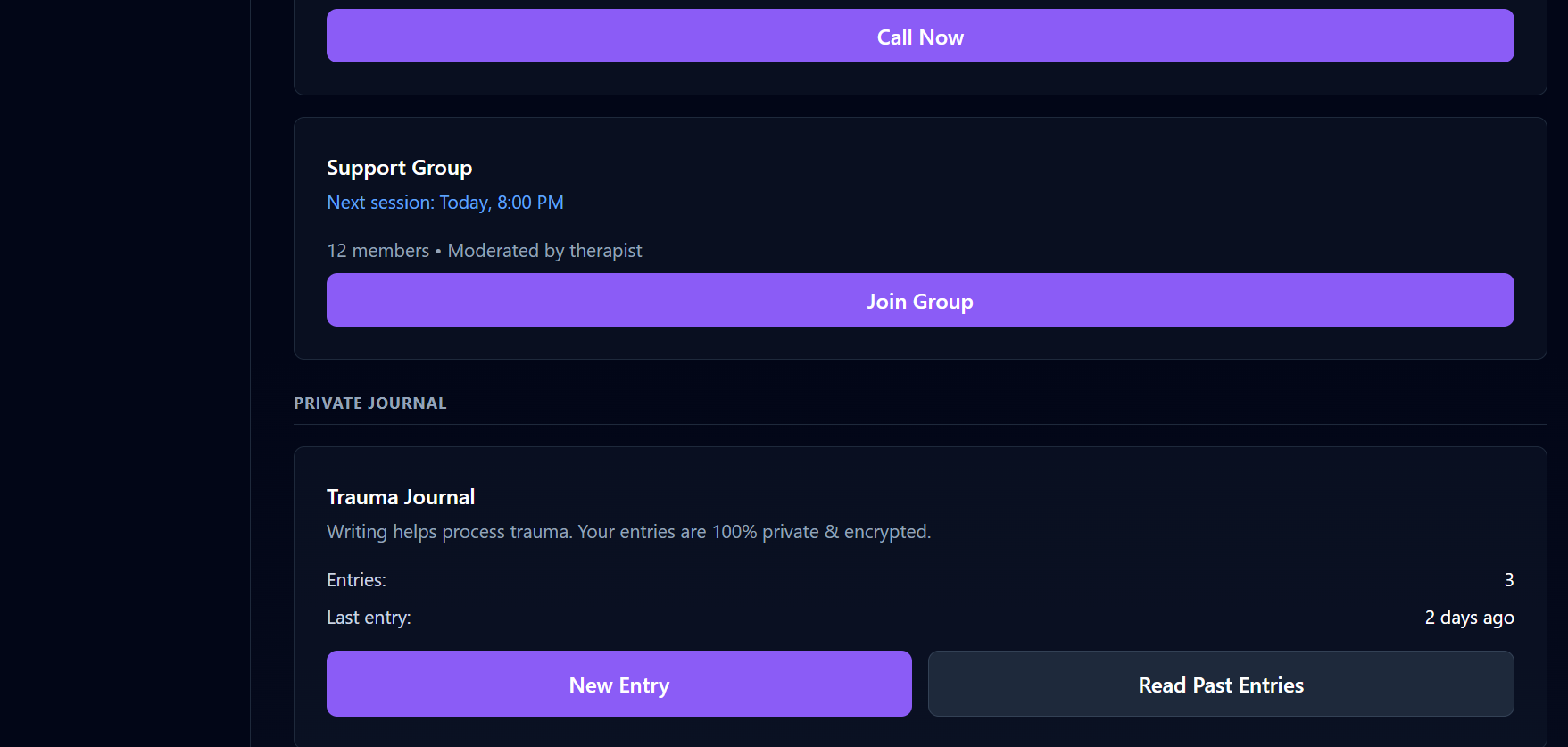
Healing Journey: safety that continues after the incident
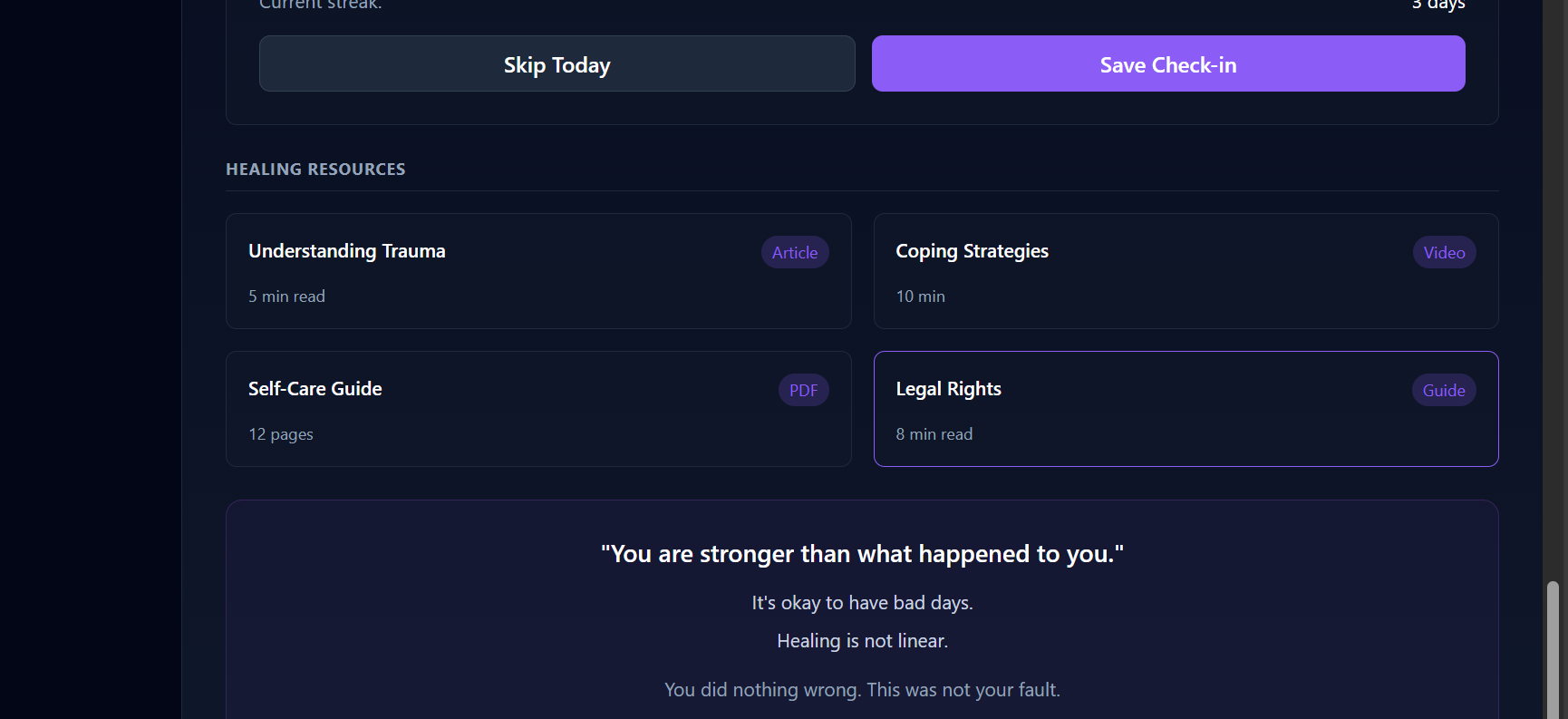
Most safety tools stop after reporting. SafeHer includes a dedicated healing and recovery module because real safety does not end after the incident is documented.
The Healing Journey includes:
- Private trauma journaling
- Grounding techniques such as 5-4-3-2-1
- Breathing exercises such as box breathing
- Self-care and coping guidance
- Curated recovery resources
This is one of SafeHer’s strongest differentiators: it treats recovery as a core part of the safety system.
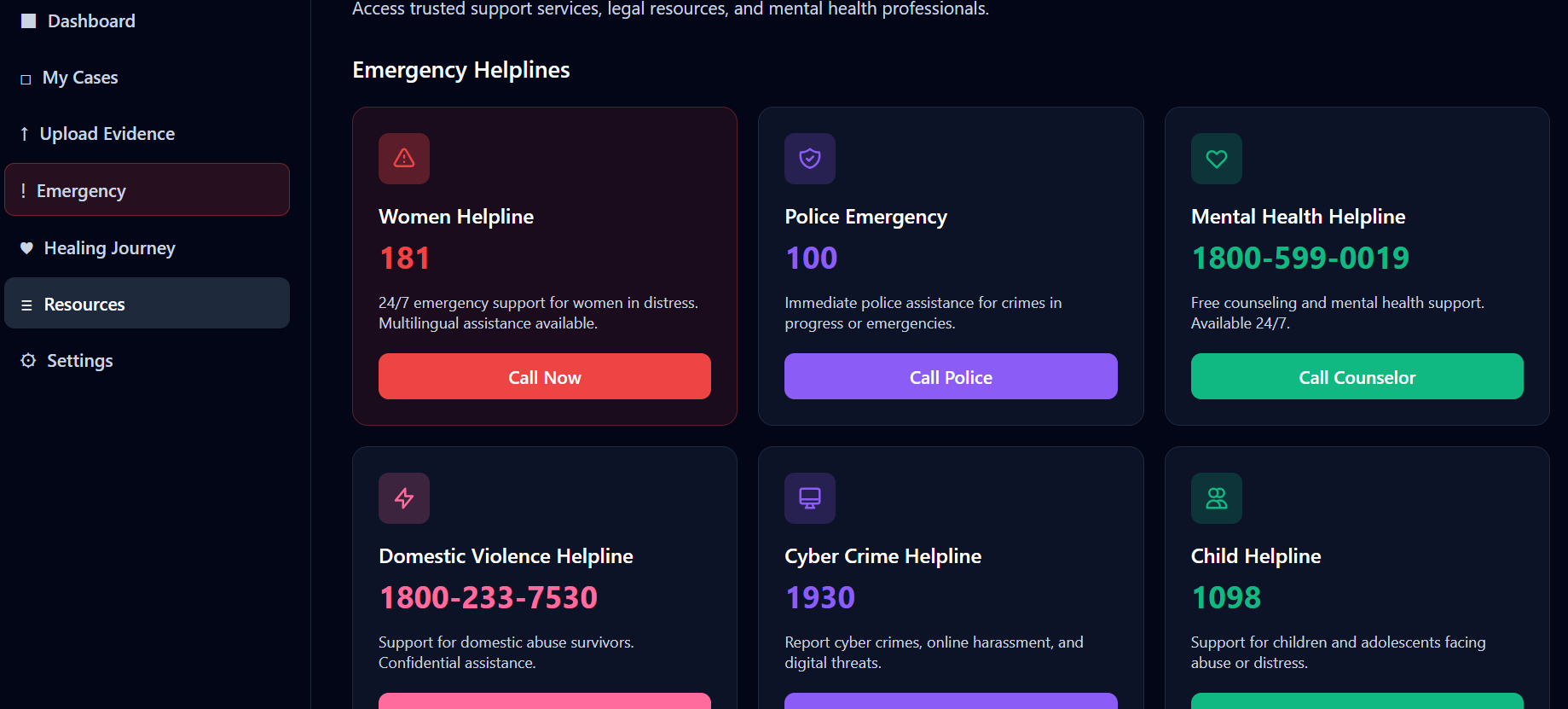
Resources: verified help in one place
SafeHer includes a resources section designed for clarity during stress. It provides direct access to:
- Women helplines
- Police contacts
- Mental health support
- Child helpline
- Cybercrime portals
It also includes legal awareness content such as:
- Relevant IT Act sections
- Sexual harassment laws
- Verified legal portals and reporting links
This prevents the user from being stuck searching for what to do next.
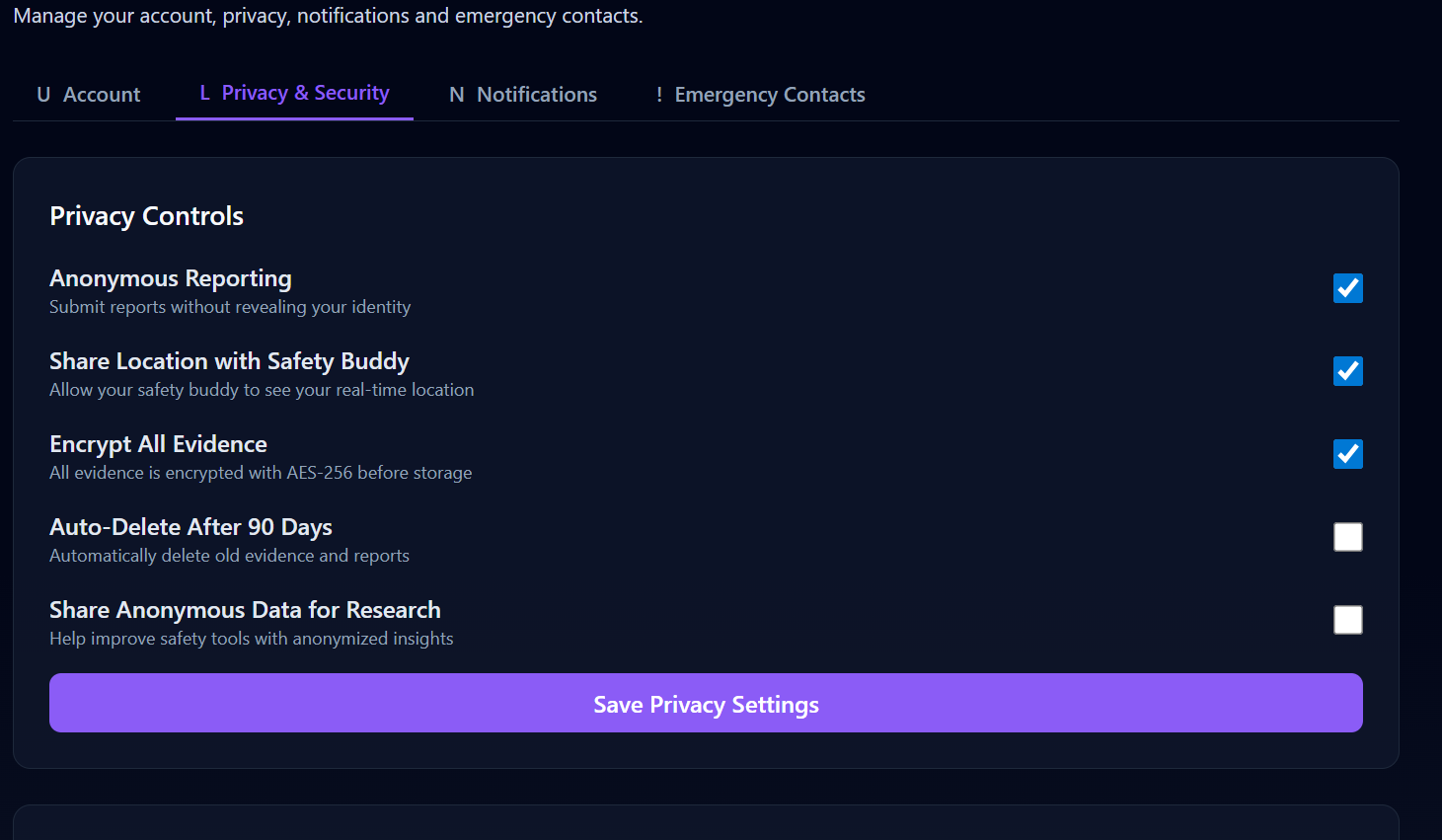
Settings and privacy: consent-based safety
SafeHer is privacy-first by design. Users remain in control of what is shared and when.
Settings include:
- Anonymous reporting preferences
- Safety buddy permissions
- Location sharing rules
- Evidence encryption
- Auto-delete options such as deletion after 90 days
- Push, SMS, and email notification preferences
- Emergency contact management
This ensures support without removing autonomy.
How we built the project
SafeHer Network was built as a modular system so each part can scale independently.
Technology used:
- React with TypeScript for the frontend
- Tailwind CSS for UI
- Framer Motion for smooth interactions
- A local-first workflow for privacy and offline readiness
The platform is structured into modules:
- Dashboard
- My Cases
- Evidence Vault
- Emergency Mode
- Healing Journey
- Resources
- Settings
This modular design makes it easy to expand later into mobile apps, multilingual support, and real reporting integrations.
Challenges we faced
The hardest part was designing a system that is powerful without becoming invasive.
We had to balance:
- safety features and emergency monitoring
- privacy, consent, and user autonomy
We also had to handle the challenge of evidence credibility. Cyber harassment cases often fail because proof is questioned, so we designed the Evidence Vault around integrity verification concepts.
Another challenge was simplifying the UI. SafeHer includes many features, but the experience must remain calm and clear. We solved this by making the dashboard the starting point and guiding the user through structured flows.
What we learned
This project taught us that safety technology is not only technical. It is also emotional, legal, and deeply human.
We learned:
- how to design trauma-aware user flows
- how evidence integrity affects reporting success
- how to structure complex safety workflows into a simple interface
- why privacy and consent must be treated as core features, not optional settings
Future scope
SafeHer Network is designed as long-term safety infrastructure.
Future improvements include:
- Native Android and iOS apps
- Real integrations with cybercrime portals and e-FIR systems
- Verified NGO and legal aid partnerships
- Multilingual support
- Privacy-preserving community safety insights
- Secure cloud sync with user-controlled encryption keys
- Stronger timestamping and audit trails for evidence
Closing
SafeHer Network is built for one purpose: women should be able to move through society with confidence, not fear.
It turns incidents into trackable cases, panic into preserved proof, and trauma into recovery — while keeping privacy and control at the center.


Log in or sign up for Devpost to join the conversation.