Inspiration
SafeHaven is a dedicated digital sanctuary for LGBTQ+ individuals, built to be the safest and most affirming space for exploring identity, finding community, and accessing support without fear or judgment. Every aspect of the website - language, navigation, safety controls, and features - is geared towards making queer users feel visible, safe, and in control of their experience.
Core vision and problem statement
SafeHaven is the answer to a very important question: LGBTQ+ people are often not safe to be themselves at home, school, and in public places, while existing platforms put them at risk of being harassed, outed, or coming across offensive content. The key idea is to establish a "digital safe home" for the LGBTQ+ users where they can explore their identities, get help, and create community with high privacy, security-first design, and supportive, non-judgmental interactions.
Safety-first experience and quick exit
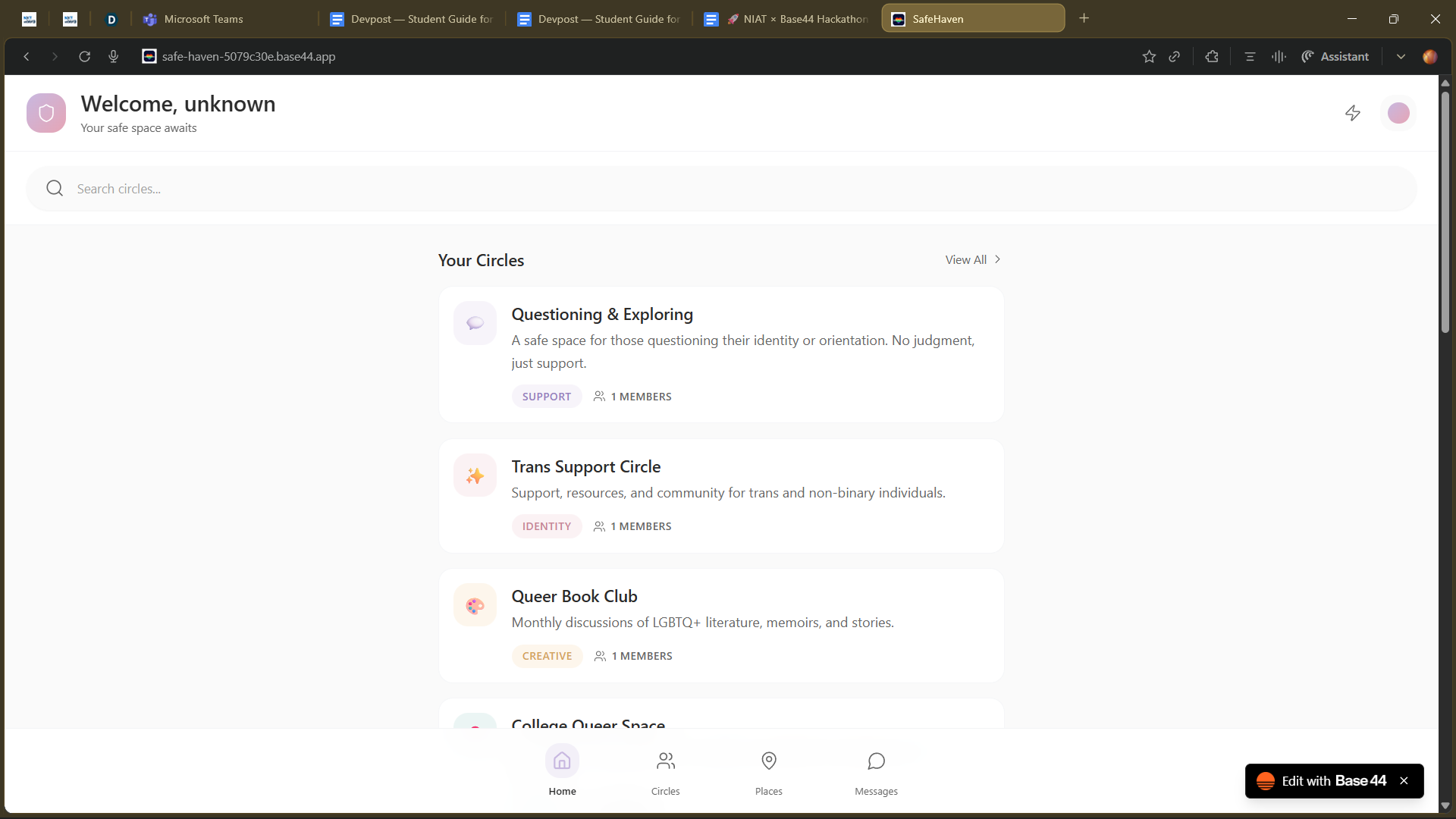
The app greets the user with a friendly "Welcome" and "Your safe space", this is the very first indication that this is not just another generic app but a caring environment that focuses on the emotional safety of the user. A very "Hold to quick exit" button is there for the users to quickly get out of the website if a person comes into the room or if they feel unsafe, this kind of operation is extremely important for closeted or at-risk LGBTQ+ users.
Home: personalized hub for support
The Home page is like the user’s personal control centre, besides "Your Circles," which represent the core communities and support groups the user has chosen to be a part of. The phrase "Whenever you’re ready" is a way of the platform putting zero pressure on the users, thus LGBTQ+ users are allowed to join, watch, or participate in their own time which also acknowledges different levels of comfort and stages of coming out.
A section titled "Suggested for your well-being" gives a hint that the platform would slowly suggest to the user appropriate circles and places based on the user's exploration so that the experience becomes very personalized yet not too overwhelming from the first day itself. This approach makes SafeHaven feel like a friendly helper rather than a loud social network.
Circles: identity, support, and creative communities
The Circles area is the community layer core of SafeHaven where users can find and join groups by using the "Search circles..." bar and by applying category filters that are very clear. With categories such as All, Support, Identity, Creative, Local, and Mental Health, LGBTQ+ users will be able to find exactly what they are looking for, be it identity-based groups (e.g., trans, non-binary, lesbian, gay, bi, questioning), emotional support, local queer meetups, or creative expression spaces.
Anyway, the design shows that it is capable of accommodating numerous specialized LGBTQ+ communities in the future even when there are no groups currently available ("No circles found"). This flexible tagging system is very effective at arranging safe spaces for different intersectional identities and needs.
Explore cards: a complete ecosystem of care
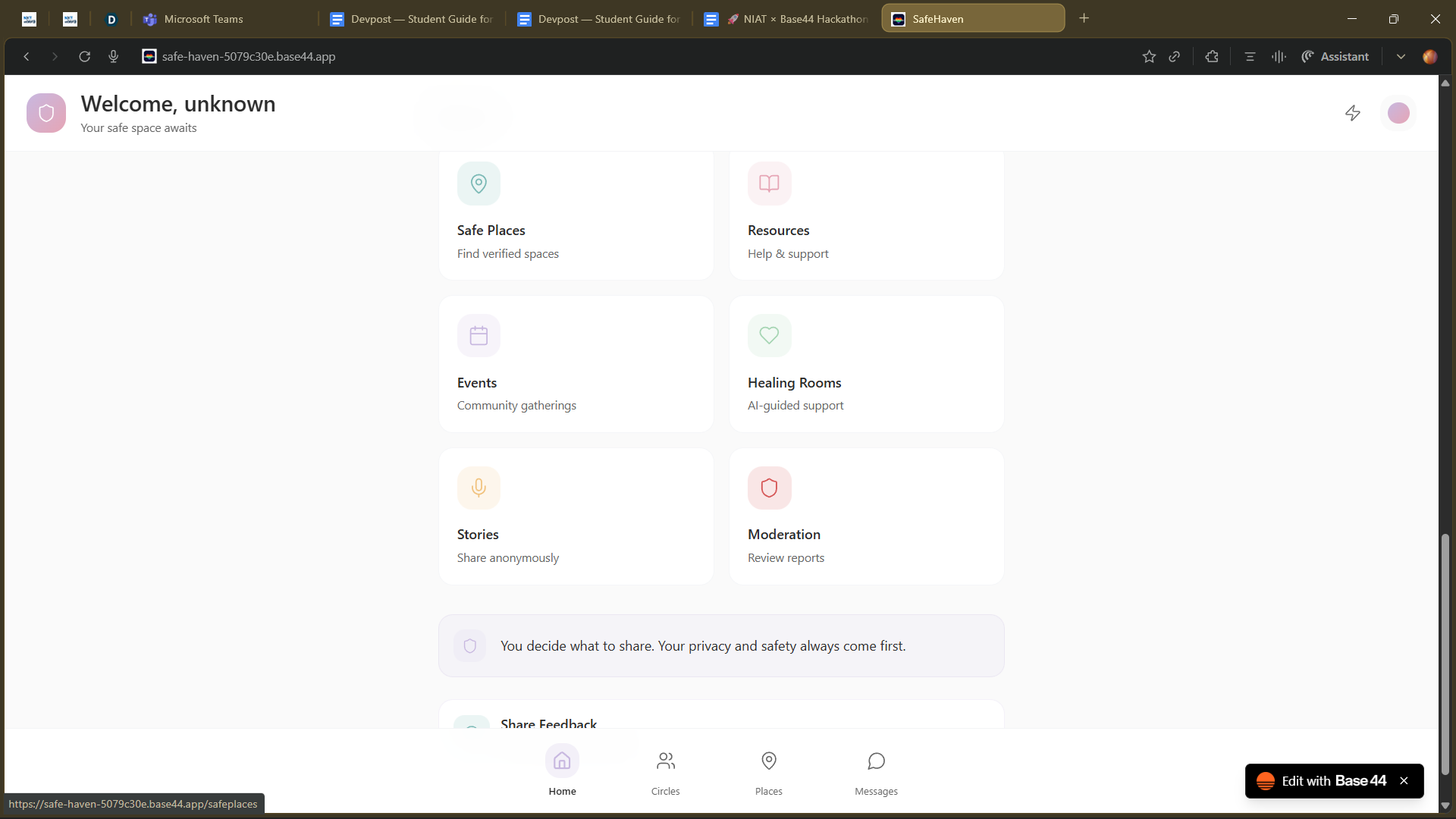
Under the main content, SafeHaven has some clearly titled cards that make the app a complete ecosystem rather than just a chat platform:
Safe Places – “Find verified spaces”: these are LGBTQ+-friendly physical or virtual places that have been sourced and checked, thus helping the users in finding out safe cafés, organizations, helplines, and online spaces.
Resources – “Help & support”: these are easy-to-use pieces of information and links mainly about mental health, LGBTQ+ rights, coming out guidance, crisis support, and self-care so that the users won’t have to rove around the internet blindly.
Events – “Community gatherings”: are workshops, circles, pride-related events, and online sessions that not only bring attendees together but also foster real relationships among them.
Healing Rooms – “AI-guided support”: these are private spaces led by AI where users can discuss their feelings, introspect, and receive gentle guidance, it can be of great help to those who are not yet ready to talk to a human.
Stories – “Share anonymously”: a storytelling platform where LGBTQ+ users can share their stories without revealing their identities, thus it alleviates the fear of being outed but at the same time, it provides a deep emotional release.
Together, these modules make SafeHaven feel like a top-tier, all-in-one wellbeing platform tailored to the realities of LGBTQ+ life.
Privacy, control, and feedback
At the bottom of the interface, SafeHaven pretty much shouts it out loud that “You decide what to share. Your privacy and safety always come first,” which is a very good demonstration of giving control to users instead of the platform. The presence of a "Share Feedback - Help us improve SafeHaven" button only invites LGBTQ+ users to be the active drivers of the platform, hence it is a living community-driven product rather than a one-way service.
The bottom navigation (Home, Circles, Places, Messages) offers a neat and user-friendly outline: a brief look at your world, your groups, safe locations, and private chats. Such transparency and serene design supplement the "topper-level" refinement and trustworthiness factor that is anticipated from a platform that claims to be a safe queer users' home.
Ready-made "Project Details" (you can copy this)
SafeHaven is a safety-first digital sanctuary designed for LGBTQ+ individuals who need a secure, judgment-free space to explore their identity, find community, and access mental health support. The platform combines curated "Circles" for support, identity, creativity, and mental health with verified "Safe Places," trusted resources, and meaningful community events to build a complete ecosystem of care.Features such as a prominently placed quick-exit button, anonymous story sharing, and AI-powered Healing Rooms make it possible for even those who live in unsafe or unsupportive environments to get help while enjoying strong privacy and control. Along with straightforward navigation (Home, Circles, Places, Messages) and a "you decide what to share" stance, SafeHaven is an attempt to create the most secure and affirming virtual home for LGBTQ+ folks craving connection, healing, and hope.
How we built it
We used Base44’s AI app builder to quickly bring SafeHaven to life. SafeHaven is basically the core experience minimal viable product in the frame of our problem statement which was about the creation of a safe digital home for LGBTQ+ users.
We worked on the user flow of Home, Circles, Places, Healing Rooms, Events, and Stories several times with our main focus being on the text and UI to communicate psychological safety, privacy, and user-friendliness. A large portion of our work was dedicated to making the interface (Home, Circles, Places, Messages) as user-friendly as possible and equipping it with security features like the quick exit control so that the user could have the experience of a safe, affirming space on any screen.”
Challenges we ran into
The most difficult problem was figuring out how to integrate the acknowledgment of LGBTQ+ safety and privacy into product changes that were simple and easy to understand, for instance, the time for requesting information and the time for staying anonymous. The development of features such as anonymous stories, AI-guided Healing Rooms, and verified safe places was done with a lot of deliberation and taking into consideration so that these features could bring real upshots without exposing users who might not be out or may be living in an unfriendly environment to danger.We were also asked to balance between simplicity and depth, which means that the app should be peaceful and not too much for a user to handle while still giving the user various support possibilities like Circles, Resources, and Events.
One of the main things we can brag about is that SafeHaven doesn’t sound like just a chat app but rather feels like a whole ecosystem where you can find the mix of Circles, Safe Places, Resources, Events, Healing Rooms, and anonymous Stories that together make up one seamless experience.Section such as the “Hold to quick exit” feature, privacy-focused messaging (“you decide what to share”), and identity-supportive circles are just a few of the examples that can be cited in support of the argument that the platform is a product for LGBTQ+ users made with love rather than a generic one.
We may also boast of the interface tone particularly the lines like “Whenever you’re ready,” which lessen the user's feeling of being pushed and emotionally meet them at their level.
What we learned
One thing we understood was the importance of designing based on people's real experiences and having the edge cases in consideration as well. This is particularly true of the LGBTQ+ community who are at risk of being outed, harassed and facing a shortage of safe offline spaces. During the time we worked on the SafeHaven project, we learned that we should extend our focus beyond features and give more importance to the role of copy, navigation, and small safety elements (e.g. quick exit and anonymous posting) in changing user's perception of security.
What's next for SAFEHAVEN
We also came to know the benefit of dividing support into different levels—community (Circles), information (Resources), spaces (Places), and self-reflection (Healing Rooms and Stories)—rather than relying solely on one channel.
As a result, with the cooperation of authentic LGBTQ+ organizations, community groups, and mental health professionals we want to be able to create Safe Places, Resources, and Events that are packed with accurate and trustworthy content.
There is a plan to open up more options for Circles by creating different intersectional and identity groups, raising the level of personalization in “Suggested for your well-being,” and setting up heavy-duty moderation and reporting tools so that every interaction can be at the level of respect and security.
After that, we see SafeHaven as an essential companion app for LGBTQ+ people globally that can be accessed both via desktop and mobile, with local resources and crisis links customized for each region.
Built With
- base44

Log in or sign up for Devpost to join the conversation.