-
-
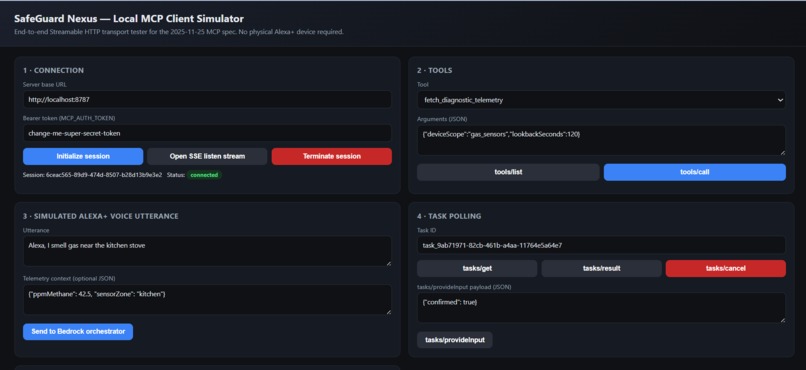
Connection Panel Tools Panel
-
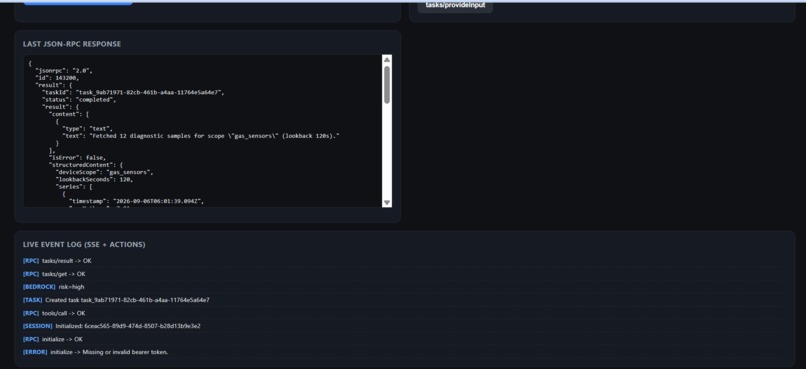
Last JSON-RPC Response
Inspiration
I wanted to bridge the critical gap between raw IoT sensor inputs and instant, reliable emergency response workflows. Traditional safety systems often suffer from high latency, fragmented data streams, and communication bottlenecks between sensors and dispatchers. SafeGuard Nexus was built to solve this by introducing an intelligent multi-agent orchestration engine that processes voice commands and sensor telemetry in real time.
What it does
SafeGuard Nexus functions as a full-scale safety orchestration platform. It accepts simulated voice utterances (like reporting a gas leak via an Alexa interface) alongside live sensor telemetry, instantly analyzes the threat zone, triages potential hazards, and coordinates automated responses. It features a robust task primitive engine and an intelligent routing layer to manage active emergency workflows seamlessly.
How I built it
I built the application using an Express.js backend coupled with a custom task primitive engine and an intelligent routing layer. To handle external cloud dependencies reliably and bypass rate limits or credential roadblocks during development, I engineered a dedicated mock architecture (USE_MOCK mode). I also integrated an interactive local Model Context Protocol (MCP) client simulator to thoroughly test end-to-end telemetry fetching, voice utterance processing, and task state polling.
Challenges I ran into
- API Limits & Credentials: Encountered strict rate limits and security blocks with cloud AI tools, which I resolved by implementing a robust local mock architecture and scrubbing sensitive credentials to satisfy security scanners.
- State Management: Handled complex asynchronous task workflows, resolving concurrency and state conflicts by ensuring inputs are strictly processed while tasks are in an active state.
Accomplishments that I'm proud of
- Successfully building and testing an end-to-end emergency orchestration engine complete with a functional local client simulator.
- Implementing resilient state handling, proactive rate limiting, and graceful exception fallbacks to ensure zero downtime.
What I learned
I gained deep experience in designing resilient backend architectures, managing asynchronous multi-agent task lifecycles, and building practical safety guardrails for real-time telemetry processing.
What's next for SafeGuard Nexus
- Expanding live multi-modal sensor integrations.
- Scaling regional emergency dispatcher APIs.
- Deploying advanced automated triage routines to further minimize response latency.
Built With
- amazon-bedrock
- api
- express.js
- javascript
- model-context-protocol-(mcp)
- node.js
- rest


Log in or sign up for Devpost to join the conversation.