-
-
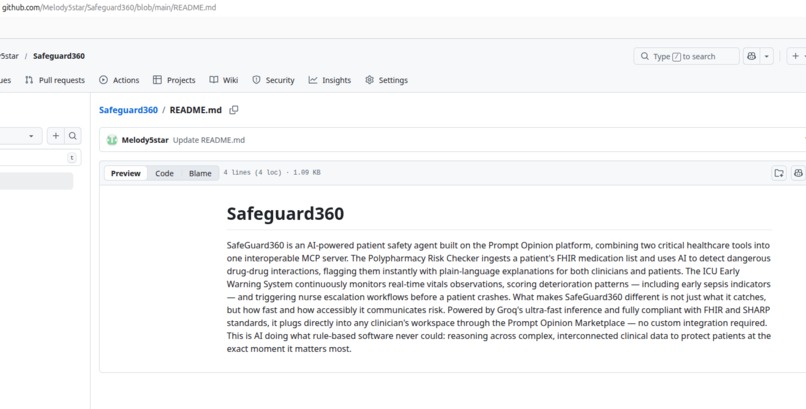
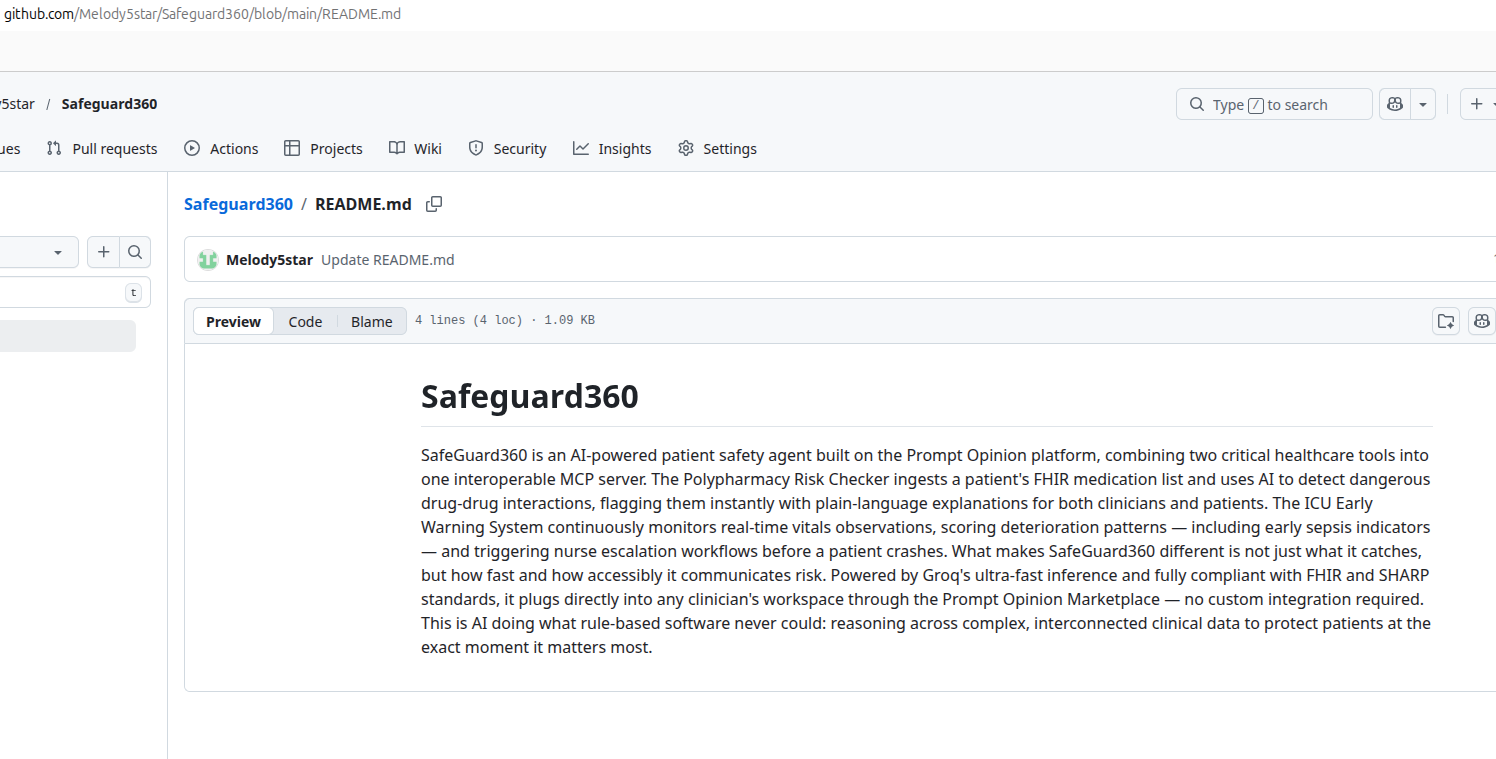
safegaurd
Inspiration-
Every year, over 1.5 million people are harmed by medication errors in hospitals alone. Elderly patients routinely leave clinics with 10+ prescriptions — and no one has the bandwidth to manually cross-check every combination. Meanwhile in ICUs, nurses monitor dozens of patients simultaneously, often catching early deterioration signs too late simply because the signal was buried in numbers on a screen.We were inspired by a simple but devastating reality: most of these harms are preventable. The data exists. The patterns are known. What's missing is an intelligent system that connects the dots in real time — one that doesn't just store patient information but actually understands it and acts on it. SafeGuard360 was born from the belief that AI should be doing this work so clinicians can focus on care, not computation.
What it does-
SafeGuard360 is a dual-function AI patient safety agent deployed on the Prompt Opinion platform, combining two critical clinical tools into one cohesive MCP server: Polypharmacy Risk Checker — Ingests a patient's FHIR medication list, analyzes every drug-drug combination using AI reasoning, and flags dangerous interactions with severity scores and plain-language explanations for both clinicians and patients. It doesn't just say "risk detected" — it explains why the combination is dangerous and what the clinical consequence could be. ICU Early Warning System — Continuously monitors real-time FHIR vitals observations (heart rate, blood pressure, temperature, SpO2, respiratory rate), applies a multi-parameter deterioration scoring model, and detects early sepsis and respiratory decline patterns before they escalate. When risk crosses a threshold, it triggers an immediate nurse escalation alert with a summary of the contributing vital signs. Both tools share a single patient context layer, meaning the agent can reason across medication risk and clinical deterioration simultaneously — something no rule-based system can do.
How we built it-
SafeGuard360 is built on a modern, standards-first AI stack: FHIR as the data backbone — Patient profiles, medication requests, and vitals observations are structured as FHIR-compliant JSON resources, making the agent immediately interoperable with any EHR that supports the standard. MCP Server (Python/FastAPI) — We built a custom MCP server exposing two tools: check_polypharmacy_risk and monitor_icu_vitals. Each tool accepts FHIR context, processes it, and returns structured risk assessments back to the Prompt Opinion platform. Groq API (Llama 3.3) — Groq's ultra-low-latency inference powers the AI reasoning layer. In a clinical context, speed is not a luxury — it's a safety requirement. Groq's LPU architecture delivers sub-second responses even on complex multi-drug analysis. SHARP Context Propagation — We leveraged Prompt Opinion's native SHARP extension specs to pass patient IDs and FHIR tokens seamlessly through the agent call chain, eliminating the need for custom token-handling logic. Prompt Opinion Marketplace — The agent is published and discoverable in the marketplace, allowing any clinician or organization to invoke it directly within their workspace without any custom integration.
Challenges we ran into=
FHIR learning curve Balancing AI confidence with clinical safety Real-time vs batch processing Making alerts actionable, not alarming , ranked by severity .
Accomplishments that we're proud of=
We're proud that SafeGuard360 isn't just a demo — it's a genuinely usable, standards-compliant architecture that could be dropped into a real clinical workflow today. Specifically: Built a working dual-tool MCP server that handles two distinct clinical reasoning tasks under one unified patient context Achieved sub-second AI response times using Groq, which is critical for clinical credibility Designed alert outputs that are clear enough for a non-technical nurse to act on immediately Successfully published the agent to the Prompt Opinion Marketplace, making it discoverable and invokable by any organization in the ecosystem Created a project that addresses two of the top causes of preventable patient harm — simultaneously
What we learned=
Building at the intersection of AI and healthcare is humbling. A few key lessons: Data standards are everything. FHIR isn't just a format — it's what makes interoperability actually possible. Working with it early rather than treating it as a later concern is essential. Prompt engineering is clinical engineering. The way you instruct an AI model in a healthcare context directly affects patient safety outcomes. Precision in language matters as much as precision in code. Speed is a clinical requirement. Switching from general-purpose LLM APIs to Groq's inference infrastructure was a revelation — it completely changes what "real-time" feels like in a healthcare agent.
What's next for SafeGuard360 — Patient Safety Agent=
SafeGuard360 is a foundation, not a finished product. The roadmap ahead is clear: Live EHR integration — Connect to real FHIR-compliant EHR systems (Epic, Cerner) via SMART on FHIR authorization, replacing mock data with live patient feeds. Expanded drug interaction database — Integrate with established clinical databases like DrugBank or RxNorm for broader, evidence-backed polypharmacy detection. Predictive deterioration modeling — Move beyond threshold-based ICU alerts toward a proper early warning score (like NEWS2) trained on historical patient trajectories. Patient-facing layer — Build a simplified interface for patients to understand their own medication risks in plain language before they leave the clinic — turning a clinician tool into a patient empowerment tool. Multi-agent collaboration — Connect SafeGuard360 with specialist agents (cardiology, nephrology, pharmacy) using A2A protocols so a full care team's context informs every safety decision.

Log in or sign up for Devpost to join the conversation.