Inspiration
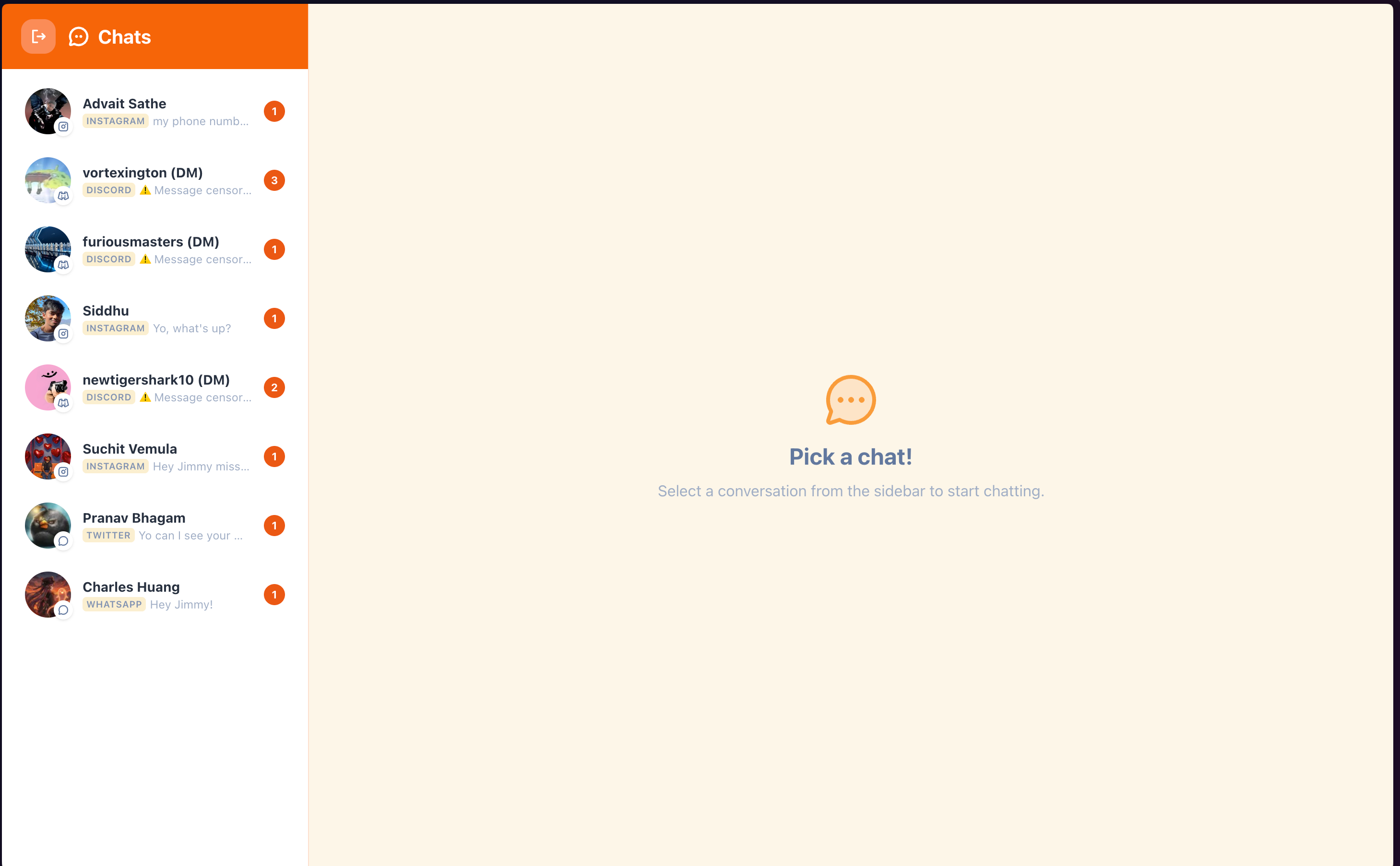
Today’s kids live across fragmented digital platforms: Discord, Instagram, Twitter, and WhatsApp. For parents, keeping them safe from cyberbullying, predatory behavior, and explicit content is a logistical nightmare. The current solutions on the market are highly invasive "spyware" apps that force parents to read every single normal conversation, completely destroying trust between parent and child. We were inspired to build a better way: a unified, secure inbox that automatically filters out harmful content in real-time, giving parents peace of mind while preserving kids' privacy.
What it does
SafeGuard acts as a bridge between a child's desire to connect and a parent's need to protect.
- For the Child: A seamless, unified chat application where they can message their approved friends across multiple platforms from one single interface.
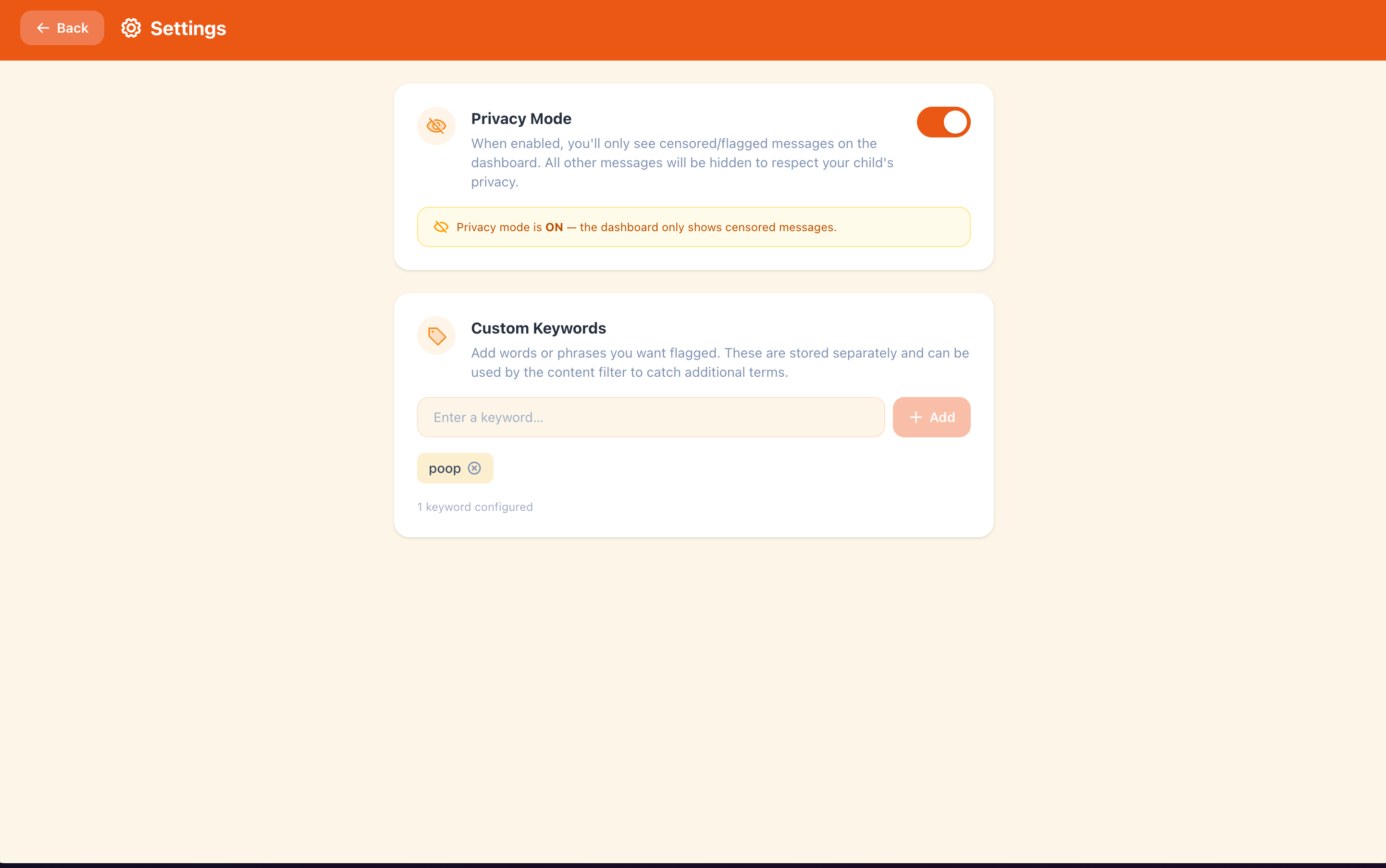
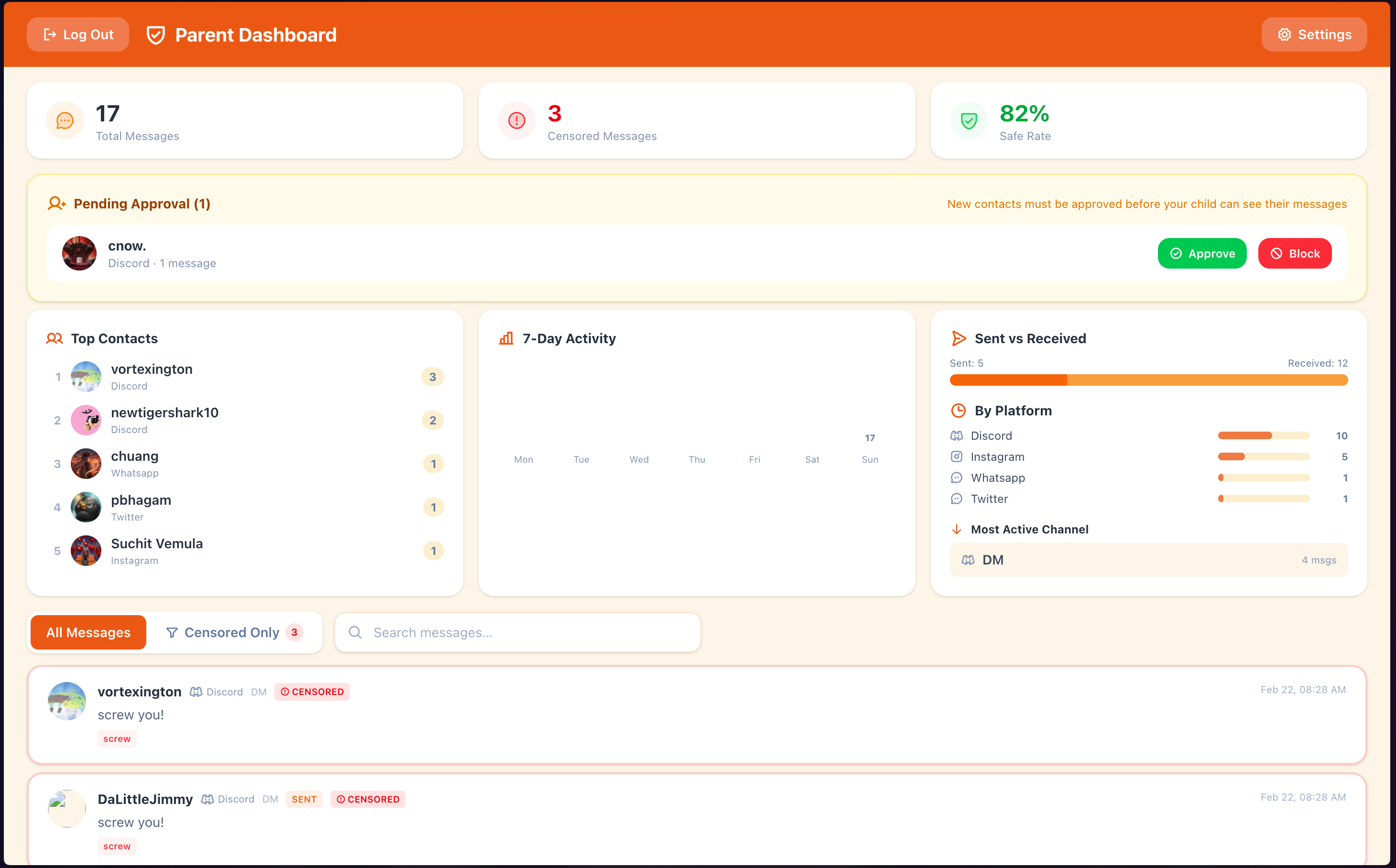
- For the Parent: A powerful data dashboard showing chat statistics, a "Pending Approval" queue for unknown contacts attempting to reach out, and an innovative Privacy Mode. When enabled, parents only see messages that have been explicitly censored or flagged by our AI, leaving normal, everyday conversations completely private.
How we built it
We split the architecture into three main pillars: a lightning-fast frontend, a multi-platform integration backend, and a robust in-house Machine Learning pipeline.
- Frontend: Built with React, TypeScript, and Vite, styled using Tailwind CSS. We designed two completely distinct user experiences—a playful chat interface for the child and a clean, data-rich analytical dashboard for parents.
- Backend: A highly concurrent Python and FastAPI server handles the heavy lifting. We used custom integrations to actively poll and send messages across platforms like Discord and Instagram. All data, relationships, and metadata are synced in real-time using Firebase, while media attachments are securely routed to Firebase Storage.
- In-House ML Pipeline: Instead of relying entirely on generic APIs, we built a custom, multi-layered moderation engine. This includes a trained sequence classification model to instantly detect profanity and slurs to analyze nuanced threats or harassment in conversational context, and an ensemble approach for visual media that to flag dangerous images.
Challenges we ran into
Interfacing with closed ecosystems like Instagram and Discord was notoriously difficult. We had to navigate severe rate limits and hardware fingerprinting to keep the polling engines stable. Furthermore, running a text classifier and an image processing pipeline synchronously threatened to cause massive latency in a live chat application. We had to heavily optimize our asynchronous background tasks in FastAPI to ensure messages were scanned and delivered without noticeable lag.
Accomplishments that we're proud of
We are incredibly proud of building our own custom, multi-layered Machine Learning pipeline rather than just taking the easy route of wrapping a generic API. Successfully syncing entirely different messaging protocols (like Discord and Instagram) into a single, cohesive, real-time interface was a massive technical hurdle we overcame. Most importantly, we are proud to have engineered "Privacy Mode"—a feature that proves safety software doesn't have to equal total surveillance.
What we learned
We learned a massive amount about asynchronous Python programming; properly managing event loops in FastAPI was crucial to keeping our platform polling instances alive alongside our REST endpoints. On the Machine Learning side, we learned that evaluating custom classification models requires looking far beyond raw accuracy to balance false positives and false negatives. Finally, we learned the value of empathy in product design, as we had to build an interface that catered to two completely different—and often opposing—user mindsets simultaneously.
What's next for SafeGuard
Our goal is to expand our platform integrations to include iMessage, Snapchat, and other similar platforms. We also plan on fine-tuning our local LLM specifically on adolescent cyberbullying datasets to make the contextual filtering even faster and more accurate. Ultimately, we aim to move the entire machine learning pipeline directly to edge devices (running natively on the user's hardware) to guarantee maximum privacy and zero latency.


Log in or sign up for Devpost to join the conversation.